

A cash flow statement explains how a business's liquid funds changed over an accounting period by tracking all actual cash inflows and outflows. Prepared under Financial Reporting Standard 1 (FRS 1) for Leaving Certificate Higher Level Accounting, it bridges the gap between accruals-based profit and the actual movement of money. In the examination, cash means cash in hand and bank balances less any bank overdraft. A full question normally asks for (1) a reconciliation of operating profit to net cash inflow from operating activities, (2) the cash flow statement under standard FRS 1 headings, and (3) a theory or management advice section.
The Purpose of Cash Flow Statements and the Meaning of Cash
A business can report high accounting profits yet become insolvent if cash is tied up in slow-moving stock, uncollected debtors, or heavy capital expenditure. The Profit and Loss Account records income earned and expenses incurred under the accruals concept, ignoring when money actually changes hands. The cash flow statement strips away credit timing differences to show where money came from and where it was spent.
A cash flow statement is useful to a business because:
- It shows liquidity and solvency, showing whether day-to-day trading generates enough cash to pay debts as they fall due.
- It aids financial planning and decision-making by revealing how capital investments, loan repayments, and dividends were funded.
- It assists banks assessing loan applications and provides external users with a transparent view of cash management.
What Cash Means in the Statement
In FRS 1 cash flow statements, cash means cash in hand plus bank balances, less any bank overdraft repayable on demand. A bank overdraft is not a long-term loan and never goes under Financing. The final line of the statement, Increase/(Decrease) in cash, must agree exactly with the change in net liquid cash between the opening and closing balance sheets.
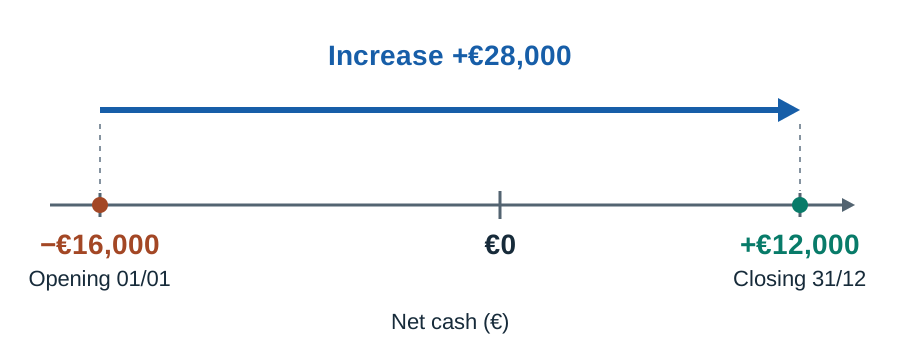
For example, if a business starts the year on 01/01 with cash of €2,000 and an overdraft of €18,000, its opening net cash is −€16,000. If on 31/12 it has cash of €3,000 and a positive bank balance of €9,000, its closing net cash is +€12,000. The net cash flow for the year is:
The bottom line of your cash flow statement must equal this €28,000 increase.
Why Profit Does Not Equal Cash
Leaving Certificate theory questions regularly ask why earning a substantial operating profit does not produce an identical rise in bank balances. The divergence arises from transactions that affect one measure without affecting the other:
1. Items Affecting Profit but Not Cash
- Non-cash expenses: Depreciation, patent amortisation, and goodwill write-offs reduce net profit in the Profit and Loss Account, but no cash leaves the bank account.
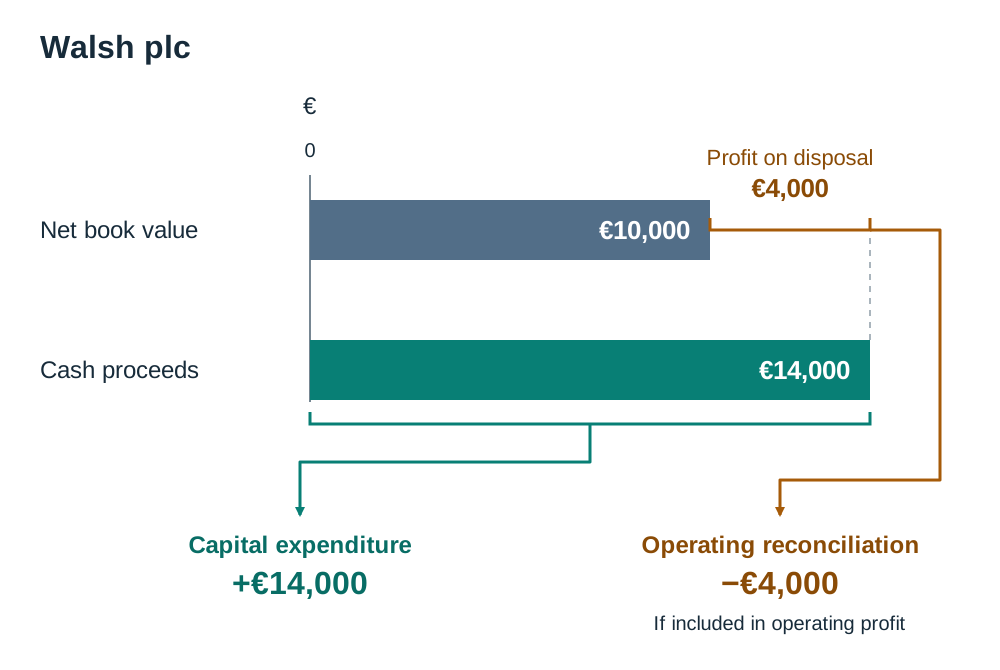
- Non-cash gains: A profit on the disposal of a fixed asset increases reported profit, yet it does not represent an operating cash flow (the gross cash proceeds appear separately under Capital Expenditure).
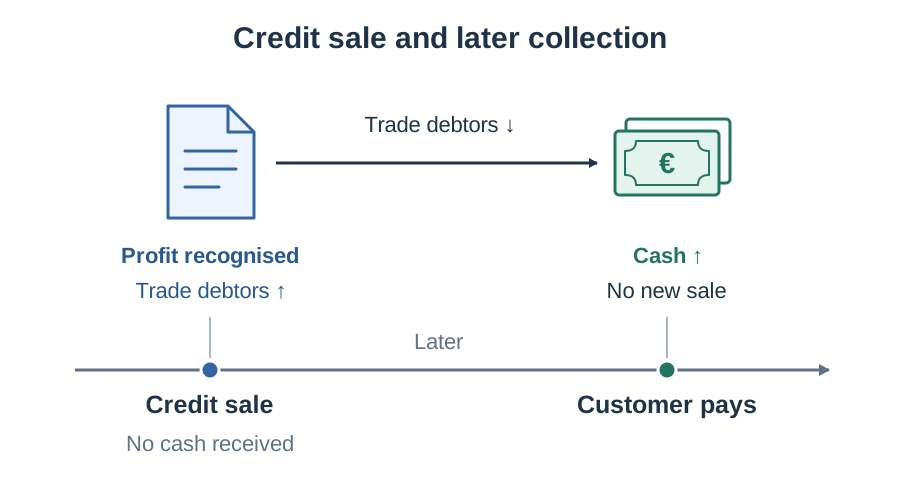
- Working capital timing differences: Credit sales create accounting profit immediately under the accruals concept. If trade debtors increase, that profit remains uncollected in invoices rather than liquid cash in the bank.
2. Items Affecting Cash but Not Profit
- Unsold inventory: Paying cash for inventory uses cash, but the goods are not expensed in the Profit and Loss Account until they are sold.
- Capital transactions: Purchasing machinery or premises causes an immediate cash outflow, but only the annual depreciation charge appears in the Profit and Loss Account.
- Financing transactions: Issuing ordinary shares or debentures brings cash in, while repaying debentures takes cash out. None of these capital sums pass through operating profit.
- Tax and dividends paid: Payments of corporation tax and ordinary dividends drain liquid funds but are appropriations of profit, not operating expenses.
By contrast, a cash gain (such as investment income received) increases both profit and cash, while a non-cash gain (such as profit on the sale of a fixed asset) increases profit only.
Workings for Missing P&L and Balance Sheet Figures
Exam questions often omit operating profit, interest paid, tax paid, dividends paid, or asset purchases. You must reconstruct these figures using labelled ledger workings before drafting the main statement.
Working Backwards to Operating Profit
When the Profit and Loss Account is condensed or omitted, reconstruct operating profit from the balance sheet reserves:
\text{Retained Profit for Year} = \text{Closing P&L Balance} - \text{Opening P&L Balance}Always subtract investment income and interest received when working back to operating profit. They belong separately under Returns on investments and servicing of finance; leaving them in operating profit double counts the cash.
Interest Paid and Taxation Paid
Marking schemes award marks for separate workings reconciling the P&L charge with balance sheet accruals:
\text{Interest Paid} = \text{P&L Interest Charge} + \text{Interest Due (01/01)} - \text{Interest Due (31/12)}\text{Taxation Paid} = \text{Tax Due (01/01)} + \text{P&L Tax Charge} - \text{Tax Due (31/12)}Equity Dividends Paid
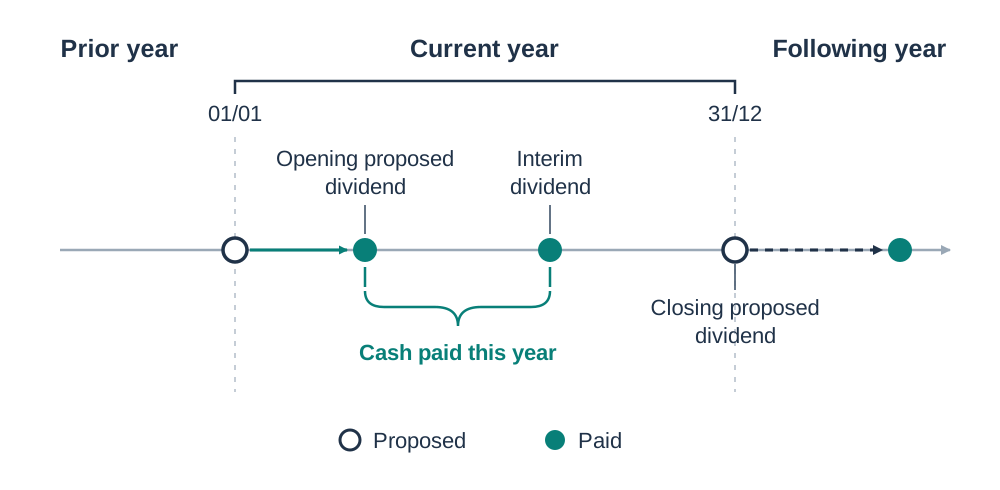
Only dividends actually paid during the financial year involve a cash movement:
This year's proposed dividend (shown in the closing balance sheet) will not be paid until the following year, so it is omitted from the cash flow statement.
Tangible Fixed Asset Workings
To find cash paid for additions and cash received on disposals, set up three standard ledger T-accounts:
- Cost Account: The debit balancing figure is purchases for cash, provided you first exclude non-cash additions such as a revaluation (credited to Revaluation Reserve) or assets acquired by issuing shares.
- Provision for Depreciation Account: The credit balancing figure is the annual P&L depreciation charge after accounting for accumulated depreciation on disposed assets.
- Disposal Account: Compares the Net Book Value (Cost less Accumulated Depreciation) to the cash received to calculate the profit or loss on sale.
Step 1: Reconciling Operating Profit to Net Cash Inflow from Operating Activities
The first required schedule converts accruals-based operating profit into the Net cash inflow from operating activities.
Apply the working capital rule here to operating items such as stock, trade debtors and trade creditors. An increase in stock or trade debtors ties up funds (subtract); a decrease releases funds (add). An increase in trade creditors delays payment to suppliers (add); a decrease uses cash to clear those debts (subtract). Do not adjust tax due, interest due, proposed dividends, cash, overdrafts or liquid resources in this operating schedule: they are dealt with separately.
| Item | Adjustment | Reason |
|---|---|---|
| Depreciation charge | Add | Non-cash expense previously deducted in calculating profit. |
| Patent amortisation / write-off | Add | Book write-down of an intangible asset involving no cash outflow. |
| Loss on sale of fixed asset | Add | Non-cash accounting loss; full cash proceeds go under Capital Expenditure. |
| Profit on sale of fixed asset | Subtract | Non-cash gain; deduct only if it was included in operating profit. |
| Increase in stock | Subtract | Cash was spent to buy extra inventory. |
| Decrease in stock | Add | Inventory was converted into cash/debtors. |
| Increase in trade debtors | Subtract | Credit sales are in profit, but cash has not yet been collected. |
| Decrease in trade debtors | Add | Customers paid outstanding balances in cash. |
| Increase in trade creditors | Add | Cash payment to suppliers was postponed. |
| Decrease in trade creditors | Subtract | Cash was paid to suppliers to reduce liabilities. |
Note on Bad Debts: Always use trade debtors net of any bad debt provision. The change in net debtors already reflects any adjustment to the provision, preventing double counting.
Step 2: FRS 1 Headings and the Cash Flow Statement
After Net cash inflow from operating activities, use the following six headings, in this order, for the exam-style layout practised here. This is not an exhaustive list of every heading in the full FRS 1 standard; other transactions, such as acquisitions and disposals of businesses, can require additional headings:
1. Returns on investments and servicing of finance
- Inflows: Interest received, investment income, and external dividends received.
- Outflows: Debenture interest paid and preference dividends paid.
2. Taxation
- Outflow: Corporation tax actually paid during the year.
3. Capital expenditure and financial investment
- Outflows: Cash paid to purchase tangible fixed assets or long-term investments.
- Inflows: Gross cash proceeds received from selling fixed assets or investments.
4. Equity dividends paid
- Outflow: Ordinary dividends actually paid in the year (prior year final dividend plus current year interim dividend).
Required Intermediate Subtotal
At this point, calculate and label the mandatory subtotal: Net cash inflow/(outflow) before management of liquid resources and financing
5. Management of liquid resources
- Movements of cash into or out of short-term, highly liquid investments such as government gilts or term deposits.
6. Financing
- Inflows: Cash received from issuing ordinary shares (including share premium) and issuing new debentures.
- Outflows: Cash used to redeem debentures or repay long-term loans.
Summing the intermediate subtotal, liquid resources, and financing yields the final line: Increase/(Decrease) in cash.
Step 3: Movement in Net Debt (When Required)
If the examination question specifically asks for a reconciliation of net cash flow to movement in net debt, prepare this supplementary schedule.
Net debt consists of total borrowings (debentures, bank loans, and bank overdrafts) less cash and liquid resources:
(Note: Cash means cash in hand and at bank before deducting overdrafts, which are already included in borrowings.)
Schedule Layout
- Increase/(Decrease) in cash for the year
- Add: Cash used to repay debentures / loans (or Less: Cash from new debt issued)
- Add: Cash used to purchase liquid resources (or Less: Cash from sale of liquid resources)
- = Decrease/(Increase) in net debt resulting from cash flows
- Net debt at start of year (01/01)
- Less: Decrease in net debt (or Add: Increase)
- = Net debt at end of year (31/12)
Check your closing figure against the balance sheet at 31/12: Closing Borrowings − (Closing cash in hand and at bank + Closing Liquid Resources) (before deducting overdrafts, which are already included in borrowings). Both figures must agree.
Advising Management on Financial Position (Higher Level)
At Higher Level, syllabus outcome 8.8 expects you to evaluate the cash flow statement to advise management on the company's financial position:
- Operating Cash Health: Check whether the net cash inflow from operating activities comfortably covers regular commitments: interest, taxation, and ordinary dividends. If operating cash cannot cover dividends, the dividends need funding from elsewhere, such as existing cash balances or borrowing.
- Financing Capital Expenditure: Evaluate how fixed asset acquisitions were funded. Prudent businesses match long-term investments with operating cash flow or long-term capital (equity and debentures). Relying on a bank overdraft to purchase machinery creates severe liquidity risk because overdrafts are repayable on demand.
- Gearing and Solvency: Review debenture redemptions or new borrowings. Reducing debt lowers interest commitments and gearing, strengthening the firm's balance sheet.
Sample Advice Paragraph
Walsh plc generated a healthy operating cash inflow of €143,000, which comfortably covered its interest (€9,500), taxation (€17,000), and ordinary dividends (€15,000). The company funded its €70,000 machinery expansion through internally generated cash and a €25,000 share issue, while successfully redeeming €20,000 of debentures. The overdraft was reduced from €55,500 to €5,000, while management should still monitor working capital, since stock rose by €8,000.
Key terms
- Cash Flow Statement
- A statement showing the cash that came into and went out of a business during the year, under standard FRS 1 headings. Here cash means cash and bank less bank overdraft.
- FRS 1
- Financial Reporting Standard 1: the accounting standard that sets out the layout and order of headings for a cash flow statement. The Leaving Certificate question uses this layout. A Financial Reporting Standard is an accounting rule that companies apply so their financial statements give a true and fair view and can be compared across years and between companies.
- Operating Profit
- Profit from day-to-day trading before interest, taxation, dividends, and non-operating income like investment returns.
- Non-Cash Gain
- An accounting gain (such as profit on the disposal of a fixed asset) that increases profit but does not create an inflow of cash.
- Cash Gain
- An income item (such as investment income received) that increases both accounting profit and liquid cash.
- Working Capital
- Current assets less current liabilities: the funds available for day-to-day operations. In Step 1, changes in stock, debtors and trade creditors are the working capital adjustments.
- Returns on Investments and Servicing of Finance
- The standard FRS 1 heading covering cash flows from interest received, investment income, debenture interest paid, and preference dividends paid.
- Bank Overdraft
- A short-term liability repayable on demand, treated as negative cash rather than a financing loan in the cash flow statement.
Check yourself
A company had a bank balance of €5,000 on 01/01 and a bank overdraft of €7,000 on 31/12. What is the net movement in cash?
A decrease in cash of €12,000. Opening net cash is +€5,000 and closing net cash is −€7,000, giving −€7,000 − (+€5,000) = −€12,000.
The balance sheet shows proposed dividends of €18,000 at 01/01 and €22,000 at 31/12. An interim dividend of €6,000 was paid during the year. What figure goes under Equity Dividends Paid?
€24,000. Cash paid equals last year's proposed dividend (€18,000) plus the interim dividend paid (€6,000). The closing proposed dividend (€22,000) is ignored.
Profit before tax is €140,000, debenture interest charged is €8,000, and investment income received is €3,000. Calculate operating profit.
€145,000 (€140,000 + €8,000 interest − €3,000 investment income). Investment income must be deducted to avoid double counting.
What is the exact wording of the intermediate subtotal required immediately after Equity Dividends Paid?
Net cash inflow/(outflow) before management of liquid resources and financing.
Why is an increase in trade debtors subtracted in the Step 1 reconciliation?
An increase in debtors means sales revenue was recorded in profit, but the cash has not yet been collected from customers.