

A control account is a summary account in the General Ledger. It records the totals of all transactions with credit customers (debtors) or credit suppliers (creditors), so its balance should equal the total of all the individual accounts. Rather than entering every single invoice, credit note, or payment, control accounts are posted periodically using aggregate totals from books of prime entry such as the Sales Day Book, Purchases Day Book, and Cash Book. At Leaving Certificate Higher Level, students must be able to prepare debtor and creditor control accounts, calculate missing credit sales and credit purchases, process contra entries and restocking charges, and reconcile differences between the control account balance and the schedule of individual accounts.
Functions and Information Sources of Control Accounts
As a business expands, tracking hundreds of individual credit customers and suppliers in a single ledger becomes unmanageable. To keep records organised, the business sets up subsidiary ledgers: the Sales Ledger (containing individual debtor accounts) and the Purchases Ledger (containing individual creditor accounts). The General Ledger retains two summary accounts: the Debtors Control Account (or Debtors Ledger Control Account) and the Creditors Control Account (or Creditors Ledger Control Account).
Five Functions of Control Accounts
- Arithmetical check: They provide an independent check on the arithmetical accuracy of the subsidiary ledgers by comparing the control account closing balance against the total of the schedule of debtors or schedule of creditors.
- Locating errors: When a trial balance fails to balance, control accounts narrow the search by showing whether the error sits in the Sales Ledger, Purchases Ledger, or General Ledger.
- Quick summary for final accounts: They supply instant year-end figures for total debtors and total creditors, removing the need to extract and total hundreds of individual ledger balances manually.
- Finding missing figures: In incomplete records questions, the control account can be used to calculate total credit sales or credit purchases as a balancing figure.
- Deterrence of fraud: Separating duties (having one clerk maintain personal ledgers while another writes up the control account) acts as a deterrent to fraud, because one person alone cannot falsify personal accounts without causing a discrepancy with the control account.
Books of Prime Entry and Information Flow
Control accounts receive periodic summary totals from books of prime entry, not from individual invoices:
- Sales Day Book: Total credit sales posted to the debit of Debtors Control.
- Purchases Day Book: Total credit purchases posted to the credit of Creditors Control.
- Sales Returns Book: Total goods returned by customers posted to the credit of Debtors Control.
- Purchases Returns Book: Total goods returned to suppliers posted to the debit of Creditors Control.
- Cash Book: Receipts from debtors, payments to creditors, discounts allowed and received, dishonoured cheques, and customer/supplier refunds.
- General Journal: Bad debts written off, interest charged on overdue accounts, contra entries, and corrections of errors.
All entries in day books and control accounts are recorded gross, meaning they include VAT where applicable. Cash sales and cash purchases are recorded in the Cash Book and posted directly to the Sales Account and Purchases Account. They never go through a control account because they do not involve credit trade.
Standard Ledger Structure and Split Balances
Trade debtors are current assets with a normal debit balance. Credit sales, dishonoured cheques, interest charged on late payments, and customer refunds increase what is owed and are debited. Receipts, discounts allowed, returns inwards, bad debts written off, and contra settlements reduce what is owed and are credited.
Trade creditors are current liabilities with a normal credit balance. Credit purchases, interest charged by suppliers, and refunds received from suppliers increase the liability and are credited. Payments, discounts received, returns outwards, and contra settlements reduce the liability and are debited.
| Transaction | Debtors Control Account | Creditors Control Account |
|---|---|---|
| Normal opening balance | Debit | Credit |
| Abnormal opening balance | Credit | Debit |
| Credit invoices (incl. VAT) | Debit | Credit |
| Returns inwards / outwards | Credit | Debit |
| Cheque / bank receipts and payments | Credit | Debit |
| Cash discounts (allowed / received) | Credit | Debit |
| Dishonoured cheques | Debit | Credit |
| Interest charged on overdue accounts | Debit | Credit |
| Bad debts written off | Credit | Not applicable |
| Restocking charges | Debit | Credit |
| Contra settlement | Credit | Debit |
| Cash refund (to overpaid customer / from overpaid supplier) | Debit | Credit |
Why Split Opening and Closing Balances Arise
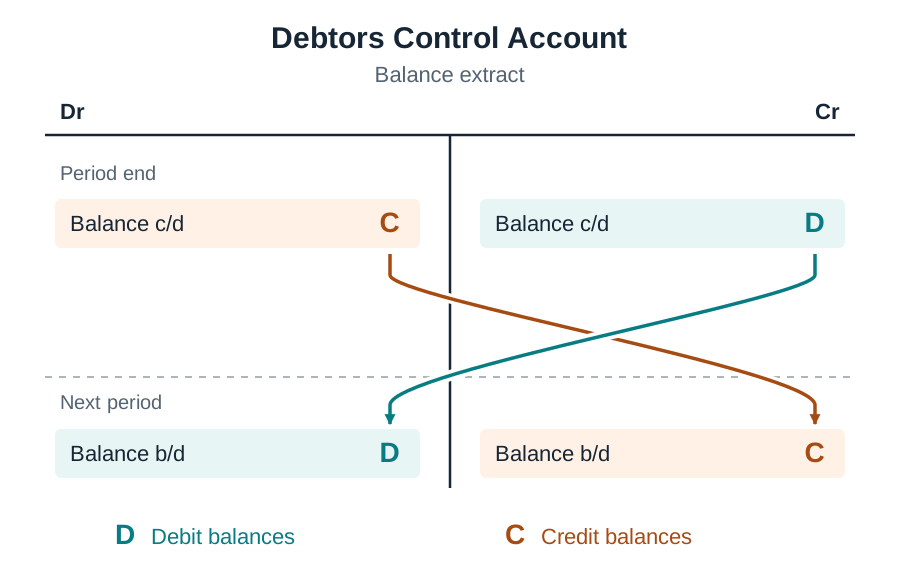
A control account can have both debit and credit opening and closing balances at the same time. Never net these into a single figure; both balances must be carried down and brought down separately.
- Credit balance on Debtors Control: Occurs when a customer accidentally overpays their account, returns goods for credit after paying their account in full, or pays an advance deposit before goods are dispatched.
- Debit balance on Creditors Control: Occurs when the business overpays a supplier by mistake, returns goods for credit after settling an account in full, or pays an advance deposit to secure raw materials.
Treatment of Bad Debts and Provisions
Only bad debts written off are credited to the Debtors Control Account. The provision for bad debts is never entered in the control account. It is an end-of-year accounting estimate, not an agreed deduction with any specific customer.
Contra Entries and Restocking Charges
1. Contra Entries (Set-Offs)
A contra entry arises when the same person or firm is both your customer and your supplier. Instead of each side paying the other, the smaller amount owed is set off against the larger one.
A contra entry reduces both total debtors and total creditors by the agreed offset figure:
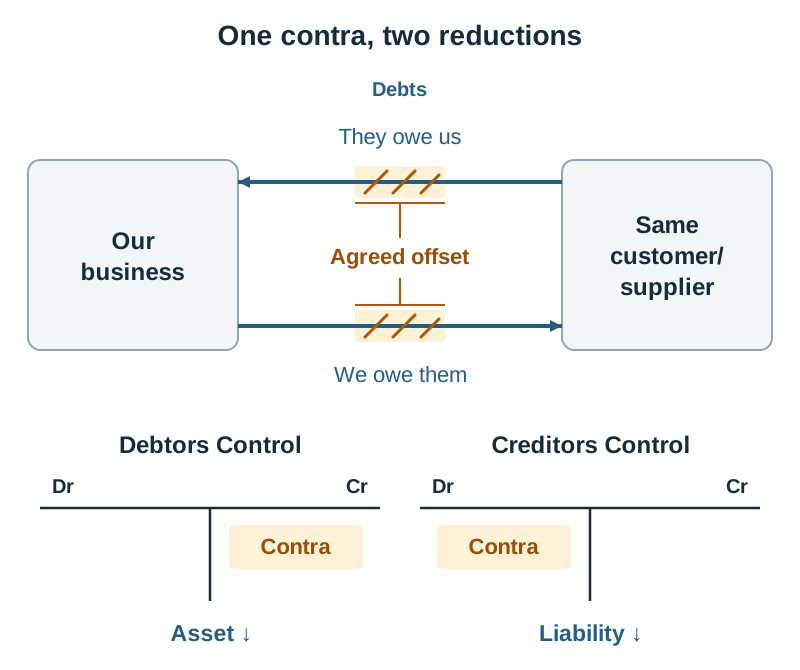
In reconciliation adjustments, an omitted contra must also be deducted from the customer's account in the schedule of debtors and from the supplier's account in the schedule of creditors.
2. Restocking Charges
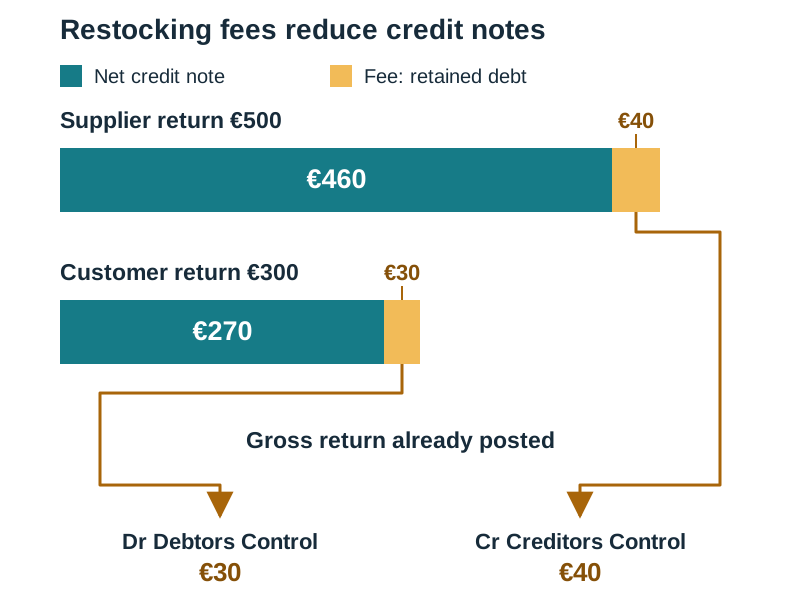
A restocking charge is a fee charged by a supplier when goods are returned. It covers the cost of repackaging and handling the goods.
- Supplier imposes a fee on our returns: If we return goods costing €500 and the supplier charges a €40 restocking fee, the net credit note received is €460. If the full €500 was entered in the Purchases Returns Book, creditors were reduced by €40 too much. The €40 fee must be credited to Creditors Control (and added back to the supplier's account in the schedule) to reinstate the liability.
- We impose a fee on a customer's returns: If a customer returns €300 worth of goods and we charge a €30 restocking fee, our net credit note is €270. If the gross €300 was entered in the Sales Returns Book, Debtors Control was credited by €30 too much. The €30 charge must be debited back to Debtors Control (and added to the customer's account in the schedule) to reinstate the customer's debt.
Finding Missing Figures in Incomplete Records
In incomplete records questions, control accounts are used to deduce credit sales or credit purchases as a balancing figure.
Finding Credit Sales
To find credit sales, write up the Debtors Control Account. Enter the opening balance (Dr), bank receipts (Cr), discounts allowed (Cr), sales returns (Cr), bad debts written off (Cr), contra entries (Cr), and closing debtors (Cr balance c/d).
Always ensure any other debit-side items are entered before calculating the balancing figure:
- Dishonoured cheques
- Interest charged to customers on overdue accounts
- Cash refunds paid to customers who had overpaid
- Any closing credit balance (carried down on the debit side)
The balancing figure on the debit side is Credit Sales.
Finding Credit Purchases
To find credit purchases, write up the Creditors Control Account. Enter the opening balance (Cr), bank payments (Dr), discounts received (Dr), purchases returns (Dr), contra entries (Dr), and closing creditors (Dr balance c/d). Also include any interest charged by suppliers (Cr) or refunds received (Cr). The balancing figure on the credit side is Credit Purchases.
Reconciling the Control Account with the Schedule of Balances
At Higher Level, examination questions provide an unadjusted control account balance and an unadjusted schedule of balances that fail to agree. You must prepare an Adjusted Control Account and an Adjusted Schedule of Balances to prove they reach the same final figure.
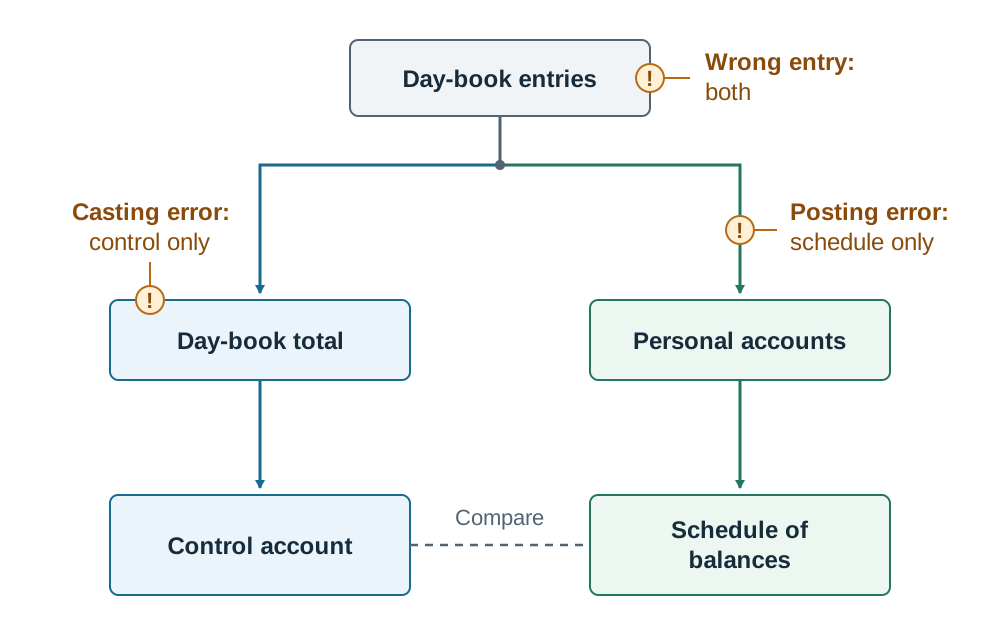
In the Irish bookkeeping system, personal ledger accounts are posted from individual entries in the day books, whereas control accounts are posted from day-book totals. Use the following diagnostic rules to determine where an adjustment belongs:
| Error Type | Control Account? | Schedule? | Adjustment Amount |
|---|---|---|---|
| Day book undercast or overcast (addition error) | Yes | No | Difference |
| Wrong figure entered in day book (e.g. €850 entered as €580) | Yes | Yes | Difference (€270 in both) |
| Correct in day book, but posted to personal account at wrong figure | No | Yes | Difference |
| Posted to wrong side of a personal account | No | Yes | Double the amount |
| Customer or supplier balance omitted from schedule | No | Yes | Full balance |
| Balance listed on wrong side in schedule | No | Yes | Double the amount |
| Complete omission of an invoice or credit note | Yes | Yes | Full invoice/credit note value |
| Contra entry omitted from both ledgers | Yes | Yes | Agreed offset amount |
| Restocking charge omitted from books | Yes | Yes | Restocking fee |
| Cash transaction entered in credit day book in error | Yes | No | Full cash amount |
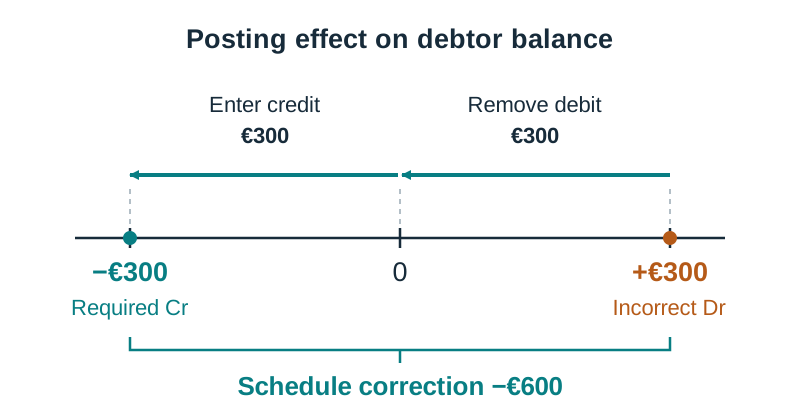
Errors in Personal Accounts and the Schedule
- Posted to wrong side: Debiting €300 to a customer's account instead of crediting it makes the balance €600 too high. Deduct €600 from the schedule.
- Balance listed on wrong side: If a debtor's credit balance of €200 is listed as a debit balance, the schedule total is overstated by €400. Deduct €400 from the schedule.
- Balance listed at wrong figure: If a balance of €1,250 is listed in the schedule as €1,520, deduct the difference of €270 from the schedule.
Limitations of Control Accounts
A control account acts as an overall check on ledger totals, but it has defined limitations. If an error affects both the control account and the schedule by the identical amount, or affects neither of them, the two records will still agree and the error will remain hidden.
- Error of Omission: A transaction is left out entirely from both the day book and the personal ledger. Once discovered in an examination question, it must be entered in both records to bring them up to date.
- Error of Commission: An invoice is debited to the correct side of the wrong customer's account (for example, debiting D. Kelly instead of P. Kelly). The schedule total and the control account still agree.
- Error of Principle: A transaction violates basic accounting principles, such as recording the purchase of an office van in the Purchases Day Book. Creditors control reconciles with the schedule, but the fixed asset and expense figures in the final accounts are wrong.
- Error of Original Entry: An incorrect figure is entered on the source document and copied into both the day book and the personal ledger (for example, an invoice for €320 recorded as €230 in both places).
- Compensating Errors: Two independent errors of equal amount cancel each other out on opposite sides of the accounts.
- Failure to identify specific accounts: A control account reveals that an arithmetical error exists somewhere in the ledger, but it cannot identify which individual customer or supplier account contains the mistake.
Key terms
- Debtors Control Account
- A summary account in the General Ledger recording the aggregate totals of all transactions affecting trade debtors, checking the arithmetical accuracy of the Sales Ledger.
- Creditors Control Account
- A summary account in the General Ledger recording the aggregate totals of all transactions affecting trade creditors, checking the arithmetical accuracy of the Purchases Ledger.
- Sales Ledger
- The subsidiary ledger containing all individual personal accounts of trade debtors.
- Purchases Ledger
- The subsidiary ledger containing all individual personal accounts of trade creditors.
- Schedule of Balances
- A list of individual account balances extracted from the sales or purchases ledger, totalled so it can be compared with the control account balance.
- Contra Entry
- An accounting offset between the sales and purchases ledgers when the same party is both a customer and a supplier, reducing both debtor asset and creditor liability balances.
- Restocking Charge
- A handling fee charged by a supplier or levied on a customer when goods are returned, reducing the net credit note value.
- Balancing Figure
- A missing figure, such as credit sales or credit purchases, calculated by entering all known debit and credit items into a control account and finding the amount needed to balance both sides.
Check yourself
A sales credit note for €300 was mistakenly debited to customer J. Byrne's account. The Schedule of Debtors total stands at €18,900. What is the corrected schedule total?
€18,300. Debiting €300 instead of crediting it made the account balance €600 too high (twice the amount). Deducting €600 from €18,900 leaves €18,300. The Debtors Control Account is unaffected because the day-book total was correct.
A credit customer overpaid their invoice by €250 and the business returned the €250 by bank transfer. How is this cash refund recorded in the Debtors Control Account?
Debit the Debtors Control Account with €250. The customer's overpayment created an abnormal credit balance; paying the refund removes that credit balance.
The Sales Day Book total was overcast by €750. Which record must be adjusted: the Debtors Control Account, the Schedule of Debtors, or both?
Adjust the Debtors Control Account only (by crediting €750). Individual customer accounts are posted from individual day-book entries, so their balances are already correct.
Name two types of bookkeeping errors that will not be revealed by reconciling a control account with its schedule.
Errors of omission (transaction left out completely from all records), errors of commission (posted to the correct side of the wrong person's account), errors of principle, errors of original entry, or compensating errors.