

Club accounts track and report the finances of non-profit organisations such as sports clubs, societies, and community associations. While commercial businesses operate to earn profit for owners, clubs exist to provide sporting, recreational, and social amenities to their members. This difference in purpose changes the accounting terminology and financial statements. Owner's equity is replaced by the accumulated fund, the profit and loss account becomes the income and expenditure account, and the result for the year is reported as a surplus or a deficit. Under syllabus unit 8.6.3, this topic also covers service firms (such as medical, dental, legal, and veterinary practices), which provide professional services for profit and use matching accounting principles. Higher Level students must prepare complete final accounts, handle double-entry adjustments for prepayments, accruals, levies, and life memberships, and advise the Annual General Meeting (AGM) on financial strategy.
Role of the Treasurer and Record-Keeping
The club treasurer is an honorary officer elected by members at the Annual General Meeting (AGM) to manage the club's finances. The committee holds members' funds on trust, making proper record-keeping essential.
Duties of the Club Treasurer
- Keep proper accounting records throughout the year.
- Issue receipts for all money collected and lodge cash promptly and intact into the club bank account.
- Pay approved bills and authorise transactions (usually jointly with another club officer).
- Prepare the annual financial statements at the close of the financial year.
- Present the treasurer's report and explain the financial statements to members at the AGM.
- Arrange for the annual accounts to be audited or independently examined.
- Advise the committee on financial strategy, including subscription rates, capital projects, fundraising, and borrowing.
Why a Club Keeps Records
- Accountability: To account to members for all funds received and disbursed.
- Statutory and AGM compliance: To present verified accounts to members and satisfy grant bodies or lenders.
- Internal control: To protect cash, track bank transactions, and reduce the risk of fraud, theft, or error.
- Performance monitoring: To determine whether individual activities (such as a bar, club lotto, or annual dinner) generate a surplus or a loss.
- Planning: To project cash requirements, determine future capital spending, and set realistic membership subscription rates.
A Simple Record-Keeping System
- An analysed cash book (receipts and payments book).
- A register of members recording subscription payments, arrears, and prepayments.
- Printed, numbered receipt books, with all cash lodged promptly.
- Cheque payments or electronic transfers supported by authorised invoices and two signatures.
- A fixed asset register recording property, grounds equipment, and depreciation.
- Regular monthly bank reconciliations.
Receipts and Payments vs Income and Expenditure
Clubs prepare two main operational summaries: the Receipts and Payments Account and the Income and Expenditure Account.
Comparison Table
| Feature | Receipts and Payments Account | Income and Expenditure Account |
|---|---|---|
| Accounting Basis | Cash basis: records cash and cheques actually received and paid out. | Accruals basis: matches income earned against expenditure incurred in the period. |
| Nature of Items | Combines capital items (equipment bought, loans) and revenue items (wages, light). | Revenue items only. Capital expenditure and capital receipts are excluded. |
| Period Covered | Includes cash relating to past, current, and future accounting years. | Restricted strictly to income and expenses that belong to the current year. |
| Non-cash items | Ignores non-cash adjustments (depreciation, bad debts written off). | Includes non-cash expenses like depreciation and bad debt write-offs. |
| Closing Balance | Shows closing cash and bank balances at year-end. | Shows the Surplus of Income over Expenditure or Excess of Expenditure over Income. |
Analysed Receipts and Payments Account
An analysed receipts and payments account is a cash book with dedicated analysis columns. Each receipt and payment is entered in the Total column and posted to its specific category column. The debit side records receipts; the credit side records payments.
| Date | Details | Total (€) | Subscriptions (€) | Bar (€) | Lotto (€) |
|---|---|---|---|---|---|
| 03/01 | Member Subscriptions | 1,200 | 1,200 | ||
| 05/01 | Bar Takings | 850 | 850 | ||
| 06/01 | Lotto Ticket Sales | 400 | 400 | ||
| Totals | 2,450 | 1,200 | 850 | 400 |
Every analysis row cross-casts: the sum of the analysis columns must equal the entry in the Total column.
The Accumulated Fund and Opening Balance Sheet
A voluntary club has no commercial share capital. Its opening net worth is called the Accumulated Fund, representing all past surpluses accumulated by the club on behalf of its members.
To find the Accumulated Fund on the first day of the financial year, apply the fundamental accounting equation:
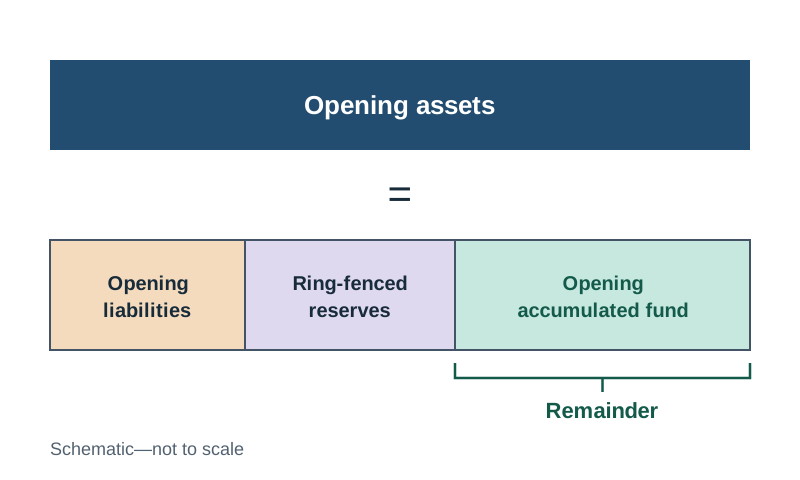
Classification of Opening Items
- Opening Assets: Club premises, playing pitches, equipment (at net book value), investments, positive bank balance, bar stock, subscriptions due from members (arrears), and prepaid expenses (such as insurance prepaid).
- Opening Liabilities: Bank overdraft, bar trade creditors, subscriptions received in advance, accrued operating expenses (unpaid electricity or rent), and loan interest due.
- Ring-Fenced Capital Reserves: Any opening balance in a dedicated Levy Reserve Fund must be deducted alongside liabilities. The levy reserve fund is a separate fund set aside for a specific project, so it is not part of the general accumulated fund. Deducting it from assets prevents capital from being counted twice.
Subscriptions and Adjusting Operating Items
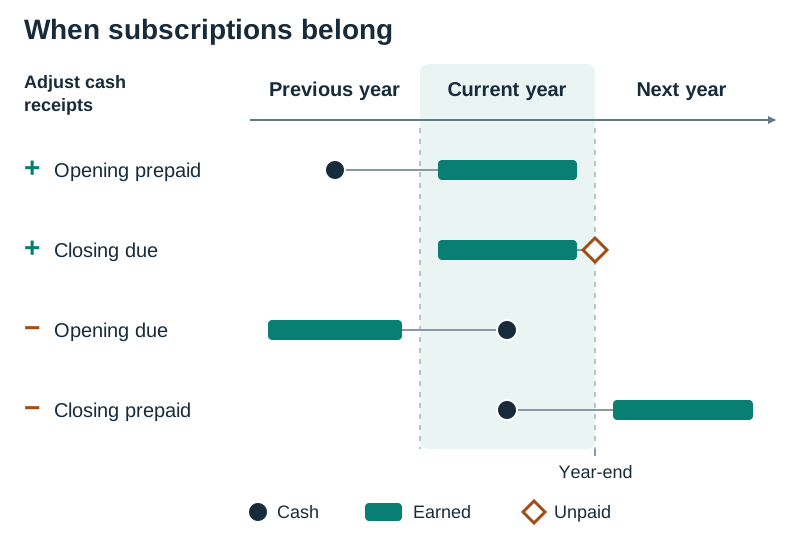
Subscriptions are annual membership fees and form the main regular income source for most clubs. Because members pay at varying times, cash received during the year does not match the subscription income earned.
Subscriptions Formula
$$
Ledger Account Format
| Subscriptions Account (Dr) | € | Subscriptions Account (Cr) | € |
|---|---|---|---|
| Balance b/d (Opening Due / Arrears) | [A] | Balance b/d (Opening Prepaid / Advance) | [B] |
| Income & Expenditure (Balancing figure) | [Earned] | Bank / Cash (Receipts & Payments) | [C] |
| Balance c/d (Closing Prepaid / Advance) | [D] | Balance c/d (Closing Due / Arrears) | [E] |
If opening subscriptions in arrears are written off as uncollectible, credit the written-off amount to the Subscriptions Account (on the same side as cash received) and debit the same amount as an expense in the Income and Expenditure Account (subscriptions written off). The subscription income figure remains intact and the bad debt loss is charged to expenditure.
General Adjustments for Expenses and Incomes
- Expenses: .
- Consumables Used: .
- Investment Income: . If cash received is less than this earned figure, enter the remainder as Investment Income Due under Current Assets.
- Asset Disposals: When equipment is sold, calculate net book value (NBV = Cost − Depreciation to date of sale). . A profit is credited to Income; a loss is debited to Expenditure.
Special Purpose Accounts and Capital vs Revenue
When a club operates a commercial facility such as a bar, restaurant, or weekly lotto, it compiles a Special Purpose Profit and Loss Account to calculate the net contribution from that activity.
Bar Trading Account Calculations
Transfer the net profit to the Income section of the Income and Expenditure Account. If the bar runs at a net loss, enter the loss on the expenditure side.
Capital vs Revenue Distinction
| Item | Type | Accounting Treatment |
|---|---|---|
| Annual Subscriptions | Revenue | Credited to Income & Expenditure Account (adjusted for accruals/prepayments). |
| Annual Operating Grant / Sponsorship | Revenue | Credited to Income & Expenditure Account. |
| Entrance / Joining Fees | Revenue | Credited to Income & Expenditure Account (unless explicitly stated as capital). |
| Member Capital Levy | Capital | Credited to the Levy Reserve Fund in Financed By. Never enters Income & Expenditure. |
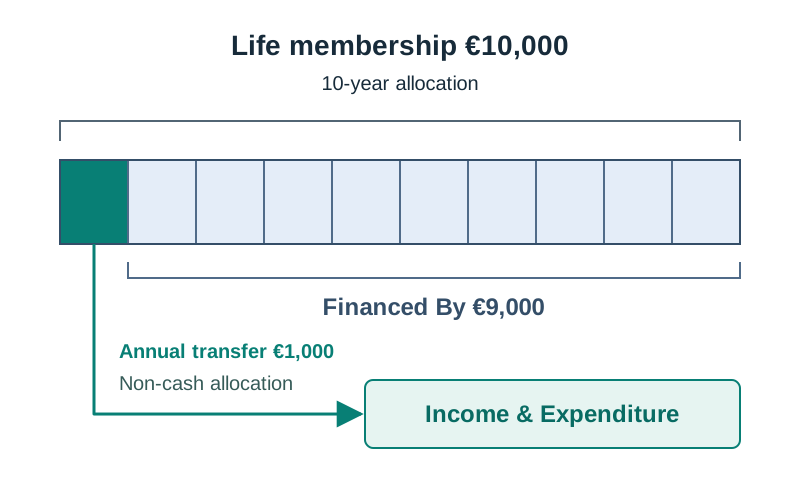
| Life Membership Lump Sum | Deferred Revenue / Liability | Credited to Life Membership in Financed By. An agreed annual portion is amortised to Income & Expenditure. |
| Capital Lottery Grant / Bequest | Capital Receipt | Follow question instructions. If none is given, show as a separate capital reserve in Financed By. Do not treat as normal operating income. |
For life membership, if €10,000 is received with an agreement to write it off over 10 years, transfer €1,000 (€10,000 / 10) to Income and retain the unamortised €9,000 in Financed By.
Accounts of Service Firms
A service firm sells a professional service rather than physical goods. Typical examples are dentists, solicitors, accountants, vets, and medical practitioners. Because service firms operate as commercial sole traders rather than voluntary clubs, their accounts use the same double-entry mechanics as club accounts with specific naming adjustments:
Terminology Comparison
| Club Accounting | Service Firm Accounting |
|---|---|
| Accumulated Fund | Capital (calculated via a Statement of Capital on day one) |
| Surplus / Deficit | Net Profit / Net Loss |
| Subscriptions | Fees Earned (private patient fees, medical card schemes, legal fees) |
| No owner withdrawals | Drawings (deducted from Capital in the balance sheet; never an expense) |
Core Method for Service Firms
- Statement of Capital: List all initial business assets less liabilities to determine the opening Capital balance.
- Fees Income: Adjust fee receipts for opening and closing fees due from clients or state schemes (e.g. Health Service Executive/Medical Card).
- Consumable Supplies: Compute dental or medical supplies used using .
- Drawings Audit: Check whether recorded drawings contain any genuine business expenses. If private drawings include payments for business costs (such as locum doctor/dentist wages or business utility bills), extract the business expense from drawings, charge it to expenditure, and reduce drawings accordingly.
- Financed By Section: Closing Capital = .
Balance Sheet Structure and Advising the AGM
Club Balance Sheet Layout
- Fixed Assets: Club premises, playing grounds, equipment (Cost, Accumulated Depreciation, Net Book Value).
- Financial Assets: Quoted government securities or prize bonds at cost.
- Current Assets: Bar stock, subscriptions in arrears, investment income due, expense prepayments, and closing bank balance.
- Creditors: amounts falling due within 1 year: Bar creditors, expense accruals, loan interest due, subscriptions prepaid, and bank overdraft.
- Financed By: Opening Accumulated Fund + Current Surplus (or − Deficit) + Levy Reserve Fund + Life Membership Fund.
Advising the AGM (Higher Level Theory)
Higher Level questions frequently ask you, as club treasurer, to evaluate a proposal to fund a major capital project or adjust membership subscription rates. Base every observation on exact figures from your accounts.
Framework for Project Funding
- Liquid Resources: Quantify actual available liquid funds: closing cash at bank plus readily realisable investments. The Levy Reserve Fund is not extra cash sitting in an additional bank account; it tells you how much of the club's net assets has already been ring-fenced for a dedicated purpose. If the levy was raised for a different project, deduct it from available cash. The remaining gap represents the amount that must be borrowed externally.
- Borrowing Capacity: Compare the borrowing requirement against the club's annual operating surplus. If the surplus comfortably exceeds estimated annual loan repayments (principal plus interest), the club can afford commercial borrowing. Mention that freehold club premises can be pledged as loan security, provided they are not already mortgaged.
- Subscriptions and Member Levies: Assess whether the club should maintain subscriptions, introduce a temporary capital levy, or seek sports capital grants to avoid over-borrowing.
Framework for Proposed Subscription Reductions
- Arguments in favour: Quote the size of the year's surplus, healthy bank balances, and the absence of pressing debts. A moderate fee reduction may attract new members and discourage arrears.
- Arguments against: Emphasise that parts of the surplus may be non-cash (e.g. depreciation write-backs or life membership amortisation) or non-recurring (one-off sponsorships, bequests). Club running costs face inflation, and upcoming facility renewals require sustained reserves.
Key terms
- Accumulated Fund
- The opening net worth or accumulated capital of a club, calculated by deducting total opening liabilities and ring-fenced reserves from total opening assets.
- Receipts and Payments Account
- A summarised cash book recording all cash inflows and outflows during an accounting period regardless of whether transactions are capital or revenue.
- Income and Expenditure Account
- The revenue account of a non-profit club that matches earned income against incurred operational running costs to calculate the surplus or deficit.
- Surplus of Income over Expenditure
- The excess of operational revenue over operational expenditure for an accounting period; added to the Accumulated Fund in the Balance Sheet.
- Excess of Expenditure over Income
- The operating deficit resulting when operational expenses exceed revenue earnings; deducted from the Accumulated Fund in the Balance Sheet.
- Levy Reserve Fund
- A ring-fenced capital reserve created from compulsory member levies to fund a specific long-term asset project, presented under Financed By in the Balance Sheet.
- Life Membership
- A single lump sum paid by a member to secure lifetime club access; recorded in Financed By and amortised to the Income and Expenditure Account over an agreed period.
- Special Purpose Profit and Loss Account
- A separate trading account prepared to determine the net profit or loss generated by a commercial club activity (such as a bar or shop) before transfer to general income.
- Subscriptions in Arrears
- Membership subscriptions earned during the current or prior periods that remain unpaid at the balance sheet date; classified as a current asset.
- Subscriptions in Advance
- Membership fees collected before year-end that relate to the subsequent financial year; classified as a current liability.
- Statement of Capital
- The opening statement of assets and liabilities prepared for a service firm sole trader to establish opening owner's equity.
Check yourself
How is a club's opening Accumulated Fund calculated?
Total opening assets minus total opening liabilities and ring-fenced capital reserves (such as an opening Levy Reserve Fund).
A club receives a €12,000 life membership fee to be spread evenly over 12 years. What appears in the current year's final accounts?
€1,000 (€12,000 / 12) is credited to the Income and Expenditure Account as operating revenue. The remaining €11,000 is shown under 'Financed By' in the Balance Sheet as a long-term liability/reserve.
How should a one-off capital lottery grant received towards building dressing rooms be treated?
It is a capital receipt. Follow the instruction in the examination question. If none is given, show it as a separate capital grant or reserve in the 'Financed By' section of the Balance Sheet. Do not credit it to the Income and Expenditure Account.
During the year, a club received €54,000 in subscriptions. Subscriptions due were €1,800 at the start and €2,200 at the end. Subscriptions prepaid were €900 at the start and €1,400 at the end. What is the subscription income for the year?
€53,900. Calculation: €54,000 (received) + €900 (opening prepaid) + €2,200 (closing due) − €1,800 (opening due) − €1,400 (closing prepaid) = €53,900.
A club sold bar equipment with an original cost of €8,000 and accumulated depreciation of €5,500 for €3,100 cash. What entries are made in the Income and Expenditure Account?
Net book value at sale is €2,500 (€8,000 − €5,500). The profit on disposal is €600 (€3,100 − €2,500), which is credited to the Income and Expenditure Account under Income.