

Principles, Objectives, and the Principal Budget Factor
A budget acts as a financial roadmap for a business, setting clear targets for income and expenditure while coordinating operations across every department. Preparing regular budgets serves four essential management functions:
- Planning: Forces management to look ahead, anticipate trading conditions, establish stock targets, and plan capital requirements rather than reacting to short-term crises.
- Coordination: Aligns individual departments (sales, production, purchasing, and finance) towards shared business goals, preventing departmental conflict.
- Communication and Motivation: Clarifies expectations for departmental supervisors. Involving line managers in budget formulation (participative budgeting) is vital because line staff possess direct operational knowledge; their input creates realistic targets and secures employee commitment.
- Control and Performance Evaluation: Establishes reliable benchmarks against which actual results are compared through variance analysis.
The Principal Budget Factor
The principal budget factor (or limiting factor) is the factor that limits how much the business can do in the budget period, usually sales demand. It is the starting point for preparing all other budgets, as a firm cannot justify manufacturing more goods than customers will purchase.
Internal constraints can also become the principal budget factor:
- Availability of raw materials
- Supply of skilled direct labour hours
- Factory machine capacity or floor space
- Capital or cash availability
All subsequent functional budgets are constructed around this constraint. For example, if machine capacity restricts output to 12,000 units, the production budget cannot be set at 15,000 units regardless of market demand.
The Functional Budget Sequence
When customer sales demand is the limiting factor, operational budgets must be prepared in a strict logical sequence, where each statement provides the foundation for the next:
- Sales Budget: Units and revenue
- Production Budget: Finished units to manufacture
- Raw Materials Usage Budget: Physical material quantities needed
- Raw Materials Purchases Budget: Quantities and expenditure to buy
- Direct Labour Budget: Labour hours and wage costs
- Factory Overhead Budget: Indirect manufacturing costs
- Closing Stock Budget: Valuation of finished goods and raw materials
- Non-Factory Expense Budget: Administration and selling expenses
- Master Budget & Cash Budget: Budgeted accounts and monthly liquidity
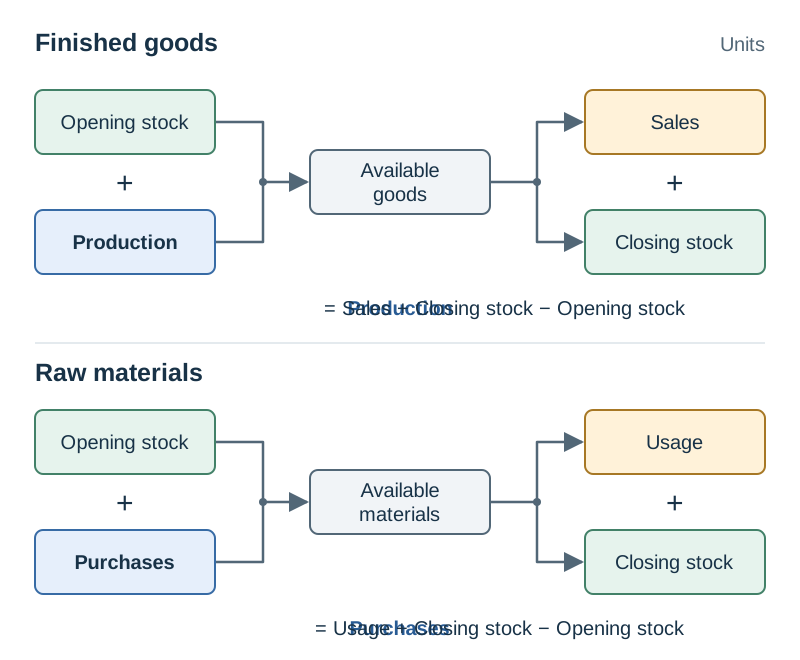
1. Sales Budget
The sales budget forecasts volume and value:
To forecast sales accurately, management evaluates market research, opinions of sales representatives, economic trends, past sales patterns, selling price adjustments, and competitor activity.
2. Production Budget
The production budget determines the number of finished goods units that must be manufactured to satisfy sales demand while leaving the planned closing stock:
Closing stock is added because these finished units must be made before the period ends. Opening stock is subtracted because these units are already in the warehouse.
3. Raw Materials Usage and Purchases Budgets
- Material Usage Budget: Multiplies budgeted production units by the standard raw material required per finished product (kg, litres, or metres).
- Material Purchases Budget: Adjusts usage for raw material stock policies and converts the final requirement into euro:
4. Direct Labour and Factory Overhead Budgets
- Direct Labour Budget: Multiplies budgeted production units by standard direct labour hours per unit, then multiplies total hours by the hourly wage rate.
- Factory Overhead Budget: Estimates the indirect factory costs, such as factory rent, supervision, power, and maintenance, splitting each into its fixed and variable parts where needed.
5. Closing Stock Budget
The closing stock budget values the stock held at the end of the budget period:
- Raw materials are valued at purchase price.
- Finished goods are valued at production cost per unit:
Selling price is never used to value closing stock.
The Master Budget and Non-Factory Expenses
The Master Budget
The master budget is the overall plan for the whole business. It summarises all the functional budgets into a budgeted profit and loss account, a budgeted balance sheet, and a cash budget:
- Budgeted Manufacturing Account: Collates raw materials consumed, direct labour, and factory overheads to calculate total cost of manufacture.
- Budgeted Trading, Profit and Loss Account: Summarises projected sales revenue, cost of sales, and administrative and selling expenses to forecast net operating profit.
- Budgeted Balance Sheet: Projects the financial position of assets, liabilities, and capital at the end of the budget period.
- Cash Budget: Month-by-month expected cash receipts, payments, and closing bank balance. Some master budget packages also include a budgeted cash flow statement.
Non-Factory Expense Budget
The non-factory expense budget estimates the costs of running the business outside the factory gates:
- Administration expenses: Office salaries, directors' fees, and office rent.
- Selling and distribution expenses: Sales commissions, advertising campaigns, and delivery van costs.
Some of these costs vary with sales (such as sales commission and delivery), while others are fixed (such as office rent). These totals appear below gross profit in the budgeted profit and loss account; they are never included in the manufacturing account or in the unit production cost.