

Fixed assets valuation deals with recording, depreciating, disposing of, and revaluing long-term assets held to generate income rather than for resale. At Leaving Certificate Higher Level, students must master the distinction between capital and revenue expenditure, the computation of straight-line and reducing-balance depreciation with time apportionment, the complete ledger accounts for disposals and trade-ins, the movement schedule for company accounts, tabular statement entries, and the accounting mechanics for upward revaluation into an unrealised capital reserve.
Capital vs Revenue Expenditure and Asset Cost
A fixed asset is a tangible resource acquired for long-term use within the business to generate income, rather than for resale in the normal course of trading. For example, a delivery van used by a bakery is a fixed asset, whereas the flour and bread are trading stock.
When spending money on fixed assets, you must distinguish between two types of expenditure:
- Capital expenditure: Money spent on acquiring, constructing, or enhancing long-term fixed assets. It includes the invoice purchase price plus all non-recurring costs required to bring the asset into working location and operational condition, such as carriage inwards, site preparation, legal fees, and installation charges. Capital expenditure is capitalised on the balance sheet and written off as depreciation over the asset's useful economic life.
- Revenue expenditure: Day-to-day running costs and ordinary maintenance incurred to maintain an asset's existing earning capacity. Examples include motor tax, insurance, fuel, routine servicing, and minor repairs. Revenue expenditure is expensed immediately in the Profit and Loss Account in the current period.
Getting this classification wrong damages the Profit and Loss Account and the Balance Sheet at the same time, so it usually costs marks twice. If a €5,000 machine installation is wrongly recorded as repairs, expenses are overstated, meaning net profit is understated by €5,000, while fixed assets on the balance sheet are also understated by €5,000. Furthermore, all subsequent depreciation calculations on that machine will be incorrect.
Why We Depreciate: Concepts, Bases, and Policies
A van bought for €30,000 will not be worth €30,000 in three years' time. Depreciation is how we charge a share of that cost to each year that uses the van, instead of charging the entire €30,000 in the year it was bought.
Formally, depreciation is the systematic spreading of an asset's depreciable amount—its cost (or revalued amount) less any expected residual value—over its estimated useful economic life. Depreciation arises from wear and tear, the passage of time, and obsolescence caused by technology or market shifts. It is a non-cash expense: it reduces reported profit without any cash leaving the bank account.
Depreciation is an allocation, not a valuation
The net book value (NBV) in the Balance Sheet (cost less accumulated depreciation) is simply the unallocated portion of historical cost. It is not an estimate of open market value.
- Depreciation is based on estimates of useful life and scrap value. Consequently, two firms with identical assets can report different profits simply by selecting different estimates.
- Because depreciation is an internal bookkeeping entry, it does not set aside cash into a fund to replace the asset. Replacement requires separate cash-flow planning.
- Freehold land is never depreciated because it has an indefinite economic life and does not suffer wear and tear. When an exam question provides a combined land and buildings figure, you must deduct the land element before calculating building depreciation.
Concepts, bases, and policies (Higher Level)
At Higher Level, you are expected to distinguish between accounting concepts, bases, and policies, using depreciation as the core example:
- A concept is a fundamental accounting rule or assumption. Depreciation exists to satisfy the accruals (matching) concept by matching the cost of asset usage against the revenue generated in that period, the prudence concept by preventing asset overstatement, and the requirement to show a true and fair view.
- A base is one of the recognised methods available to apply a concept. For depreciation, the recognised bases are the straight-line method and the reducing-balance method, alongside the chosen estimates of useful life and residual value.
- A policy is the specific base and rate a business selects, applies consistently, and discloses in its notes. For example, a company policy might state: "Buildings are depreciated at 2% per annum, straight line, on the revalued amount."
- Under the consistency concept, this chosen policy must be applied uniformly from period to period to ensure figures remain comparable over time.
Calculating Depreciation: Straight-Line vs Reducing-Balance
The syllabus tests two distinct methods of calculating depreciation:
1. Straight-Line Method
A method that charges the same amount of depreciation each full year, spreading the cost evenly over the asset's useful life. It is best suited to assets that lose value steadily over time, such as buildings and fixtures.
Where a fixed annual percentage is given, apply the percentage directly to the original cost (or revalued amount) each year:
2. Reducing-Balance (Diminishing-Value) Method
This method applies a constant percentage to the opening net book value (NBV) at the start of each accounting period. The depreciation charge is highest in year one and declines each subsequent year. It is suitable for assets that lose efficiency rapidly and face higher repair bills as they age, such as delivery vans and computers.
Method Comparison over Three Years
Consider an asset costing €20,000 depreciated at 20% per annum under both methods:
| Year | Straight Line (20% on Cost) | Closing NBV | Reducing Balance (20% on NBV) | Closing NBV |
|---|---|---|---|---|
| Year 1 | €4,000 | €16,000 | €4,000 | €16,000 |
| Year 2 | €4,000 | €12,000 | €3,200 (20% of €16,000) | €12,800 |
| Year 3 | €4,000 | €8,000 | €2,560 (20% of €12,800) | €10,240 |
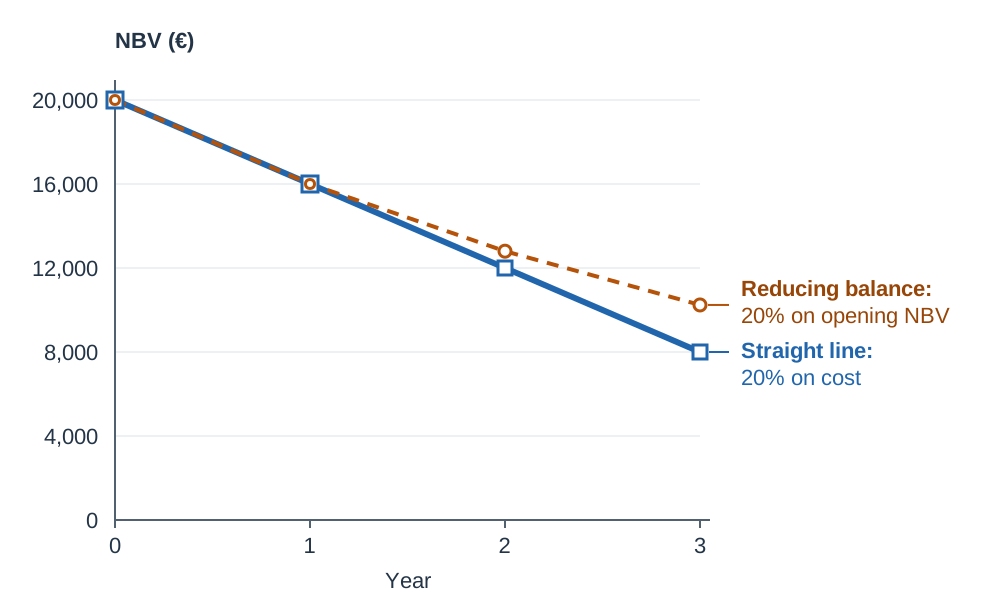
Notice that reducing balance charges more early on and never quite reaches zero, which is why it suits vans and technology that lose most of their commercial value in the opening years.
Time Apportionment (Part-Year Rule)
Read the depreciation policy sentence in the question first. If it specifies that depreciation is charged from the date of purchase to the date of sale, calculate the exact number of months the asset was in use:
If the policy states that a full year's depreciation is charged in the year of purchase and none in the year of sale, follow that instruction instead.
Contrast example: A machine bought on 01/10/2024 for €24,000 with a 25% straight-line rate incurs €1,500 under a date-based policy (€24,000 × 25% × 3/12), but €6,000 under a full-year policy. Underline the depreciation policy sentence before calculating anything, as choosing the wrong rule changes every figure in the provision account and balance sheet.
Double-Entry Ledger Records and Disposals
To preserve the historical cost on record, asset purchases remain in the asset account at cost, while wear and tear accumulates in a separate provision for depreciation account, which carries a credit balance.
- Year-end depreciation entry: Debit Profit and Loss Account (operating expense), Credit Provision for Depreciation Account.
The Four-Step Disposal Process
When an asset is sold, scrapped, or traded in, open a temporary disposal account to determine the resulting gain or loss:
- Transfer original cost: Debit Asset Disposal Account, Credit Fixed Asset Account with the original cost of the asset leaving the business.
- Transfer accumulated depreciation: Debit Provision for Depreciation Account, Credit Asset Disposal Account with all depreciation charged on that asset up to the date of disposal, including any current-year part-year charge.
- Record proceeds or allowance:
- Cash or cheque sale: Debit Bank Account, Credit Asset Disposal Account.
- Trade-in: Debit New Asset Account (with the agreed trade-in allowance), Credit Asset Disposal Account.
- Settling a debt with an asset: If an old asset is handed to a creditor to clear what is owed, debit Creditors Account and credit Asset Disposal Account with the amount of debt cancelled. That cancelled debt is treated exactly like sale proceeds.
- Scrapped for nil proceeds: If an asset is simply scrapped with nothing received, make no entry at step 3; the entire net book value becomes the loss on disposal.
- Balance the disposal account:
- If debits exceed credits, the balancing figure is a loss on disposal, debited to the Profit and Loss Account as an expense.
- If credits exceed debits, it is a profit on disposal, credited to the Profit and Loss Account as income.
When an asset is bought via trade-in, the new asset must be debited with its full purchase cost, which equals the trade-in allowance plus the bank payment. (See Worked Examples 1 and 3 for full ledger treatments).
Property Revaluation and Capital Reserves
Land and buildings often appreciate over time. Revaluing them upwards provides a true and fair view of property values, enhances borrowing capacity with lenders, and gives a realistic capital base.
However, revaluation also carries practical consequences for future financial performance. It increases the annual depreciation charge on buildings in subsequent years, which lowers reported net profit. It also increases the capital employed figure in the balance sheet, which reduces the company's Return on Capital Employed (ROCE) percentage.
How to record an upward revaluation
When an asset is revalued upwards at the start of a year, accumulated depreciation is written back to nil and the asset cost is uplifted to the new valuation figure:
- Debit Fixed Asset Account (with New Valuation − Original Cost)
- Debit Provision for Depreciation Account (with total accumulated depreciation to date, resetting the balance to zero)
- Credit Revaluation reserve Account (with the total surplus: New Valuation − Prior Net Book Value)
If the new valuation happens to be lower than original cost (but still above previous net book value), the asset account is credited with the difference instead. Whichever way the asset account moves, the Revaluation Reserve is always credited with new valuation less previous net book value.
Key Revaluation Rules
- The Revaluation Reserve is an unrealised capital reserve shown under Capital and Reserves in the balance sheet. Because no cash has been received from an actual sale, this surplus cannot be distributed as cash dividends under company law and the prudence concept.
- Following revaluation, future depreciation must be calculated on the new revalued buildings amount, never on original cost.
- When a revalued asset is eventually sold, the surplus remaining in the Revaluation Reserve becomes realised and is transferred directly to revenue reserves (retained profit).
Reporting Formats: Fixed Asset Schedules and Tabular Statements
Fixed assets can be examined across the paper: as full company accounts in Section 1, as ledger depreciation questions, or within tabular statements.
Fixed Assets Schedule
In company final accounts, preparing a fixed assets schedule before drafting the balance sheet is the most reliable way to establish correct closing figures.
Fixed Assets Note for the year ended 31/12/2024:
| Movement | Land & Buildings (€) | Machinery (€) | Total (€) |
|---|---|---|---|
| Cost/valuation 01/01/2024 | 600,000 | 100,000 | 700,000 |
| Revaluation | 250,000 | – | 250,000 |
| Additions | – | 54,000 | 54,000 |
| Disposals | – | (40,000) | (40,000) |
| Cost/valuation 31/12/2024 | 850,000 | 114,000 | 964,000 |
| Accumulated depreciation 01/01/2024 | 48,000 | 42,000 | 90,000 |
| Depreciation written back on revaluation | (48,000) | – | (48,000) |
| Charge for the year | 13,000 | 22,100 | 35,100 |
| Depreciation on disposals | – | (26,000) | (26,000) |
| Accumulated depreciation 31/12/2024 | 13,000 | 38,100 | 51,100 |
| Net book value 31/12/2024 | 837,000 | 75,900 | 912,900 |
Take care with the two write-off adjustments: accumulated depreciation written back on revaluation, and accumulated depreciation removed on disposals. Omitting either leaves accumulated depreciation overstated and the closing net book value incorrect.
Fixed Assets in a Tabular Statement
Each tabular statement transaction must maintain the fundamental equation: Assets = Liabilities + Capital.
| Transaction | Effect on Columns |
|---|---|
| Depreciation for the year | Accumulated Depreciation column increases (+), Profit & Loss column decreases (−) by the same amount |
| Upward revaluation | Asset Cost/Valuation increases by (new valuation − old cost), Accumulated Depreciation decreases to nil, Revaluation Reserve increases by total surplus |
| Sale of asset for cash | Asset Cost decreases by cost, Accumulated Depreciation decreases by depreciation to date, Bank increases by proceeds, Profit & Loss adjusted (+/−) for profit or loss |
| Trade-in of asset | Asset Cost decreases by old cost and increases by new asset cost, Accumulated Depreciation decreases by old asset depreciation, Bank decreases by cheque paid, Profit & Loss adjusted (+/−) for profit or loss |
| Asset given to creditor in full settlement | Asset Cost decreases by cost, Accumulated Depreciation decreases by depreciation to date, Creditors decreases by debt cancelled, Profit & Loss adjusted (+/−) for difference between debt cancelled and NBV |
Worked line: A creditor owed €2,700 accepts equipment (cost €5,000, accumulated depreciation €2,400, NBV €2,600) in full settlement. In the tabular statement: Equipment cost −€5,000; Accumulated Depreciation −€2,400 (assets fall by net €2,600); Creditors −€2,700; Profit & Loss +€100 (profit on disposal because debt cancelled of €2,700 exceeds NBV of €2,600). The two sides balance: assets fall by €2,600, while liabilities fall by €2,700 and capital rises by €100 (net change −€2,600).
Financial Statement Impact: Profit & Loss, Balance Sheet, and Cash Flow
Profit and Loss Presentation
- The depreciation charge for the year is an operating expense. In company accounts, allocate it according to function: premises and office equipment depreciation to administration expenses, delivery vans to distribution costs, and factory machinery to cost of sales.
- Profit or loss on disposal must be disclosed separately. A loss on disposal is shown as an operating expense, while a profit on disposal is shown under other income. Never net disposal profits or losses against the annual depreciation charge.
Tangible vs Intangible Fixed Assets
Tangible fixed assets have physical substance (premises, equipment, vehicles). Intangible fixed assets do not (goodwill, patents). Both appear under Fixed Assets on the balance sheet, with intangibles listed first.
Goodwill arising on the purchase of a business is calculated as:
where Net Assets Acquired equals Assets Acquired minus Liabilities Assumed. Writing down an intangible asset over its useful life is termed amortisation (debit Profit and Loss, credit the intangible asset provision).
Cash Flow Statement Presentation
- In the reconciliation of operating profit to net cash flow from operating activities, depreciation is added back because it is a non-cash expense that reduced profit without using cash.
- Any profit on disposal is deducted from operating profit (and any loss on disposal is added back) because it represents a book adjustment rather than operating cash flow.
- Under investing activities, actual cash paid to acquire fixed assets appears as an outflow, and cash proceeds received from asset sales appear as an inflow. Always record the gross cash proceeds received, never the net book value.
Key terms
- Fixed Asset
- A tangible asset acquired for long-term use in the business to generate revenue, rather than for resale.
- Capital Expenditure
- Spending on acquiring, constructing, or enhancing fixed assets, including delivery and installation costs, capitalised on the balance sheet.
- Revenue Expenditure
- Day-to-day operational spending incurred on running the business or maintaining the earning capacity of fixed assets, expensed in the Profit and Loss Account.
- Depreciation
- The systematic allocation of the depreciable amount of a fixed asset over its estimated useful economic life as a non-cash operating expense.
- Useful Economic Life
- The expected period over which a fixed asset is expected to generate economic benefits for a business before becoming obsolete or inefficient.
- Residual Value
- The amount the business expects to receive for an asset when it is finally disposed of at the end of its useful life (also called scrap or salvage value).
- Net Book Value (NBV)
- The carrying value of an asset in the accounts, calculated as original cost (or revalued amount) less total accumulated depreciation to date.
- Straight-Line Method
- A method that charges the same amount of depreciation each full year, so the cost is spread evenly over the asset's useful life.
- Reducing-Balance Method
- A depreciation method applying a constant percentage to the opening net book value of the asset each period, producing decreasing annual charges.
- Provision for Depreciation Account
- A separate balance sheet ledger account with a credit balance that accumulates all depreciation charges written off against an asset to date.
- Disposal Account
- A temporary ledger account opened to remove an asset's cost and accumulated depreciation and calculate the resulting profit or loss on disposal.
- Trade-In Allowance
- The agreed value granted by a seller for an old asset given in part-exchange against the purchase price of a replacement asset.
- Revaluation Reserve
- A non-distributable capital reserve in the balance sheet that records the unrealised surplus arising from revaluing fixed assets above their net book value.
- Consistency Concept
- The accounting rule requiring that identical accounting policies and methods are applied uniformly from year to year to ensure comparability.
- Goodwill
- An intangible fixed asset representing the excess of the purchase price paid for an acquired business over the fair value of its net assets.
Check yourself
What is the double entry to record the annual depreciation charge in the ledger?
Debit the Profit and Loss Account (operating expense) and Credit the Provision for Depreciation Account.
A machine bought for €30,000 has a residual value of €3,000 and an expected useful life of 6 years. What is its annual straight-line depreciation charge?
€4,500 per year, calculated as (€30,000 − €3,000) ÷ 6 years.
An asset costing €50,000 with accumulated depreciation of €32,000 is sold for €21,000. Is there a profit or loss on disposal, and how much?
There is a profit on disposal of €3,000. The net book value was €18,000 (€50,000 − €32,000), and the sale proceeds of €21,000 exceeded book value by €3,000.
Land and buildings costing €390,000 with accumulated depreciation of €15,000 are revalued to €450,000. What entries are made in a tabular statement?
Land & Buildings cost/valuation +€60,000 (€450,000 − €390,000); Accumulated Depreciation −€15,000; Revaluation Reserve +€75,000 (€450,000 − €375,000 NBV). Total assets rise by €75,000 and capital rises by €75,000, keeping the statement balanced.
How should a business record an old vehicle with an NBV of €3,500 given to a trade creditor in full settlement of a €3,800 debt?
Debit Creditors Account with €3,800, Credit Delivery Van Disposal Account with €3,800, and credit the resulting €300 difference to the Profit and Loss Account as a profit on disposal.
Distinguish between an accounting concept, an accounting base, and an accounting policy, using depreciation as your example.
The concept is the accruals (matching) concept. The bases are the methods available (straight line or reducing balance). The policy is the firm's chosen method and rate (such as 2% straight line on buildings), which must be applied consistently from year to year.