

Sole trader final accounts summarise a business's trading performance over a financial year and present its financial position on the final day of that period. For Leaving Certificate Higher Level Accounting, you prepare two core statements: the Trading, Profit and Loss Account (which determines Gross Profit, Operating Profit, and Net Profit) and the Balance Sheet (which sets out Fixed Assets, Working Capital, Long-Term Debt, and the owner's Net Worth). On recent exam papers, this topic appears as a 120-mark question in Section 1, requiring roughly 50 to 55 minutes. Most marks accumulate in the workings. Success depends on mastering year-end adjustments—such as stock write-downs, accruals, prepayments, bad debt provisions, asset disposals, and upward revaluations—and presenting them through clearly numbered, cross-referenced workings.
The Sole Trader Business Structure and Entity Concept
A sole trader is an individual who owns and runs their own business enterprise, such as a local retail shop, trade service, or professional practice. It is the most common form of business organisation in Ireland.
Key Features of a Sole Trader
- Owned and controlled by one person, who provides the capital and takes all profits.
- Not a separate legal entity: The business and the owner are identical in the eyes of the law. Consequently, the owner has unlimited liability, meaning personal assets can be seized to pay business debts if the business cannot settle them.
- Low setup formalities: The owner must register a business name (if trading under a name other than their own) and register for tax with Revenue, but accounts do not need to be published or audited.
- Key advantages include complete managerial freedom, fast decision-making, privacy of financial affairs, and personal entitlement to all trading profits.
- Key disadvantages include unlimited liability, limited capital resources, lack of continuity of existence upon the owner's death or retirement, and heavy personal workload and risk.
The Business Entity Concept and Drawings
In accounting, we apply the entity concept. The financial transactions of the enterprise are recorded separately from the private affairs of the proprietor. When the owner introduces personal funds or assets, it is credited to capital. When the owner withdraws cash or trading goods for personal use, or pays private household bills from the business bank account, it is debited to drawings.
Drawings directly reduce the owner's capital in the Balance Sheet. They are never treated as operational expenses in the Profit and Loss Account because private consumption generates no revenue for the business.
Conceptual Framework: SSAP 2, Concepts, Bases, and Policies
At Higher Level, you are required to understand the conceptual framework of accounting and distinguish clearly between fundamental concepts, accounting bases, and accounting policies.
Fundamental Accounting Concepts (SSAP 2)
- Going concern: The business will continue to trade for the foreseeable future with neither the intention nor the necessity of liquidation or a severe curtailment of operations.
- Accruals (matching): Revenue and costs are recognised as they are earned or incurred (not as cash is received or paid) and matched in the Profit and Loss Account of the period to which they relate.
- Consistency: There must be consistent accounting treatment of like items within each accounting period and from one financial year to the next to ensure comparability over time.
- Prudence: Revenue and profits are not anticipated and are included in the accounts only when realised as cash or claims to cash that can be assessed with reasonable certainty. Full provision is made for all known liabilities and expected losses.
Distinguishing Concepts, Bases, and Policies
- Fundamental accounting concepts: Broad, foundational assumptions that govern the preparation of financial statements (going concern, accruals, consistency, and prudence).
- Accounting bases: The practical methods developed by the profession for applying fundamental accounting concepts to financial transactions. For example, choosing between the straight-line method and the diminishing-balance method for fixed asset depreciation, or choosing FIFO rather than weighted average for valuing stock.
- Accounting policies: The specific bases, methods, and rules selected and consistently followed by the management of an enterprise as being most appropriate to its circumstances to give a true and fair view in its financial statements.
Capital Versus Revenue Expenditure
The distinction between capital and revenue spending is fundamental to measuring profit and asset values correctly.
- Capital expenditure: Money spent to purchase, extend, or permanently improve a fixed asset, or to bring it into working condition ready for use. Examples include the purchase price of premises, legal fees on conveyancing, architect fees, delivery and installation of machinery, building an extension, and wages of the firm's own workers while building that extension. Capital expenditure is recorded as an asset on the Balance Sheet and then written off over its working life through depreciation.
- Revenue expenditure: Everyday running costs incurred in operating the business and maintaining its earning capacity. Examples include wages, insurance, light and heat, rent, and repairs and maintenance to machinery or premises. Revenue expenditure is charged in full against this year's income in the Profit and Loss Account.
The Test to Apply
Ask whether the spending creates or permanently improves a long-term asset (capital), or merely keeps an existing asset in working order (revenue).
Effect of Misclassifying an Item
If €12,000 paid for an extension to premises is mistakenly debited to Repairs, and buildings are depreciated at 2% of cost:
- Repairs is overstated by €12,000, so net profit is understated by €12,000.
- Buildings at cost is understated by €12,000, so fixed assets and capital are understated.
- To correct the error: deduct €12,000 from Repairs in the Profit and Loss Account, add €12,000 to Buildings at cost in the Balance Sheet, and charge extra depreciation of €12,000 × 2% = €240 in the Profit and Loss Account.
Conversely, capitalising revenue spending (such as debiting vehicle servicing to the Delivery Vans cost account) overstates both net profit and fixed assets.
The Trading Account: Cost of Sales and Inventory Adjustments
The Trading Account calculates Gross Profit, which measures the profit made on buying and selling goods before taking operating expenses or finance charges into account.
Sales Returns and Purchases Returns
- Sales returns (returns inwards): Goods sent back to us by customers. Deduct from gross sales to get Net Sales. Also deduct from Debtors if the credit note has not yet been processed.
- Purchases returns (returns outwards): Goods we sent back to suppliers. Deduct from gross purchases to get Net Purchases. Also deduct from Creditors if not yet recorded.
Closing Stock and Net Realisable Value (NRV)
Under the prudence concept, closing stock is valued at the lower of cost and net realisable value (expected selling price less any costs to complete and sell). If stock costing €5,000 has a net realisable value of €3,200, it must be written down by €1,800 to €3,200.
In the final accounts, the reduced valuation (€3,200) is deducted from goods available for sale in the Cost of Sales calculation, and the same figure appears as Closing Stock under Current Assets in the Balance Sheet. The write-down reduces Gross Profit automatically; do not create an extra expense.
Goods on Sale or Return
Adjustments for goods transferred on a sale-or-return agreement depend on whether the business sent the goods or received them:
- Goods sent out on sale or return: If goods sent to a customer were recorded as a normal credit sale before acceptance, reverse the sale at the invoice price (deduct from Sales and deduct from Debtors), and restore the goods at original cost into Closing Stock in both the Trading Account and the Balance Sheet.
- Goods received on sale or return: If goods received from a supplier on approval were wrongly recorded as a credit purchase, they are not our stock until accepted. Deduct the cost from Purchases in the Trading Account, deduct the same figure from Creditors in the Balance Sheet, and remove the goods from Closing Stock if they were included in the year-end stock count.
Goods Taken for Own Use
When the owner takes trading goods for personal consumption, deduct the cost from Purchases in the Trading Account and add the figure to Drawings in the Balance Sheet. This prevents goods consumed privately from inflating Cost of Sales.
Carriage Inwards Versus Carriage Outwards
Carriage inwards is the transport cost incurred to bring purchased goods into the premises; it is a direct cost added to Purchases in the Trading Account. Carriage outwards is the delivery cost of sending goods to customers; it is an operating cost listed under Selling and Distribution Expenses in the Profit and Loss Account.
Laying Out the Profit and Loss Account: Administration, Selling and Distribution, and Finance Charges
Operating expenses must not be listed as an undivided block. Use the standard layout expected in Leaving Certificate examination answers:
- Gross Profit: Brought down from the Trading Account.
- Add Operating Income / Gains: Secondary trading receipts such as discount received, commission earned, bad debts recovered, or a decrease in the provision for bad debts. Note that trial balances often report Discount (net): a credit balance is treated as income added after Gross Profit, while a debit balance is treated as an expense under Administration.
- Less Administration Expenses: Overhead costs of running the business premises and general operations: office salaries, rent, insurance, light and heat, general office expenses, patents written off, and depreciation of buildings.
- Less Selling and Distribution Expenses: Costs incurred in advertising, selling, and delivering products: sales advertising, sales commission, carriage outwards, bad debts written off, increases in the provision for bad debts, delivery van depreciation, and any loss on disposal of delivery vehicles.
- Operating Profit: Gross Profit plus other income, minus Total Administration and Selling Expenses.
- Add Investment Income: Apportioned from the date the investment was bought, plus any income due.
- Less Interest Payable: Finance charges on fixed mortgages, debentures, or term bank loans, shown below Operating Profit to separate operational performance from financing structure.
- Net Profit for the Year: The final net surplus belonging to the sole trader, transferred into the Capital account in the Balance Sheet.
If you are unsure whether an expense belongs under Administration or Selling (such as general bad debts or vehicle running costs), place it under the more logical heading and move on. Marks are awarded for correct figures and a properly grouped statement; do not leave expenses in an unclassified list.
Common Trial Balance Adjustments Drill
Below are six recurring adjustments that regularly feature in Higher Level final accounts questions:
1. Patents Written Off (Amortisation)
The trial balance figure reflects the balance after earlier years' write-offs have been deducted. Calculate the annual charge using the remaining life:
For example, if the trial balance at 31/12/2026 shows Patents €62,400 to be written off over 6 years starting in 2024: two years (2024 and 2025) have elapsed, leaving 4 years remaining. The annual write-off is €62,400 ÷ 4 = €15,600 (Administration Expense). In the Balance Sheet, show Patents under Intangible Fixed Assets at €62,400 − €15,600 = €46,800.
2. Investment Income Apportioned and Part-Received
If 3% Investments of €120,000 were acquired on 01/06/2026 (7 months held to 31/12/2026), total income earned is €120,000 × 3% × 7/12 = €2,100 (credited below Operating Profit). If Advertising in the trial balance of €4,200 mistakenly includes 3 months' investment income received (€120,000 × 3% × 3/12 = €900), correct advertising by adding it back: €4,200 + €900 = €5,100 (Selling Expense). The remaining balance owed of €2,100 − €900 = €1,200 is shown as Investment Income Due under Current Assets.
3. Expense Paid for Part of the Year (e.g. Rent to 31/08)
If an expense covers fewer than twelve months, find the monthly cost first, charge the full twelve months to Profit and Loss, and accrue the unpaid months:
- Rent of €17,600 paid for 8 months (01/01 to 31/08) means the monthly rate is €17,600 ÷ 8 = €2,200.
- Profit and Loss charge (12 months) = €2,200 × 12 = €26,400 (Administration Expense).
- Accrual (4 months remaining) = €2,200 × 4 = €8,800 (Creditors: amounts falling due within one year).
4. Loan Interest with Mid-Year Extra Borrowing
Calculate interest in two slices: the original borrowing held for the full year, plus the new borrowing time-apportioned from the date received.
- A 6% Fixed Mortgage stands at €220,000 on 31/12/2026, including €70,000 received on 01/06/2026. Mortgage interest paid is €7,400.
- Original loan (€150,000 × 6%) = €9,000; New loan (€70,000 × 6% × 7/12) = €2,450. Total annual interest = €11,450 (Finance Charge).
- Interest accrued = €11,450 − €7,400 = €4,050 (Creditors: amounts falling due within one year).
- The principal loan of €220,000 is shown under Creditors: amounts falling due after more than one year.
5. Expense Incorporating Suspense
When an expense line reads "Insurance (incorporating suspense) €20,900", a net debit or credit error was posted to Insurance to make the trial balance balance. If the note explains that bad debts of €900 written off were credited to debtors but omitted from the debit side, the journal is Dr Bad Debts €900, Cr Suspense €900. Removing the €900 debit balance from Insurance leaves the true insurance expense at €20,900 − €900 = €20,000, while Bad Debts increases by €900 under Selling Expenses.
6. Bad Debts and Provision for Bad Debts
Always process debtor adjustments in strict order:
- Reverse unapproved sale-or-return sales from Debtors.
- Deduct any additional bad debts written off from Debtors and add to Bad Debts expense in Selling and Distribution.
- Calculate the required closing Provision for Bad Debts as a percentage of the remaining eligible debtors.
- Compare the new provision with the opening provision in the trial balance: an increase is charged as a Selling and Distribution Expense; a decrease is credited as operating income after Gross Profit.
- On the Balance Sheet, deduct the full closing provision from Debtors under Current Assets.
Fixed Assets: Depreciation, Disposals, and Upward Revaluation
Fixed assets are held for long-term operational use. Their cost is allocated over their useful lives to match the revenues they help generate.
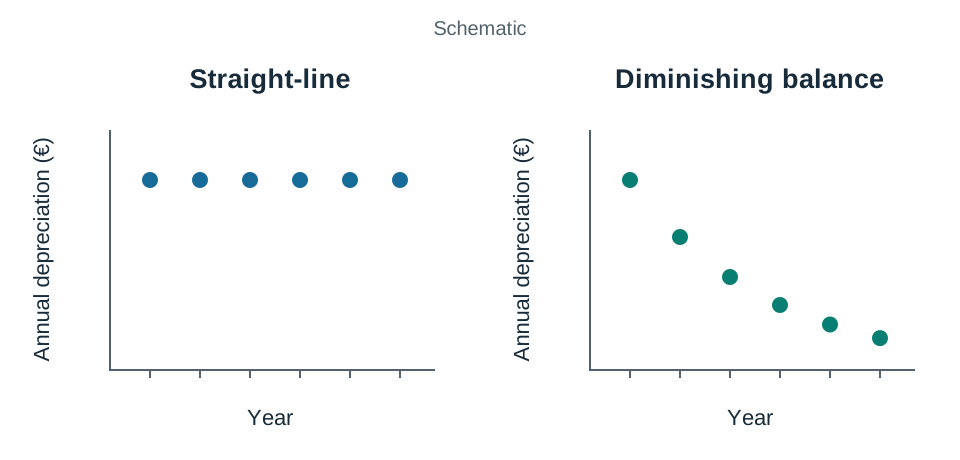
Depreciation Methods and Scrap Value Policies
- Straight-line method:
If a delivery van costing €40,000 has a scrap value of 5% of cost (€2,000) and a 5-year life, the annual charge is (€40,000 − €2,000) ÷ 5 = €7,600 per annum (19% of cost).
- Diminishing (reducing) balance method applies a uniform percentage to opening Net Book Value (Cost minus Accumulated Depreciation):
- Depreciation policy wording: Check the policy stated in the question carefully:
- "Depreciation is calculated from date of purchase to date of sale": Time-apportion the charge by months for both acquisitions and disposals.
- "A full year's depreciation is charged in the year of purchase and none in the year of sale": Charge zero on the asset sold this year, and charge a full twelve months on the new asset bought.
Asset Disposals and Trade-Ins
When an asset is sold or traded in during the year:
- Update depreciation on the sold asset up to its disposal date.
- Open an Asset Disposal Account: transfer the original cost of the asset to the debit side.
- Transfer the total accumulated depreciation on that asset up to the disposal date to the credit side.
- Credit the trade-in allowance or cash sale proceeds to the Disposal Account.
- The balancing figure is a Profit (credit exceeds debit, credited to operating income) or Loss on Disposal (debit exceeds credit, charged to Selling and Distribution Expenses).
- Capitalise the new asset at its full acquisition cost, not the net cheque paid.
Dr                     Disposal of Van Account                     Cr
----------------------------------------------------------------------
Delivery Van (Cost) €20,000 | Provision for Depreciation       €11,000
                            | Delivery Vans (Trade-in Value)    €8,000
                            | Profit & Loss (Loss on Disposal)  €1,000
                    ------- |                                  -------
                    €20,000 |                                  €20,000
Upward Revaluation of Land and Buildings
When premises are revalued:
- Charge normal depreciation on buildings for the year up to the date of revaluation.
- Eliminate the total accumulated depreciation on buildings to date (write it back to zero).
- Revalue the asset to its new figure on the Balance Sheet.
- The surplus over net book value creates the Revaluation Reserve:
Under the realisation principle, an unrealised revaluation surplus is never credited to the Profit and Loss Account; it is shown under Capital and Reserves in the Balance Sheet.
Balance Sheet Presentation, Order of Liquidity, and Net Worth
The Balance Sheet must balance: what the business owns, less what it owes to outside parties, equals the owner's stake. Two subtotals are used and they are not the same figure:
- Total Assets less Current Liabilities (Capital Employed) = Fixed Assets + Working Capital. This represents the total long-term funding employed in the business, financed by long-term debt plus Capital and Reserves.
- Net Assets (Net Worth) = Total Assets minus all outside liabilities (both current and long-term). This represents the owner's true stake in the business and equals Closing Capital plus the Revaluation Reserve.
Structure of the Balance Sheet
- Tangible Fixed Assets: Presented across three columns: Cost/Valuation, Accumulated Depreciation, and Net Book Value. Note that trial balances use the term Provision for depreciation; the Balance Sheet column heading is Accumulated depreciation—both refer to the same cumulative total.
- Intangible Fixed Assets: Assets such as patents, shown at the trial balance figure less this year's write-off.
- Current Assets: Listed strictly in ascending order of liquidity (least easily turned into cash first):
- Closing Stock
- Debtors (less Closing Provision for Bad Debts)
- Prepayments and Income Due
- VAT (only if a debit balance in the trial balance, representing a refund due from Revenue)
- Bank (if in funds)
- Cash in hand
- Creditors: Amounts Falling Due Within One Year: Short-term debts payable within twelve months: Trade Creditors, Expense Accruals, Bank Overdraft, Income Received in Advance, PAYE/PRSI/USC liabilities, and VAT (if a credit balance, representing tax owed to Revenue). Always check which side of the trial balance VAT is on before placing it.
- Working Capital (Net Current Assets): Current Assets minus Creditors falling due within one year.
- Creditors: Amounts Falling Due After More Than One Year: Long-term borrowing (e.g. 5% Fixed Mortgage), deducted from Total Assets less Current Liabilities to arrive at Net Assets.
- Financed By: Capital and Reserves:
Adding any Revaluation Reserve yields total Capital and Reserves, which exactly equals Net Assets.
Understanding the Three Core Outputs
- Gross Profit: Tells you how much profit is made on the trading of goods themselves before any operational overheads are considered.
- Net Profit: Tells you what surplus remains after paying all day-to-day administration, selling, and finance expenses.
- Net Worth: Tells you the true value of the owner's stake in the business on that date.
Key terms
- Gross Profit
- The profit earned directly from buying and selling goods, calculated as Net Sales minus Cost of Sales.
- Net Profit
- The final surplus remaining after adding secondary income to Gross Profit and deducting administration, selling, distribution, and financing costs.
- Net Worth
- The owner's true equity in the business, calculated as Total Assets minus Total Outside Liabilities (equivalent to Closing Capital plus Revaluation Reserve).
- Drawings
- Cash, goods, or business assets taken by the owner for personal use, or personal bills settled with business funds; deducted directly from Capital in the Balance Sheet.
- Accruals Concept
- The fundamental accounting concept requiring revenues and costs to be recognised in the accounting period in which they are earned or incurred, not when cash is received or paid.
- Prudence Concept
- The accounting rule that profits are never anticipated and only recognised when realised, while full provision is made for all known liabilities and expected losses.
- Accounting Bases
- The practical methods developed for applying fundamental accounting concepts to financial statements, such as selecting straight-line versus reducing-balance depreciation.
- Accounting Policies
- The specific bases, methods, and rules selected and consistently followed by a business entity to give a true and fair view in its financial statements.
- Provision for Bad Debts
- An estimated allowance set aside against outstanding trade debtors to provide for anticipated non-payment, deducted from Debtors under Current Assets in the Balance Sheet.
- Order of Liquidity
- The sequence in which Current Assets are listed on the Balance Sheet in ascending order of liquidity (least easily converted into cash first): Stock, Debtors less Provision, Prepayments and Income Due, VAT (debit), Bank, and Cash.
- Capital Expenditure
- Expenditure incurred to purchase, extend, or permanently improve fixed assets, capitalised on the Balance Sheet and depreciated over the asset's useful life.
- Revenue Expenditure
- Everyday operational spending incurred in running the business and maintaining assets, charged in full against income in the Profit and Loss Account.
- Revaluation Reserve
- An unrealised capital surplus arising when a fixed asset is revalued upwards above its Net Book Value, presented within Capital and Reserves in the Balance Sheet.
- Working Capital
- Current Assets minus Creditors falling due within one year, representing the operational liquidity available to fund day-to-day trade.
Check yourself
Goods originally costing €4,000 were sent to a customer on a sale-or-return basis at an invoice price of €5,600. At year-end, the customer has not yet decided to buy. What entries are required?
Deduct €5,600 from Sales in the Trading Account and deduct €5,600 from Debtors in the Balance Sheet. Then restore the cost of €4,000 into Closing Stock in both the Trading Account (reducing Cost of Sales) and Current Assets in the Balance Sheet.
A machine costing €60,000 is depreciated straight-line over 8 years with a scrap value of 10% of cost. It was purchased on 01/04/2026. The policy is to calculate depreciation from the date of purchase. Calculate the depreciation charge for the year ended 31/12/2026.
Scrap value = 10% of €60,000 = €6,000. Annual charge = (€60,000 − €6,000) ÷ 8 = €6,750 per year. For 9 months (April to December): €6,750 × 9/12 = €5,062.50.
A business spent €8,000 installing safety equipment into its factory premises and debited the amount to Factory Repairs. Buildings are depreciated at 2% per annum. What is the effect of this error on Net Profit and the Balance Sheet?
Net profit is understated by €7,840 (repairs was overstated by €8,000, offset by €160 omitted depreciation). In the Balance Sheet, Fixed Assets and Capital are understated by the net book value of €7,840 (€8,000 cost − €160 depreciation).
Explain the distinction between an accounting basis and an accounting policy under the Higher Level syllabus.
An accounting basis is a practical method developed to apply fundamental accounting concepts (such as choosing straight-line versus reducing-balance depreciation). An accounting policy is the specific set of bases and rules selected and consistently followed by a business entity to give a true and fair view in its financial statements.
A sole trader has Total Assets of €450,000, Current Liabilities of €35,000, and an 8% Term Loan of €80,000. Calculate Net Worth and Capital Employed.
Net Worth = Total Assets (€450,000) − Total Outside Liabilities (€35,000 + €80,000) = €335,000. Capital Employed = Total Assets less Current Liabilities = €450,000 − €35,000 = €415,000 (which also equals Net Worth €335,000 + Term Loan €80,000).