

Depreciation is the systematic allocation of the depreciable cost of a tangible fixed asset over its useful economic life. In Leaving Certificate Accounting, mastering this topic requires understanding the core accounting concepts that govern it—principally the accruals (matching), prudence, and consistency concepts—along with the practical bookkeeping mechanics of ledger accounts, part-year additions, trade-in disposals, upward revaluations of land and buildings, and balance sheet presentation across sole trader, company, and tabular statement formats.
Meaning, Causes, and Conceptual Basis of Depreciation
A fixed asset is an asset acquired for long-term use within a business to help generate revenue, rather than for resale to customers. Tangible fixed assets include premises, plant and machinery, motor vehicles, fixtures, and computer equipment. Except for freehold land, these assets decline in value and productive service over time.
Depreciation is the measure of the wearing out, consumption, or other reduction in the useful economic life of a fixed asset arising from wear and tear, obsolescence, or the passage of time.
- Wear and tear: Physical deterioration resulting from normal everyday operational use, such as an engine wearing out or machine parts eroding.
- Obsolescence: The process of an asset becoming out of date or economically inefficient due to technological advances or new production methods, even though it remains in working order.
- Passage of time: Assets with legal or contractual time limits, such as fixed-term leaseholds or patents, decline in value as their expiry date approaches.
Basic Principles of the Depreciation Rules
- Every tangible fixed asset with a finite useful economic life must be depreciated, even if its current market value is rising.
- The depreciable amount (cost or valuation less estimated residual value) must be allocated systematically over the asset's useful economic life.
- The useful economic life, residual value, and depreciation method should be reviewed regularly. If the estimated life is revised, the remaining net book value is written off over that revised remaining life.
- Freehold land is not depreciated because its useful economic life is regarded as indefinite.
Why Businesses Charge Depreciation
Depreciation is not an optional calculation, and it does not provide cash to replace the asset. It is an internal non-cash expense required by fundamental accounting concepts:
- The Accruals (Matching) Concept: The cost of generating revenue must be matched against the revenue earned in that same accounting period. Because a delivery van helps generate income across several years, its cost must be spread over those same years rather than written off entirely in Year 1.
- The Prudence Concept: Revenue and profits are not anticipated, while all known liabilities and losses are provided for. Omitting depreciation understates expenses, which overstates net profit in the Profit and Loss Account and overstates net assets in the Balance Sheet.
- True and Fair View: Financial statements must show a realistic assessment of financial performance and position. Omitting depreciation distorts net profit and the carrying value of fixed assets, preventing the accounts from presenting a true and fair view.
- The Consistency Concept: The method and rates selected for each category of fixed assets must be applied consistently from year to year to ensure financial statements are comparable over time.
The Cash Flow Link
Depreciation reduces net profit, but no physical money leaves the business. In the cash flow statement, depreciation is added back to operating profit when reconciling operating profit to net cash inflow from operating activities. For the same reason, a loss on disposal is added back, while a profit on disposal is deducted.
Methods of Calculating Depreciation
Two primary calculation methods are examined at Higher Level: the straight-line method and the reducing-balance method.
1. Straight-Line Method (Fixed Instalment)
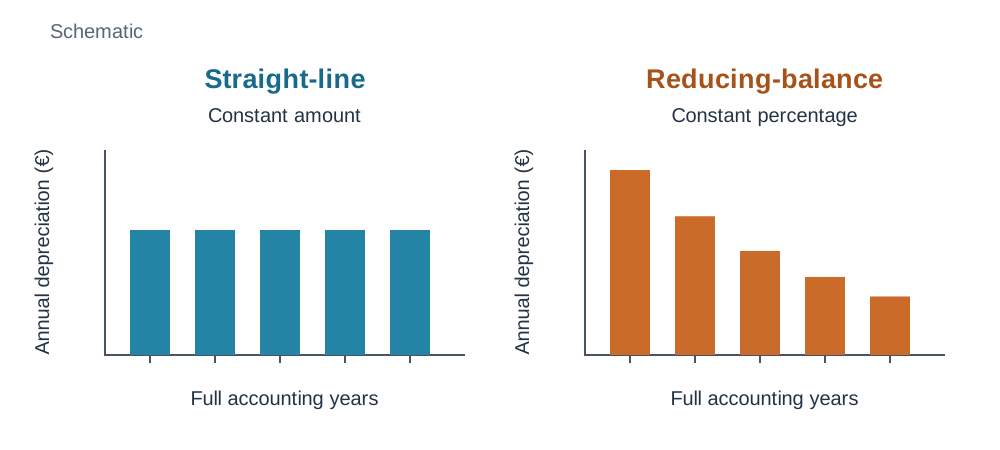
Under the straight-line method, an identical monetary amount of depreciation is written off in each full accounting year. It is suited to assets that deliver a steady, uniform flow of economic benefits over time, such as buildings or office fixtures.
Where the examination specifies a fixed annual percentage, the rate is applied directly to the original cost:
2. Reducing-Balance (Diminishing Value) Method
Under the reducing-balance (diminishing value) method, a fixed percentage is applied to the net book value of the asset at the start of each accounting period. The depreciation charge is highest in Year 1 and decreases steadily in each subsequent year.
This method is particularly suitable for assets that lose value rapidly in their early years and incur rising maintenance and repair costs as they age, such as motor vehicles, plant and machinery, and computer equipment. The falling annual depreciation charge balances out the rising annual repair expenses, producing a fairer and more even total operating charge over the life of the asset.
| Feature | Straight-Line Method | Reducing-Balance Method |
|---|---|---|
| Calculation base | Original cost (less residual value) | Net book value at start of period |
| Annual charge pattern | Constant in every full year | Highest in Year 1, decreases annually |
| Asset suitability | Buildings, fixtures, leaseholds | Motor vehicles, technology, machinery |
| Residual value | Subtracted from cost before dividing | Never fully written off; leaves a residual scrap balance |
Ledger Accounts, Statements, and Question Policies
Under double-entry bookkeeping, fixed assets remain recorded at original cost or revalued amount in their designated asset account. The annual depreciation charge is recorded separately in a Provision for Depreciation Account (also called Accumulated Depreciation), which always has a credit balance. In the Balance Sheet it is deducted from the asset's cost—it is never shown as a liability and it is not money set aside.
The Year-End Double Entry
- Debit: Profit and Loss Account (with the annual depreciation expense for the period)
- Credit: Provision for Depreciation Account (accumulating total depreciation to date)
Which Statement Does the Charge Go Into?
The calculation is identical, but the destination depends on the type of business:
- Sole trader or company: Charged as an expense in the Profit and Loss Account.
- Manufacturing account: Depreciation on factory buildings, plant, and machinery is charged as a factory overhead before Cost of Manufacture. Depreciation on office equipment and delivery vans remains an administrative or selling expense in the Profit and Loss Account. If a premises is split (e.g. 3/4 factory and 1/4 office), split the depreciation charge in that exact ratio.
- Club or service firm: Depreciation is listed under Expenditure in the Income and Expenditure Account.
Part-Year Apportionment Policies
Always inspect the exact wording of the question regarding depreciation timing:
- Monthly pro-rata basis: Depreciation is charged in proportion to the exact months the asset was owned during the financial year.
- Year-of-purchase convention: A full year's depreciation is charged in the year of purchase and none in the year of disposal.
Reading a Fixed Asset Account Backwards
Exam questions often provide an existing ledger account and ask you to deduce missing figures:
- Find the rate: Annual charge ÷ cost (straight line), or annual charge ÷ opening net book value (reducing balance).
- Find the number of years owned: Accumulated depreciation ÷ annual charge.
- Find the accumulated depreciation on an asset sold: It is the figure debited to the Provision account and credited to the Disposal account. If given the profit or loss instead: Net book value = proceeds − profit (or proceeds + loss), then accumulated depreciation = cost − net book value.
- Explain an entry: An entry reading "Disposal Account €18,000" on the debit side of the Provision account means the depreciation accumulated over prior years on the asset sold is being removed from the ledger because that asset is no longer owned.
Disposals, Trade-Ins, and Tabular Statements
When a fixed asset is sold, scrapped, or traded in, its cost and accumulated depreciation must be removed from the ledger. Think of the Disposal Account as a scoreboard: on one side you put what the asset was worth in the books; on the other, what you actually received for it. Whichever side is short is the profit or loss.
Reading the Question: 5-Point Checklist
Before writing entries, identify:
- What is the depreciation rate, and is it on cost or on net book value?
- Is the timing pro-rata by month, or a full year in purchase and none in sale?
- What are the exact dates of acquisition and disposal?
- Was there a trade-in allowance, and what was the net cash or cheque paid?
- Does the question require T-accounts, a Fixed Assets Note, or a tabular statement line?
Step-by-Step Ledger Procedure
- Update current-year depreciation: Calculate and credit any depreciation due on the disposed asset for its months of use in the current year to the Provision for Depreciation Account.
- Remove original cost: Debit Disposal Account and credit Fixed Asset Account with the asset's original purchase cost.
- Remove accumulated depreciation: Debit Provision for Depreciation Account and credit Disposal Account with all depreciation charged on this asset up to its disposal date.
- Record proceeds or trade-in allowance:
- Cash or cheque sale: Debit Bank and credit Disposal Account.
- Trade-in allowance against a replacement: Debit Fixed Asset Account and credit Disposal Account with the agreed trade-in value.
- Balance paid on a replacement: Debit Fixed Asset Account and credit Bank with the net cash paid.
- Balance the Disposal Account:
- Balancing figure is a profit on disposal: Debit Disposal Account and credit Profit and Loss Account (operating gain).
- Balancing figure is a loss on disposal: Credit Disposal Account and debit Profit and Loss Account (operating expense).
A profit on disposal simply means too much depreciation was charged over the asset's life; a loss means too little was charged. Either way, it is an adjustment to profit, not a cash movement.
Tabular Statement Entries
On a tabular statement, record the double entry across the columns:
- Depreciation for the year: Reduce the fixed asset column (or increase accumulated depreciation) by the charge, and reduce the Profit and Loss column by the same amount. Bank is unaffected.
- Disposal / trade-in: Reduce the asset column by original cost, reduce accumulated depreciation by total depreciation on that asset, and enter what was received—Bank for cash, Fixed Assets for a trade-in, or Creditors if given in settlement of a liability. Any difference is posted to Profit and Loss as profit or loss on disposal.
- Worked tabular line: A creditor owed €3,000 accepts a van (cost €12,000, accumulated depreciation €9,500) in full settlement. Vehicles at cost −€12,000; Accumulated depreciation −€9,500 (net assets increase by €9,500); Creditors −€3,000; Profit and Loss +€500 profit on disposal (€3,000 received less €2,500 net book value).
Appreciation and Upward Revaluations
Appreciation is an increase in the market value of a fixed asset above its book value, most commonly seen in freehold land and buildings. Under the prudence concept, appreciation is not normally recorded in the accounts—profits are not anticipated. It is recognised only when directors formally revalue the asset.
Even after a formal revaluation, the gain is unrealised because no sale has taken place. It is credited to a Revaluation Reserve in the Financed By section of the Balance Sheet and never to the Profit and Loss Account. The Revaluation Reserve is a capital reserve: it cannot be used to pay cash dividends, though it may be used to issue bonus shares.
Revaluing fixed assets brings them into the Balance Sheet at something close to their current market value, so the accounts give a truer and fairer view of the firm's financial position. The depreciation charge is then based on the current value rather than an out-of-date cost, so profit is not overstated. Furthermore, the more realistic asset figure gives more meaningful ratios (such as return on capital employed) and provides a better picture for lenders considering the property as security.
Double-Entry Accounting for Revaluation
- Eliminate accumulated depreciation: Debit Provision for Depreciation Account and credit Revaluation Reserve Account with the entire depreciation accumulated up to the revaluation date.
- Adjust asset to new valuation: Adjust the asset account so that its balance equals the new valuation figure — debit the asset if the valuation exceeds the existing balance and credit the Revaluation Reserve with the increase; credit the asset if the valuation is below the existing balance and debit the Revaluation Reserve with the reduction.
Timing Trap: When Was the Asset Revalued?
Check the valuation date carefully in the question:
- Revalued on the first day of the year (01/01): Calculate the current year's depreciation on the new valuation figure.
- Revalued on the last day of the year (31/12): Charge the current year's depreciation on the old cost or valuation first. Then write back the entire accumulated depreciation—including the charge just made—and raise the asset account to the new figure.
Depreciating Revalued Assets
Once an asset is revalued, future depreciation is based on the new valuation. When land and buildings are bundled together, isolate the non-depreciable freehold land: only the buildings element is depreciated.
Balance Sheet Presentation and the Fixed Assets Note
In a sole trader's Balance Sheet, fixed assets are presented in three columns on the face of the statement: Cost − Accumulated Depreciation = Net Book Value.
In company accounts, this detail is presented in a Fixed Assets Note to the accounts. The Balance Sheet itself carries only the closing Net Book Value total, cross-referenced to the note.
Layout of the Fixed Assets Note
| Land & Buildings € | Delivery Vans € | Total € | |
|---|---|---|---|
| Cost / Valuation | |||
| At 01/01/2024 | 500,000 | 70,000 | 570,000 |
| Additions | – | 50,000 | 50,000 |
| Disposals | – | (40,000) | (40,000) |
| Revaluation | 250,000 | – | 250,000 |
| At 31/12/2024 | 750,000 | 80,000 | 830,000 |
| Accumulated Depreciation | |||
| At 01/01/2024 | 40,000 | 19,000 | 59,000 |
| Charge for year | 12,000 | 15,500 | 27,500 |
| On disposals | – | (18,000) | (18,000) |
| Written back on revaluation | (40,000) | – | (40,000) |
| At 31/12/2024 | 12,000 | 16,500 | 28,500 |
| Net Book Value 31/12/2024 | 738,000 | 63,500 | 801,500 |
| Net Book Value 01/01/2024 | 460,000 | 51,000 | 511,000 |
Essential Exam Presentation Points
- Always show reductions (disposals and revaluation write-backs) in brackets.
- Cross-reference every charge for the year to a clearly labelled separate working.
- Closing cost minus closing accumulated depreciation must equal the closing net book value carried to the Balance Sheet.
- Net Book Value reconciliation check: Closing NBV = Opening NBV + Additions − Total depreciation charge for the year − Net book value of disposals at date of disposal + Revaluation surplus.
Key terms
- Depreciation
- The measure of the wearing out, consumption, or other reduction in the useful economic life of a fixed asset arising from wear and tear, obsolescence, or the passage of time.
- Useful Economic Life
- The expected period over which a fixed asset will provide economic benefits and productive service to the business before becoming obsolete or uneconomic to operate.
- Residual Value
- The estimated net disposal proceeds or scrap value of a fixed asset at the end of its useful economic life.
- Net Book Value (NBV)
- The carrying amount of an asset in the accounting records, calculated as original cost or revalued amount less accumulated depreciation.
- Straight-Line Method
- A depreciation method that writes off an identical monetary amount in each full accounting year based on original cost less estimated residual value.
- Reducing-Balance Method
- A depreciation method that applies a constant percentage to the diminishing net book value at the start of each accounting period.
- Provision for Depreciation Account
- A separate credit-balance ledger account that accumulates all annual depreciation charges against a specific class of fixed assets.
- Disposal Account
- A temporary clearing account opened upon the sale, trade-in, or scrapping of a fixed asset to compare net book value with proceeds and determine profit or loss.
- Trade-In Allowance
- The agreed credit value granted by a seller for an old asset handed over as part-payment towards a replacement asset.
- Revaluation Reserve
- A capital reserve appearing in the equity section of the balance sheet that records unrealised gains arising from the upward revaluation of fixed assets.
- Obsolescence
- The loss of economic usefulness of an asset caused by technological progress, market changes, or improved alternatives, rather than physical wear.
- Wear and Tear
- The physical deterioration of a tangible fixed asset caused by normal operational use over time.
Check yourself
Which accounting concept requires the cost of an asset to be allocated across the periods that benefit from its use?
The accruals (or matching) concept.
An asset bought for €60,000 has an estimated scrap value of €6,000 and an expected useful life of 6 years. What is its annual straight-line depreciation charge?
€9,000 per annum, calculated as (€60,000 − €6,000) ÷ 6 years.
A machine costing €30,000 is depreciated at 20% per annum using the reducing-balance method. What is the depreciation charge in Year 2?
€4,800. Year 1 depreciation is €30,000 × 20% = €6,000, leaving an opening NBV of €24,000 in Year 2. Year 2 depreciation is €24,000 × 20% = €4,800.
What are the two debit entries made in the Fixed Asset Account when an old vehicle is traded in against a new one?
A debit for the agreed trade-in allowance (contra-entry to the Disposal Account) and a debit for the net cash/cheque paid (contra-entry to the Bank Account).
An asset costing €25,000 with accumulated depreciation of €16,000 is sold for €7,500. Calculate the profit or loss on disposal and state how it is transferred.
The Net Book Value is €9,000 (€25,000 − €16,000). Selling for €7,500 produces a loss on disposal of €1,500 (€7,500 − €9,000). It is closed by crediting the Disposal Account and debiting the Profit and Loss Account.
Buildings cost €300,000, accumulated depreciation at 01/01/2024 was €30,000, and the depreciation rate is 2% of cost. On 31/12/2024, the buildings were revalued to €420,000. Calculate the 2024 depreciation charge and the total amount credited to the Revaluation Reserve.
Depreciation charge for 2024 is €6,000 (€300,000 × 2%). Accumulated depreciation prior to revaluation is €36,000 (€30,000 + €6,000), giving an NBV of €264,000. Amount credited to Revaluation Reserve is €156,000 (New valuation €420,000 − NBV €264,000; comprised of €120,000 cost increase and €36,000 depreciation written back).