
Measurement means finding the size of a physical quantity, such as length or mass, using the correct unit and the correct instrument. In the Junior Cycle exam, you are tested on choosing the right laboratory tools, avoiding common measuring errors, and calculating quantities such as volume, speed, and density.
Quantities, Units, and Instruments
Scientists use the International System of Units (SI) so data can be compared reliably across the world. Common prefixes include kilo- (1 km = 1000 m), centi- (1 m = 100 cm), and milli- (1 cm = 10 mm).
| Quantity | Unit and symbol | Measuring instrument |
|---|---|---|
| Length | metre (m) | metre stick or a callipers |
| Mass | kilogram (kg) / gram (g) | electronic balance |
| Time | second (s) | stopwatch |
| Temperature | degree Celsius (°C) | thermometer |
| Liquid volume | cubic centimetre (cm³) / millilitre (mL) | graduated cylinder |
| Force | newton (N) | newton metre (spring balance) |
| Current | ampere (A) | ammeter |
| Potential difference | volt (V) | voltmeter |
| Resistance | ohm (Ω) | ohmmeter |
Mass measures the amount of matter in an object, while weight is the downward pull of gravity measured in newtons.
Two key calculated quantities:
- Speed = distance ÷ time. A runner travelling 20 m in 4 s has a speed of 5 m/s.
- Resistance = potential difference ÷ current. A 6 V supply producing a current of 2 A gives a resistance of 6 ÷ 2 = 3 Ω.
Reading Instruments and Avoiding Errors
Always guard against experimental errors when taking readings in the laboratory:
- Zero error: Occurs when an instrument gives a reading other than zero when nothing is being measured. Always press the 'tare' button on an electronic balance before adding a sample.
- Parallax error: An apparent shift in a reading caused by looking at a scale from an angle. Always look directly perpendicular and at eye level to the mark.
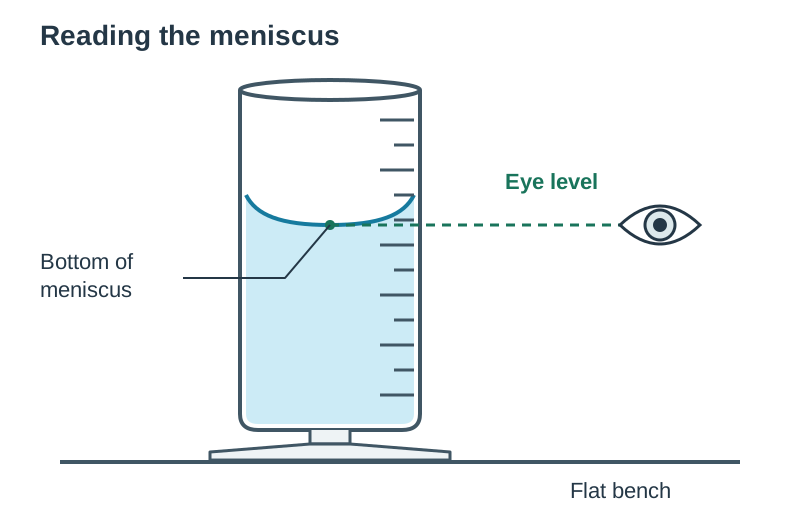
- Meniscus: Water curves upwards at the edges in glassware. Place your graduated cylinder on a flat bench and read the volume at eye level at the bottom of the curved surface.
- Timing errors: Human reaction time introduces errors during very short intervals. To measure the period of a pendulum accurately, time 10 full swings together and divide the total by 10.
Area, Volume, and Density
Area is the amount of surface enclosed within a boundary. For a rectangle, Area = length × width (in cm² or m²).
Volume is the space an object occupies:
- Regular solid: Volume = length × width × height (in cm³).
- Liquid: Measure using a graduated cylinder (1 mL = 1 cm³).
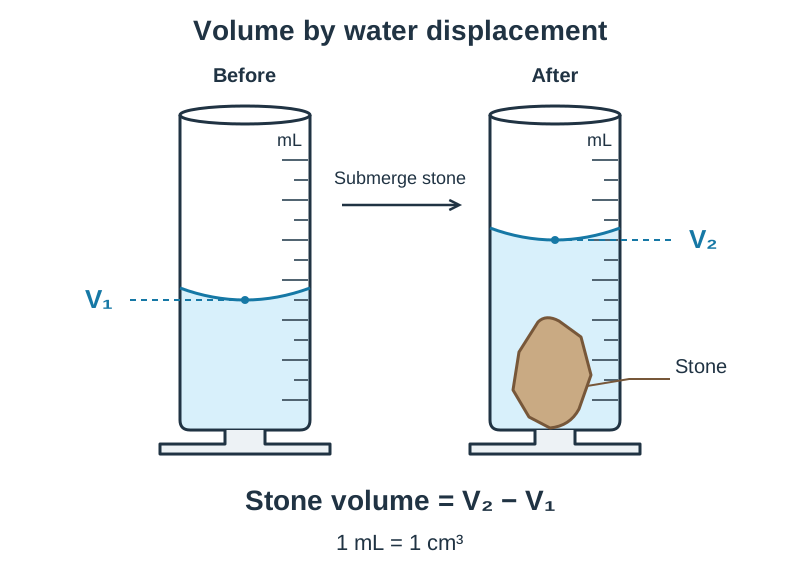
- Irregular solid: Use water displacement. Submerge the object in water; the volume of the object equals the rise in water level or the liquid collected from an overflow can.
Density is the mass of a substance per unit volume:
Density is commonly expressed in g/cm³ or kg/m³. An object floats in water if its density is less than 1 g/cm³.
Accuracy, Precision, and Reliability
These three terms describe experimental quality and are often tested together:
- Accuracy: How close a measured value is to the true or accepted value.
- Precision: How close repeated measurements of the same item are to each other.
- Reliability: How consistent the results are when an investigation is repeated.
A set of readings can be precise without being accurate. For example, a balance with an uncorrected zero error of +5 g gives readings of 55 g, 55 g, and 55 g for an actual 50 g mass. These readings are precise because they agree closely, but inaccurate because the true value is 50 g.
To ensure reliable data, repeat your trials, discard anomalous results, and calculate a mean.
Key terms
- Meniscus
- The curved upper surface of a liquid column, read at eye level at its bottom.
- Parallax error
- A measurement error caused by viewing an instrument scale from an angle instead of directly at eye level.
- Zero error
- A reading shown by an instrument when the true quantity being measured is zero.
- Density
- The mass of a substance per unit volume, calculated as mass divided by volume.
- Accuracy
- How close a measured result is to the true or accepted value.
- Precision
- How close repeated measurements of the same quantity are to one another.
- Reliability
- How consistent the results are when an investigation is repeated.
Check yourself
Which instrument measures potential difference, and in what unit?
A voltmeter, in volts (V).
Water in a graduated cylinder sits at 40 cm³. When a stone is submerged, the level rises to 58 cm³. What is the stone's volume?
18 cm³ (58 cm³ − 40 cm³).
How do you eliminate zero error on an electronic balance before adding a sample?
Press the tare or zero button so the display reads 0.0 g.
How can you reduce timing errors caused by human reaction time when timing a pendulum?
Time 10 full swings together and divide the total recorded time by 10.
Which instrument measures small diameters with high precision?
A callipers (or digital callipers).