

Density tells us how tightly packed the mass is inside a given volume of a material. In your Junior Cycle exam, you will measure mass and volume in the laboratory, calculate density using the formula, and explain why things float or sink.
The Density Formula and Units
Density is the mass of one cubic centimetre of a substance. A block of metal feels much heavier than a foam block of the same size because it packs far more mass into that space.
We calculate density using a simple relationship:
- Density = mass ÷ volume
- Mass = density × volume
- Volume = mass ÷ density
| Quantity | Laboratory Instrument | Common Unit |
|---|---|---|
| Mass () | Electronic balance (or scales) | grams (g) |
| Volume () | Ruler or graduated cylinder | cubic centimetres (cm³) or ml |
| Density () | Calculated from mass and volume | grams per cubic centimetre (g/cm³) |
Remember that 1 ml equals 1 cm³. Liquid water has a density of 1.0 g/cm³, which gives us a useful benchmark for comparison.
Measuring Density in the Lab
To find the density of any object, you always need two laboratory measurements: its mass and its volume.
- Regular solid: Measure its mass on an electronic balance. Use a ruler to find length, width, and height, then multiply them to get volume.
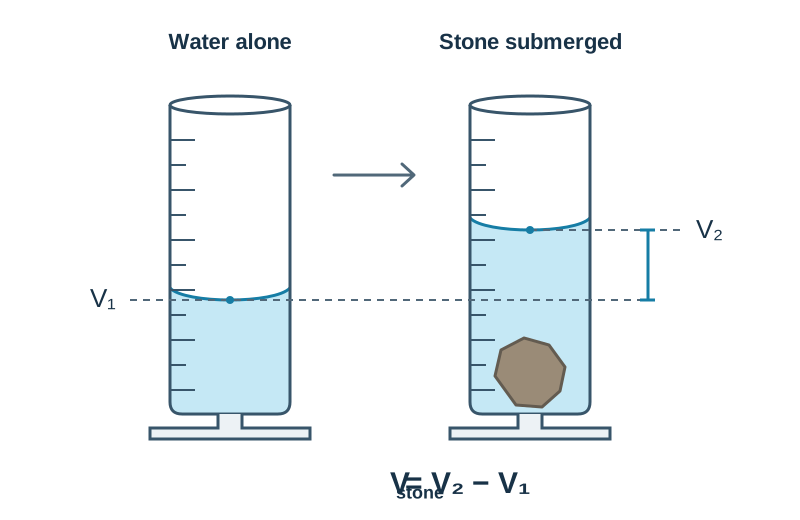
- Irregular solid: Weigh the dry object on a balance first. Drop it gently into a graduated cylinder with water and record the volume increase.
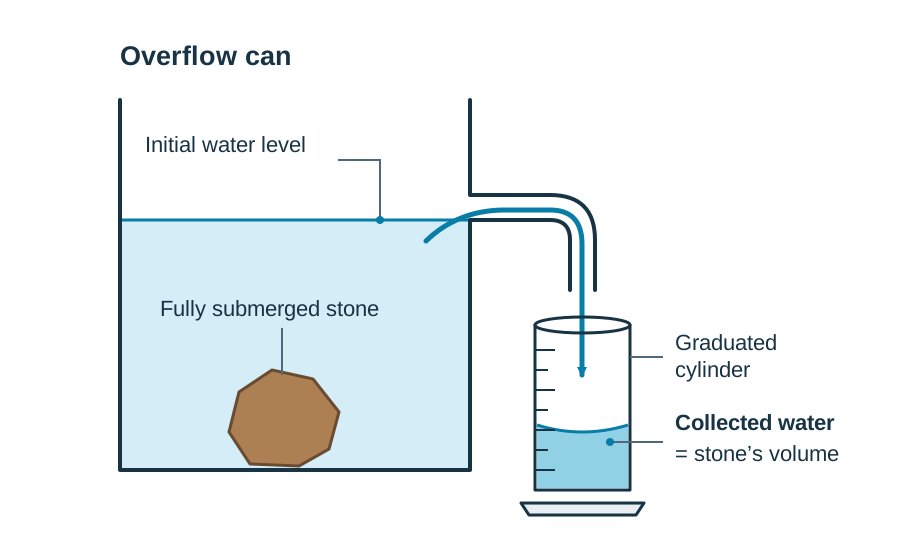
- Overflow can method: Fill an overflow can to the spout and submerge the solid. Catch the displaced water in a graduated cylinder to read its volume.
- Liquid: Weigh an empty graduated cylinder, add your liquid, and note the volume at the bottom of the meniscus. Reweigh the cylinder and subtract the empty mass to find the mass of the liquid.
Flotation and Everyday Applications
Whether something floats or sinks depends entirely on density rather than total weight. A tiny pebble sinks quickly, but an enormous cruise ship stays afloat.
- The flotation rule: An object floats if its density is lower than the liquid. It sinks if its density is higher.
- Ice: Water expands as it freezes, so ice has a density of 0.9 g/cm³. Because 0.9 g/cm³ is less than 1.0 g/cm³, ice cubes and icebergs float in water.
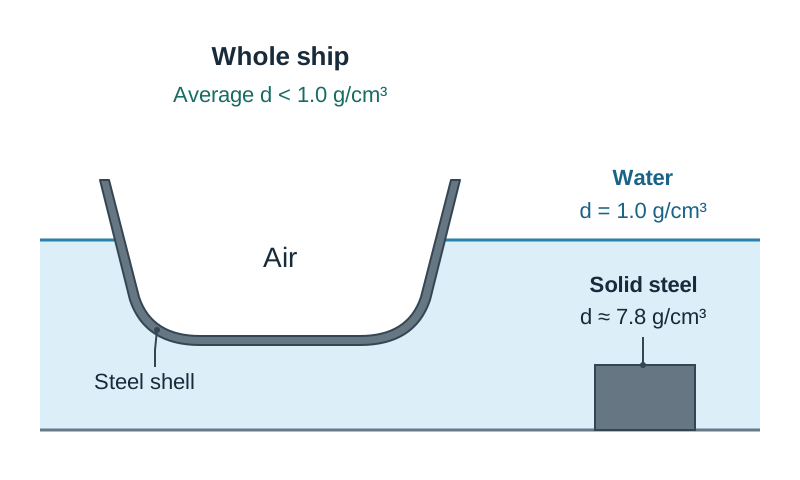
- Ships: Solid steel has a density of about 7.8 g/cm³ and sinks instantly. A ship floats because its hollow shape traps air, lowering the average density of the entire hull below 1.0 g/cm³.
Key terms
- Density
- The mass of a substance per unit volume, calculated as mass divided by volume.
- Mass
- The amount of matter inside an object, measured in grams (g) or kilograms (kg) on a balance.
- Volume
- The space an object takes up, measured in cubic centimetres (cm³) or millilitres (ml).
- Displacement
- Finding the volume of an irregular solid by measuring how much liquid it pushes aside.
- Meniscus
- The curved surface of a liquid, always read at eye level from the bottom of the curve.
- Average density
- The total mass of an object, including all enclosed air pockets, divided by its total volume.
Check yourself
What formula do we use to calculate density?
Density = mass ÷ volume.
An oil sample has a density of 0.8 g/cm³. What is the mass of 50 cm³ of this oil?
Mass = density × volume = 0.8 × 50 = 40 g.
A plastic bead has a density of 1.15 g/cm³. Will it float or sink in water?
It will sink because its density is greater than that of water (1.0 g/cm³).
If you saw an aluminium bar in half, what happens to its density?
It stays the same because both the mass and the volume are halved.