

A force is a push or a pull that can change an object's speed, direction, or shape. In the Junior Cycle examination, you will calculate weight and pressure, distinguish between mass and weight, analyse force diagrams, and interpret spring-extension graphs.
What is a Force and Force Diagrams
A force is a push or a pull acting on an object. Force is measured in newtons (N) using a newton meter.
- Forces can make an object speed up, slow down, stop, change direction, or change shape.
- Common forces include weight (gravity), thrust, friction, air resistance (drag), upthrust, and tension.
Labelling force diagrams
- Show each force as an arrow starting on the object, pointing in the direction the force acts.
- Draw a longer arrow for a bigger force and a shorter arrow for a smaller force.
- Write the name and numerical size beside each arrow, such as "weight = 30 million N (downwards)".
Balanced and Unbalanced Forces
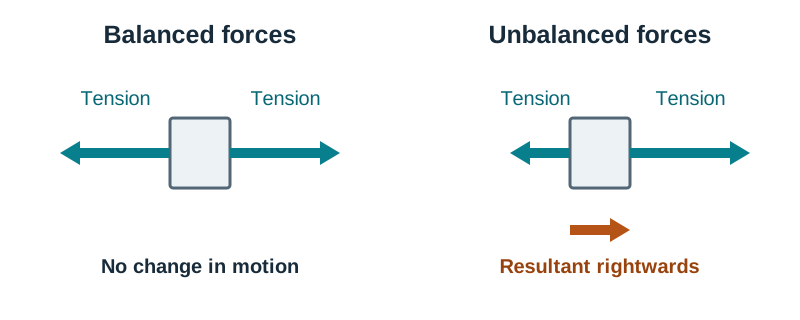
Usually more than one force acts on an object at once. What happens depends on whether those forces cancel out.
- Balanced forces are equal in size and opposite in direction. An object remains stationary or continues moving at a steady speed in a straight line.
- Unbalanced forces always change motion: the object speeds up, slows down, or changes direction.
- The relationship between force, mass, and acceleration is:
where is force in newtons (N), is mass in kilograms (kg), and is acceleration (how quickly speed changes, measured in ).
When examining moving objects, average speed is calculated as:
measured in metres per second (m/s).
Friction and Pressure
Friction
Friction is a contact force that opposes movement between two touching surfaces sliding past each other. Friction turns movement energy into heat, which is why rubbing your hands warms them.
- Useful friction: gives shoes grip on footpaths and allows vehicle brakes to stop wheels.
- Unwanted friction: causes machine parts and tyres to wear out, wasting energy.
- Reducing friction: use lubrication (such as oil), ball bearings to roll instead of slide, or streamlining to cut through air.
Pressure
Pressure describes how concentrated a force is over an area:
Pressure is measured in pascals (Pa), which is equal to .
- The same force spread over a larger surface area creates a smaller pressure.
- Wide snowshoes or boots spread a person's weight over a large area, reducing pressure so they do not sink into the snow.
Mass and Weight
Everyday language often treats mass and weight as identical, but in science they are different quantities.
| Property | Mass () | Weight () |
|---|---|---|
| Definition | The amount of matter in an object | The force of gravity pulling on an object |
| SI Unit | Kilogram (kg) | Newton (N) |
| Measuring tool | Balance | Newton meter (spring balance) |
| Effect of location | Stays the same everywhere | Changes depending on local gravity () |
We calculate weight using the equation:
where is weight in newtons (N), is mass in kilograms (kg), and is acceleration due to gravity in (approximately or on Earth).
Hooke's Law and Springs
Elastic materials stretch under an applied load and return to their original shape when released.
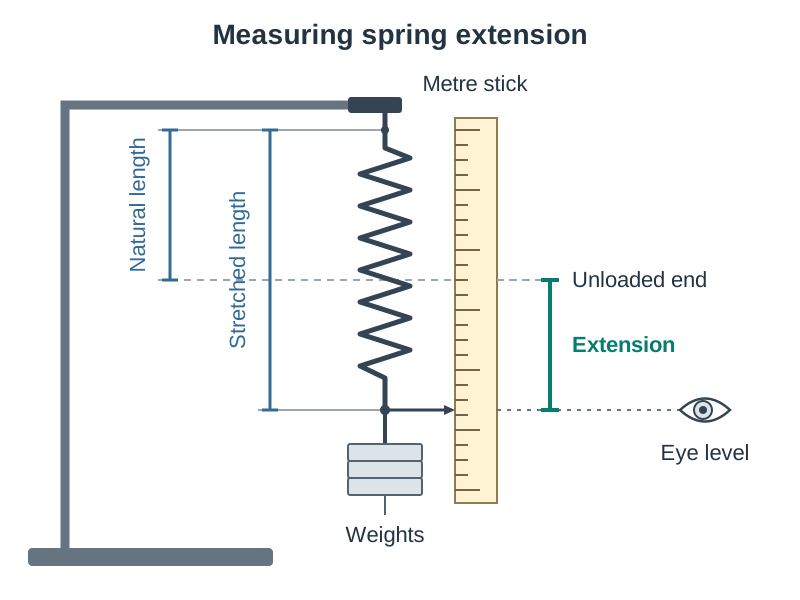
- Extension is the increase in length: .
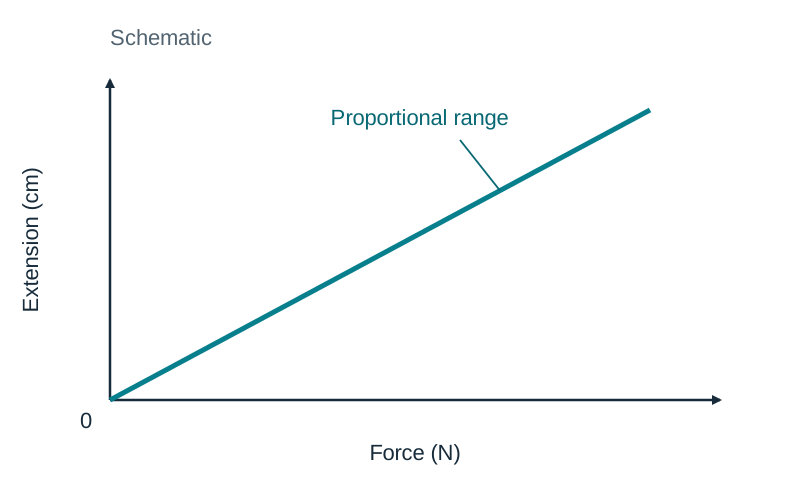
- Hooke's Law states that the extension of a spring is directly proportional to the applied force, provided the elastic limit is not exceeded.
- Directly proportional means doubling the applied stretching force doubles the extension.
- The elastic limit is the largest force a spring can take and still spring back to its original length. Past the elastic limit, it stays permanently stretched.
Describing the spring investigation
- Hang the spring from a stand and measure its natural length using a metre stick.
- Add weights one at a time and record the new length each time.
- Variable changed: force (N). Variable measured: extension (cm).
- Keep the investigation fair and reliable: use the same spring throughout, read the ruler at eye level to avoid parallax error, and repeat readings.
Key terms
- Force
- A push or a pull that can change an object's speed, direction of motion, or shape, measured in newtons (N).
- Balanced forces
- Forces that are equal in size and opposite in direction, resulting in no change in an object's motion.
- Unbalanced forces
- Forces on an object that do not cancel out, so the object speeds up, slows down, or changes direction.
- Friction
- A contact force that acts between two touching surfaces to oppose motion.
- Pressure
- The force applied per unit area, calculated as Force ÷ Area and measured in pascals (Pa) or N/m².
- Mass
- The amount of matter in an object, measured in kilograms (kg).
- Weight
- The force of gravity acting on an object, measured in newtons (N).
- Elastic limit
- The largest force a spring can take and still spring back to its original length; past this point, it stays permanently stretched.
Check yourself
What instrument is used in the laboratory to measure forces?
A newton meter (spring balance).
What happens to the motion of an object when all forces acting on it are balanced?
It stays stationary or continues moving at a constant speed in a straight line.
Why does wearing wide boots stop you from sinking into deep snow?
The large surface area spreads out your weight, reducing the pressure exerted on the snow.
A box of weight 600 N rests on a table over an area of 0.5 m². Calculate the pressure.
Pressure = Force ÷ Area = 600 ÷ 0.5 = 1200 Pa.
If a force of 3 N stretches a spring by 6 cm, what extension will a 9 N force produce within the elastic limit?
18 cm, because extension is directly proportional to applied force.