
Energy is what makes things happen: it is the ability to do work, and it is measured in joules (J). The Junior Cycle exam tests how energy changes between forms, the principle of conservation of energy, calculating efficiency using energy or power, and evaluating energy sustainability.
Forms of Energy, Chains, and Conservation
Energy exists in many different forms and is measured in joules (J).
| Form of Energy | Description and Example |
|---|---|
| Kinetic | Energy of moving objects, such as a moving car or blowing wind |
| Potential (stored) | Stored energy due to height (gravitational) or stretching (elastic), such as water behind a dam or a drawn bow |
| Chemical | Stored in chemical bonds, such as in food, fuels, and batteries |
| Thermal (heat) | Energy in a hot object, such as a radiator |
| Electrical | Carried by moving electric charges along a wire |
| Light and Sound | Light is energy you can see from lamps or the Sun; sound travels as vibrations |
The principle of conservation of energy states that energy cannot be created or destroyed, only changed from one form to another.
Energy changes are written as a chain with arrows, in order, naming every form:
- Water heated in a kettle to spin a turbine and light a bulb: electrical → heat → kinetic → electrical → light.
- Ball falling from a high shelf: gravitational potential → kinetic. The potential energy lost equals the kinetic energy gained.
Energy Dissipation and Sankey Diagrams
During any energy transfer, some energy always spreads out into the surroundings in a less useful form, usually as heat or sound. This is called energy dissipation.
When a car brakes, kinetic energy is dissipated as heat into the brake pads, tyres, and road. The energy has not been destroyed. It has spread out into the surroundings, where it is too spread out to be useful.
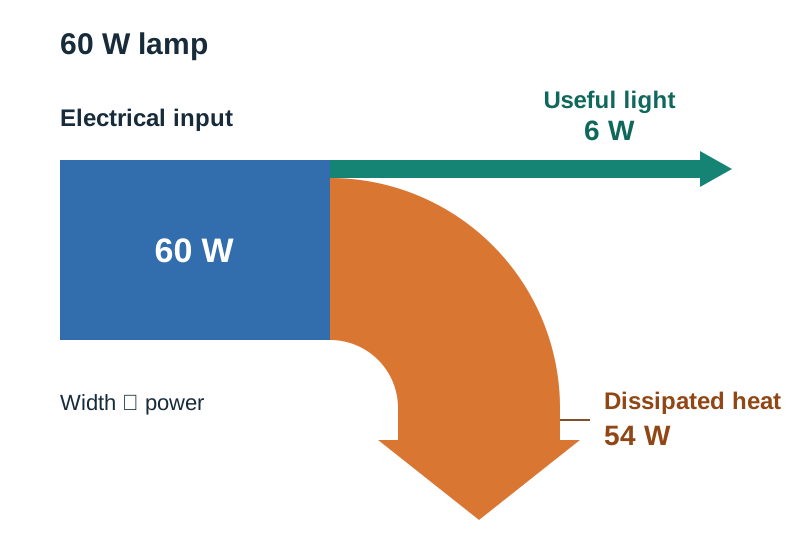
A Sankey diagram shows energy flows visually using arrows:
- The input arrow enters on the left; useful energy goes straight across and wasted energy curves away downwards.
- The input arrow width always equals the total combined width of all the output arrows.
Calculating Energy Efficiency and Power
Efficiency measures what percentage of the total energy or power supplied to a device is converted into useful output:
Efficiency (%) = (useful energy output ÷ total energy input) × 100
Total energy input = useful energy output + wasted energy
- Power is the rate of energy change per second: power = energy ÷ time.
- The unit of power is the watt (W), where 1 W = 1 joule per second.
- Efficiency works identically with power: efficiency (%) = (useful power out ÷ total power in) × 100.
- Worked line: a 60 W lamp emits 6 W of light: efficiency = (6 ÷ 60) × 100 = 10%.
No real device is 100% efficient because some energy is always dissipated as heat or sound. An efficiency above 100% means you have made a calculation error.
Improving Device Efficiency and Sustainability
In Junior Cycle Science, you design, build, and test an energy-transforming device, such as a rubber-band car or solar water heater. To improve its efficiency, you reduce unwanted heat, sound, or friction.
| Unwanted Loss | How to Reduce It |
|---|---|
| Friction between moving parts | Add oil or grease to axles and bearings |
| Air resistance | Streamline the body shape |
| Heat escaping to the surroundings | Add thermal insulation or a lid (stops conduction, convection, radiation) |
When testing an improvement, change only one variable at a time.
Electricity Generation and Sustainability
- Non-renewable sources will run out: coal, oil, natural gas (fossil fuels) and nuclear fuel.
- Renewable sources will not run out: wind, solar, hydro, tidal, geothermal, and biomass.
- Burning fossil fuels releases carbon dioxide, which causes climate change; using less electricity and switching to renewables reduces this damage.
Key terms
- Energy
- The ability to do work, measured in joules (J).
- Principle of Conservation of Energy
- States that energy cannot be created or destroyed, only changed from one form to another.
- Energy dissipation
- The spreading out of energy into the surroundings in a less useful form, usually as heat or sound.
- Power
- The rate at which energy is converted, measured in watts (W), where 1 W = 1 J/s.
- Efficiency
- The percentage of total energy (or power) input converted into useful output.
- Sankey diagram
- A scale diagram showing energy transfers, where the width of each arrow represents the quantity of energy.
- Renewable energy
- An energy source that can be replenished naturally and will not run out, such as wind or solar.
Check yourself
State the Principle of Conservation of Energy.
Energy cannot be created or destroyed, only changed from one form to another.
A 1500 W hairdryer produces 1200 W of useful heat and kinetic energy. What is its efficiency?
Efficiency = (1200 ÷ 1500) × 100 = 80%.
In a Sankey diagram, what does the width of an arrow represent?
The amount (quantity) of energy flowing.
Name two non-renewable fossil fuels.
Any two from: coal, oil, natural gas (or peat).