
Reproduction ensures species survival, while genetics explains how traits pass between generations. The Junior Cycle exam tests reproductive anatomy, the menstrual cycle, stages of pregnancy, genetic crosses using Punnett squares, pedigree charts, and socio-scientific issues including contraception and IVF.
Asexual and Sexual Reproduction
Reproduction produces new individuals to keep a species from going extinct. Organisms reproduce in two main ways:
| Feature | Asexual Reproduction | Sexual Reproduction |
|---|---|---|
| Parents | One parent | Two parents |
| Gametes | None involved | Sperm and egg fuse |
| Offspring | Clones (genetically identical) | Unique (genetic variation) |
| Examples | Bacteria, amoeba dividing | Humans, flowering plants |
A gamete carries half the normal number of chromosomes (23 in humans). During fertilisation, male and female gamete nuclei fuse to form a single-celled zygote (46 chromosomes).
In flowering plants:
- Pollen carries male gametes from the anther to the stigma; this is pollination.
- Fertilisation occurs when a pollen nucleus fuses with an egg nucleus in the ovule, forming a seed.
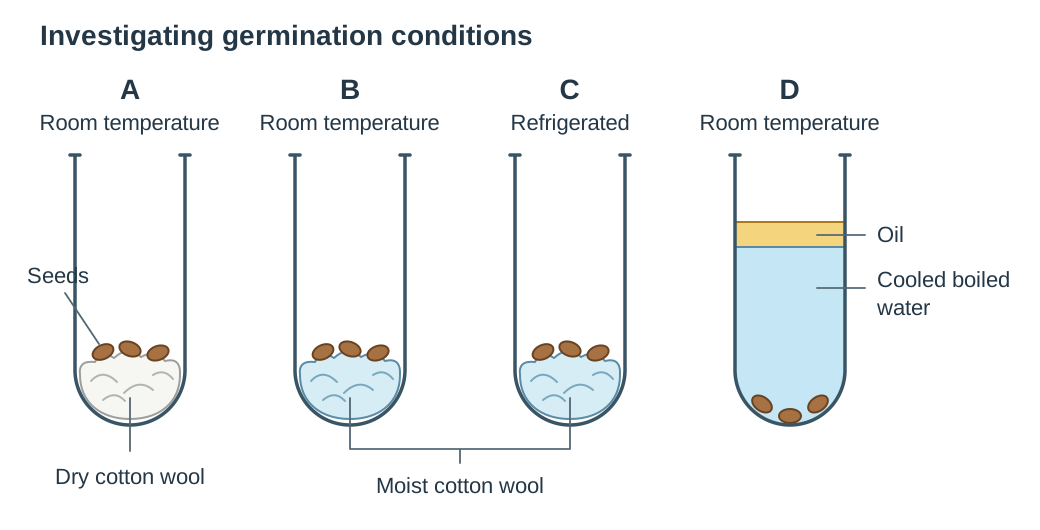
- Seeds need water, oxygen, and a suitable warm temperature to germinate.
- In a germination test, boiling and cooling water removes dissolved oxygen to show oxygen is essential.
Human Reproduction and Development
Reproductive organs
In males, the testes produce sperm and testosterone. Sperm leave the testes through the sperm duct, where fluid is added to form semen. In females, ovaries produce eggs and oestrogen.
The menstrual cycle
The menstrual cycle lasts about 28 days:
- Days 1 to 5: Menstruation — the lining of the uterus breaks down and is lost through the vagina.
- Days 6 to 13: The uterus lining rebuilds and an egg matures.
- Day 14: Ovulation — an ovary releases a mature egg into the fallopian tube.
- Fertilisation is most likely in the days just before and just after ovulation, because sperm can survive a few days in the female system while the egg survives about one day.
Fertilisation to birth
Fertilisation occurs in the fallopian tube. The dividing ball of cells implants into the uterus lining; this is implantation. The placenta transfers food and oxygen to the foetus and removes wastes without maternal and foetal blood mixing directly. Amniotic fluid cushions the foetus.
DNA, Chromosomes, and Variation
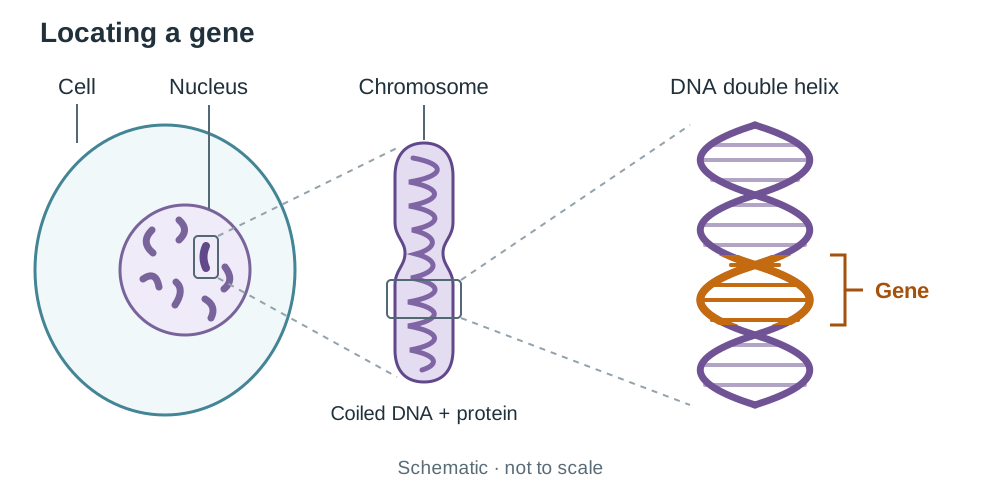
DNA inside the cell nucleus carries the genetic instructions for life in a double helix shape.
- Chromosomes are thread-like coils of DNA and protein, arranged in 23 pairs (46 total) in human body cells.
- A gene is a short section of DNA on a chromosome that codes for a specific protein.
- Variation describes the differences between individuals of the same species.
- Inherited variation is passed down in DNA from parents, while acquired variation develops during life through experience or environment. For example, two sisters have different natural hair colour (inherited), but one has a scar from a fall (acquired).
- A mutation is a permanent change in the DNA sequence.
Inheritance Patterns and Pedigree Charts
Every individual inherits two alleles for each gene, one from each parent. An allele is an alternative version of a gene.
- A dominant allele masks a recessive allele and is written with a capital letter (such as B).
- A recessive allele is only expressed when two copies are present (such as bb).
- Genotype is the genetic make-up of an organism (such as BB, Bb, or bb).
- Phenotype is the physical appearance resulting from the genotype (such as brown eyes).
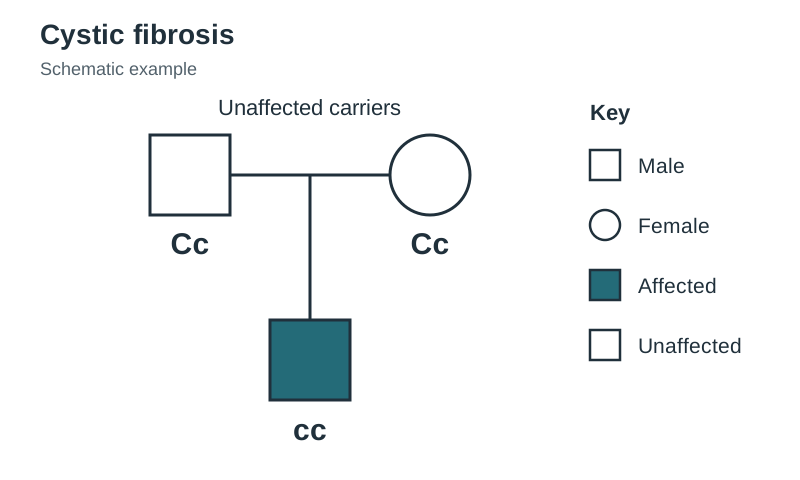
- A carrier has one recessive disease allele and one dominant healthy allele, for example Cc for cystic fibrosis, and shows no symptoms.
- Pedigree charts track inherited conditions across generations using squares for males and circles for females.
Health, Contraception, and Societal Issues
Human health depends on both inherited and environmental factors:
- Inherited factors include single-gene disorders such as cystic fibrosis.
- Environmental factors include diet, exercise, lifestyle choices, and micro-organisms.
- Micro-organisms can cause disease (for example bacteria causing food poisoning) but some are useful, such as gut bacteria that help digestion and bacteria used to make yoghurt.
Contraception methods prevent pregnancy:
- Condoms physically block sperm from reaching the egg and protect against sexually transmitted infections (STIs).
- Hormonal pills prevent ovulation but offer no protection against STIs.
In IVF, eggs are collected and fertilised with sperm in a laboratory dish, and an embryo is then placed in the uterus. Genetic screening means testing a person's DNA for alleles that cause a genetic disorder. Both technologies raise ethical questions regarding embryo storage and the cost of medical care.
Key terms
- Gamete
- A sex cell (sperm or egg) carrying half the normal number of chromosomes (23 in humans).
- Fertilisation
- The fusion of a male gamete nucleus with a female gamete nucleus to form a single-celled zygote.
- Implantation
- The process where the developing embryo attaches itself into the lining of the uterus.
- Gene
- A section of DNA on a chromosome that codes for making a specific protein.
- Allele
- An alternative version of a gene.
- Genotype
- The genetic make-up of an organism, represented by letters such as Bb.
- Phenotype
- The observable physical characteristic of an organism resulting from its genotype.
- Carrier
- A person who has one recessive allele for a disorder and shows no symptoms.
Check yourself
In which part of the female reproductive system does fertilisation take place?
The fallopian tube.
How many chromosomes are found in a normal human gamete?
23 chromosomes.
What three conditions do seeds need in order to germinate?
Water, oxygen, and a suitable warm temperature.
How does the hormonal contraceptive pill prevent pregnancy?
It prevents ovulation so that no egg is released from the ovary.
If two heterozygous parents (Bb) have a child, what is the percentage chance of having a child with the recessive phenotype (bb)?
25% (or 1 in 4).