
Electricity is the flow of charge around a closed circuit to transfer energy and power devices. In the Junior Cycle exam, you will calculate quantities using Ohm's law and the power equation, draw circuits with standard symbols, interpret graphs, and explain how electronic sensors work.
Current, Potential Difference, and Resistance
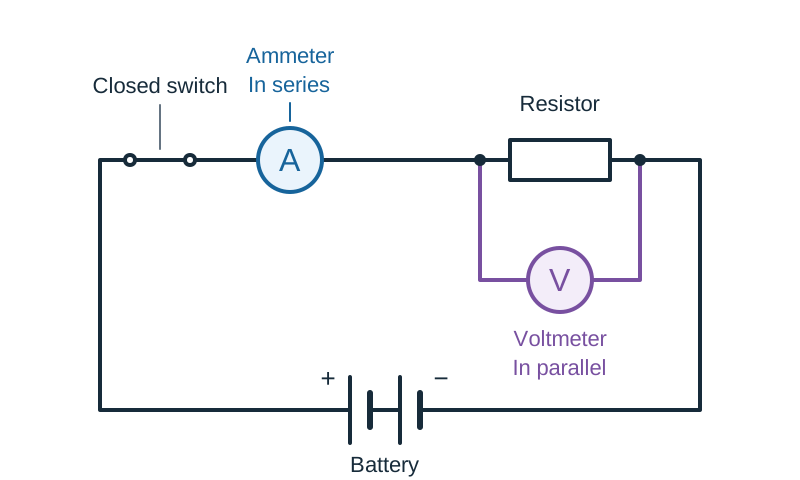
Current is the flow of charge, voltage is what pushes it, and resistance is what slows it down. An electric current only flows when there is an energy source and an unbroken loop.
| Quantity | Symbol | SI Unit | Measuring Instrument | Circuit Connection |
|---|---|---|---|---|
| Current | Ampere (A) | Ammeter | In series (along the loop) | |
| Potential difference | Volt (V) | Voltmeter | In parallel (across the component) | |
| Resistance | Ohm () | Calculated from meter readings | Measure and , then use |
- Copper is a conductor, so it is used for the wire; plastic is an insulator, so it is used for the covering to prevent electric shocks.
Ohm's Law and Circuit Investigations
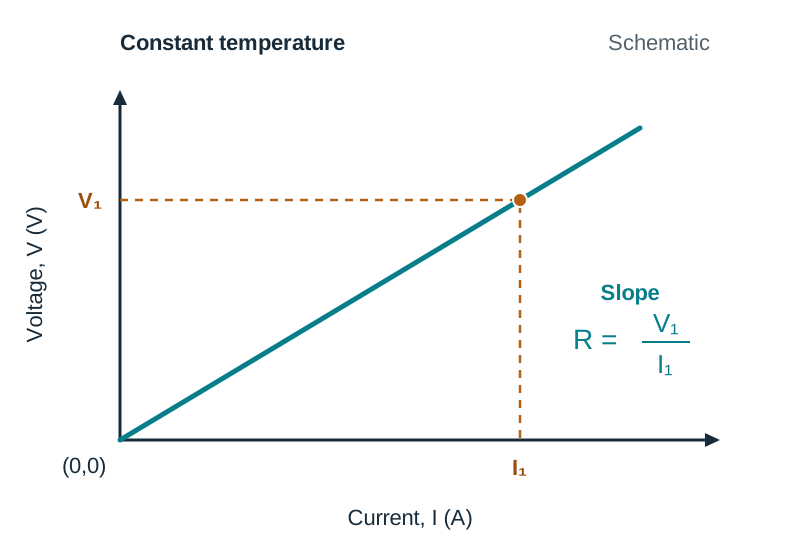
Ohm's law states that for a metallic conductor at constant temperature, the potential difference across it is directly proportional to the current flowing through it:
- A graph of voltage against current produces a straight line through the origin .
- The slope of this voltage–current graph gives the resistance: choose any point on the line and divide its voltage by its current ().
- If an exam question gives a resistance–temperature graph, calculate first, then read across from that resistance to the line and down to find the temperature.
- In the lab, switch off between readings so the wire does not heat up, because a hot wire has a different resistance and the results would be unfair.
Electrical Power, Efficiency, and Energy Changes
Electrical power () is the rate at which an appliance transforms electrical energy into other forms, measured in watts (W):
Energy cannot be created or destroyed; it only changes from one form to another. In any electrical appliance, the useful output is the energy you want, and the wasted output is dissipated to the surroundings, usually as heat and sound.
- In a dishwasher, heat and kinetic energy are useful, while sound is wasted.
- Generating electricity by burning fossil fuels releases carbon dioxide, driving climate change.
- Using energy-efficient devices like LEDs and generating electricity from renewable sources such as wind and solar reduces environmental impact.
Drawing Circuits: Series and Parallel
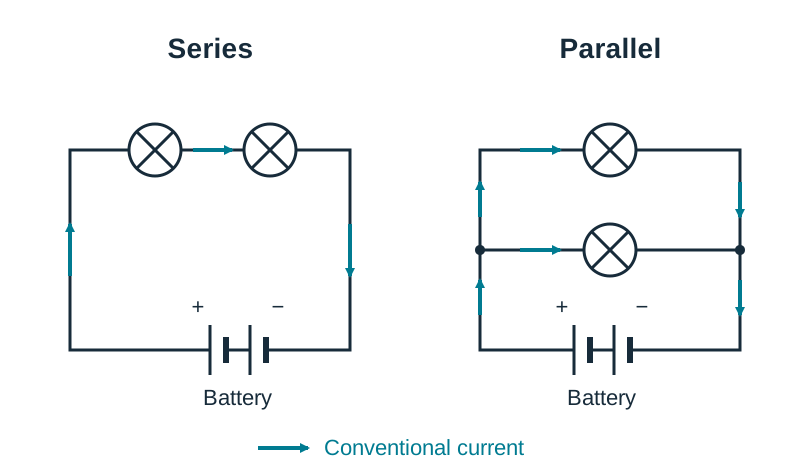
Always draw circuit diagrams with straight lines, sharp corners, and no gaps:
- Common symbols include: cell (long thin line for , short thick line for ), battery (two or more cells), bulb (circle with an X), switch, resistor (rectangle), ammeter (A in a circle), and voltmeter (V in a circle).
- Put the ammeter in the main loop, connect the voltmeter across the component, and label every part.
| Feature | Series Circuit | Parallel Circuit |
|---|---|---|
| Current | Same at every point in the loop | Splits across separate branches |
| Voltage | Shared between components | Full supply voltage across each branch |
| Component failure | If one bulb blows, all bulbs go out | If one bulb blows, others stay lit |
Electronic Control Components
Electronic circuits use specialised components to control current or sense the environment:
| Component | Operating Behaviour | Everyday Application |
|---|---|---|
| Diode | Allows current in forward bias only; blocks reverse current | Protecting circuits from reverse current |
| LED | Emits light in forward bias; needs a series resistor to prevent burnout | Low-energy indicators and displays |
| Variable resistor | Resistance changes manually when adjusting a slider | Dimmer switches and volume dials |
| LDR | Resistance decreases as light intensity increases | Automatic street lights |
| Thermistor | Resistance decreases as temperature increases | Digital thermostats and fire alarms |
Key terms
- Electric Current
- The flow of electrons through a conductor, measured in amperes (A) using an ammeter.
- Potential Difference
- The energy the source gives to charge to push it around a circuit, measured in volts (V) using a voltmeter.
- Resistance
- The opposition of a material to the flow of electric current, measured in ohms ().
- Ohm's Law
- The rule stating that voltage is directly proportional to current for a metallic conductor at constant temperature ().
- Diode
- A component that allows electric current to flow through it in one direction only.
- Light-Dependent Resistor (LDR)
- An input sensor whose resistance decreases as light brightness increases.
- Thermistor
- A temperature sensor whose resistance decreases as temperature increases.
- Electrical Power
- The rate at which an appliance converts electrical energy into other forms, measured in watts (W).
Check yourself
An electric fan takes in 100 J of electrical energy and gives out 60 J of kinetic energy. Name the wasted energy form and calculate the efficiency.
Heat (and sound); efficiency = (60 / 100) × 100% = 60%.
What happens to the current in a circuit if the resistance doubles while the voltage stays constant?
The current is halved ().
Why are domestic lights wired in parallel rather than in series?
So that each light receives full mains voltage and can operate independently if another bulb blows.
Why must an LED always have a resistor connected in series with it?
To limit the current and protect the LED from burning out.