

This topic explores celestial bodies, the Earth–Sun–Moon system, planetary data, the Big Bang theory, and space exploration. In the exam, you need to interpret planetary tables, explain day and night, seasons, and eclipses, describe evidence for the expanding universe, and explain rocketry principles.
Celestial Bodies and the Universe
Gravity is the attractive force that keeps celestial bodies in stable orbits throughout the universe.
- A star is a massive ball of gas producing light and heat through nuclear fusion in its core.
- A planet orbits a star, is rounded by its own gravity, and has cleared its orbital path.
- A dwarf planet has not cleared its orbital path of other debris (for example, Pluto).
- A moon is a natural satellite that orbits a planet.
- Asteroids are small rocky bodies; most orbit the Sun in the asteroid belt between Mars and Jupiter.
- Comets are balls of ice and dust with long, stretched orbits. Near the Sun the ice turns to gas, forming a tail that is pushed away from the Sun.
- Halley's Comet is a periodic comet with an orbital period of approximately 76 years.
- A galaxy is a huge group of stars, gas, and dust held together by gravity; our Sun is one star in the Milky Way galaxy.
- In order of increasing size: moon → planet → solar system → galaxy → universe.
The Earth–Sun–Moon System
The relative positions and motions of the Earth, Sun, and Moon cause predictable events observed from Earth.
- Day and night occur because the Earth spins on its axis once every 24 hours; the side facing the Sun experiences daylight.
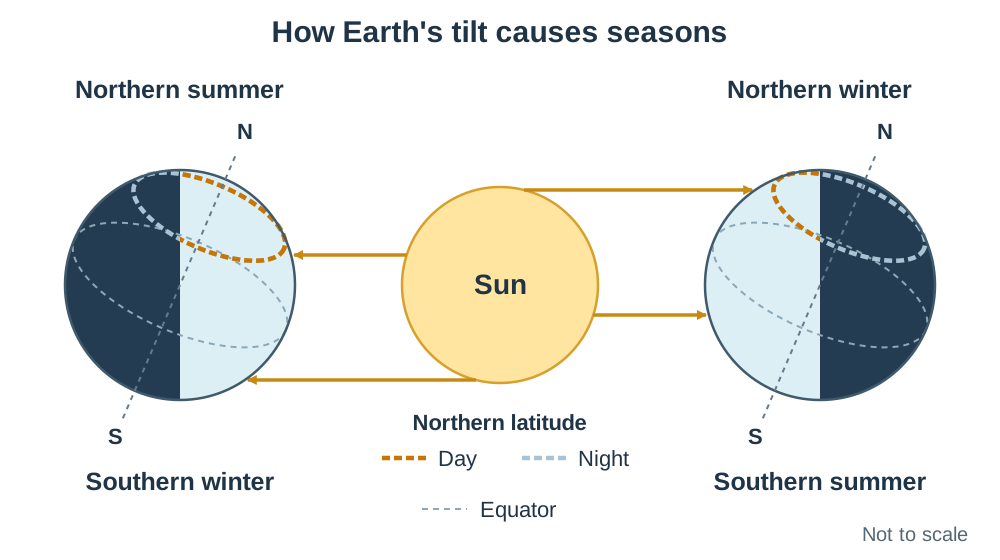
- Seasons occur because the Earth's axis is tilted, so each hemisphere receives more direct sunlight and longer daylight hours during its summer.
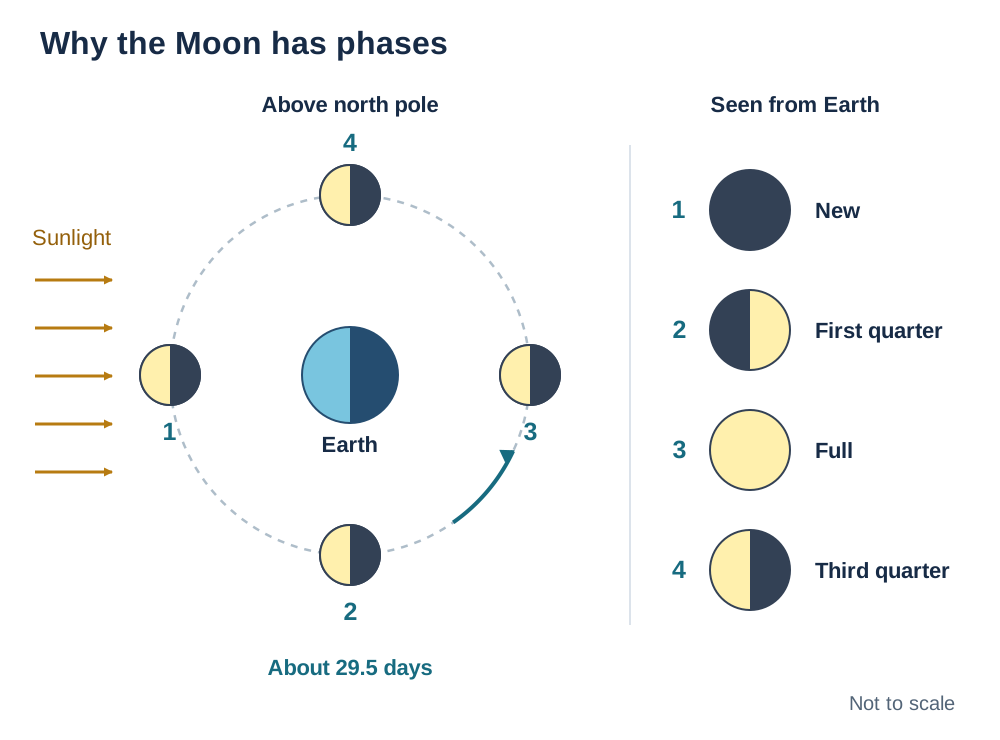
- Lunar phases change over roughly 29.5 days as the Moon orbits Earth, showing varying portions of its sunlit half to us.
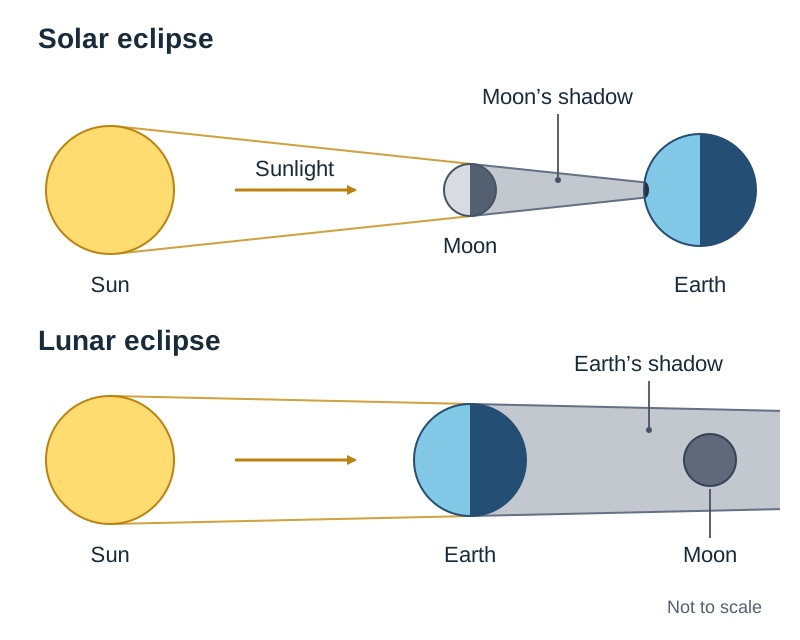
- A solar eclipse occurs when the Moon passes directly between the Sun and Earth, blocking sunlight from reaching Earth.
- A lunar eclipse occurs when Earth passes between the Sun and the Moon, causing Earth's shadow to fall on the Moon.
Planetary Models and Planetology
- Ptolemy proposed the geocentric model, which incorrectly placed Earth at the centre with all bodies orbiting it.
- Copernicus proposed the heliocentric model, placing the Sun at the centre of planetary orbits.
- Using a telescope, Galileo saw moons orbiting Jupiter, which showed that not everything orbits the Earth.
- The eight planets in order from the Sun are Mercury, Venus, Earth, Mars, Jupiter, Saturn, Uranus, and Neptune.
- The four inner planets are rocky terrestrial worlds; the four outer planets are gas and ice giants.
- As distance from the Sun increases, orbital period increases and surface temperature generally decreases.
- Mass (measured in kg) is constant everywhere, but weight (the force of gravity in N) changes depending on local surface gravity.
Origin of the Universe: The Big Bang Theory
- The Big Bang theory states that the universe expanded rapidly from an extremely hot, dense point roughly 13.8 billion years ago (about 14 billion years).
- As space expanded and cooled, simple hydrogen and helium atoms formed.
- Gravity pulled these gas clouds together over billions of years into stars and galaxies.
- Light from distant galaxies shows red shift: the light is stretched to longer, redder wavelengths. This shows the galaxies are moving away from us, so the universe is expanding.
- Cosmic Microwave Background (CMB) radiation is the faint leftover thermal glow detected evenly across all directions in space.
- Together, galactic red shift and CMB radiation provide the primary observational evidence supporting the Big Bang.
Space Exploration and Rocketry
- Space is an airless vacuum, so rockets must carry liquid oxygen in a tank to burn their fuel.
- Propellants like hydrogen and oxygen are liquefied at low temperatures to greatly reduce storage volume.
- Rocket engines produce an upward force called thrust; to lift off, this thrust must exceed the total weight of the rocket and fuel.
- Hazards of spaceflight include cosmic radiation, micrometeorite or space debris collisions, and bone and muscle loss from microgravity.
- Benefits to society include satellite telecommunications, GPS navigation, weather forecasting, and technological spin-offs.
- Future exploration includes crewed missions to Mars, asteroid mining, and searching for life, though space debris and high economic costs remain key challenges.
Key terms
- Celestial body
- Any naturally occurring object located in space outside Earth's atmosphere.
- Heliocentric model
- The astronomical model placing the Sun at the centre of the solar system.
- Geocentric model
- The historical model placing Earth stationary at the centre of the universe.
- Big Bang theory
- The scientific model stating that the universe expanded from an extremely hot, dense point roughly 13.8 billion years ago.
- Cosmic Microwave Background (CMB)
- Faint leftover thermal radiation from the early universe that is detectable in all directions of space.
- Red shift
- The stretching of light from distant galaxies to longer, redder wavelengths, showing they are moving away from us.
- Galaxy
- A massive system of billions of stars, gas, and dust held together by gravity.
- Light-year
- A unit of astronomical distance equal to the distance light travels in one Earth year.
Check yourself
What observation by Galileo supported the heliocentric model?
He observed moons orbiting Jupiter, showing that not all celestial objects orbit the Earth.
Why does Ireland experience summer in June?
The Earth's axis is tilted towards the Sun, giving the northern hemisphere more direct sunlight and longer days.
Halley's Comet was last observed in 1986. Given its 76-year orbital period, when will it next be seen?
In 2062 (1986 + 76 = 2062).
Why must a space shuttle carry a separate tank of liquid oxygen into orbit?
Space is an airless vacuum, so an on-board oxidiser is required to burn the fuel.
Name two pieces of observational evidence supporting the Big Bang theory.
The red shift of light from distant galaxies and Cosmic Microwave Background (CMB) radiation.