
Space travel involves launching spacecraft beyond Earth's atmosphere for research, satellite technology, and exploration. The Junior Cycle exam tests your understanding of launch forces and fuel storage, the hazards and everyday benefits of space missions, and societal debates on future exploration.
Rocket Launch Forces and Propellants
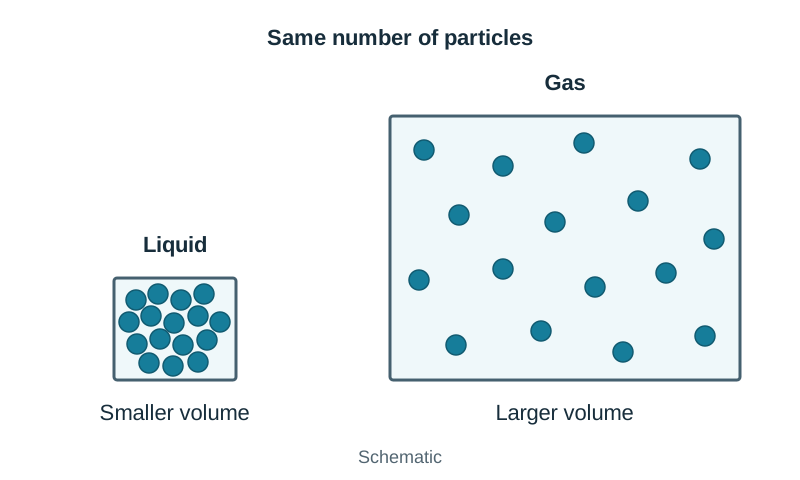
A rocket only leaves the ground when the upward force from its engines beats its own weight. It carries a huge mass of fuel, stored as a liquid so it fits in the tank.
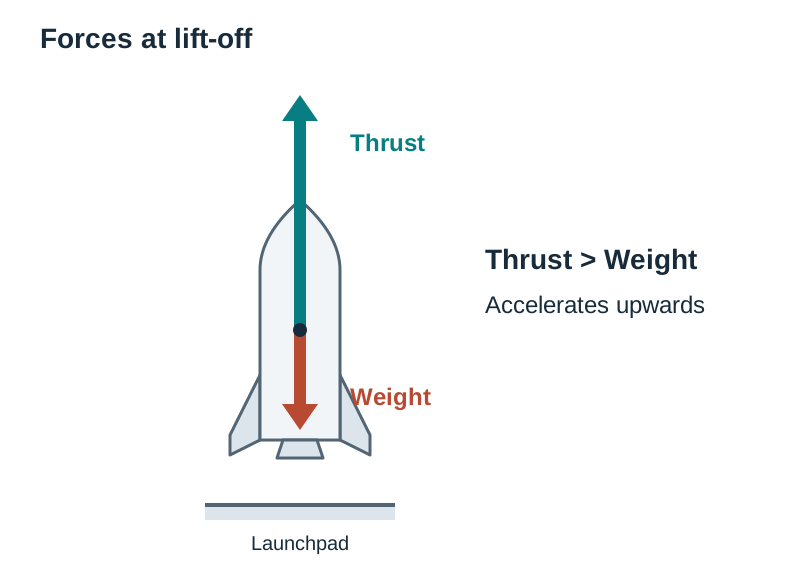
| Forces at Launch | Net Force | Rocket Motion |
|---|---|---|
| Thrust < Weight | Downward net force | Stays on launchpad |
| Thrust = Weight | Balanced forces (0 N) | Stays on launchpad |
| Thrust > Weight | Upward resultant force | Lifts off and accelerates |
- Mass is the amount of matter in the rocket, measured in kilograms; weight is the force of gravity on that mass, measured in newtons.
- As fuel burns and leaves as exhaust gas, the rocket's mass falls, so its weight falls and it speeds up.
- Liquid storage: particles in a liquid are packed much closer together than in a gas, allowing a huge mass of fuel to fit inside a tank.
- Combustion reaction: hydrogen + oxygen → water.
- Oxidiser: space is a vacuum with no air, so rockets must carry on-board oxygen to burn their fuel.
Hazards of Space Exploration
Leaving Earth's atmosphere exposes astronauts and spacecraft to extreme physical dangers.
- Launch risks: rocket fuels are highly explosive and require precise engine control to prevent catastrophic failures.
- Atmospheric re-entry: coming back into the atmosphere, friction with the air heats the spacecraft to very high temperatures, so it needs a heat shield.
- Microgravity: because their bodies are not supporting any weight, astronauts lose bone strength and their muscles get weaker.
- Cosmic radiation: outside Earth's atmosphere and magnetic field, high-energy radiation damages living cells and increases long-term cancer risk.
- Space debris: old satellites and pieces of rockets orbit Earth at very high speed and can damage a spacecraft in a collision.
- Living in space: astronauts are far from home in a small space for months, which is stressful and lonely.
Everyday Benefits and Spin-off Technologies
Space exploration drives scientific discovery and produces practical technologies used daily across the world.
- Scientific knowledge: probes, landers, and space telescopes tell us about other planets, moons, and the origin of the universe.
- Artificial satellites: orbit Earth to enable GPS navigation, global telecommunications, mobile networks, and weather forecasting.
- Earth observation: environmental satellites track climate change, polar ice melt, ocean temperatures, and deforestation.
- Spin-off technology: inventions developed for space missions that solve everyday problems on Earth.
- Solar power: high-efficiency solar panels designed for space stations now generate renewable electricity on rooftops.
- Advanced materials: innovations include memory foam, scratch-resistant lenses, and fire-resistant fabrics for emergency workers.
Future Exploration and Society
Decisions about future missions involve scientific, financial, and ethical arguments often explored in Classroom-Based Assessment 2.
- Robots or people? Uncrewed probes are cheaper and risk no lives; human crews can react to surprises but need air, food, and water.
- Economic debate: critics argue that spending billions on Moon or Mars exploration is wasteful when funding is needed on Earth for healthcare, poverty, and climate action.
- Research value: supporters point out that space research creates skilled jobs, inspires young scientists, and drives new technologies that benefit all of society.
- Orbital pollution: junk in low Earth orbit threatens the satellites modern society relies on, so countries must agree rules about clearing it up.
Key terms
- Thrust
- The upward driving force produced when a rocket engine expels hot exhaust gases downwards.
- Weight
- The downward force of gravity acting on an object, measured in newtons (N).
- Microgravity
- The condition of apparent weightlessness experienced in orbit because the spacecraft and crew are in continuous free fall.
- Oxidiser
- A substance, such as liquid oxygen, carried on a spacecraft to provide the oxygen needed to burn fuel in a vacuum.
- Space debris
- Discarded human-made objects, such as spent rocket stages and dead satellites, orbiting Earth at high speed.
- Spin-off technology
- A commercial product or material originally developed for space missions that solves everyday problems on Earth.
Check yourself
What relationship between thrust and weight is necessary for a rocket to lift off?
Upward thrust must be greater than the total downward weight.
Why does the total weight of the shuttle decrease during the first 20 seconds after the fuel is ignited?
Mass decreases as large amounts of fuel are rapidly burned and expelled as exhaust gas.
Why must a space rocket carry its own oxygen supply into orbit?
Space is a vacuum with no oxygen to support the combustion of fuel.
Name two physical health hazards caused by prolonged exposure to microgravity.
Loss of bone strength (density) and weakening of muscles.