

The Earth-Sun-Moon system explains predictable astronomical events including day and night, seasons, lunar phases, and eclipses. The exam asks you to use a model of the system to explain these events, to name or draw the correct Sun-Earth-Moon alignment, and sometimes to work out how long light takes to travel a given distance.
Motions in the System: Rotation and Revolution
Two main movements control the Earth-Sun-Moon system, held in place by gravity.
- Earth spins on its axis from west to east once every 24 hours. This spinning motion is called rotation, and it creates day and night as different sides turn into and out of sunlight.
- Earth also travels in an orbit around the Sun. This orbital motion is called revolution, taking approximately 365.25 days to complete one year.
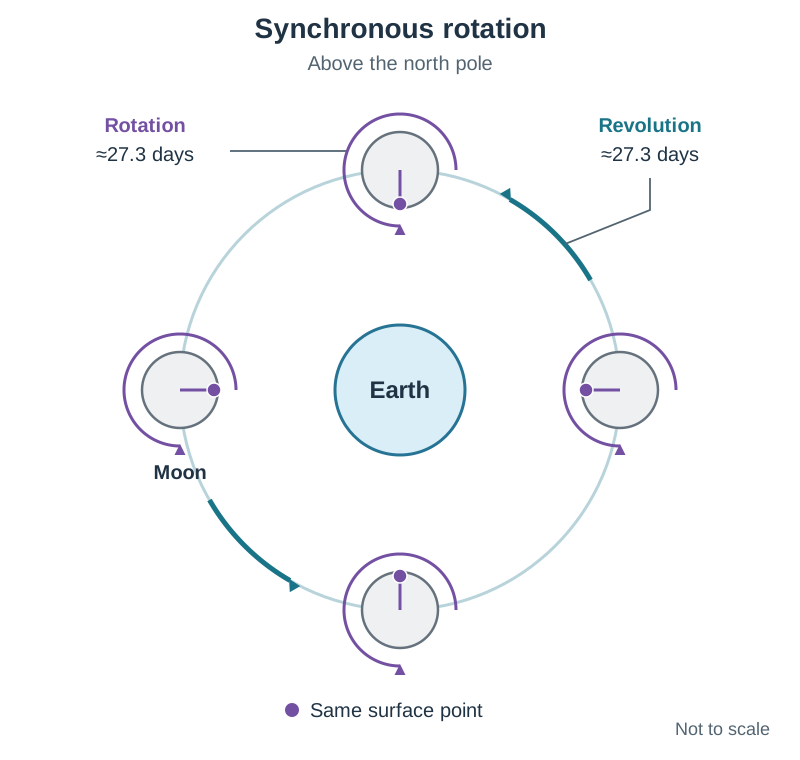
- The Moon revolves around Earth in about 27.3 days. The Moon also takes the same time, about 27.3 days, to rotate once on its axis. Because its rotation takes the same time as its orbit (synchronous rotation), the same face always points towards Earth.
- Tides: the Moon's gravity pulls on Earth's oceans, giving two high tides and two low tides at a given coast each day as Earth rotates.
Earth's Axial Tilt and the Seasons
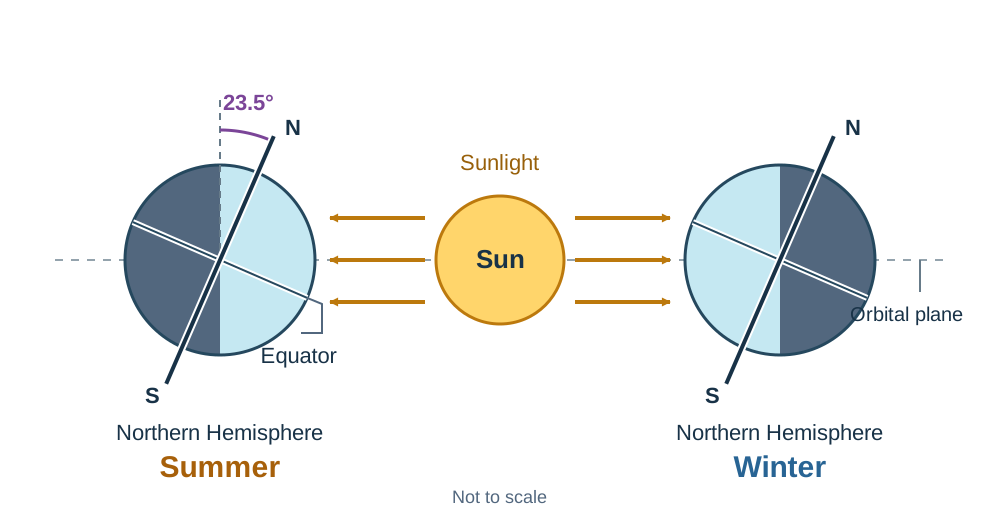
Seasons are caused by the 23.5° axial tilt of Earth relative to its orbital plane, not by changing distance from the Sun. As Earth orbits, its axis always points in the same direction in space.
The angle of sunlight controls how strongly the surface heats: the more directly the rays strike, the smaller the area they are spread over and the stronger the heating.
- Summer: a hemisphere tilts towards the Sun, so the Sun is higher in the sky and its rays strike the ground more directly. The energy falls on a smaller area, giving stronger heating and longer daylight.
- Winter: a hemisphere tilts away from the Sun, so rays strike at a slant. The energy spreads over a larger area, giving weaker heating and shorter daylight.
- Equinoxes: in March and September, neither hemisphere tilts towards or away from the Sun, giving roughly equal day and night worldwide.
Phases of the Moon
The Moon does not make its own light; it reflects sunlight. Exactly half of the lunar sphere is always lit by the Sun.
As the Moon orbits Earth, our viewing angle of this illuminated half changes, producing lunar phases:
- New moon: the Moon is between Earth and the Sun, so its lit side faces away from us.
- Waxing: the lit part we see grows — crescent, then half (first quarter), then gibbous.
- Full moon: Earth is between the Sun and Moon, allowing us to see the entire lit face.
- Waning: the lit part we see shrinks back the same way.
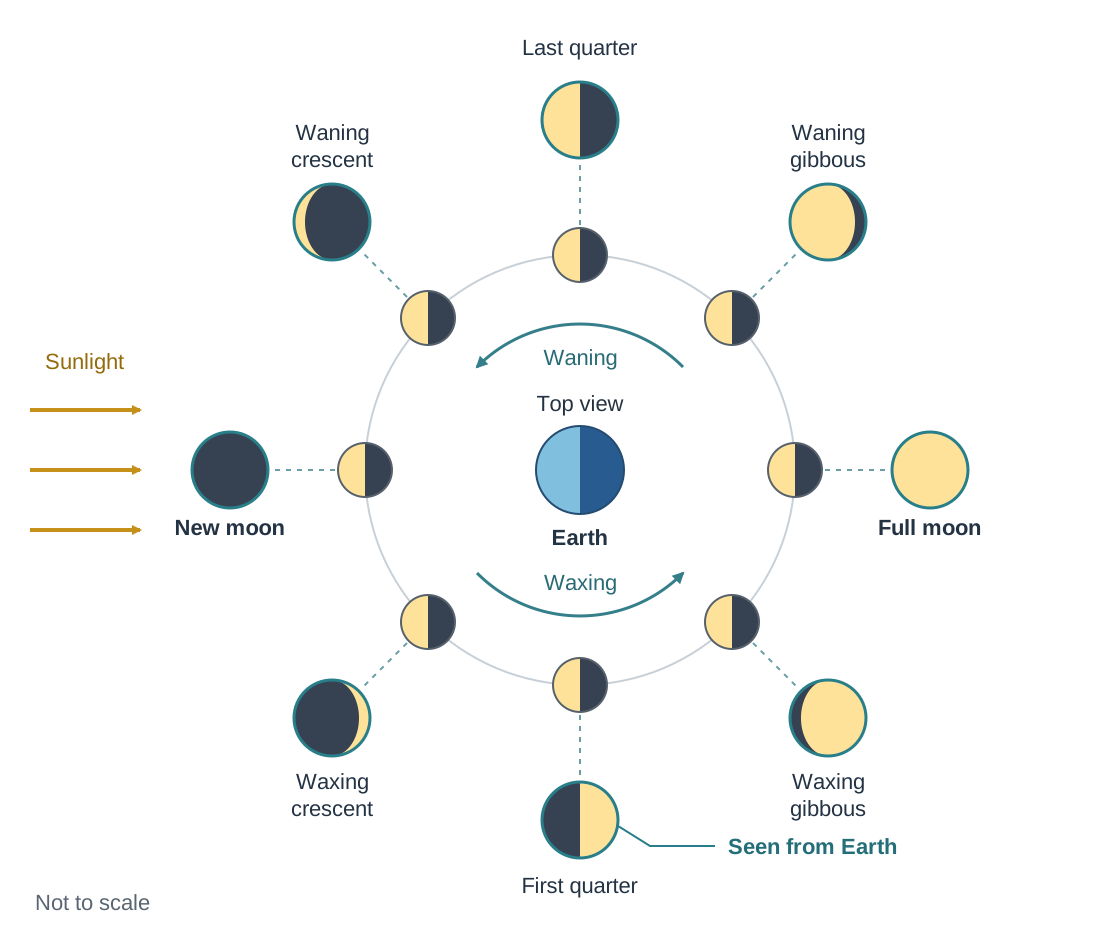
A complete cycle of phases takes about 29.5 days, which is roughly one month. A solar eclipse can only happen at new moon and a lunar eclipse only at full moon.
Solar and Lunar Eclipses
An eclipse happens when the Sun, Earth and Moon line up in a straight line, so that one body casts its shadow on another.
| Eclipse Type | Alignment Order | Moon Phase | What Happens |
|---|---|---|---|
| Solar eclipse | Sun – Moon – Earth | New Moon | The Moon passes directly between the Sun and Earth, casting its shadow onto Earth. |
| Lunar eclipse | Sun – Earth – Moon | Full Moon | Earth passes directly between the Sun and the Moon, casting Earth's shadow across the Moon. |
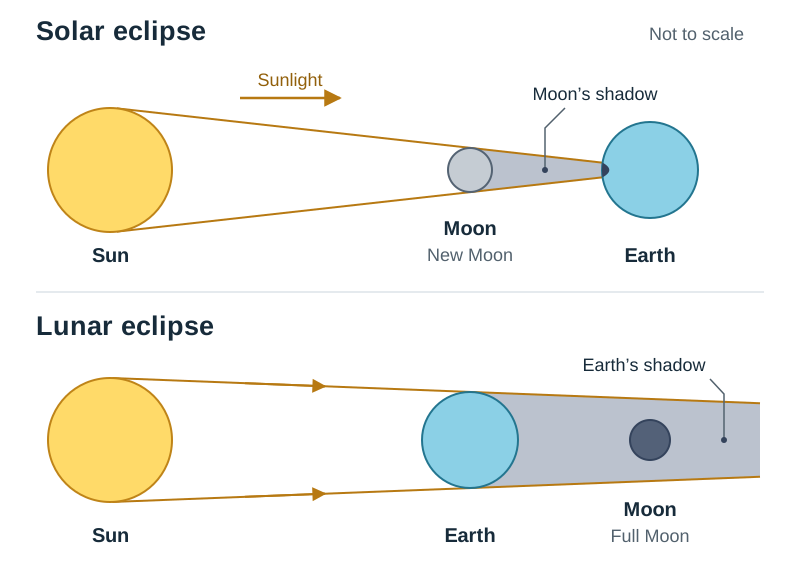
Eclipses do not occur every month because the Moon's orbit is tilted by about 5° relative to Earth's orbital plane. Most months, the Moon passes slightly above or below the Sun-Earth line, so the shadows miss.
Key terms
- Rotation
- The spinning of an object on its own axis, taking 24 hours for Earth.
- Revolution
- The movement of one celestial body travelling in an orbit around another, taking 365.25 days for Earth.
- 23.5° axial tilt
- The fixed angle by which Earth's rotational axis leans relative to its orbital plane.
- Synchronous rotation
- When a body's rotation period matches its orbital period, keeping the same face pointing inward.
- Solar eclipse
- An event where the Moon passes between the Sun and Earth, casting a shadow on Earth.
- Lunar eclipse
- An event where Earth passes between the Sun and the Moon, casting Earth's shadow on the Moon.
- Scientific model
- A diagram, physical setup, or simulation used to explain and predict natural phenomena.
Check yourself
What is the angle of Earth's axial tilt?
23.5°.
Which body is positioned in the middle during a solar eclipse?
The Moon (Sun – Moon – Earth).
Why is the far side of the Moon never visible from Earth?
The Moon rotates on its axis in the exact same time it takes to orbit Earth (synchronous rotation).
Why do eclipses not occur every month?
The Moon's orbit is tilted by about 5° relative to Earth's orbit, so the bodies do not always align in a straight line.
At which moon phase can a lunar eclipse occur?
Full moon.