

Celestial objects are the natural objects in space: stars, planets, moons, asteroids, comets, and galaxies. The exam asks you to describe how they are related, to read planetary data tables, and to explain seasons, lunar phases, and eclipses using the Earth–Sun–Moon system.
1. Celestial Objects and Their Relationships
A celestial body is any natural object outside Earth's atmosphere. Gravity holds these objects in predictable orbits.
- A solar system is a star with all the planets, moons, asteroids, and comets that orbit it.
- Moons orbit planets; planets, asteroids, and comets orbit a star; stars sit in galaxies; galaxies sit in space.
- Size order, smallest to largest: moon → planet → star → solar system → galaxy → universe.
| Object | Key Feature | Example |
|---|---|---|
| Star | Generates light and heat through nuclear fusion | The Sun |
| Planet | Orbits a star, rounded by gravity, cleared its orbit | Earth, Mars |
| Moon | Natural satellite that revolves around a planet | Earth's Moon |
| Asteroid | Small, rocky body left over from planet formation | Asteroid belt |
| Comet | Body of ice and dust with an elongated orbit | Halley's Comet |
| Galaxy | Billions of stars, gas, and dust held by gravity | Milky Way |
- The eight planets in order from the Sun are Mercury, Venus, Earth, Mars, Jupiter, Saturn, Uranus, and Neptune.
- The asteroid belt lies between Mars and Jupiter.
- A comet's tail always points away from the Sun due to solar wind.
2. Origin of the Universe: The Big Bang Model
The Big Bang model states that the universe began about 13.8 billion years ago from an extremely hot, dense point.
- Space expanded rapidly and cooled down, allowing subatomic particles to form.
- Simple atoms of hydrogen and helium formed first as temperatures dropped.
- Over millions of years, gravity pulled these gases together to form the first stars and galaxies.
- Evidence: light from distant galaxies is red-shifted, showing that galaxies are moving away from us, which proves the universe is expanding.
Model: the inflating balloon
- Draw dots on an uninflated balloon to represent galaxies.
- As you blow into the balloon, the dots move farther apart because the rubber stretches.
- This demonstrates how expanding space separates galaxies from each other.
- Limitation: the balloon surface is two-dimensional, whereas space expands in three dimensions.
3. Comparing Solar System Bodies
Exam papers use planetary data tables with relative values, where Earth is set as 1.
| Body | Relative Mass | Relative Radius | Relative Surface Gravity | Composition |
|---|---|---|---|---|
| Earth | 1.00 | 1.00 | 1.00 | Rocky (Terrestrial) |
| Mars | 0.11 | 0.53 | 0.38 | Rocky (Terrestrial) |
| Moon | 0.01 | 0.27 | 0.17 | Rocky (Terrestrial) |
- Mercury, Venus, Earth, and Mars are rocky planets.
- Jupiter and Saturn are gas giants made mainly of hydrogen and helium.
- Uranus and Neptune are ice giants containing frozen water, ammonia, and methane.
- Mass is the amount of matter in an object (kg) and never changes with location.
- Weight is the downward force of gravity (N) acting on that mass.
- Weight (N) = mass (kg) × surface gravity (N/kg). A 60 kg person weighs 60 × 10 = 600 N on Earth, but 60 × 3.8 = 228 N on Mars.
4. Day, Night, and Seasons
The motions of Earth relative to the Sun create predictable natural cycles.
- Rotation is the spinning of Earth on its axis once every 24 hours, causing day and night.
- Revolution is Earth's orbit around the Sun, taking approximately 365.25 days.
- Earth's axis is tilted at 23.5° and always points in the same direction as Earth orbits the Sun.
- Always explain seasons using Earth's tilt, never distance from the Sun.
- The hemisphere tilted towards the Sun receives direct sunlight and has longer days.
- When the Sun is high, its energy is spread over a smaller area of ground, so the heating is stronger (summer).
- When tilted away, rays strike at a slant, spreading solar energy over a larger area and causing shorter days (winter).
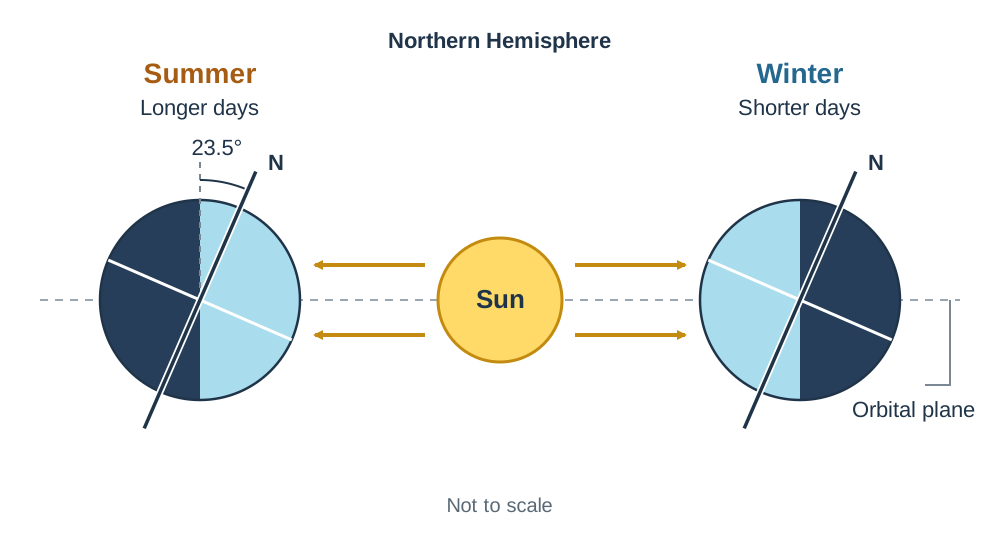
Model: shine a fixed lamp at a globe tilted at 23.5° and move it around in an orbit.
5. Moon Phases and Eclipses
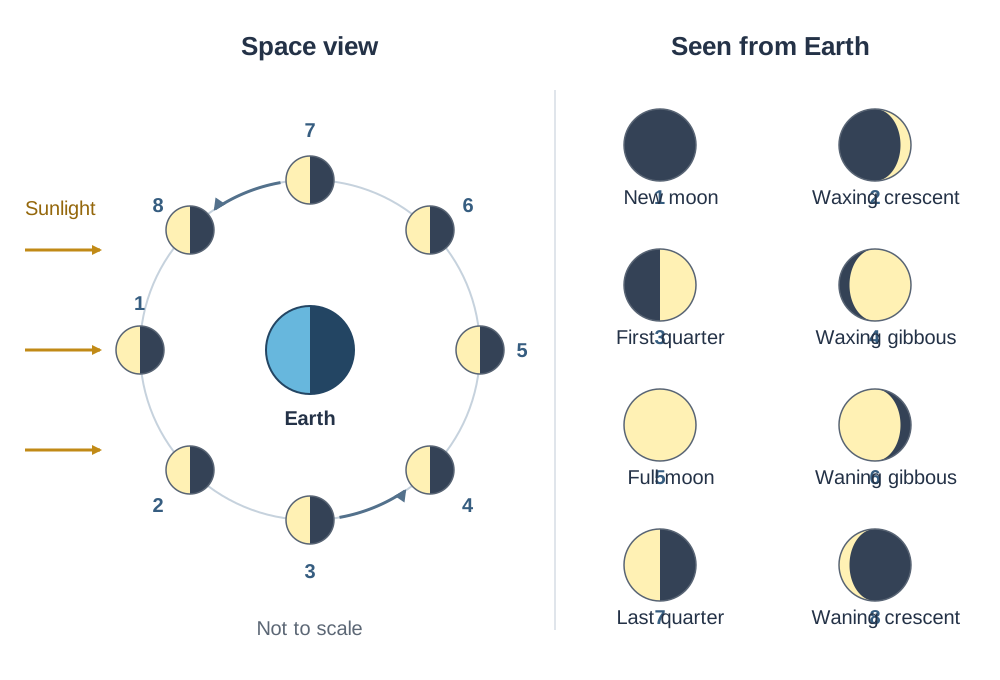
The Moon takes about 27.3 days to orbit Earth, but about 29.5 days to go from one new moon to the next.
- Half of the Moon is always lit by the Sun. Lunar phases occur because our viewing angle of that sunlit side changes as the Moon orbits Earth.
- Waxing means the visible lit portion is growing; waning means it is shrinking.
- The cycle runs: new moon → waxing crescent → first quarter → waxing gibbous → full moon → waning gibbous → last quarter → waning crescent.
| Eclipse | Straight-Line Alignment | What Happens |
|---|---|---|
| Solar Eclipse | Sun–Moon–Earth | The Moon blocks sunlight, casting its shadow on Earth. Can only happen at new moon. |
| Lunar Eclipse | Sun–Earth–Moon | Earth blocks sunlight, casting its shadow over the Moon. Can only happen at full moon. |
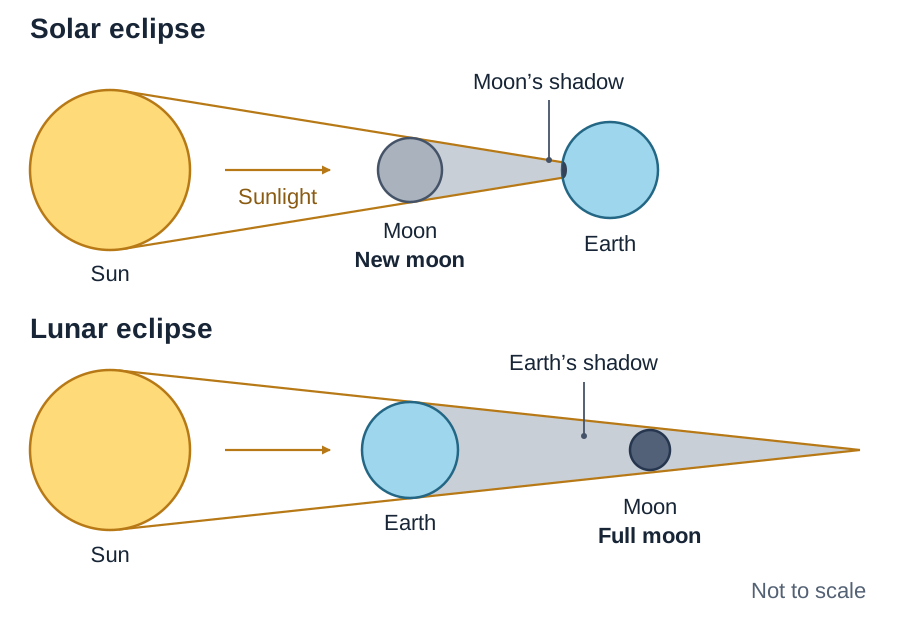
- Eclipses do not happen every month because the Moon's orbit is tilted relative to Earth's orbit.
Key terms
- Star
- A luminous celestial body of gas that produces heat and light by nuclear fusion.
- Planet
- A celestial body orbiting a star that is rounded by gravity and has cleared its orbit.
- Solar system
- A central star and all the celestial bodies that revolve around it under its gravity.
- Moon
- A natural satellite that revolves in an orbit around a planet.
- Comet
- A body of ice and dust orbiting a star that develops a tail pointing away from the Sun.
- Rotation
- The spinning of an object on its own axis, taking 24 hours for Earth.
- Revolution
- The movement of one celestial body travelling in an orbital path around another.
- Light-year
- The distance light travels through a vacuum in one year; a unit of distance, not time.
Check yourself
What is the correct order of a moon, a star, and a planet in size from smallest to largest?
Moon → planet → star.
What piece of evidence supports the Big Bang model of an expanding universe?
Light from distant galaxies is red-shifted, showing they are moving away from us.
At which lunar phase can a solar eclipse happen?
New moon.
Calculate the weight of a 50 kg student on Mars, where surface gravity is 3.8 N/kg.
Weight = 50 kg × 3.8 N/kg = 190 N.