
This topic explores how different energy sources are classified and how our society can meet its energy needs sustainably. The Junior Cycle examination tests your ability to interpret fuel data, explain the environmental impacts of combustion, describe energy changes, and justify an informed view on future energy use.
Classifying Energy Sources
An energy source provides usable heat or electricity. Every energy source is classified into one of two main categories based on its availability.
| Type | Definition | Examples |
|---|---|---|
| Renewable | Replenished naturally in a short time and will not run out. | Solar, wind, hydroelectric, tidal, biomass. |
| Non-renewable | Exists in a finite amount and will eventually run out. | Coal, crude oil, natural gas, peat (turf), uranium. |
- Crops like willow or sugar cane can be replanted and regrown each year, so their fuel supply is naturally replaced.
- Making turbines and solar panels uses energy and causes some emissions during manufacture.
Fossil Fuels and Nuclear Energy
Fossil fuels
A fossil fuel formed over millions of years from the buried remains of ancient organisms.
- Coal, oil, and natural gas are all fossil fuels and their supply is finite.
- Fuels need oxygen from the air in order to burn.
- Fossil fuels consist largely of hydrocarbon compounds made of hydrogen and carbon only.
- Burning hydrocarbons produces carbon dioxide (CO2) and water (H2O).
- Carbon dioxide is a greenhouse gas that traps heat and drives climate change.
- Coal and oil also contain sulphur impurities; burning these releases sulphur dioxide (SO2), which dissolves in rain to cause acid rain.
- Peat (turf) is an Irish fuel that forms over thousands of years, far faster than coal or oil but still far too slowly to be renewable.
Generating electricity from fuels
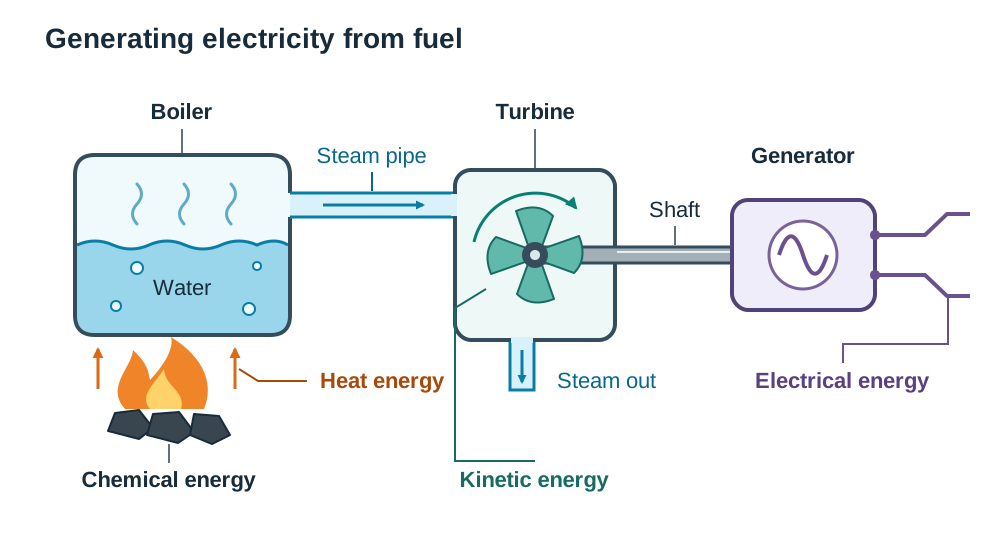
Most thermal power stations share the same basic operating steps: burning fuel boils water to steam, the high-pressure steam turns a turbine, and the turbine drives an electrical generator.
- Energy chain: chemical energy → heat energy → kinetic energy → electrical energy.
Nuclear energy
Nuclear fission splits uranium atoms to release large amounts of heat energy without producing greenhouse gases.
- Nuclear power is non-renewable because uranium is a mined mineral in finite supply.
- The process leaves behind hazardous radioactive waste that must be stored safely for thousands of years.
Renewable Energy Technologies
Most renewables release no gases while they are working. Biomass is the exception: burning it does release carbon dioxide, but the crop takes in carbon dioxide as it grows.
In a wind turbine, moving air turns the blades: kinetic energy of the wind → kinetic energy of the blades → electrical energy.
| Source | How It Works | Major Advantage | Main Limitation |
|---|---|---|---|
| Wind | Moving air turns a turbine and generator. | Free energy source during operation. | Intermittent: generates no power when wind speeds are too low or calm. |
| Solar | Photovoltaic cells convert light to electricity. | Can be fitted on house roofs or used in remote places with no power lines. | Generates electricity only during daylight hours. |
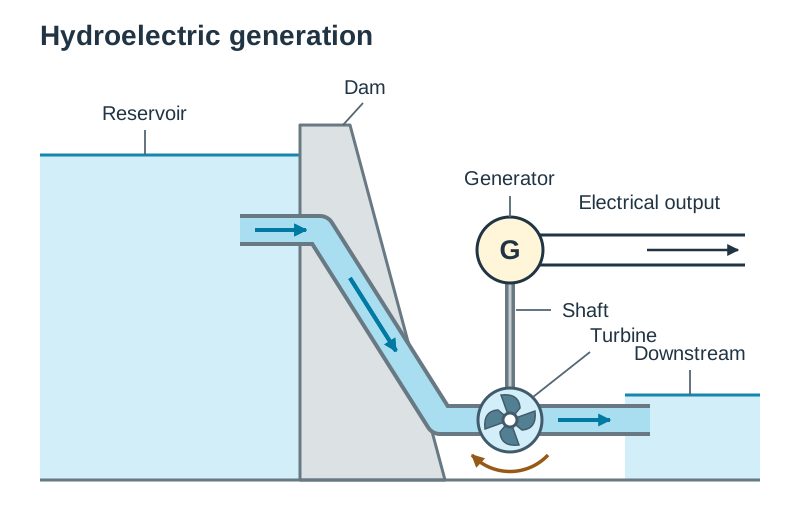
| Hydroelectric | Falling water from a dam turns a turbine. | Can be switched on quickly when extra electricity is needed. | Reservoirs flood upstream land and destroy habitats. |
| Tidal | Flowing coastal tides drive underwater turbines. | Tides are predictable, so the amount of electricity can be planned in advance. | Can disrupt marine wildlife and ship navigation. |
| Biomass | Burning recently grown plant material or waste. | Absorbs CO2 while growing, balancing carbon released on burning. | Requires land that could otherwise grow food crops. |
Meeting Future Energy Needs Sustainably
Sustainability means meeting present needs without compromising the ability of future generations to meet their own needs.
- An energy mix combines several renewable sources with reliable backup systems to keep the electricity grid stable.
- Ireland has strong wind energy resources, but our transport and heating sectors still rely heavily on imported oil and gas.
- Storing surplus renewable electricity in large battery systems or pumped hydroelectric dams helps balance generation on calm or cloudy days.
- Energy efficiency means using improved technology to complete a task with less energy input, such as replacing incandescent bulbs with LED lighting.
- Energy conservation means changing human behaviour to reduce unnecessary consumption, such as switching off appliances and walking instead of driving.
- Upgrading home attic and wall insulation stops heat escaping, directly cutting domestic fuel demand.
Key terms
- Renewable energy source
- An energy source that is replenished naturally in a short time and will not run out.
- Non-renewable energy source
- A finite energy source that cannot be replaced within a human lifespan once consumed.
- Fossil fuel
- A finite fuel formed over millions of years from the buried remains of ancient living organisms.
- Hydrocarbon
- A chemical compound consisting of the elements hydrogen and carbon only.
- Nuclear fission
- The splitting of a large atomic nucleus to release heat energy.
- Sustainability
- Meeting present needs without compromising the ability of future generations to meet their own needs.
- Energy efficiency
- Using better technology to perform a task using less energy input.
- Energy conservation
- Reducing energy usage through behavioural changes.
Check yourself
Which gas from the air is required for any fuel to burn?
Oxygen.
What two chemical products are formed during the complete combustion of a pure hydrocarbon?
Carbon dioxide (CO2) and water (H2O).
Why will the fuel supply from biofuel crops like sugar cane or willow not run out?
They can be replanted and regrown each year to replace what was harvested.
What gas impurity in coal leads to acid rain when burned?
Sulphur dioxide (SO2).
List the sequence of energy changes that occur in a coal-fired power station to produce electricity.
Chemical energy → heat energy → kinetic energy → electrical energy.