
Cycling of matter describes how water and carbon move between Earth's surface, living things, and the atmosphere. Exam questions test your ability to describe the biological and physical steps in each cycle, interpret cycle diagrams, and explain how human activity disrupts this balance.
The Water Cycle
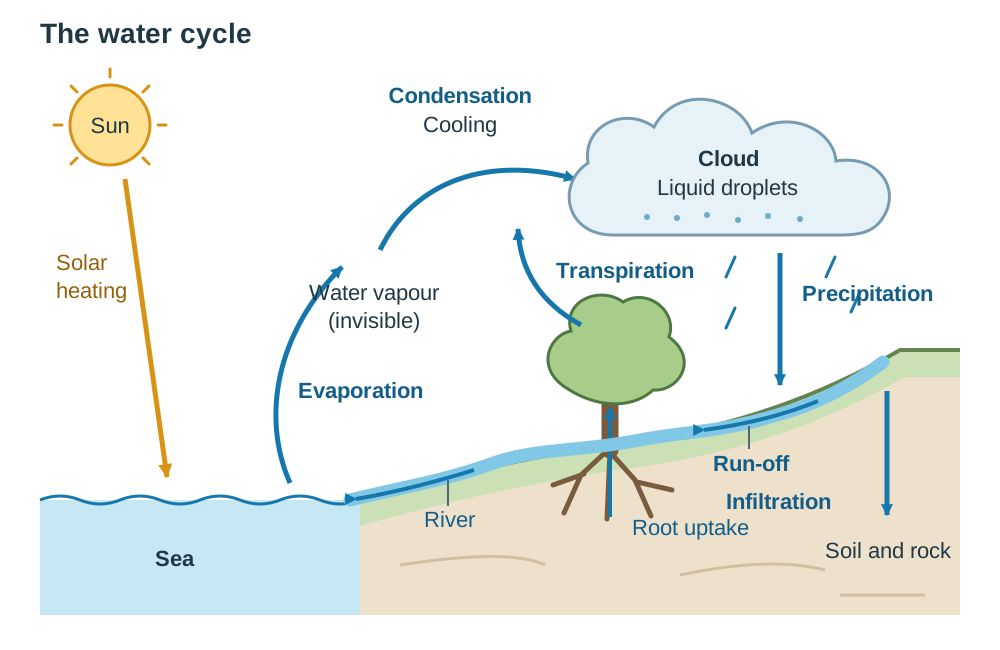
Water moves continuously between the Earth and the atmosphere through physical changes of state driven by heat from the Sun. No new substances are made, so every step in the cycle can be reversed.
- Evaporation: The Sun heats liquid water in oceans and lakes, turning it into invisible water vapour.
- Transpiration: Plant roots absorb water from the soil, and it evaporates out through pores in their leaves.
- Condensation: Warm water vapour rises and cools, turning back into tiny liquid droplets that form clouds.
- Precipitation: Droplets join together until they are too heavy to float, falling as rain, snow, sleet, or hail.
- Run-off and Infiltration: Fallen water either flows across land into streams and rivers, or seeps deep into soil and rock.
The Carbon Cycle
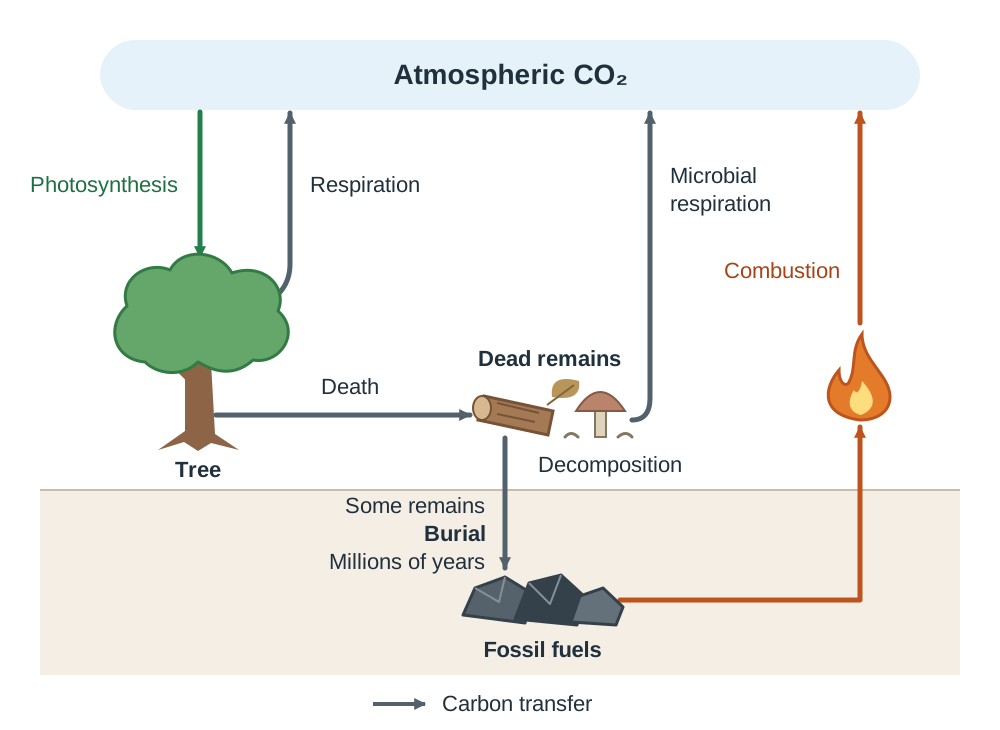
Carbon is the foundation of all living matter. Carbon atoms are never destroyed; they move between the air, organisms, the ocean, and underground rock.
- Photosynthesis: Green plants absorb carbon dioxide from the air and combine it with water to produce glucose and oxygen (carbon dioxide + water → glucose + oxygen). This makes plants a natural carbon sink.
- Respiration: All living cells break down glucose with oxygen to release energy, producing carbon dioxide and water (glucose + oxygen → carbon dioxide + water).
- Combustion: Burning fuels like wood, coal, peat, oil, and gas reacts carbon with oxygen, releasing carbon dioxide.
- Decomposition: Bacteria and fungi break down dead plant and animal remains, releasing trapped carbon through microbial respiration.
- Storage: Dissolved carbon forms carbonate rocks like limestone in oceans, while buried organisms turned into fossil fuels over millions of years.
Human Impact and Climate Change
The natural greenhouse effect traps heat radiated from the Earth's surface and keeps our planet warm enough for living things. Human activity releases greenhouse gases much faster than natural sinks can absorb them, creating an enhanced greenhouse effect.
- Burning coal, oil, and gas releases ancient underground carbon into the atmosphere.
- Deforestation clears away vast tracts of forest, destroying trees that would otherwise remove carbon dioxide.
- Rising global temperatures melt glaciers, raise sea levels, and create more severe storms and droughts.
- Actions that reduce our carbon footprint include planting trees (afforestation), using wind and solar power, insulating homes, and choosing public transport or bicycles.
Key terms
- Evaporation
- The physical change of state where liquid water absorbs heat energy and turns into water vapour gas.
- Transpiration
- The release and evaporation of water vapour through tiny pores in the leaves of living plants.
- Condensation
- The physical change of state where cooling water vapour turns back into liquid water droplets.
- Precipitation
- Water falling from clouds to Earth's surface as rain, hail, sleet, or snow.
- Carbon Sink
- A natural reservoir, such as a growing forest or an ocean, that absorbs more carbon dioxide than it gives out.
- Carbon Source
- A process, such as respiration or the combustion of fuels, that releases carbon dioxide into the air.
- Enhanced Greenhouse Effect
- Extra warming of the atmosphere caused by human emissions trapping surplus heat.
- Carbon Footprint
- The total amount of greenhouse gases released due to the direct and indirect actions of an individual or group.
Check yourself
Why are the steps in the water cycle considered physical changes?
No new chemical substances are created, and every change of state can be reversed.
What name is given to the loss of water vapour from plant leaves?
Transpiration.
Which biological process takes carbon dioxide out of the atmosphere?
Photosynthesis.
Name two major human activities that increase atmospheric carbon dioxide.
Burning fossil fuels and clearing forests (deforestation).