
The Periodic Table organises all known chemical elements in order of increasing atomic number, placing elements with similar chemical properties into vertical groups. In the Junior Cycle exam, you use it to work out the protons, neutrons and electrons in an atom, to classify elements, and to predict the ratio of atoms in a compound.
Organisation of the Periodic Table
Elements are arranged by atomic number, the number of protons in the nucleus. Elements with similar properties appear again at regular intervals — that is why it is called the periodic table.
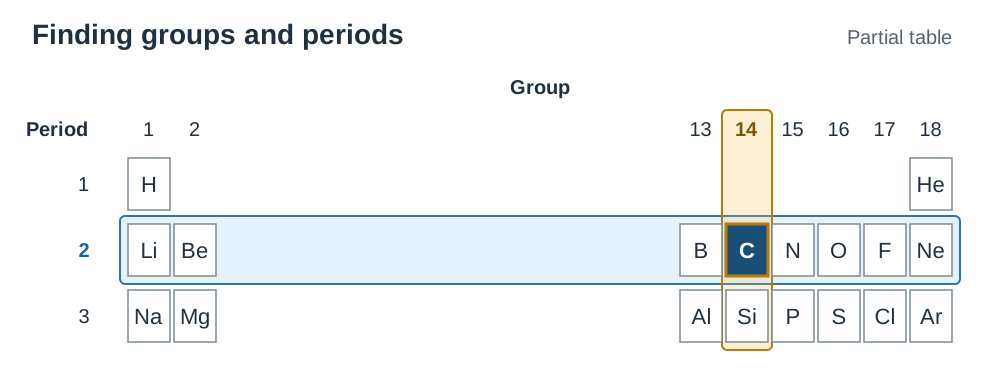
- Group: a vertical column (numbered 1 to 18). Elements in the same group have the same number of outer electrons and similar chemical properties.
- Period: a horizontal row (numbered 1 to 7). The period number equals the number of occupied electron shells.
- Group 1 contains the alkali metals (lithium, sodium, potassium), which are soft and very reactive. Hydrogen sits at the top of Group 1 but is a non-metal.
- Group 17 contains reactive non-metals (halogens), and Group 18 contains unreactive noble gases.
- Metals sit on the left and centre; they are shiny, malleable, and conduct heat and electricity. Non-metals sit on the right and are poor conductors.
Classifying Substances
Matter can be classified by how its atoms are combined:
- Element: a substance made of only one type of atom, e.g. iron (Fe) or oxygen gas (O₂).
- Compound: two or more different elements chemically joined in a fixed ratio, e.g. water (H₂O).
- Mixture: two or more substances mixed together but not chemically joined, so they can be separated by physical methods, e.g. air or petrol.
To count the number of elements in a chemical formula, count the different capital letters. For example, ammonium nitrate (NH₄NO₃) contains three elements: nitrogen (N), hydrogen (H), and oxygen (O).
Inside the Atom and the Bohr Model
Atoms contain a central nucleus surrounded by electrons orbiting in shells.
| Particle | Relative Mass | Relative Charge | Location |
|---|---|---|---|
| Proton | 1 | +1 | Nucleus |
| Neutron | 1 | 0 | Nucleus |
| Electron | almost zero | −1 | Shells |
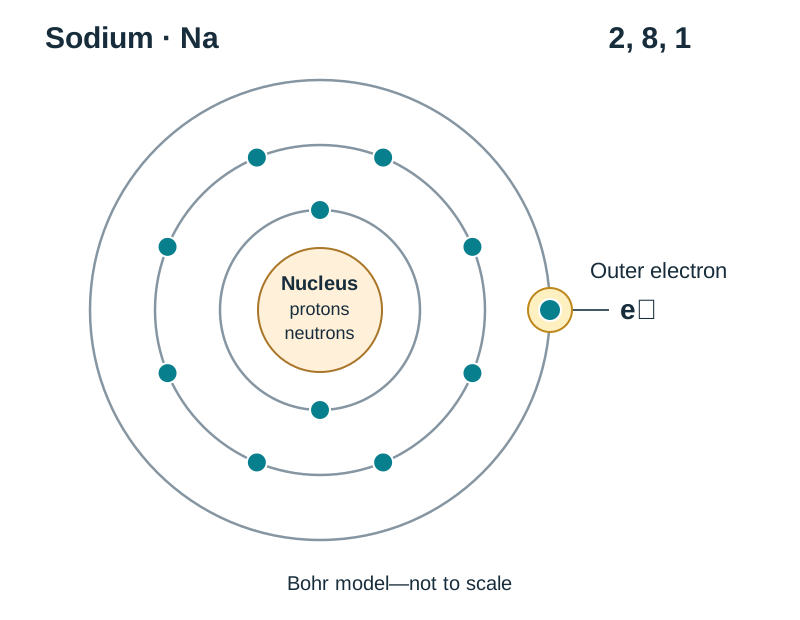
- The Bohr model shows the nucleus in the centre with electrons orbiting in shells. It is called a planetary model because electrons orbit the nucleus like planets orbit the Sun.
- To draw a Bohr diagram, fill shells from the inside out: 2 in the first shell, 8 in the second, and 8 in the third (for the first 20 elements). Sodium (11 electrons) is arranged 2, 8, 1.
- To identify an element, match its protons to the atomic number on your exam table (7 protons = nitrogen, N). Count across for group (Group 14) and down for period (Period 2) to find carbon.
Predicting Ionic Compounds
An ionic bond is the force of attraction between oppositely charged ions. Metals transfer electrons to non-metals so both get full outer shells:
- Group 1 metals lose 1 electron to form +1 ions (e.g. Na⁺).
- Group 2 metals lose 2 electrons to form +2 ions (e.g. Mg²⁺, Ca²⁺).
- Group 16 non-metals gain 2 electrons to form −2 ions (e.g. O²⁻).
- Group 17 non-metals gain 1 electron to form −1 ions (e.g. Cl⁻, F⁻).
Compounds are neutral, so positive and negative charges must balance to zero. For sodium chloride, one Na⁺ balances one Cl⁻, giving an atom ratio of 1:1 and the formula NaCl. For calcium chloride, one Ca²⁺ needs two Cl⁻: (+2) + 2(−1) = 0, giving an atom ratio of 1:2 and the formula CaCl₂.
Predicting Covalent Molecules
A covalent bond forms when non-metal atoms share pairs of electrons. A molecule is a group of atoms held together by covalent bonds.
For Groups 13 to 18, subtract 10 from the group number to find the outer electrons. Valency is the number of electrons an atom loses, gains, or shares when bonding.
| Group | Outer Electrons | Bonds Formed | Example Formula |
|---|---|---|---|
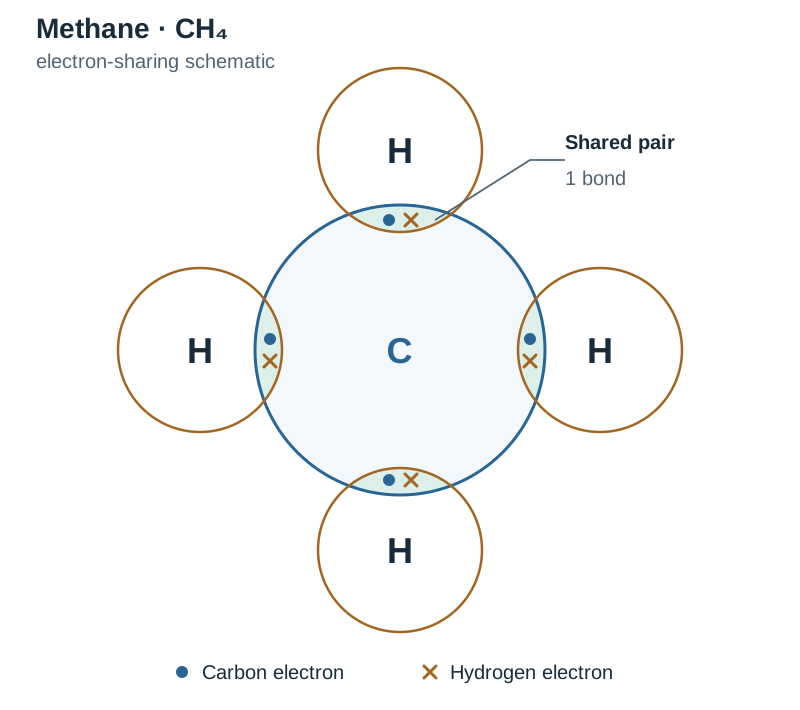
| 14 | 4 | 4 | CH₄ (methane) |
| 15 | 5 | 3 | NH₃ (ammonia) |
| 16 | 6 | 2 | H₂O (water) |
| 17 | 7 | 1 | HCl (hydrogen chloride) |
Hydrogen has 1 electron and needs 1 share to fill its only shell. Therefore, one carbon atom shares electrons with four hydrogen atoms to form CH₄.
Key terms
- Atomic Number
- The number of protons in the nucleus of an atom.
- Mass Number
- The total number of protons and neutrons in the nucleus of an atom.
- Group
- A vertical column in the Periodic Table containing elements with the same number of outer-shell electrons.
- Period
- A horizontal row in the Periodic Table showing the number of occupied electron shells.
- Ion
- A charged atom or group of atoms formed by losing or gaining electrons.
- Ionic Bond
- The force of attraction between oppositely charged ions.
- Covalent Bond
- A chemical bond formed when non-metal atoms share pairs of electrons.
- Valency
- The number of electrons an atom loses, gains, or shares when it forms chemical bonds.
Check yourself
Why is the Bohr model of the atom often described as a planetary model?
Because electrons orbit the central nucleus in shells, similar to how planets orbit the Sun.
How many elements are present in ammonium nitrate, NH₄NO₃?
Three elements (nitrogen, hydrogen, and oxygen), found by counting each distinct capital letter.
An atom has 19 protons and a mass number of 39. How many neutrons does it have?
20 neutrons (39 − 19 = 20).
What is the formula of the compound formed between potassium (Group 1) and oxygen (Group 16)?
K₂O, because two K⁺ ions balance one O²⁻ ion: 2(+1) + (−2) = 0.