
Chemical reactions rearrange atoms into new substances with new properties while total mass is conserved. The Junior Cycle examination focuses on measuring reaction rates, fair testing with variables, energy profile diagrams, gas preparation tests, and acid-base neutralisation.
Chemical Changes and Conservation of Mass
A physical change alters state or appearance without making new substances, like ice melting. A chemical change creates new substances with different properties, such as burning magnesium.
Signs of a chemical reaction include colour changes, temperature changes, gas bubbles, or forming an insoluble solid.
- Under the law of conservation of mass, mass is not created or destroyed in any chemical reaction.
- The atoms are rearranged into new substances; no atoms are created or destroyed.
- In an open beaker, fizzing gas escapes into the air, making the mass appear to drop. If you seal a fizzy tablet and water in a flask with a balloon over the top, the mass stays the same, because the gas cannot escape.
Investigating Rates of Reaction
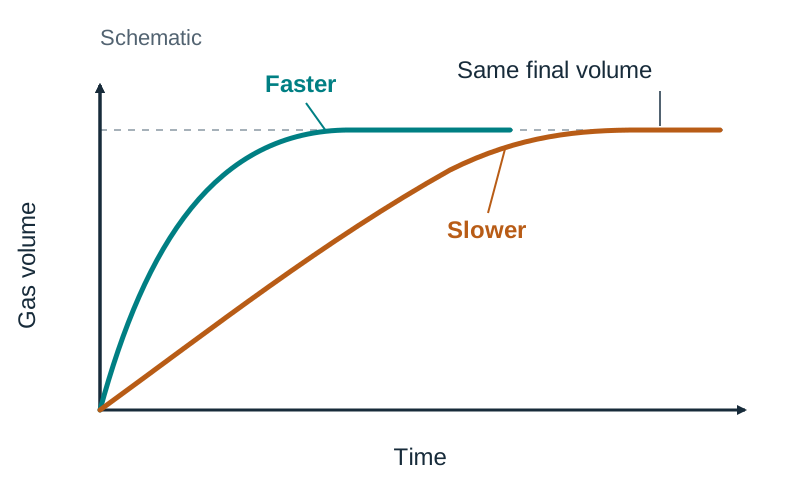
The rate of reaction measures how quickly reactants turn into products. For particles to react, they must collide with enough energy to overcome the activation energy barrier.
A variable is any factor that can change or be measured. When investigating rate, change only one variable at a time, measure the outcome (such as gas volume), and keep all other variables constant to ensure a fair test.
| Variable changed | Effect on rate | Reason using collision theory |
|---|---|---|
| Higher temperature | Faster | Particles move faster and collide more often with greater energy. |
| Higher concentration | Faster | There are more particles in the same volume, so collisions happen more often. |
| Smaller particle size | Faster | Crushing a solid exposes a larger surface area for collisions. |
| Adding a catalyst | Faster | Lowers the activation energy, so more collisions have enough energy to react. |
Always wear safety glasses during these investigations because dilute acids are corrosive.
Common Gases and Biochemical Reactions
A catalyst speeds up a chemical reaction without being used up itself. Enzymes like catalase in potato or yeast act as biological catalysts.
Two common acid reactions generate laboratory gases:
- acid + metal → salt + hydrogen
- acid + metal carbonate → salt + water + carbon dioxide
| Gas | Substances used | How collected | Test | Result |
|---|---|---|---|---|
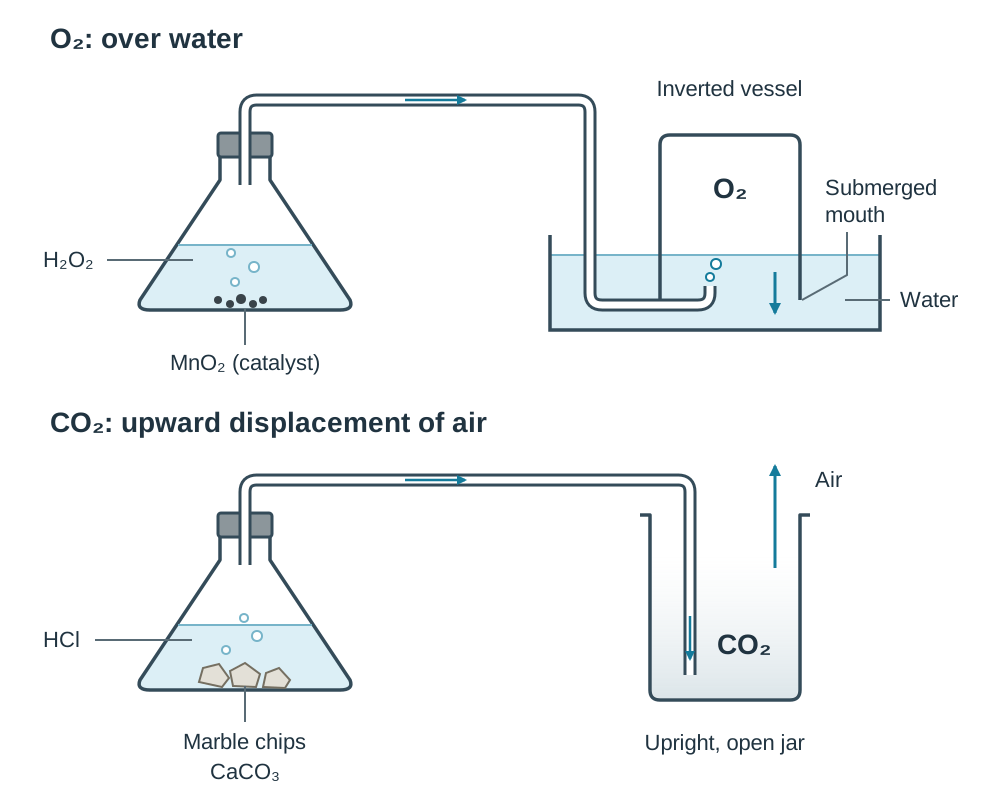
| Oxygen (O₂) | Hydrogen peroxide + manganese dioxide (catalyst) | Over water | Glowing wooden splint | Relights splint |
| Carbon dioxide (CO₂) | Hydrochloric acid + marble chips (CaCO₃) | Upward displacement of air | Bubble through limewater | Limewater turns milky; extinguishes a flame (used in fire extinguishers) |
| Hydrogen (H₂) | Hydrochloric acid + zinc or magnesium | Over water | Lighted splint near mouth of tube | Burns with a 'pop' sound |
Energy Changes and Profile Diagrams
Chemical reactions transfer energy to or from their surroundings.
- An exothermic reaction releases heat energy to the surroundings, causing the temperature to rise (e.g. combustion, neutralisation).
- An endothermic reaction absorbs heat energy from the surroundings, causing the temperature to drop (e.g. photosynthesis, chemical cold packs).
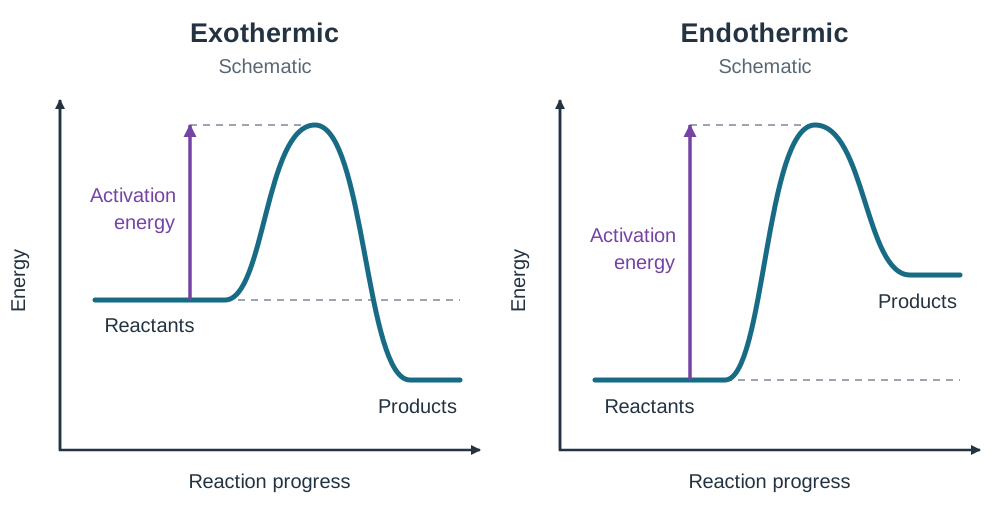
An energy profile diagram graphs energy against reaction progress. In an exothermic profile, products finish at a lower energy level than reactants because energy was released. In an endothermic profile, products finish higher than reactants.
The activation energy is always drawn as the vertical height from the reactant energy level up to the peak of the curve.
Acids, Bases and the pH Scale
The pH scale measures how acidic or basic a solution is, ranging from 0 to 14. Values below 7 are acidic, pH 7 is neutral, and values above 7 are basic (alkaline).
- Litmus paper turns red in acid and blue in base.
- Universal indicator gives an approximate pH number matched against a colour chart (red for strong acid, green for neutral, purple for strong base).
- A pH meter or digital probe is better than universal indicator because it gives an exact numerical pH reading instead of a colour you must judge by eye.
Neutralisation occurs when an acid reacts with a base to form a salt and water:
- acid + base → salt + water
- HCl + NaOH → NaCl + H₂O
An everyday application is taking antacid tablets to neutralise excess stomach acid.
Key terms
- Conservation of mass
- Mass is not created or destroyed — the mass of the products equals the mass of the reactants.
- Rate of reaction
- How fast reactants are used up, or products are formed, in a given time.
- Activation energy
- The minimum energy colliding particles must possess for a chemical reaction to occur.
- Catalyst
- A substance that speeds up a chemical reaction without being used up itself.
- Exothermic
- A reaction that releases heat energy to the surroundings, causing the temperature to rise.
- Endothermic
- A reaction that absorbs heat energy from the surroundings, causing the temperature to fall.
- Neutralisation
- The chemical reaction between an acid and a base producing a salt and water.
- pH scale
- A scale from 0 to 14 that indicates the acidity or alkalinity of a solution.
Check yourself
What is the confirmatory test and positive result for oxygen gas?
Place a glowing wooden splint into the gas; the splint relights.
Why does crushing a solid reactant increase the rate of reaction?
It increases the exposed surface area, leading to more frequent collisions between particles.
Why is a pH meter considered better than universal indicator solution?
A pH meter gives an exact numerical pH value instead of an approximate colour that must be judged by eye.
What two products are always formed when an acid reacts with a base?
A salt and water.