
Acids and bases are chemical opposites that react together during neutralisation to form a salt and water. The Junior Cycle exam tests how you measure pH, use indicators, and predict the products of acid reactions.
Acids, Bases, and Everyday Safety
Acids taste sour and have a pH below 7, while bases are chemical opposites that neutralise them. We meet harmless acids like citric acid in fruit every day, but lab acids are dangerous.
- Hydrochloric acid and sulfuric acid are common laboratory acids.
- An alkali is a base that dissolves in water, such as sodium hydroxide.
- Insoluble bases like copper oxide do not dissolve in water.
- Neutral substances like pure water have a pH of exactly 7.
- Concentrated acids and alkalis are corrosive and chemically attack skin and surfaces.
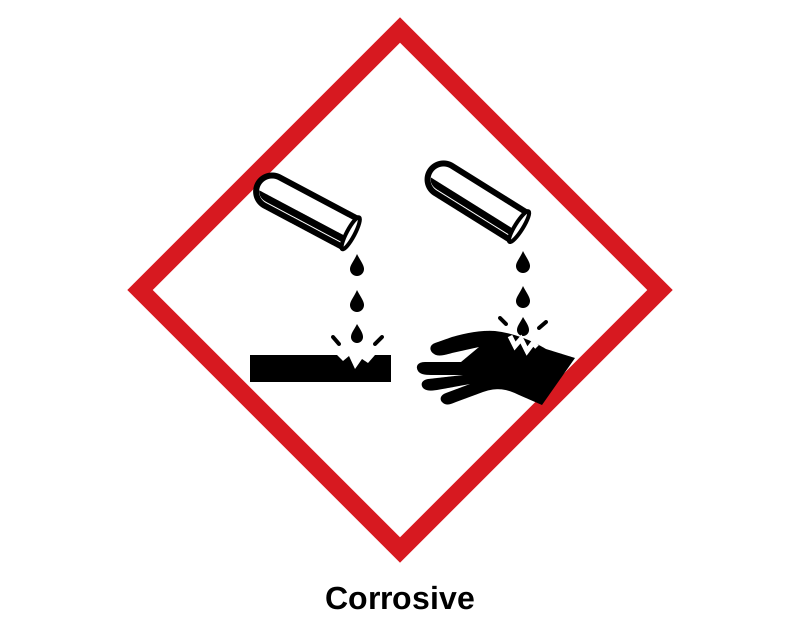
Always wear safety goggles and gloves when you handle corrosive chemicals in the lab. The hazard label shows liquid spilling from two test tubes, burning into a metal bar and a hand.
Indicators and the pH Scale
You cannot taste laboratory chemicals, so you use indicators to spot acids and bases safely. Litmus changes colour quickly, but it will not tell you how strong a solution is.
- Blue litmus paper turns red in an acid.
- Red litmus paper turns blue in a base.
- Neutral solutions leave both colours of litmus unchanged.
- Universal indicator shows a spectrum of colours linked to numbers from 0 to 14.
- A digital pH meter gives the most accurate numerical reading.
| Type of Solution | pH Range | Universal Indicator Colour |
|---|---|---|
| Strongly acidic | 0 to 3 | Red |
| Weakly acidic | 4 to 6 | Orange or yellow |
| Neutral | 7 | Green |
| Weakly basic (alkaline) | 8 to 10 | Blue |
| Strongly basic (alkaline) | 11 to 14 | Purple |
Adding water dilutes an acid or base and pulls its pH value closer to 7.
Neutralisation Reactions
Neutralisation happens when an acid and a base cancel each other out to make a salt and water. The type of salt depends on the acid you choose.
- Hydrochloric acid makes chloride salts, sulfuric acid makes sulfates, and nitric acid makes nitrates.
- Neutralisation is exothermic, meaning it gives out heat and warms the flask.
- Antacid tablets contain mild bases like magnesium hydroxide to settle excess stomach acid.
- Farmers spread crushed limestone on acidic soil to bring the pH back up for crops.
Reactions with Carbonates and Metals
Acids also react with carbonates and metals to produce characteristic gases.
Acid and Carbonate Reaction
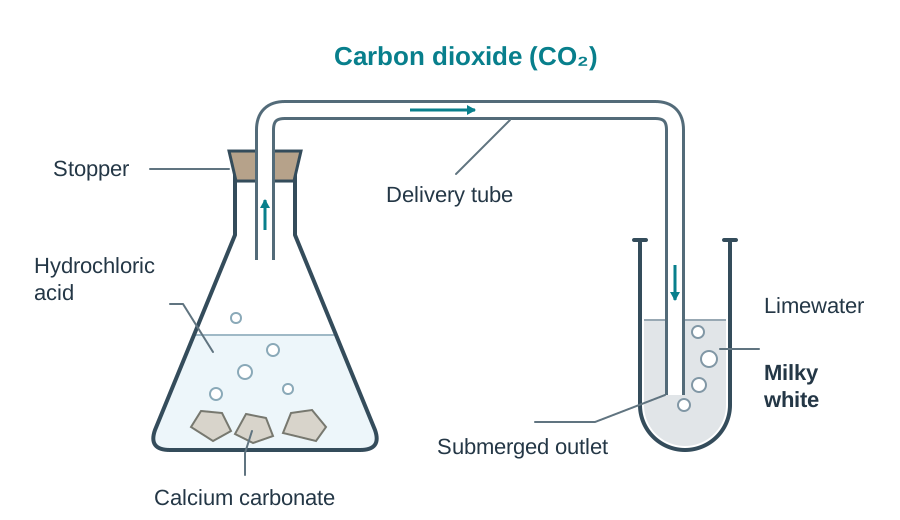
When an acid reacts with a carbonate, it fizzes and releases carbon dioxide gas:
Bubbling this gas through limewater turns the limewater milky white. A lit splint held in carbon dioxide goes out at once.
Acid and Metal Reaction
Acids react with reactive metals such as magnesium or zinc to produce hydrogen gas:
Holding a lit splint to the mouth of the test tube produces a sharp pop sound as the hydrogen burns.
Key terms
- Acid
- A substance with a pH below 7 that turns blue litmus paper red.
- Base
- A substance that reacts with an acid to form a salt and water.
- Alkali
- A base that dissolves in water to produce an alkaline solution.
- Indicator
- A chemical dye that changes colour depending on whether a solution is acidic or basic.
- pH Scale
- A scale from 0 to 14 measuring how acidic or basic a substance is.
- Neutralisation
- A chemical reaction between an acid and a base that produces a salt and water.
- Salt
- A compound formed when the hydrogen in an acid is replaced by a metal.
- Exothermic
- A reaction that gives out heat energy to its surroundings.
Check yourself
What colour does red litmus paper turn in a basic solution?
It turns blue.
Which solution is more acidic: pH 2 or pH 5?
pH 2, because the lower the pH below 7, the more acidic the solution.
What two products form when an acid reacts with a base?
A salt and water.
What gas turns limewater milky?
Carbon dioxide.
Why does the temperature rise when an acid reacts with an alkali?
The neutralisation reaction is exothermic and releases heat energy.