
Elements are grouped as metals or non-metals, and the two groups behave very differently. Junior Cycle questions regularly test classifying elements from property data, predicting physical states at 20 °C, explaining rusting conditions, and linking metal uses to specific properties.
Comparing Metals and Non-Metals
Metals sit on the left and centre of the Periodic Table, while non-metals sit on the right.
| Property | Metals | Non-Metals |
|---|---|---|
| Appearance | Shiny (lustrous) when clean | Dull surface when solid |
| Electrical conductivity | Good conductors | Poor conductors (graphite is the exception) |
| Thermal conductivity | Good heat conductors | Poor heat conductors |
| Shaping | Malleable and ductile | Brittle as solids (shatter easily) |
| Melting and boiling points | High (except mercury) | Usually lower |
| State at 20 °C | Solids (except mercury, a liquid) | Solids, one liquid (bromine), or gases |
- Malleable means a material can be hammered or pressed into shapes without breaking.
- Ductile means a material can be stretched and drawn into thin wires.
- Copper is ductile and a good electrical conductor, making it ideal for electrical wiring.
- Aluminium is light, strong, and does not corrode easily, so it is used in aeroplane bodies and cans.
- Gold is shiny and unreactive, which makes it suitable for jewellery and coins.
Testing Properties and Predicting State
Material properties and reactions you may be asked about. Conductivity and reaction with acid are the tests that tell metals from non-metals:
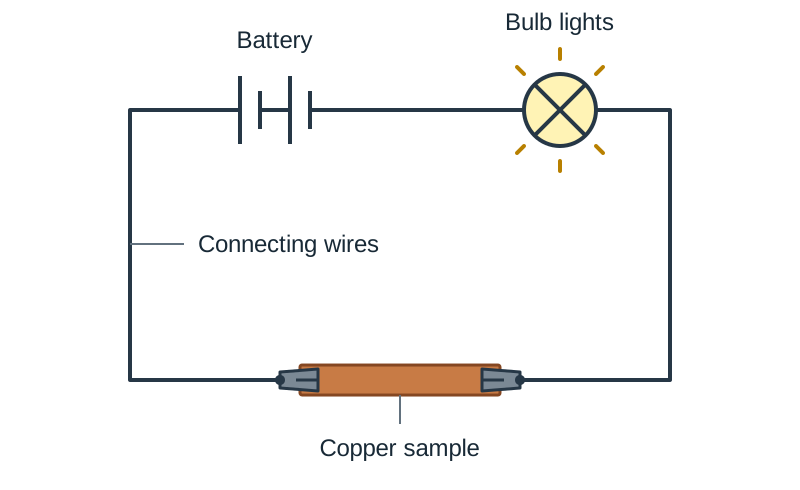
- Electrical conductivity: place the sample in a circuit with a battery and bulb; metals complete the circuit and the bulb lights.
- Solubility: stir a measured mass into water; pure metals do not dissolve in water, but many metal compounds do.
- Chemical reaction: metals react with acids to produce hydrogen gas (zinc + hydrochloric acid → zinc chloride + hydrogen). A lighted splint held at the tube mouth produces a squeaky pop.
- Combining ratios: metals combine with non-metals in predictable atomic ratios, such as a 1:1 ratio for Group 1 with Group 7 (NaCl) and a 1:2 ratio for Group 2 with Group 7 (MgCl₂).
To identify physical state at 20 °C from data:
- Solid: melting point is above 20 °C.
- Liquid: melting point is below 20 °C, but boiling point is above 20 °C.
- Gas: boiling point is below 20 °C.
Alloys and Their Uses
An alloy is a mixture of two or more elements, where at least one element is a metal. Alloys are mixtures, not chemical compounds.
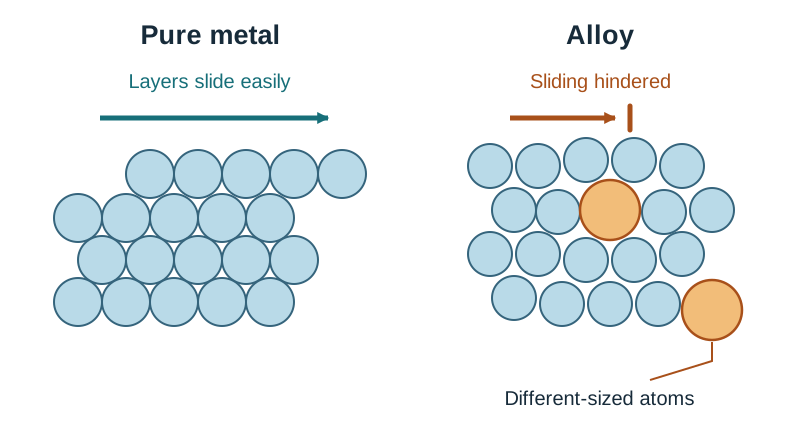
- Pure metals contain uniform rows of identical atoms that slide over each other easily, making pure metals relatively soft.
- In an alloy, the different-sized atoms stop the layers sliding, so the alloy is harder than the pure metal.
Two common alloys:
- Steel (iron and carbon): much stronger and harder than pure iron; used in building girders and car bodies.
- Brass (copper and zinc): hard and does not corrode easily; used for musical instruments and door handles.
Rusting and Material Sustainability
Rusting is the corrosion of iron and steel.
iron + oxygen + water → hydrated iron oxide (rust)
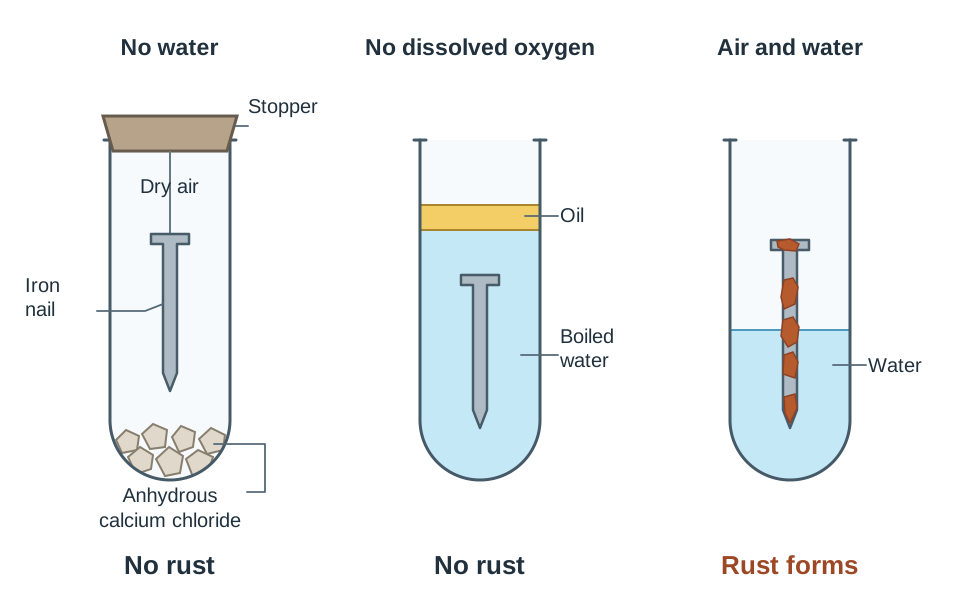
Both oxygen and water must be present together for rust to form:
- Nail in dry air with anhydrous calcium chloride: no rust (no water).
- Nail in boiled water sealed with an oil layer: no rust (no dissolved oxygen).
- Nail in open water and air: rust forms.
Methods of prevention include:
- Painting, oiling, and greasing: create a barrier against air and moisture.
- Galvanising: coating iron or steel with zinc. The zinc coating keeps air and water off the iron, and the zinc reacts instead of the iron even if the coating is scratched.
Sustainability: extracting metals from raw ores consumes vast energy and depletes non-renewable resources, whereas recycling scrap metal conserves ores and uses far less energy.
Key terms
- Alloy
- A mixture of two or more elements, at least one of which is a metal.
- Malleable
- Able to be hammered or pressed into shape without breaking.
- Ductile
- Able to be stretched and drawn out into thin wires.
- Corrosion
- The chemical breakdown and wearing away of a metal when it reacts with air and water.
- Rusting
- The specific corrosion of iron or steel by reaction with oxygen and water to form hydrated iron oxide.
- Galvanising
- Coating iron or steel with a protective layer of zinc to prevent rust.
Check yourself
Which metal is a liquid at room temperature (20 °C)?
Mercury.
Why is an alloy harder than a pure metal?
Differently sized atoms disrupt the regular rows, preventing the layers from sliding over each other.
What gas is produced when zinc reacts with hydrochloric acid, and what is the test for it?
Hydrogen; it burns with a squeaky pop when tested with a lighted splint.
Which metal is coated onto iron during galvanising?
Zinc.