
Chemical compounds contain different elements chemically joined in fixed numerical ratios of atoms, represented by chemical formulae. In the Junior Cycle examination, you will use the Periodic Table to determine combining power and predict or justify these ratios.
Groups, Outer Electrons, and Valency
Atoms bond to achieve a stable outer electron shell. The electrons in an atom's outermost shell are called valence electrons. The valency of an atom is its combining power.
| Group | Valence Electrons | Valency | Common Examples |
|---|---|---|---|
| Group 1 | 1 | 1 | H, Li, Na, K |
| Group 2 | 2 | 2 | Mg, Ca |
| Group 13 | 3 | 3 | Al |
| Group 14 | 4 | 4 | C, Si |
| Group 15 | 5 | 3 | N, P |
| Group 16 | 6 | 2 | O, S |
| Group 17 | 7 | 1 | F, Cl, Br |
| Group 18 | 8 (helium has 2) | 0 | Ne, Ar |
- Groups 1, 2, 13 and 14 have a valency equal to their number of outer electrons.
- Groups 15 to 17 have a valency equal to 8 minus their number of outer electrons.
- Group 18 noble gases have full outer shells, so they have a valency of 0 and do not form compounds.
Finding Position and the Crossover Method
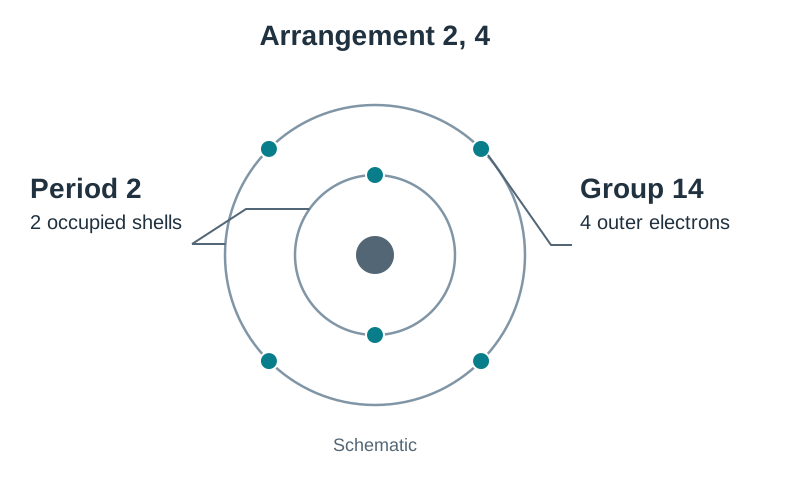
The number of outer electrons gives an atom's group (1, 2, 3 or 4 outer electrons means Group 1, 2, 13 or 14; 5, 6, 7 or 8 means Group 15, 16, 17 or 18). The number of occupied shells gives its period. For example, an atom with arrangement 2, 4 sits in Period 2, Group 14.
In a binary compound, the total combining power of one element must equal the total combining power of the other.
Use the four-step crossover method:
- Write the symbols of both elements side by side (metal or left-hand element first).
- Write each element's valency below its symbol.
- Swap the valency numbers across to find the combining ratio.
- Simplify to the simplest whole-number ratio, omitting any subscript of 1.
Magnesium (valency 2) and oxygen (valency 2) swap to 2:2, simplifying to 1:1 (). Carbon (valency 4) and oxygen (valency 2) swap to 2:4, simplifying to 1:2 ().
Naming Binary Compounds
Once you work out a chemical formula, you can name the compound using standard rules:
- Write the metal (or left-hand element) name first, then change the second element's ending to -ide: is sodium chloride, is magnesium oxide, and is calcium chloride.
- When both elements are non-metals, prefixes show the number of atoms present: is carbon monoxide, and is carbon dioxide.
Formulae and Interlocking Models
A subscript written after a chemical symbol shows how many atoms of that element are present. If no number is written, exactly one atom is present.
- Formula ratios describe counts of individual atoms, not their masses.
- Distinguish between elements and atoms: contains two different elements, but five total atoms (2 aluminium, 3 oxygen).
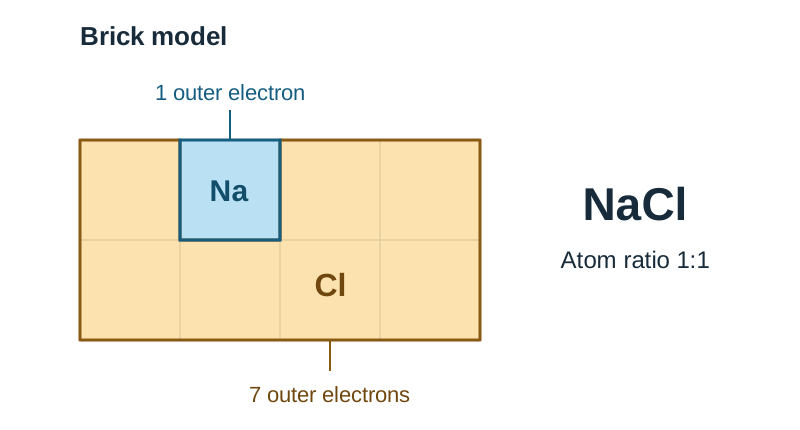
- A question may ask you to model a compound using interlocking bricks or particle diagrams.
- In brick models, the size of each piece shows the number of outer electrons, and the pieces only interlock when the combining powers match.
Key terms
- Element
- A pure substance made of only one type of atom that cannot be broken down chemically into simpler substances.
- Compound
- A substance formed when two or more different elements chemically combine in a fixed ratio.
- Binary compound
- A chemical compound composed of exactly two different elements.
- Valence electrons
- The electrons located in the outermost occupied shell of an atom.
- Valency
- The combining power of an atom, determined by the number of electrons it loses, gains, or shares to achieve a full outer shell.
- Chemical formula
- A shorthand notation using symbols and subscript numbers to show the elements and ratio of atoms in a substance.
Check yourself
What is the valency of calcium (Group 2)?
2
What is the atom ratio of nitrogen to hydrogen in ammonia (NH3)?
1:3 (one nitrogen atom to three hydrogen atoms).
Name the compound with the formula MgO.
Magnesium oxide.
Predict the chemical formula for the compound formed between sodium (Group 1) and sulfur (Group 16).
Na2S, because sodium has valency 1 and sulfur has valency 2.
How many total atoms and how many different elements are present in one unit of calcium chloride (CaCl2)?
Two different elements (Ca and Cl) and three total atoms (one calcium atom and two chlorine atoms).