
Reaction rate measures how fast reactants turn into products during a chemical reaction. For your Junior Cycle exam, you need to read rate graphs, explain collisions and energy profiles, and describe what changes reaction speeds.
Measuring Reaction Rates and Reading Graphs
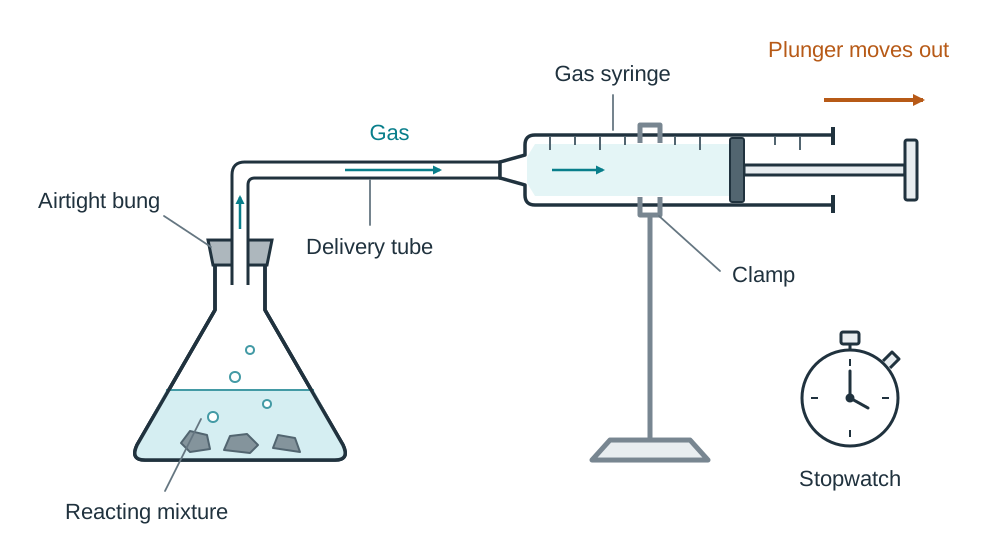
We measure reaction rates by checking how quickly reactants disappear or new products form over time. When a reaction makes a gas, we can catch it in a gas syringe or let it escape from a flask on an electronic balance.
Rate curves plotted over time share three key stages:
- The curve is steepest at the start because plenty of reactant particles are colliding.
- The slope becomes gentler as reactants are used up and collisions drop off.
- The line goes completely horizontal when the reaction finishes because at least one reactant has run out.
A steeper slope always means a faster reaction, while the height of the flat plateau tells you the total amount of product formed.
Collision Theory and Energy Profiles
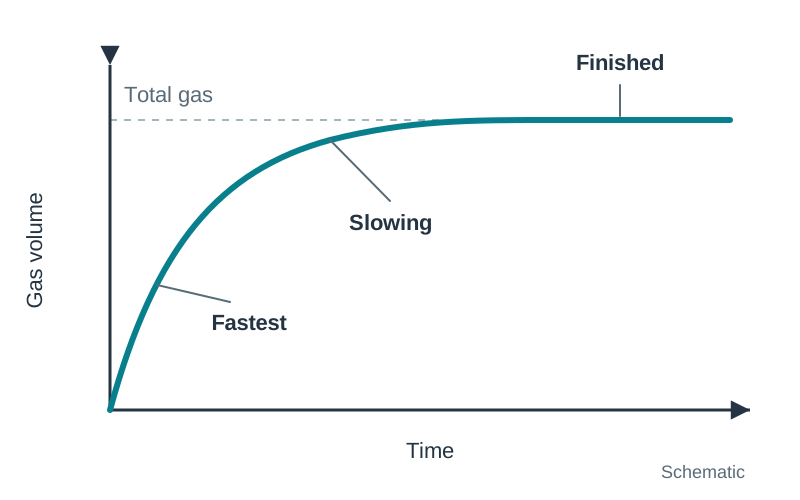
For a reaction to take place, particles have to bump into each other with enough energy. The minimum energy needed for a collision to actually work is called the activation energy.
Energy profile diagrams show how energy changes from start to finish:
- Exothermic reactions give out heat to the surroundings, meaning products finish lower than reactants.
- Endothermic reactions take in heat from the surroundings, so products finish higher than reactants.
- Activation energy is shown as the height from the reactant line up to the top peak of the curve.
- A catalyst lowers this peak by offering an easier pathway, leaving starting and ending energy levels untouched.
Variables That Change Reaction Rates
You can speed up any reaction by getting particles to collide more often or with greater energy.
| Variable | What the particles do | Effect on rate |
|---|---|---|
| Higher temperature | Particles move faster and hit each other with more energy | Speeds up |
| Higher concentration | Particles crowd closer together in the same volume, causing more collisions | Speeds up |
| Smaller particle size | Breaking solids into powder exposes far more surface area | Speeds up |
| Adding a catalyst | Gives an alternative route that lowers the activation energy | Speeds up |
The choice of reactant also matters. For example, magnesium ribbon reacts much faster with acid than zinc does because magnesium is more reactive.
Producing Common Gases and Biochemical Reactions
Examiners regularly ask about three classic laboratory reactions that produce gases:
- Oxygen is made by breaking down hydrogen peroxide with manganese dioxide, and it relights a glowing wooden splint.
- Carbon dioxide is made by reacting hydrochloric acid with marble chips, and it turns limewater milky.
- Hydrogen is made from hydrochloric acid and magnesium ribbon, and it burns with a squeaky pop.
Living organisms rely on biological catalysts called enzymes to speed up cellular reactions. Catalase in raw potato breaks down toxic hydrogen peroxide into water and oxygen gas. If temperatures climb too high, enzymes denature and stop working.
Key terms
- Rate of reaction
- The change in concentration of any one reactant or product per unit time.
- Activation energy
- The minimum energy that colliding particles must have for a chemical reaction to occur.
- Catalyst
- A substance that speeds up a chemical reaction without being used up itself.
- Enzyme
- A biological catalyst made of protein that speeds up biochemical reactions in living cells.
- Exothermic
- A reaction that releases heat energy to its surroundings, causing a rise in temperature.
- Endothermic
- A reaction that takes in heat energy from its surroundings, causing a drop in temperature.
- Variable
- Any factor in an experiment that can be changed, controlled, or measured.
Check yourself
Which gas turns limewater milky when calcium carbonate reacts with hydrochloric acid?
Carbon dioxide.
Why does a higher acid concentration speed up a reaction with magnesium?
More acid particles are packed into the same volume, leading to more frequent collisions.
How does a catalyst lower the activation energy of a reaction?
It provides an alternative reaction pathway that requires less energy.
What happens to an enzyme if it is heated well beyond its optimum temperature?
It denatures and permanently loses its ability to catalyse reactions.