
Everything around us is made of matter, which can be sorted into elements, compounds and mixtures depending on whether atoms are chemically joined. In the Junior Cycle examination, you will classify substances, predict chemical formulas using the Periodic Table, and describe experiments used to separate mixtures.
Elements, Metals and Non-Metals
An element is a pure substance made of only one type of atom (the smallest particle of an element) that cannot be broken down into simpler substances by chemical reactions. Every element is listed on the Periodic Table with a unique chemical symbol starting with a capital letter.
- Substances are also classified by their physical state at room temperature: solid (iron, sulfur), liquid (water, ethanol), or gas (oxygen, hydrogen).
- Metals are shiny, conduct heat and electricity, have high melting points, and are malleable (can be hammered into shape), such as copper, iron and aluminium.
- Non-metals are dull, do not conduct electricity, have low melting points, and are brittle, such as sulfur and oxygen.
- To justify that an unknown element is a metal in an exam question, state that it conducts electricity and has a high melting point.
Compounds and Predicting Formulas
A compound consists of two or more different elements chemically combined in a fixed ratio. For example, reactive sodium metal and poisonous chlorine gas react to form harmless table salt, sodium chloride ().
- Each different capital letter is a different element. A small number applies only to the symbol just before it; no number means one atom.
- Valency (how many bonds an atom can form) comes from outer-shell electrons.
- Across the groups: Group 1 = 1, Group 2 = 2, Group 13 = 3, Group 14 = 4, Group 15 = 3, Group 16 = 2, Group 17 = 1, Group 18 = 0 (noble gases do not form compounds). Group 17 is sometimes called Group 7, and Group 18 called Group 8.
- If the two valencies are the same, the ratio is 1:1 (, ). If they are different, swap the numbers: carbon (valency 4) combines with hydrogen (valency 1) to form , and magnesium (valency 2) with chlorine (valency 1) gives .
Mixtures and Separation Techniques
A mixture contains two or more substances mixed together but not chemically combined. A solution is a mixture where a solute dissolves evenly into a solvent, such as salt in water. Mixtures are separated using physical methods:
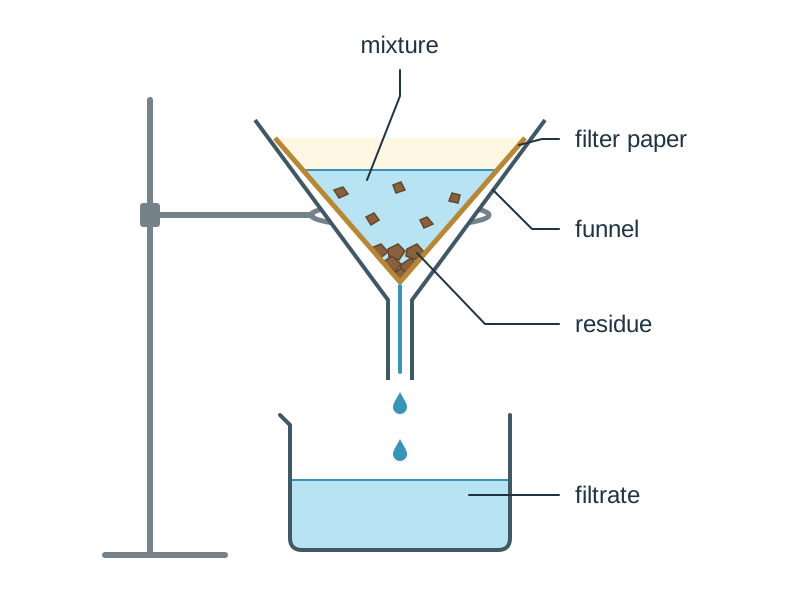
- Filtration: Separates an insoluble solid from a liquid. The solid trapped on the filter paper is the residue; the liquid passing through is the filtrate.
- Evaporation: Separates a dissolved solid from a liquid by boiling off the liquid, leaving crystals behind.
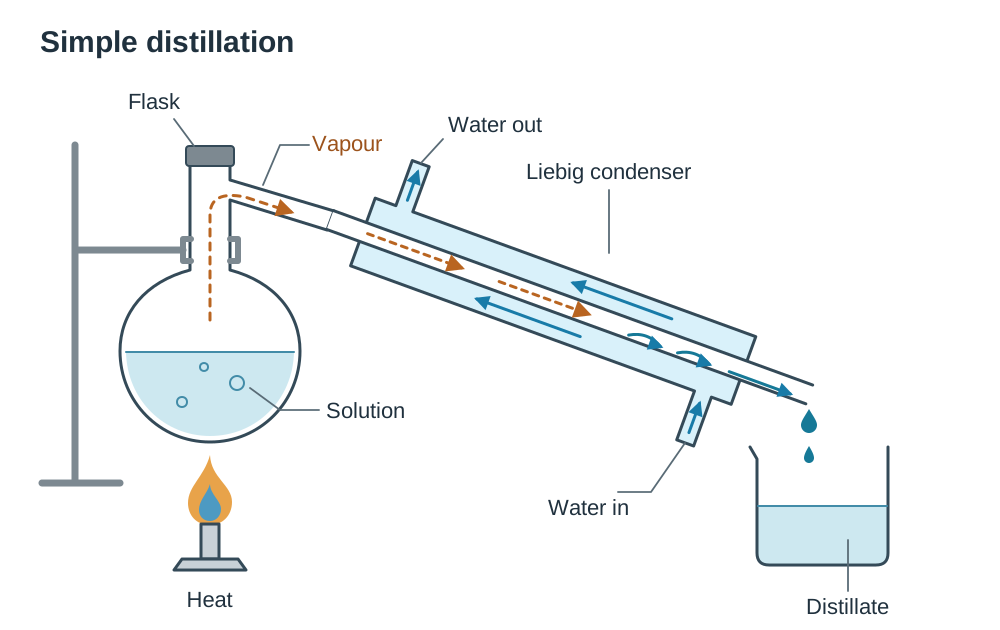
- Distillation: Separates a liquid from a solution using a flask, a heat source, a Liebig condenser to cool vapour into liquid, and a beaker to collect the distillate.
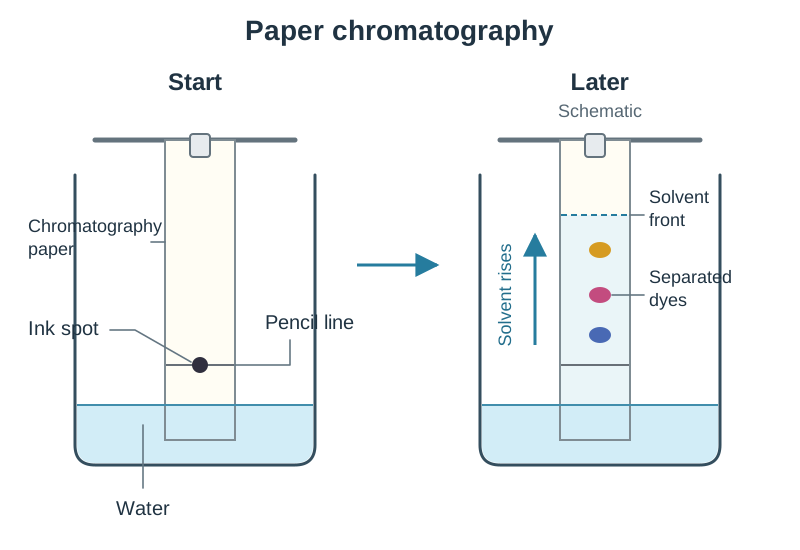
- Paper chromatography: Draw a pencil line near the bottom of chromatography paper and place an ink spot on it. Stand the paper in a beaker of water with the spot above the water level. The solvent rises and carries dyes different distances, separating the colours.
Comparing Elements, Compounds and Mixtures
Use this table to distinguish between the three classes of matter:
| Feature | Element | Compound | Mixture |
|---|---|---|---|
| Composition | Only one type of atom | Two or more elements | Two or more substances |
| Bonding | Atoms of same type | Joined by chemical bonds | Not chemically combined |
| Proportions | Pure single substance | Fixed, definite ratio | Variable amounts |
| Properties | Unique properties | Completely new properties | Keeps individual properties |
| Separation | Cannot be broken down | Separated only by chemical reactions | Separated easily by physical methods |
In particle diagrams, elements show identical single or paired circles, compounds show different circles joined together, and mixtures show unbonded particles mingled together.
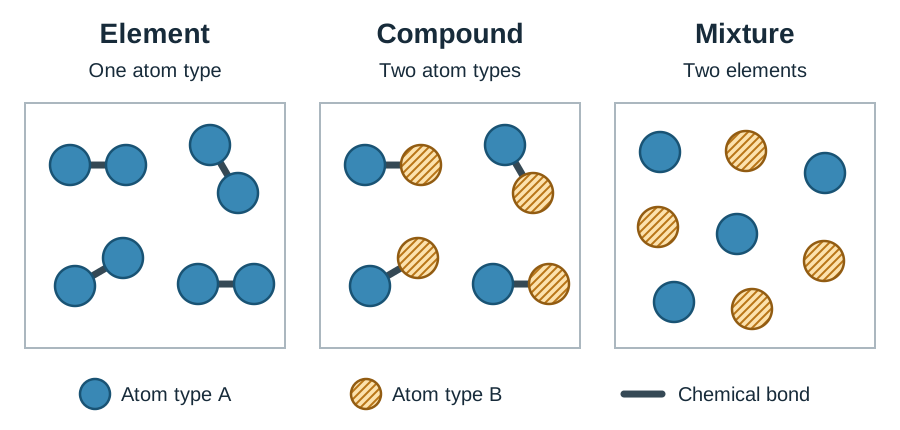
Key terms
- Element
- A pure substance that contains only one type of atom and cannot be broken down into anything simpler by chemical reactions.
- Compound
- A pure substance formed when two or more different elements chemically combine in a fixed ratio.
- Mixture
- Two or more substances mixed together but not chemically combined.
- Valency
- The combining capacity of an atom, showing how many chemical bonds it can form based on its outer-shell electrons.
- Solution
- A uniform mixture formed when a solute dissolves completely into a solvent.
- Distillation
- A separation method that boils a liquid into vapour and condenses it back to a pure liquid using a condenser.
- Chromatography
- Separating dissolved coloured substances by letting a solvent carry them up a strip of paper.
Check yourself
An element melts at 1538 °C and conducts electricity. Is it a metal or a non-metal?
A metal, because metals are good electrical conductors and have high melting points.
How many elements and total atoms are in one molecule of carbon dioxide (CO₂)?
Two elements (carbon and oxygen) and three total atoms (one carbon atom and two oxygen atoms).
What is the formula of the compound formed between carbon (Group 14) and hydrogen (Group 1)?
, because carbon has a valency of 4 and hydrogen has a valency of 1.
In paper chromatography of ink, why must the pencil line sit above the solvent level at the start?
To prevent the ink spot from dissolving directly into the solvent in the beaker rather than travelling up the paper.