
An atom is the basic building block of all matter, made of a dense central nucleus surrounded by orbiting electrons. In the Junior Cycle examination, you need to describe and model this structure, compare the three subatomic particles, and calculate proton, neutron, and electron numbers.
1. Inside the Atom
An atom is the smallest particle of an element that still has the chemical properties of that element.
- The nucleus is the tiny, dense centre of the atom containing protons and neutrons.
- Electrons orbit outside the nucleus in pathways called shells.
- Almost all of an atom's mass is packed into the nucleus.
- If an atom were the size of a GAA pitch, the nucleus would be like a coin placed at the centre.
- In the Bohr planetary model, electrons orbit the central nucleus just as planets orbit the Sun.
- An element is made of only one type of atom; a compound is made of two or more types of atom chemically joined, such as water (H₂O).
2. Comparing Subatomic Particles
Atoms contain three subatomic particles, each with a distinct location, relative mass, and electrical charge:
| Particle | Location | Relative Mass | Relative Charge |
|---|---|---|---|
| Proton | Nucleus | 1 | +1 |
| Neutron | Nucleus | 1 | 0 (neutral) |
| Electron | Shells outside the nucleus | 1/1840 (almost zero) | −1 |
- Protons and neutrons have equal masses of 1.
- Electrons are tiny and have an almost zero mass, roughly 1,840 times lighter than a proton.
- Protons and electrons carry equal-sized charges with opposite signs.
- Remember PEN: Protons are Positive (+1), Electrons are negative (−1), Neutrons are neutral (0).
3. Atomic Number, Mass Number, and Counting Particles
Two numbers on the Periodic Table tell you how an atom is put together:
- Atomic number is the number of protons in the nucleus and identifies the element.
- Mass number is the total number of protons and neutrons added together in the nucleus.
- In any neutral atom, the number of electrons equals the number of protons, so the positive and negative charges cancel out.
- Remember MAN: Mass number minus Atomic number gives Neutrons (neutrons = mass number − atomic number).
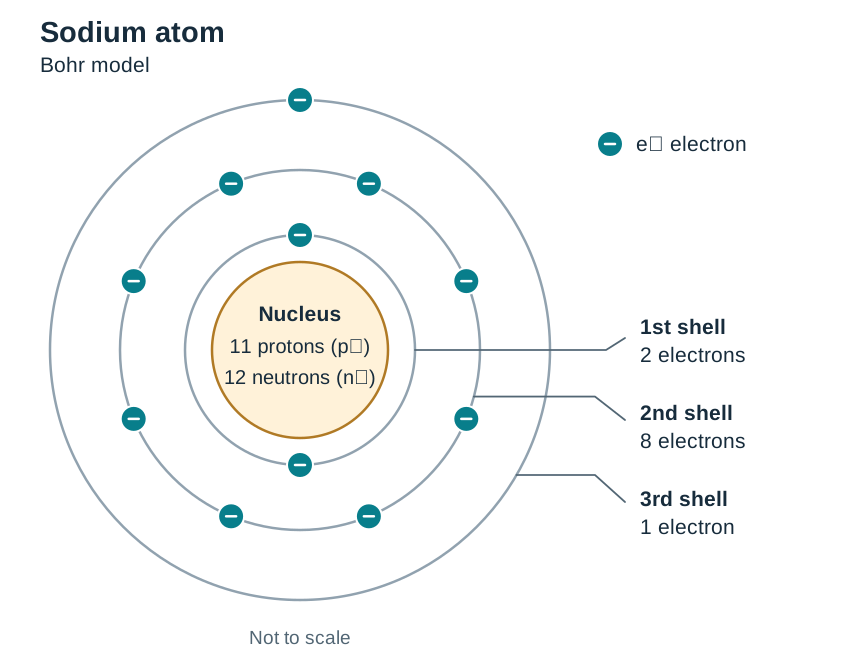
- Count the protons, then find that number on the Periodic Table to name the element: 7 protons means nitrogen, 11 protons means sodium.
4. Drawing and Using Atomic Models
A scientific model helps us picture structures that are too small to see directly.
- In a Bohr model, you draw the nucleus at the centre with electron shells as rings around it.
- Protons and neutrons are written or drawn inside the central nucleus.
- The first electron shell holds a maximum of 2 electrons.
- The second shell holds up to 8 electrons, and the third shell holds up to 8 electrons.
- Scientists update or replace scientific models whenever new experimental evidence is discovered.
Key terms
- Atom
- The smallest unit of an element that retains the chemical properties of that element.
- Nucleus
- The dense, positively charged central core of an atom containing protons and neutrons.
- Proton
- A positively charged subatomic particle (+1) with a relative mass of 1, found in the nucleus.
- Neutron
- A neutral subatomic particle (0) with a relative mass of 1, found in the nucleus.
- Electron
- A negatively charged subatomic particle (−1) with almost zero mass (1/1840), orbiting the nucleus in shells.
- Atomic Number
- The number of protons found in the nucleus of an atom.
- Mass Number
- The total number of protons and neutrons combined in the nucleus of an atom.
Check yourself
Which two subatomic particles are located inside the nucleus?
Protons and neutrons.
Why does a neutral atom carry no overall electrical charge?
It contains equal numbers of positive protons and negative electrons that cancel each other out.
An atom of fluorine has an atomic number of 9 and a mass number of 19. How many neutrons does it have?
10 neutrons (19 − 9 = 10).
What is the maximum number of electrons that can fit in the first electron shell?
2 electrons.
Why is Bohr's model of the atom called a 'planetary model'?
Because the electrons orbit the nucleus in the same way that planets orbit the Sun.