
Matter is anything that has mass and takes up space, existing as a solid, liquid, or gas. In the Junior Cycle exam, you need to describe these states using the particle model, explain changes of state and heating curves, and show that mass is conserved during physical changes.
The Three States and Their Particles
All matter is made of tiny, constantly moving particles. How these particles are arranged gives each state its distinct properties:
| Property | Solid | Liquid | Gas |
|---|---|---|---|
| Shape | Fixed | Takes container's shape | Fills entire container |
| Volume | Fixed | Fixed | Spreads out to fill space |
| Flow | Does not flow | Flows easily | Flows and spreads out quickly |
| Compressibility | Difficult to compress | Difficult to compress | Easy to compress |
| Particle arrangement | Touching, regular rows, vibrating in place | Touching, irregular, sliding past each other | Far apart, moving fast in all directions |
In exam diagrams, draw solids as touching circles in neat rows, liquids as touching circles in a jumbled arrangement, and gases as widely spaced circles.
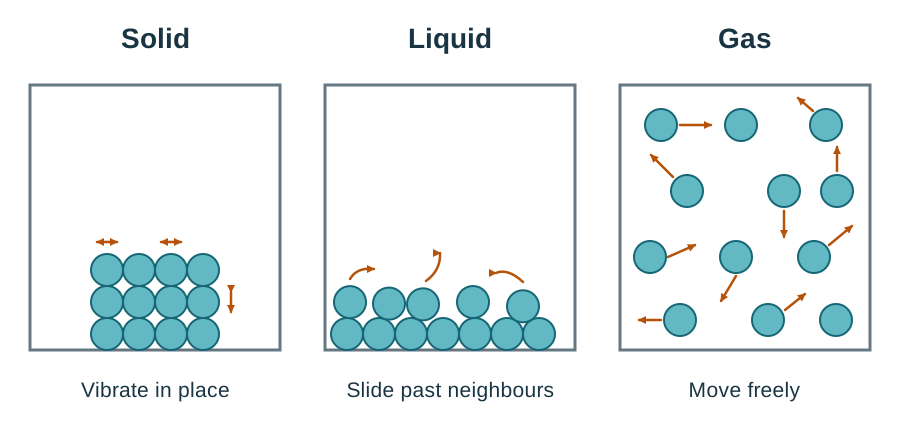
Diffusion is the spreading out of particles from an area of high concentration to low concentration. It happens quickly in gases, slowly in liquids, and does not noticeably happen in solids because the particles cannot move from their fixed positions.
Changes of State and Heating Curves
Heating or cooling changes the energy and arrangement of particles:
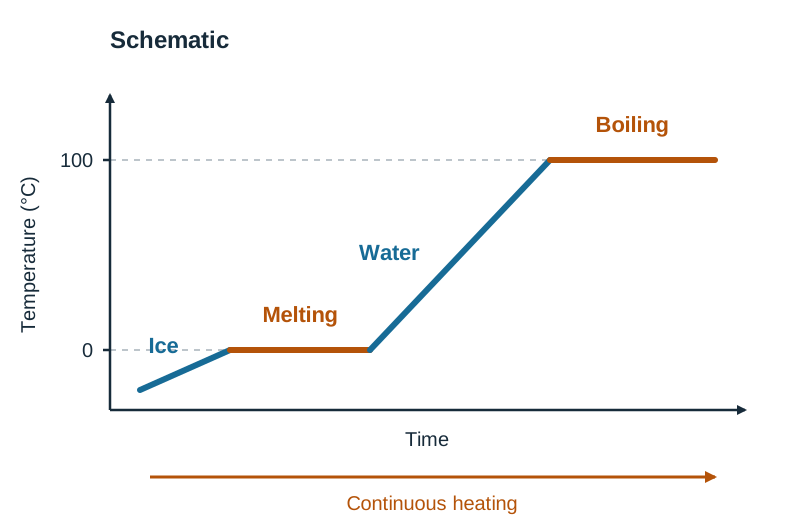
- Melting (0 °C for ice): A solid absorbs heat, particles vibrate faster, and they break free from fixed positions to become a liquid.
- Freezing: A liquid cools, particles slow down, and they lock into fixed positions.
- Evaporation: A liquid turns into a gas only at the surface, at any temperature below the boiling point.
- Boiling (100 °C for water): A liquid turns into a gas throughout the entire liquid at a fixed temperature.
- Condensation: A gas cools and turns back into a liquid.
- Sublimation: A solid turns directly into a gas without melting first, such as dry ice.
Finding a melting or boiling point:
- Heat the substance gently with the thermometer bulb in the substance, not touching the beaker.
- Record the temperature every 30 seconds and plot temperature on the y-axis against time on the x-axis.
- On the graph, the line stays flat during melting and boiling because the heat energy is used to break forces between particles instead of raising the temperature.
Physical Change and Conservation of Mass
It is vital to distinguish state changes from chemical reactions:
- In a physical change, no new substance is formed and the change can be reversed by heating or cooling, such as ice melting.
- In a chemical change, a new substance is formed and the change is not easily reversed, such as methane burning or iron rusting.
Conservation of mass states that total mass stays unchanged during any physical or chemical change because no particles are created or destroyed:
- Melting 50 g of ice produces exactly 50 g of water.
- If a puddle dries up or water boils in an open beaker, the mass seems to disappear only because water vapour escapes into the air. In a closed container, total mass is fully conserved.
Key terms
- Matter
- Anything that has mass and takes up space.
- Diffusion
- The spreading out of particles from an area of high concentration to an area of low concentration.
- Melting point
- The specific temperature at which a solid changes into a liquid throughout.
- Boiling point
- The specific temperature at which a liquid changes to a gas throughout the liquid.
- Evaporation
- The change from a liquid to a gas that occurs only at the surface below the boiling point.
- Physical change
- A change in which no new substance is formed and the process can be reversed.
- Chemical change
- A change in which a new substance is formed and the process is not easily reversed.
- Solution
- A mixture formed when a solid (the solute) dissolves completely in a liquid (the solvent); dissolving is a physical change, not melting.
Check yourself
Why can gases be compressed easily, whereas liquids and solids cannot?
Gas particles are spaced far apart with large empty spaces between them, while particles in liquids and solids are already touching.
What happens to the temperature of water while it is boiling?
The temperature stays constant at 100 °C until all the liquid has turned to gas.
Where is the thermometer bulb placed when finding the boiling point of water?
In the water itself, without touching the bottom or sides of the beaker.
Give two differences between a physical change and a chemical change.
In a physical change no new substance is made and it is easily reversed; in a chemical change a new substance is made and it is hard to reverse.
If 35 g of ice melts inside an airtight sealed flask, what will the mass of the liquid water be?
35 g, because mass is conserved during a physical change in a closed system.