
A mixture contains two or more substances mixed together but not chemically combined, so they can be separated using physical methods. The Junior Cycle exam tests your ability to choose the right technique, sketch or label apparatus accurately, and explain how differences in physical properties make each separation work.
Mixtures and Choosing a Separation Method
A mixture is two or more substances mixed together but not chemically combined. Because no chemical bonds form, the substances keep their individual properties and can be separated by physical methods.
| Mixture Type | Separation Method | Physical Property Exploited |
|---|---|---|
| Insoluble solid in a liquid | Filtration | Particle size and solubility |
| Soluble solid in a liquid | Evaporation | The liquid turns to vapour on heating; the solid does not |
| Liquid from a solution or liquids that mix | Distillation | Differences in boiling point |
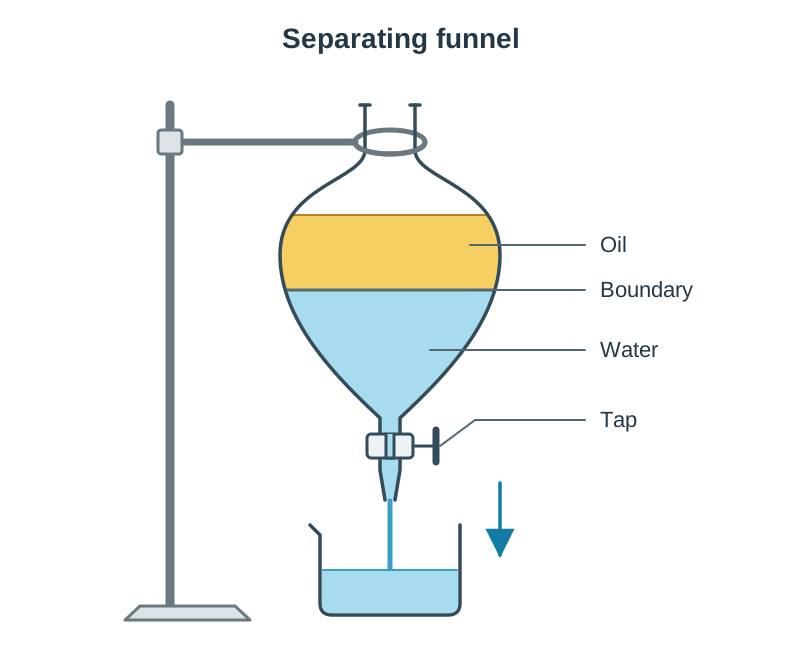
| Two liquids that do not mix (e.g. oil and water) | Separating funnel | Different densities — the denser liquid sinks to the bottom |
| Soluble coloured dyes | Paper chromatography | Differences in solubility in a solvent |
| Magnetic solid mixed with non-magnetic solid | Magnetism | Magnetic attraction |
For magnetism, passing a magnet over a mixture of iron filings and sulfur powder removes the magnetic iron, leaving the yellow sulfur behind. For a separating funnel, let the two layers settle, then open the tap to run off the bottom layer, closing it as soon as the boundary reaches the tap.
Mass is conserved: the parts you separate out add up to the mass of the original mixture, unless some escapes as vapour.
Filtration and Evaporation
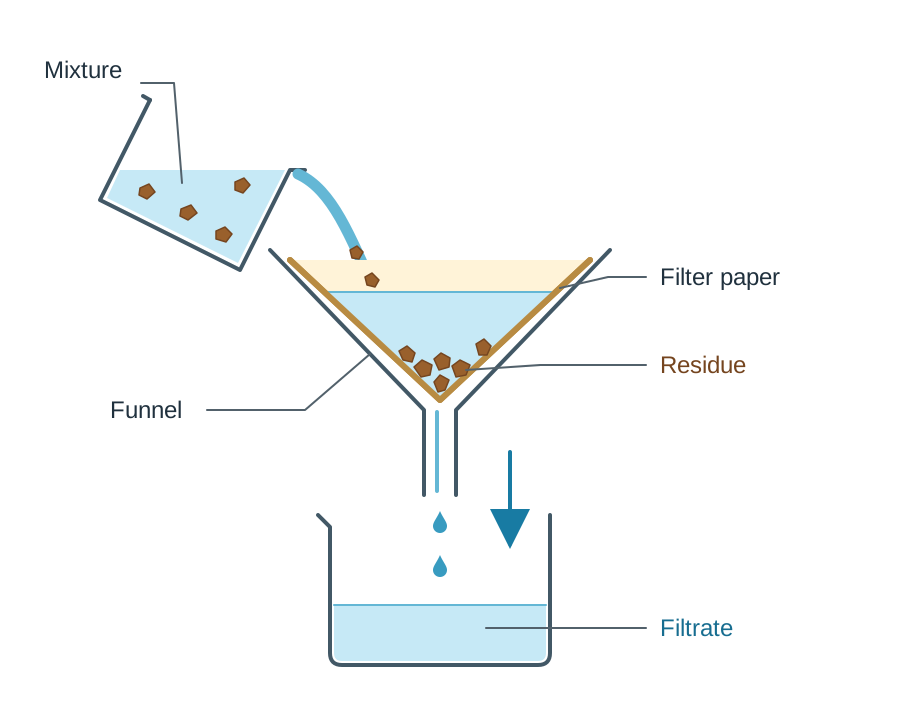
Filtration separates an insoluble solid from a liquid. An insoluble solid does not dissolve in the liquid.
- Pour the mixture into a glass funnel lined with folded filter paper.
- The liquid passes through tiny holes in the filter paper and is collected below as the filtrate.
- Larger solid particles cannot fit through the holes and stay behind on the paper as the residue.
- Useful memory aid: Residue Remains, Filtrate Flows.
Evaporation separates a dissolved solid from a liquid when you only need to keep the solid. Pour the solution into an evaporating basin and heat it with a Bunsen burner. The liquid evaporates off into the air, leaving dry crystals behind. Stop heating before the basin is fully dry, or hot crystals can spit out. Let the last of the liquid evaporate on its own.
Simple Distillation
Distillation separates and collects a liquid from a solution, or separates two liquids that mix together, such as alcohol and water, if they boil at different temperatures. It works by combining boiling and condensing.
- Heat the mixture in a distillation flask with anti-bumping chips, which keep the boiling smooth.
- The liquid with the lower boiling point vaporises first.
- The vapour rises and passes into the inner tube of a Liebig condenser.
- Cold water enters the outer cooling jacket at the bottom and exits at the top, keeping the jacket completely full.
- The vapour cools, condenses back to a liquid, and is collected in a beaker as the distillate.
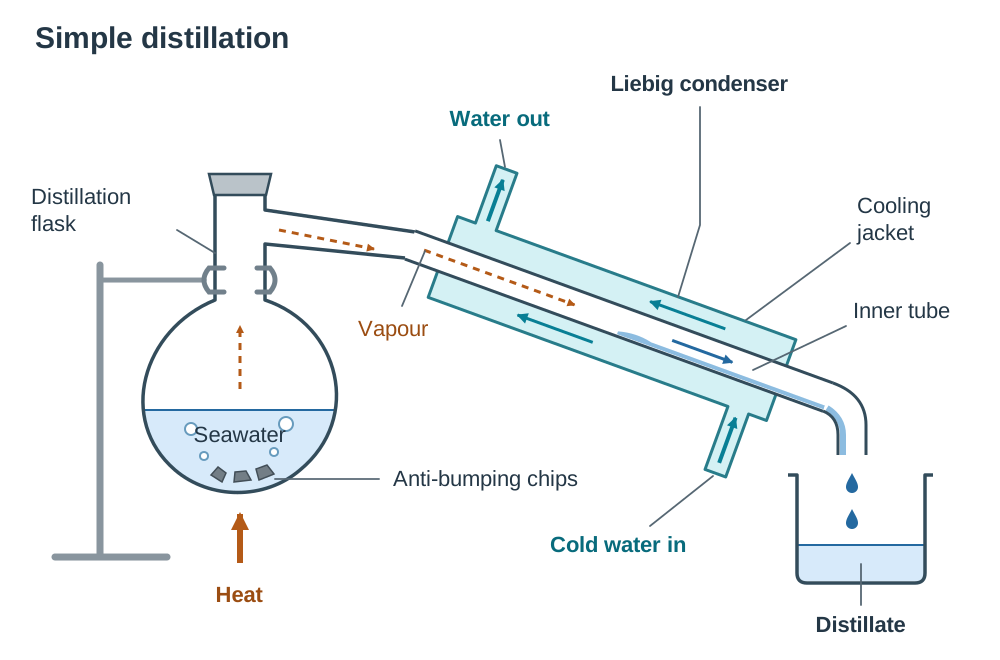
Used to get drinking water from seawater, and to separate ethanol (boils at 78 °C) from water (boils at 100 °C).
Paper Chromatography
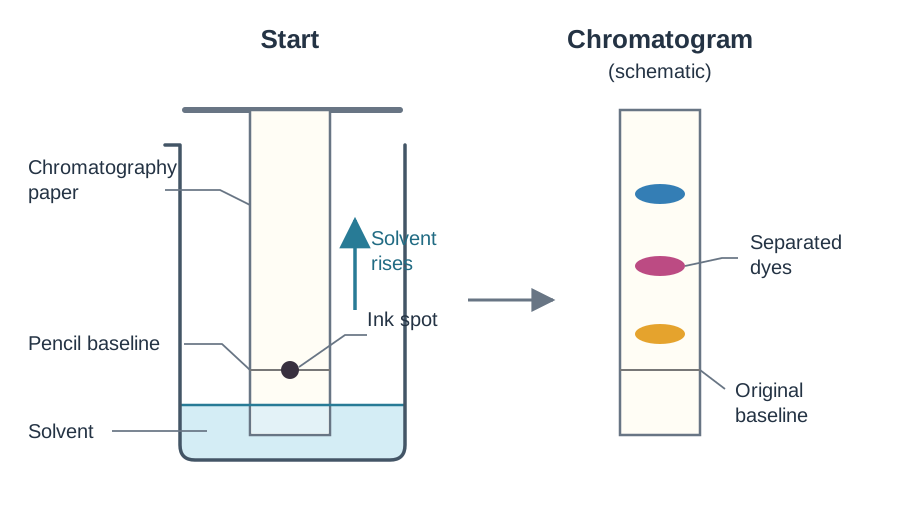
Paper chromatography separates mixtures of soluble coloured substances, such as food dyes, paints, or marker inks.
- Draw a baseline in pencil near the bottom of chromatography paper. Pencil graphite is insoluble, so it will not dissolve in the solvent or blur the results.
- Place a small spot of the ink mixture onto the pencil line.
- Stand the paper in a beaker of solvent, with the solvent just below the ink spot.
- As the solvent rises up the paper, it carries the dissolved dyes along with it.
Dyes with higher solubility in the solvent travel faster and further up the paper, while less soluble dyes stay nearer the bottom. The finished paper showing the separated coloured bands is called a chromatogram.
Key terms
- Mixture
- Two or more substances mixed together that are not chemically combined.
- Solution
- A mixture formed when a solute dissolves in a solvent, such as salt dissolved in water.
- Insoluble
- Describes a substance that does not dissolve in a given liquid.
- Filtrate
- The clear liquid that passes through the filter paper during filtration.
- Residue
- The insoluble solid trapped on the filter paper after filtration.
- Liebig condenser
- Glassware with an outer water jacket that cools vapour back into a liquid during distillation.
- Distillate
- The condensed liquid collected after distillation.
- Chromatogram
- The strip of paper showing the separated bands of coloured substances after chromatography.
Check yourself
What name is given to the liquid that passes through filter paper?
Filtrate.
Give one difference between a mixture and a compound.
A mixture can be separated by physical methods; a compound can only be separated by a chemical reaction.
Why must the baseline on chromatography paper be drawn in pencil rather than pen?
Pencil graphite is insoluble and will not dissolve in the solvent or blur the chromatogram.
What two changes of state take place during distillation?
Boiling (liquid to vapour) followed by condensation (vapour to liquid).
Which piece of laboratory apparatus is used to separate a mixture of oil and water?
A separating funnel.