
Workshop tools allow you to mark out, hold, cut, drill, and finish metals safely and accurately. The Junior Cycle exam tests your ability to choose the right tool for a specific job, describe practical steps, and explain key workshop safety rules.
Marking Out and Workholding
Before making cuts, you must transfer dimensions accurately from a working drawing onto your stock material. Taking every measurement from one prepared datum edge stops small errors from multiplying.
- Steel rule: measures flat lengths directly in millimetres.
- Engineer's square: guides a scriber at 90 degrees to a datum edge and checks right angles.
- Scriber: hardened steel point that scratches fine layout lines on metal surfaces.
- Centre punch: makes a small conical dent that stops a twist drill wandering off centre.
- Bench vice: mounted over a bench leg to clamp work securely for cutting and filing.
- Soft jaws: copper or aluminium covers that stop serrated vice jaws marking finished workpieces.
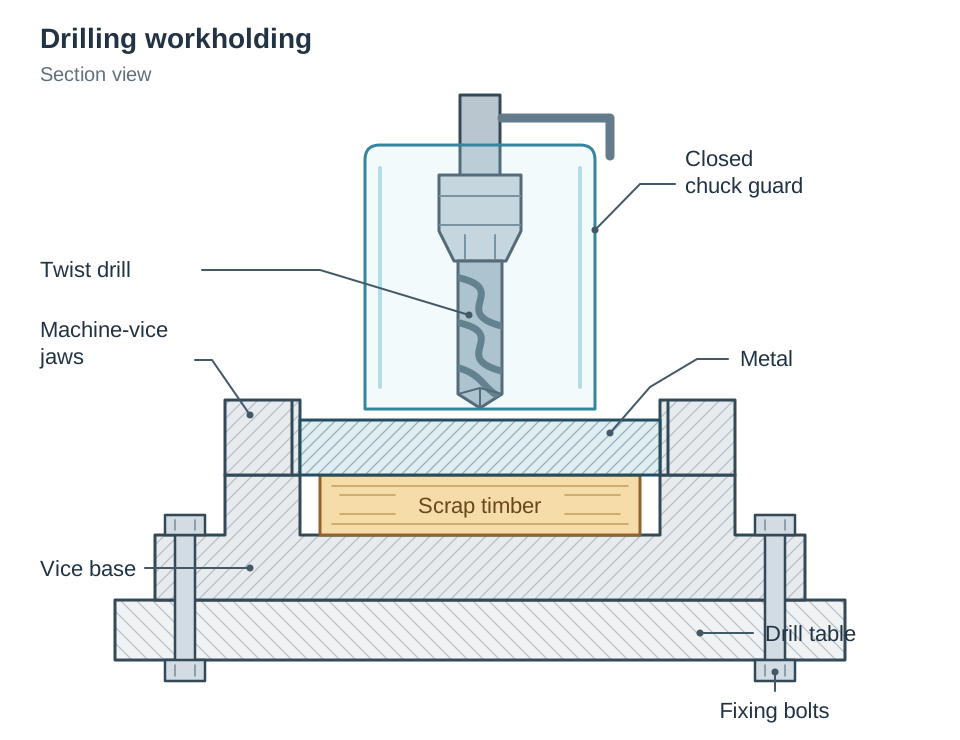
- Machine vice: bolts to the pillar drill table to prevent the workpiece spinning during drilling.
Hand Cutting and Filing Tools
Hacksaws and files remove waste metal so you can bring pieces to size and leave smooth edges. Choosing the right blade pitch and file shape makes the work faster and prevents broken tools.
- Hacksaw: holds a replaceable blade under tension to cut through metal stock.
- Three-teeth rule: keep at least three consecutive teeth touching the metal to prevent snagging and stripped teeth.
- Flat file: removes waste metal across flat surfaces and outside edges.
- Half-round file: files internal curves and concave hollows with its curved face.
- Round file: enlarges circular holes and files small internal curves.
- Safe edge: a smooth file edge with no teeth that protects adjacent finished surfaces.
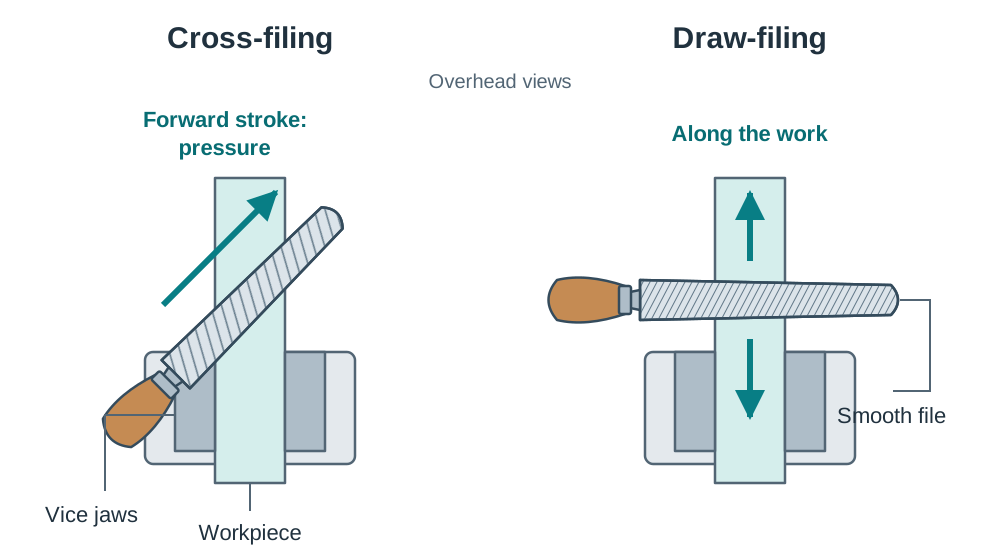
- Cross-filing: move the file diagonally across the work, applying pressure on the forward stroke only.
- Draw-filing: hold a smooth file across the workpiece and move it along its length to improve the finish.
Drilling Operations and Hole Types
A pillar drill turns a twist drill bit to cut cylindrical holes through clamped workpieces. Choose the rotation speed to suit the material and drill diameter.
- Spindle speed means drill rotations per minute; for the same material, larger bits need slower speeds.
- Scrap timber: placed under the metal in a machine vice to protect the vice base from damage.
- Pilot hole: a small hole drilled first to guide a larger bit accurately.
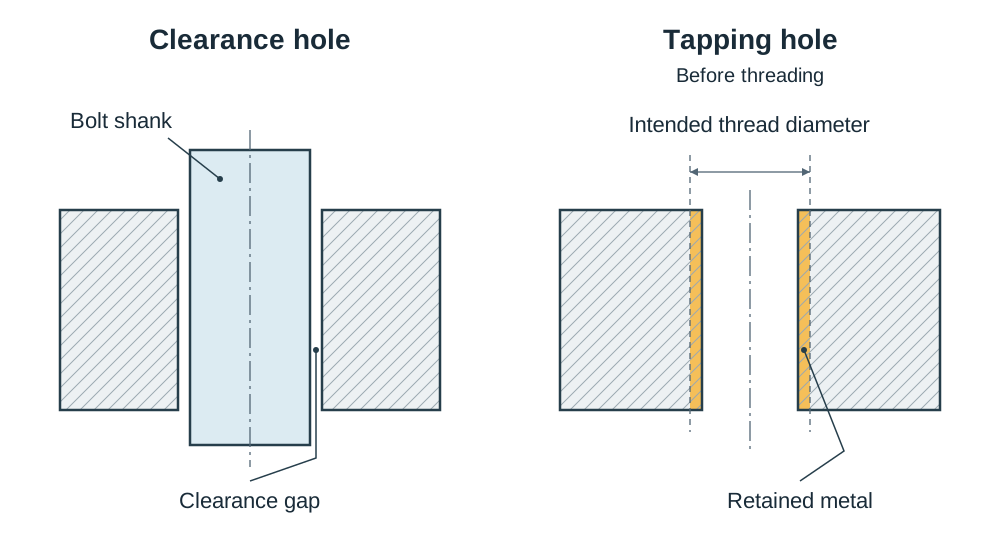
- Clearance hole: drilled slightly larger than a bolt shank so the fastener slides straight through.
- Tapping hole: drilled smaller than the thread diameter, leaving metal for cutting internal screw threads.
- Countersink bit: creates a conical recess so countersunk screw heads sit flush with the surface.
- Reamer: slightly enlarges a pre-drilled hole to an accurate diameter and improves its surface finish.
Workshop Safety and Tool Care
Keeping your workshop tidy and inspecting hand tools protects you and your classmates from serious injuries. Faulty tools spoil your workpiece and can cause sharp metal fragments to fly off.
- Eye protection: wear safety glasses whenever you are cutting, drilling, filing, or grinding.
- Drilling safety: tie back hair, secure loose clothing, remove jewellery, and close the chuck guard.
- Chuck key: always take the chuck key out before starting the drill so it cannot fly out.
- File handles: never use a file without a tight wooden or plastic handle fitted to the tang.
- File card: wire brush used along the teeth to clean out pinned metal swarf.
- Mushroomed heads: Do not use a mushroomed chisel or punch; fragments can fly off. Report it to the teacher for repair.
- Swarf removal: Switch off, wait until the drill stops, then remove swarf with a brush.
Key terms
- Datum edge
- A prepared reference edge from which all marking-out measurements are taken.
- Three-teeth rule
- The rule requiring at least three saw teeth in contact with work to prevent tooth breakage.
- Soft jaws
- Protective vice covers made of copper, aluminium, or fibre that stop serrations marking work.
- Safe edge
- The smooth edge of a file without teeth that protects adjacent surfaces from damage.
- Pinning
- The clogging of file teeth with trapped metal particles, which reduces cutting efficiency.
- Pilot hole
- A small preliminary hole drilled to guide a larger drill bit accurately on centre.
- Clearance hole
- A hole drilled slightly larger than a bolt shank so it passes through freely.
- Tapping hole
- An undersized hole that leaves sufficient metal for cutting internal screw threads.
Check yourself
Why use soft jaws when clamping finished work?
They prevent the serrated vice jaws from marking the surface.
Which file is best suited to enlarging a small circular hole?
A round file, also known as a rat-tail file.
Why do you place scrap timber beneath a workpiece in a machine vice before drilling?
It supports the metal and prevents the drill point from cutting into the steel vice body.
What tool clears metal pins trapped in file teeth?
A wire file card brushed along the direction of the teeth.