
Heat treatment changes the properties of metals by controlled heating and cooling to suit a practical job. In Junior Cycle Engineering, questions test hardening, tempering, annealing, case hardening, and workshop safety precautions.
Annealing and Suitability
Heat treatments apply mostly to ferrous metals containing carbon, such as medium-carbon steel and high-carbon steel. Non-ferrous metals like copper and aluminium or plastics like acrylic cannot be hardened by heating and quenching.
- Annealing softens a metal and removes internal stress after cutting, bending, or hammering.
- Steel is annealed by heating to cherry red (around 800 °C) and cooling very slowly, often packed in dry sand or ashes.
- Copper is annealed by heating to a dull red and quenching directly in cold water.
- Normalising reheats steel to cherry red and lets it cool in still air to restore an even grain structure.
Hardening Steel
Hardening makes high-carbon steel wear-resistant so it can hold a sharp cutting edge.
- Heat the steel evenly in a brazing hearth to bright cherry red (around 800 °C).
- Soak the steel briefly at this temperature so the heat reaches the centre.
- Quench the hot steel immediately in cold water or clean oil.
Water usually cools steel faster than oil. Oil cools more gently and can reduce cracking or distortion. Quenched steel gains high hardness, but it also becomes very brittle.
Tempering Steel
Hardened steel chips easily under impact. Tempering follows hardening to reduce brittleness and increase toughness.
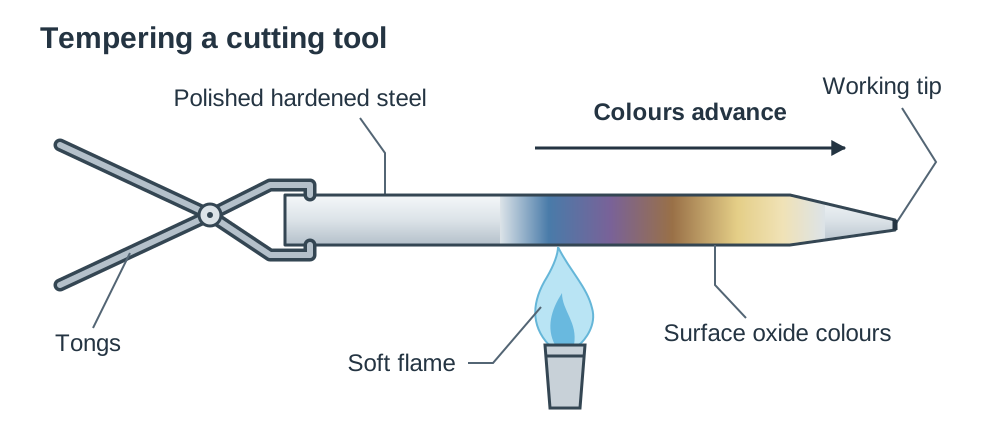
- Clean the hardened metal with emery cloth so you can see bare, bright metal.
- Heat the steel gently behind the cutting point using a soft flame.
- Watch the oxide temper colours move along the metal toward the working tip.
- Quench the tool in water the instant the correct colour reaches the tip.
| Temper Colour | Temperature | Typical Application |
|---|---|---|
| Pale straw | 230 °C | Lathe tools, scribers |
| Brown | 260 °C | Centre punches |
| Purple | 280 °C | Cold chisels |
| Blue | 300 °C | Screwdrivers, springs |
Case Hardening and Safety
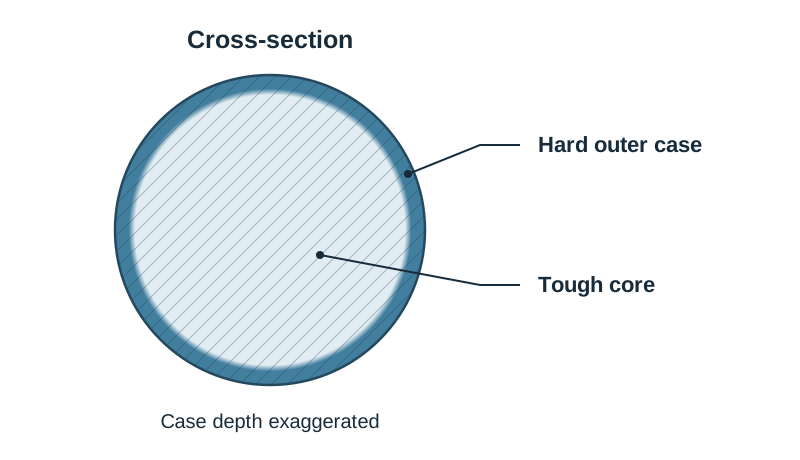
Mild steel lacks the carbon needed to harden throughout. Case hardening gives mild steel a hard outer skin while keeping a tough core that absorbs sudden shocks.
- Heat the mild steel to cherry red in the hearth.
- Dip the hot steel into a carbon-rich powder compound.
- Reheat the piece to cherry red so carbon soaks into the surface layer.
- Quench the component in cold water.
This process suits parts that face sliding wear, like gate rollers and hinge pins. When working at the hearth, wear safety goggles, heat-resistant leather gauntlets, and an apron, and always handle hot metal using tongs.
Key terms
- Hardening
- Heating suitable carbon steel and rapidly quenching it to increase hardness; it also becomes brittle.
- Quenching
- Plunging hot metal into a liquid bath of water or oil to cool it rapidly.
- Tempering
- Reheating hardened steel below its hardening temperature to reduce brittleness and increase toughness.
- Annealing
- Heating a metal and cooling it at a controlled rate to soften it and relieve internal stresses.
- Case Hardening
- Adding carbon to the surface of mild steel to produce a hard outer skin and a tough inner core.
- Temper Colour
- A coloured oxide film on polished steel that shows the temperature reached during tempering.
Check yourself
What is quenching?
Plunging hot metal into water or oil to cool it rapidly.
Why is hardened steel tempered before use in tools?
Hardening leaves the steel brittle; tempering cuts that brittleness and restores toughness.
Which temper colour marks the correct temperature for a cold chisel?
Purple, which corresponds to around 280 °C.
What combination of properties does case hardening give mild steel?
A hard, wear-resistant outer skin and a tough inner core.