
Assembly and joining techniques allow engineers to connect components using temporary fasteners, permanent mechanical joints, thermal methods, or chemical adhesives. Exam questions ask you to identify joining methods, explain their uses, and justify suitable choices for practical engineering projects.
Temporary Fasteners and Locking Devices
A temporary joint allows parts to be dismantled easily for servicing or repair without damaging the components. A permanent joint cannot be separated without destroying the fastener or damaging the parts.
| Fastener or Device | Function | Application |
|---|---|---|
| Bolt and nut | Clamps parts together through a clearance hole | Machine frames, chassis brackets |
| Stud | Threaded at both ends; one end screws into a tapped hole, a nut tightens on the other | Engine cylinder heads, casing covers |
| Machine screw | Screws directly into a pre-tapped hole | Inspection covers, mounting plates |
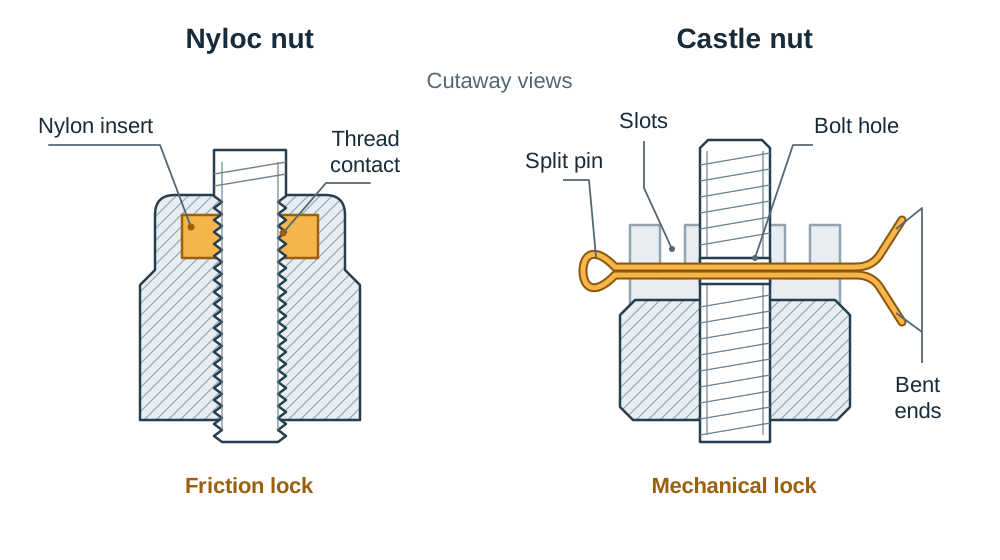
| Nyloc nut | Nylon insert deforms around bolt threads to create friction | Wheel axles, steering linkages, robotic arms |
| Castle nut with split pin | Pin passes through nut slots and a drilled bolt hole for a positive mechanical lock | Go-kart axles, trailer hubs |
| Plain washer | Spreads the clamping load and protects the surface | Under nuts and bolt heads |
Cutting Screw Threads (Taps and Dies)
Internal threads are cut inside a drilled hole using taps, while external threads are cut onto a round bar using a circular split die held in a die stock.
Internal Tapping Sequence
- Drill a tapping-size hole, which is slightly smaller than the bolt diameter so metal remains for the threads.
- Mount the taper tap in a tap wrench and align it at 90° to the surface, checking squareness from two directions.
- Apply cutting fluid to lubricate the cut and keep the tool cool.
- Turn clockwise for half a turn, then reverse a quarter turn to break the swarf.
- Follow with the second tap to deepen the thread groove.
- Use a plug tap to finish threads near a blind hole’s bottom; never force it against the bottom.
Riveting and Assembly Practice
Rivets create strong, permanent joints in sheet metal assemblies.
Solid Rivets
- A snap head rivet forms a rounded dome above the surface.
- The shank must extend beyond the plates by 1.5 × the rivet diameter to form the head.
- Example calculation: 2 mm + 2 mm + (1.5 × 4 mm) = 10 mm total shank length.
- Support the preformed head underneath with a bolster (dolly).
- Squeeze the plates together tightly using a rivet set.
- Form the dome using a ball-pein hammer and finish the shape with a rivet snap.
Pop Riveting and Assembly
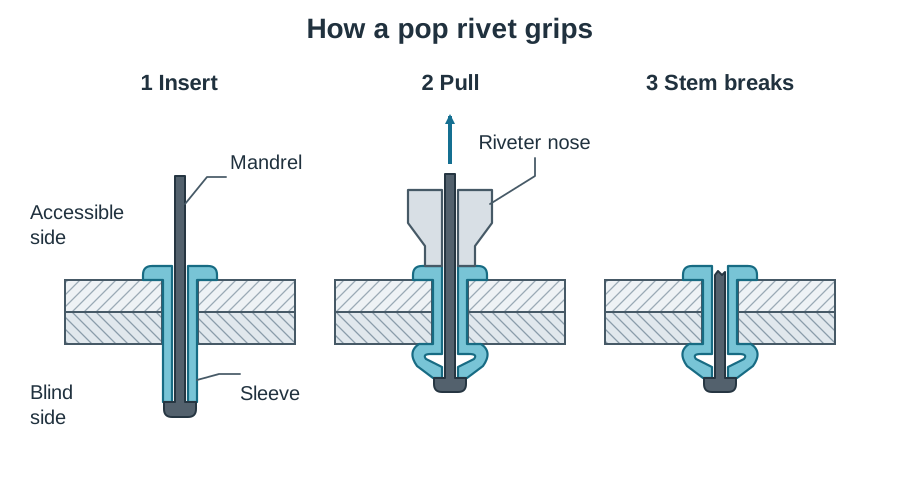
- Pop riveting joins materials when there is access to one side only, such as hollow tubing.
- A pop riveter pulls an internal mandrel through a hollow sleeve until it expands the blind side and snaps off.
- When assembling from working drawings, verify hole sizes, remove all sharp burrs, and trial-fit components before permanent fastening.
Thermal Joining, Welding, and Adhesives
Thermal joining uses heat to bond metals permanently. Welding melts the parent metals so they fuse into one solid piece, making it ideal for tubular steel frames and gates.
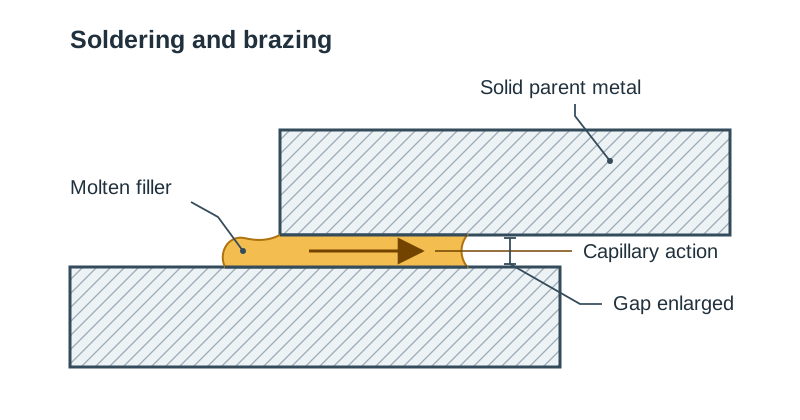
Soldering and brazing do not melt the parent metal. Instead, they melt a filler alloy that is drawn into the narrow joint gap by capillary action.
- Soft soldering: Uses lead-free tin alloy (~190–250 °C) for electronic circuits and thin brass.
- Brazing: Uses a brass alloy filler rod called spelter (~900 °C) on a brazing hearth for steel frames.
- Flux: Cleans surface oxides and prevents new oxidation during heating so the filler flows freely.
- Adhesives: Bond materials without heat distortion, such as epoxy resin for metals or Tensol cement for acrylic.
- Safety: For MIG/arc welding, use a correctly filtered welding helmet, safety glasses, protective gloves and clothing, and fume extraction. Wear tinted goggles for brazing.
Key terms
- Temporary joint
- A connection designed to be dismantled easily for servicing or maintenance without damaging the parts.
- Permanent joint
- A joint that cannot be separated without destroying the fastener or damaging the joined components.
- Tapping
- The workshop process of cutting an internal screw thread inside a drilled hole using a tap.
- Nyloc nut
- A locking nut fitted with a nylon collar that deforms around bolt threads to prevent loosening from vibration.
- Clearance hole
- A drilled hole slightly larger than the fastener diameter that allows a bolt or screw to pass through freely.
- Flux
- A chemical agent that removes oxides from metal surfaces and prevents further oxidation during thermal joining.
- Welding
- A permanent thermal joining process that melts and fuses the parent metals together, often with a filler rod.
- Capillary action
- The physical process by which molten filler metal is drawn into the narrow gap between close-fitting components.
Check yourself
Which thermal joining process melts the parent metal components so they fuse together?
Welding (such as MIG or arc welding).
Why is pop riveting chosen over solid riveting when assembling hollow tubular steel or ducting?
It can be installed entirely from the outside when only one side of the joint is accessible.
What is the function of flux in soldering and brazing?
It removes surface oxides and prevents further oxidation during heating so filler flows freely.
Which tap finishes threads near the bottom of a blind hole?
The plug tap.