
On a lathe, the workpiece rotates in a chuck while a cutting tool is fed into it to shape cylindrical parts. In the Junior Cycle examination, you are assessed on identifying lathe operations from engineering drawings, explaining workshop safety precautions, and understanding CNC machining.
The Centre Lathe and Workholding
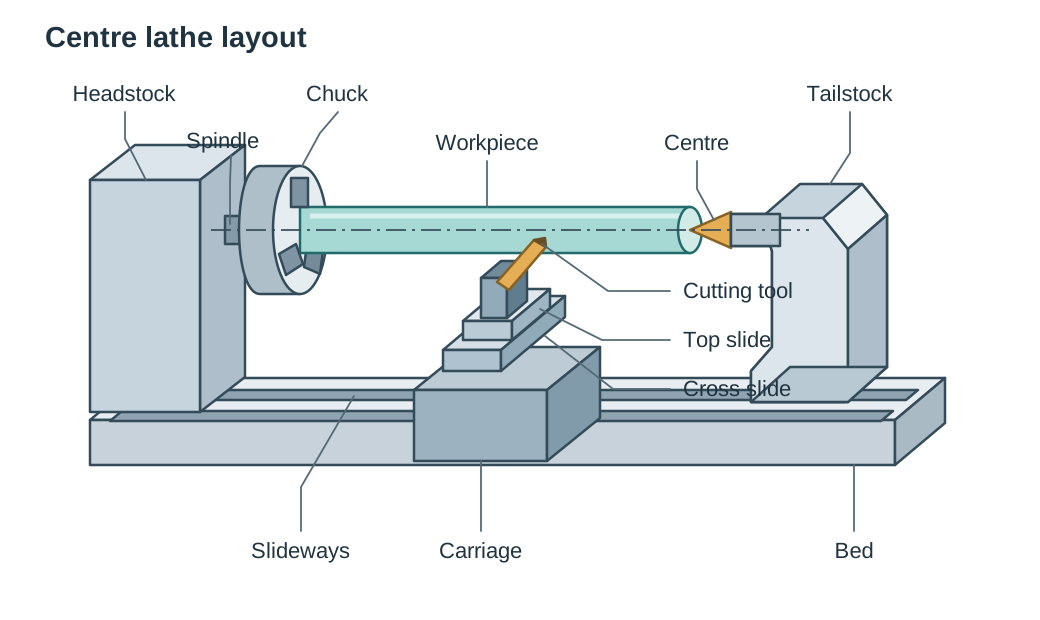
A centre lathe machines round components by rotating stock against a cutting tool.
- Lathe bed: a rigid cast-iron base with machined slideways that align the carriage and tailstock.
- Headstock: supports and drives the main spindle, which rotates the chuck and workpiece.
- Tailstock: slides along the bed to support long bars or hold drilling tools.
- Carriage: travels along the bed and supports the cross slide for facing and the top slide for turning angles.
Workholding devices secure the stock safely during rotation:
- A three-jaw chuck uses an internal scroll mechanism to move all jaws together, quickly self-centring round or hexagonal stock.
- A four-jaw chuck has four independent jaws adjusted separately, allowing accurate centring of square, rectangular, or irregular shapes.
- A lathe centre fits into the tailstock to support the end of long workpieces and prevent flexing.
Lathe Turning Operations
Always clamp the cutting tool with minimal overhang and align its cutting edge level with the workpiece centre height.
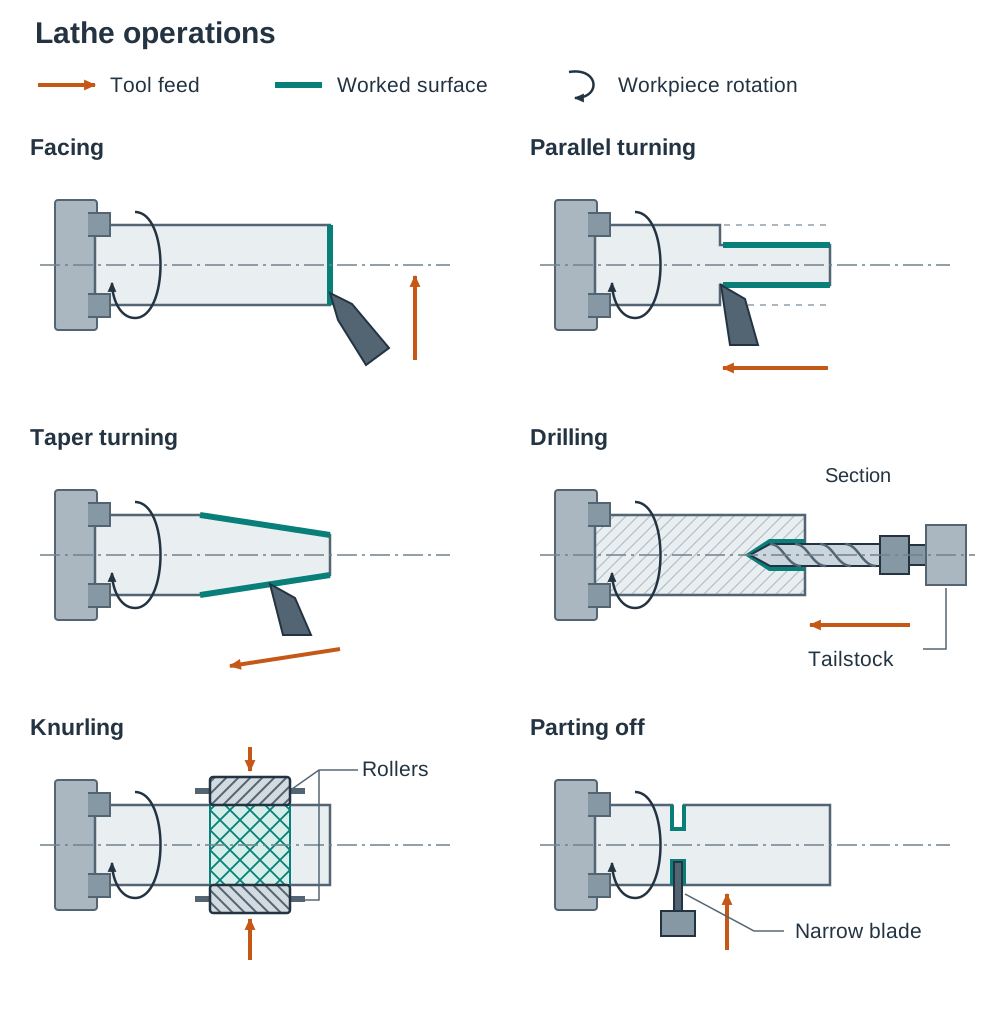
| Operation | Tool Movement | Purpose on Component |
|---|---|---|
| Facing | Cross slide feeds across the end | Cuts a flat end square to the workpiece axis |
| Parallel turning | Carriage feeds along the bar axis | Reduces the diameter to a uniform cylinder |
| Taper turning | Feeds along the angled top slide | Produces a conical shape or chamfer |
| Drilling | Feeds axially into the rotating end from the tailstock | Centre drill first to start the hole, then drill to depth |
| Knurling | Presses hardened patterned rollers into the surface | Squeezes metal to form a textured diamond grip |
| Parting off | Feeds a narrow blade squarely into the work | Cuts the finished part off from the bar stock |
Large diameters and hard metals are turned at slower spindle speeds, while smaller diameters and softer metals can run faster.
Lathe Safety and Quality Checks
Adhering to workshop safety standards protects the operator from severe injury:
- Always remove the chuck key from the chuck immediately after tightening.
- Wear safety goggles to protect eyes from flying swarf (hot metal chips).
- Tie back long hair, roll up loose sleeves, and remove ties or jewellery.
- Keep the chuck guard down whenever the spindle is running.
- Stop the machine completely before clearing swarf with a brush, never with bare hands.
Achieving dimensional accuracy and a high-quality surface finish requires care:
- Mark out lengths with a steel rule and odd-leg callipers before cutting shoulders.
- Always stop the lathe before checking diameters using a vernier calliper or micrometer.
- Take a light finishing cut with a sharp tool and slow feed for a smooth surface.
CNC Turning
A CNC (Computer Numerical Control) lathe automates the turning process by following pre-programmed coordinate instructions rather than manual handwheels.
- CAD (Computer-Aided Design) draws the part; CAM (Computer-Aided Manufacturing) generates toolpaths for machining.
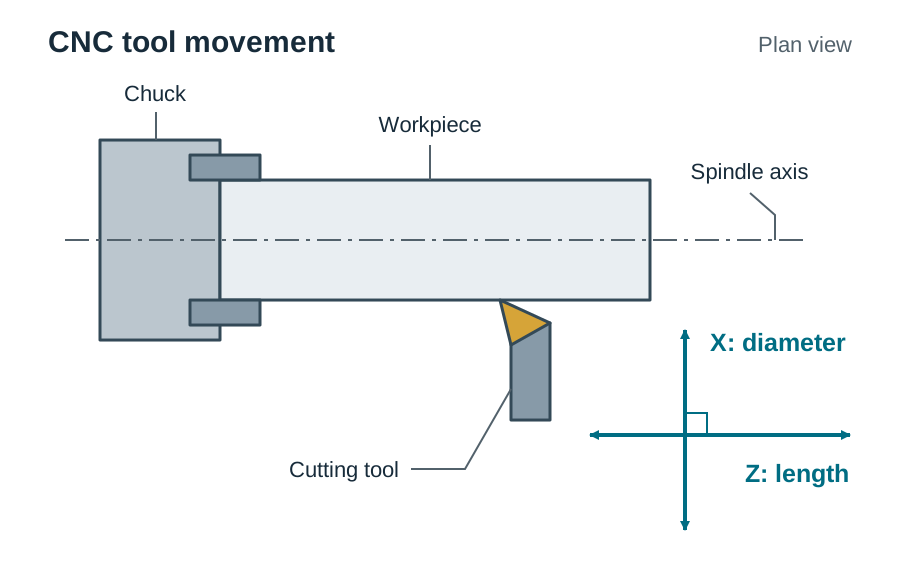
- X-axis: moves the tool across the bed perpendicular to the spindle to control component diameter.
- Z-axis: moves the tool along the length of the bed parallel to the spindle to control component length.
- Simulation: displays a virtual dry-run on screen to detect programming errors and reduce collision risk before cutting metal.
Compared with a manual lathe, a CNC lathe produces identical parts rapidly with high precision and repeatability, but the machine has a high initial purchase cost and requires skilled programmers.
Key terms
- Facing
- Machining across the end of a workpiece to produce a flat surface square to the centreline.
- Parallel Turning
- Moving the cutting tool along the axis of rotation to reduce the diameter to a uniform size.
- Taper Turning
- Feeding the cutting tool at an angle to create a conical shape on the workpiece.
- Knurling
- Pressing hardened rollers into the surface of rotating metal to create a textured pattern for grip.
- Three-Jaw Chuck
- A self-centring lathe workholding device whose three jaws move together to grip round or hexagonal bar.
- Computer Numerical Control (CNC)
- The automated control of machine tools using pre-programmed coordinate software commands.
Check yourself
Which workholding chuck is best suited for quickly centring round metal bar?
A three-jaw self-centring chuck.
What lathe operation creates a diamond pattern to improve hand grip on a tool handle?
Knurling.
Which lathe part holds the drill chuck to produce a hole along the centreline of a bar?
The tailstock.
State one advantage of using a CNC lathe over a manual centre lathe.
It can produce identical parts repeatedly to high accuracy and at higher production speeds.