
Engineering materials are classified by composition and chosen by matching their properties to the functional demands of a product. Questions can ask you to identify properties, choose suitable materials and explain finishes.
Material Properties
A material property describes how it behaves when forces or environmental conditions act upon it.
| Property | What it means | Everyday example |
|---|---|---|
| Strength | Resists an applied force without breaking or permanently bending | Steel crane hook, scaffolding |
| Hardness | Resists surface scratching, indentation, and wear | Drill bit, knurling wheel |
| Toughness | Absorbs sudden shock and impact without breaking | Hammer head, cold chisel |
| Brittleness | Cracks or shatters easily under impact with little or no bending | Cast-iron vice body, glass |
| Elasticity | Returns to its original shape when the force is removed, provided it has not been stretched or bent too far. | Coil spring |
| Ductility | Can be stretched and drawn into thin wire without snapping | Copper electrical wire |
| Malleability | Can be hammered, rolled, or pressed into shape without cracking | Aluminium sheet, rivet |
| Conductivity | Allows heat or electricity to flow through easily | Copper cable, aluminium saucepan |
Common Metals, Alloys, and Plastics
Metals are classified by their iron content. Ferrous metals have iron as their main element; mild steel rusts easily, while stainless steel resists corrosion. Non-ferrous metals contain no iron and do not rust, such as aluminium and copper. An alloy is a mixture of two or more elements, with at least one being a metal.
Plastics are divided into two main groups:
- Thermoplastic: softens when heated and can be reshaped repeatedly (acrylic, polypropylene).
- Thermosetting: sets permanently hard during moulding and cannot be re-softened by heating (melamine, epoxy resin).
Smart materials change their properties in response to external stimuli. A thermochromic plastic changes colour with temperature, acting as a visual heat warning on baby feeding spoons.
Selecting Materials for Design
A material is chosen because it suits the job the part has to do. When asked to justify a choice, link a relevant property or selection factor to the product’s needs (for example, mild steel is easy to weld, allowing gate-frame bars to be joined securely).
Key selection factors:
- Forces acting on the part: pulled parts require tensile strength, while rotating shafts must resist twisting.
- Working environment: outdoor parts need corrosion resistance, provided by the material itself or a protective coating.
- Weight: low density helps keep scooter frames light and easy to control.
- Manufacturing process: materials must suit workshop tools, like acrylic for strip-heating or mild steel for welding.
- Cost and availability: Consider cost, availability in suitable sizes, and whether the material can be recycled to reduce waste.
- User ergonomics: soft foam handles provide comfort and a non-slip grip for users with limited dexterity.
Surface Finishes and Corrosion Protection
Corrosion is deterioration caused by reactions with the surroundings. Rusting specifically attacks iron and steel when exposed to both oxygen and water. Finishes prevent rust, resist wear, and improve appearance.
- Painting and dip-coating: form a sealed barrier over metal to shut out moisture and air.
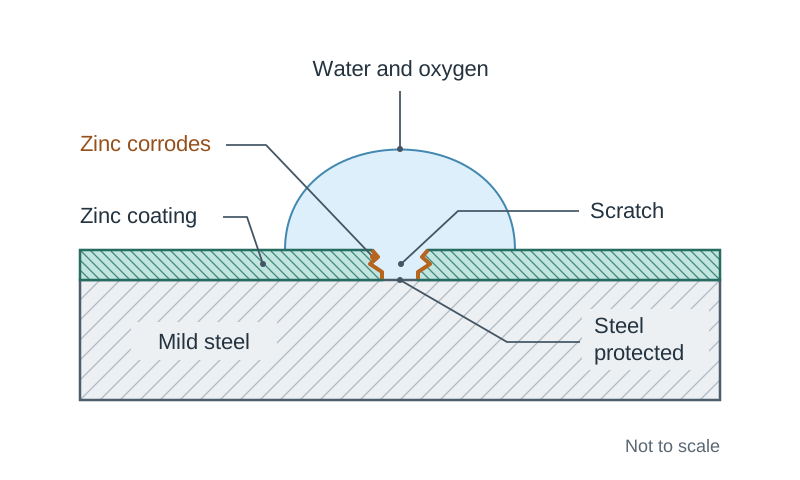
- Galvanising: dipping mild steel into molten zinc. The zinc seals out moisture, and if scratched, the zinc corrodes instead of the steel.
- Tinplate: steel sheet coated with a thin layer of tin. The tin seals out moisture and is non-toxic, keeping food cans safe.
- Anodising: an electrochemical process for aluminium that thickens its natural oxide layer, producing a hard-wearing, corrosion-resistant surface that can be coloured with dyes.
- Workshop finish: remove burrs and file edges smooth, then use progressively finer abrasive paper while keeping the part to its required dimensions.
Key terms
- Ferrous metal
- A metal that contains iron as its main element, such as mild steel or cast iron.
- Non-ferrous metal
- A metal containing no iron, which does not rust, such as aluminium, copper, or zinc.
- Alloy
- A mixture of two or more elements, where at least one is a metal, formed to improve properties like strength or corrosion resistance.
- Hardness
- The ability of a material to withstand surface scratching, indentation, and abrasive wear.
- Toughness
- The ability of a material to absorb sudden shock and impact blows without fracturing.
- Ductility
- The ability of a material to be pulled, stretched, and drawn into a thin wire without breaking.
- Malleability
- The ability of a material to be hammered, rolled, or pressed into shape without cracking.
- Galvanising
- The process of coating mild steel with a protective layer of zinc to prevent rusting.
Check yourself
Which property allows copper to be drawn out into thin electrical cables?
Ductility.
Why can acrylic be reshaped using heat?
It is a thermoplastic, so it softens when heated.
What is the primary function of a thermochromic material on a baby spoon?
It acts as a visual safety indicator by changing colour when food is too hot.
What metal is applied to mild steel during galvanising?
Zinc.
Is stainless steel ferrous or non-ferrous, and does it rust?
Ferrous: iron is its main element. Chromium forms a protective surface layer that resists rusting.