
Marking out transfers dimensions and shapes from a working drawing onto material to guide cutting, shaping, and assembly. The Junior Cycle exam tests your ability to choose tools, describe manufacturing sequences, calculate component sizes, and explain safe workshop practice.
Marking Out and Reading Drawings
Accurate marking out begins from a prepared datum edge or line to prevent errors building up across measurements.
- Scriber: Scratches fine, clean layout lines onto metal surfaces.
- Steel rule: Keep its scale close to the work and look directly above the reading to reduce viewing-angle errors.
- Engineer's try square: Marks lines at 90° to a datum edge and checks edges for squareness.
- Odd-leg callipers: Scribes lines parallel to a true datum edge.
- Dividers: Steps off distances and scribes arcs or circles on metal.
- Centre punch: Creates a 90° indentation in metal to stop drill bits wandering.
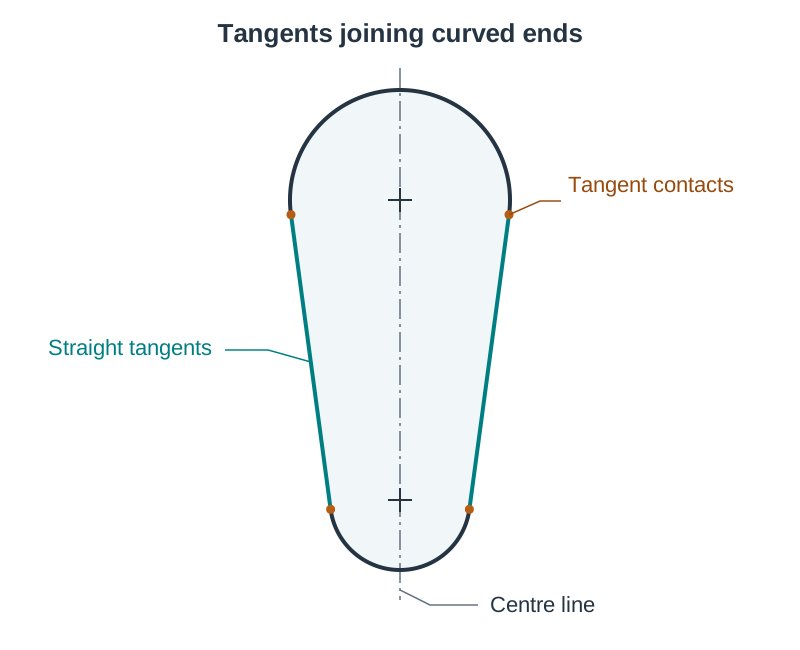
Straight tangent lines connect curved arcs smoothly without crossing them to complete shaped profiles.
Benchwork, Bending, and Joining
Material removal must follow marked lines while leaving enough waste material to finish cleanly.
- Cutting: Saw roughly 1 mm into the waste material, then file accurately to the line.
- Internal slots: Drill holes at each end, remove waste with a piercing saw, and file edges flat.
- Draw-filing: Sliding a flat file sideways along an edge produces a smooth, square finish.
- Threading: A tap cuts internal threads, while a die cuts external threads on round rods.
- Tapping drills: Holes must be smaller than the tap, such as a 4.2 mm hole for an M5 thread.
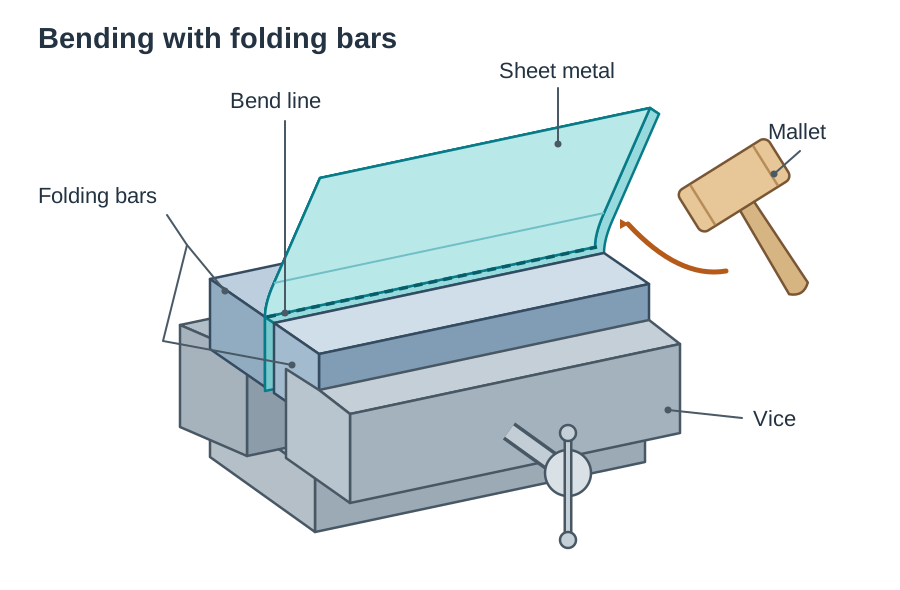
- Bending: Clamp sheet metal between folding bars in a vice and bend using a mallet.
- Permanent joints: Permanent joints cannot be dismantled without damaging or destroying the joint, including MIG welding and riveting.
- Temporary joints: Fasteners like nuts, bolts, and machine screws allow components to be taken apart easily.
Centre Lathe Operations and Heat Treatment
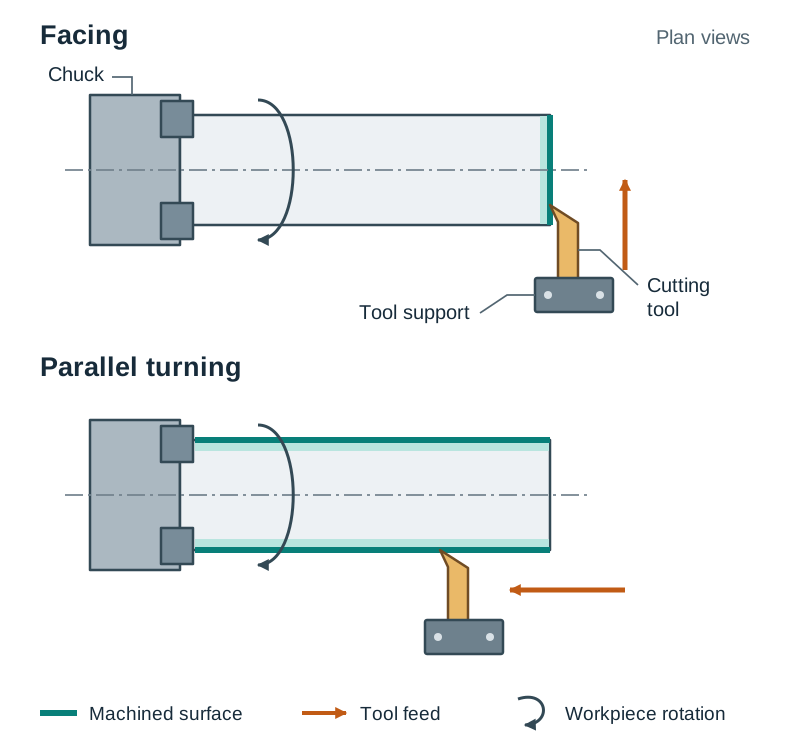
A centre lathe rotates a workpiece while a rigid cutting tool shapes it.
- Facing: Feeds the cutting tool across the end face to produce a flat surface.
- Parallel turning: Moves the tool along the workpiece length to reduce its diameter uniformly.
- Drilling: Holds a drill chuck in the tailstock to drill an accurate end hole.
- Knurling: Presses a patterned roller into the metal to create a textured diamond grip.
- Chamfering: Cuts a small angled bevel on sharp edges for safety and neat appearance.
Heating and quenching hardens medium- and high-carbon steel; this method does not harden mild steel:
- Hardening: Heating steel to cherry red and quenching rapidly in water or oil makes it hard but brittle.
- Tempering: Reheating hardened steel to a lower temperature reduces brittleness and increases toughness.
- Annealing: Heating steel and cooling it very slowly softens the metal and relieves internal stresses.
Workshop Safety, Finishing, and CAD/CAM
Safe working practices protect both you and your workpiece:
- Drilling safety: Clamp work in a bolted machine vice so it cannot spin if the drill binds.
- Eye protection: Wear safety goggles against swarf (sharp metal chips); remove the chuck key before drilling.
- Lathe safety: Stop the spindle completely before measuring work or clearing swarf with a hand brush.
- Surface finishing: Anodising aluminium, dip-coating, or painting protects metal from corrosion and enhances appearance.
- CAD (Computer-Aided Design): Software used to create precise 2D drawings and 3D models of components.
- CAM (Computer-Aided Manufacture): Computer software prepares instructions that control machines making components.
Key terms
- Datum
- A prepared reference edge, surface, or line from which all subsequent measurements are taken.
- Centre Punch
- A hardened steel tool with a 90° point used to create an indentation in metal that guides a drill bit.
- Tangent
- A straight line that touches the curve of an arc or circle smoothly at a single point without crossing it.
- Facing
- A lathe operation where the cutting tool moves across the end of a rotating bar to produce a flat face.
- Parallel Turning
- A lathe operation where the cutting tool feeds along the length of the workpiece to reduce its diameter.
- Draw-Filing
- A finishing technique of sliding a flat file sideways along an edge to remove rough marks and leave a smooth surface.
- Hardening
- Heating high-carbon steel to cherry red and quenching it rapidly to make it hard and wear-resistant.
- Tempering
- Reheating hardened steel gently to a lower temperature to decrease brittleness and increase toughness.
Check yourself
How do you check whether a filed metal edge is at right angles to a datum edge?
Place the stock of an engineer's try square against the datum edge and check for light under the blade.
What tapping drill size is required before tapping an M5 thread in steel?
A 4.2 mm drill bit.
Which centre lathe process creates a diamond textured pattern to improve grip?
Knurling.
Why is hardened high-carbon steel tempered?
To reduce its brittleness and increase its toughness.
Name one suitable permanent joining method for tubular steel frames.
MIG welding.