
Polymers are lightweight, durable materials made of long molecular chains, divided into thermoplastics and thermosetting plastics. The Junior Cycle exam tests material selection, workshop shaping and finishing, industrial forming, and sustainable disposal.
Thermoplastics and Thermosetting Plastics
Many common plastics are derived from oil or gas. Polymerisation joins small molecules, called monomers, into long chains.
| Feature | Thermoplastics | Thermosetting Plastics |
|---|---|---|
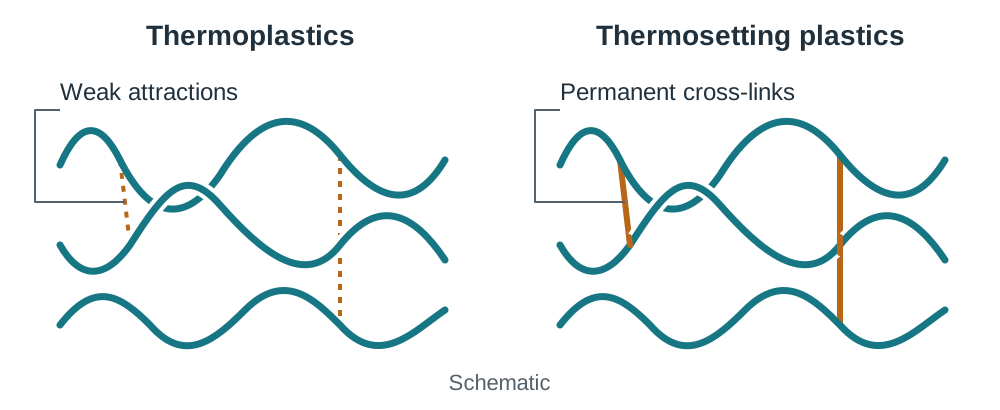
| Molecular structure | Long, tangled chains with weak bonds between them | Chains permanently linked by chemical cross-links |
| Reaction to heat | Softens when heated; hardens when cooled | Curing permanently sets the chains; chars rather than melts |
| Reshaping | Can be reheated and reshaped repeatedly | Cannot be softened or reshaped after curing |
| Recyclability | Can be remelted for recycling where facilities exist | Cannot be remelted for recycling |
Plastic memory: previously bent acrylic sheet tends to return towards its original flat shape when reheated.
Common Polymers and Selection
Engineers select plastics by matching material properties to product requirements.
| Polymer | Type | Key Properties | Common Uses |
|---|---|---|---|
| Acrylic | Thermoplastic | Clear, rigid, good surface finish, brittle | Display stands, machine guards |
| Polyethylene | Thermoplastic | Lightweight, flexible, weather-resistant | Water pipes, sports nets, squeeze bottles |
| Polypropylene | Thermoplastic | Tough, fatigue-resistant, flexes repeatedly | Hinged containers, school chairs |
| Silicone | Elastomer (cured) | Soft, flexible, heat-resistant, safe on skin | Wearable wristbands, seal rings |
| Bakelite | Thermosetting plastic | Hard, rigid, excellent heat and electrical insulator | Cookware handles, electrical plugs |
| Polyurethane | Thermosetting plastic | Tough, impact-resistant, hard-wearing | Skateboard wheels, shoe soles |
For example, Bakelite is chosen for saucepan handles because it is a heat insulator that remains rigid and will not melt when hot.
A resin identification code uses numbers 1–7 to identify plastic categories; 7 means other plastics. Codes may use plain triangles or older chasing arrows. The code alone does not guarantee recyclability.
Workshop Shaping and Finishing
Acrylic and polypropylene sheets can be line bent.
Line Bending
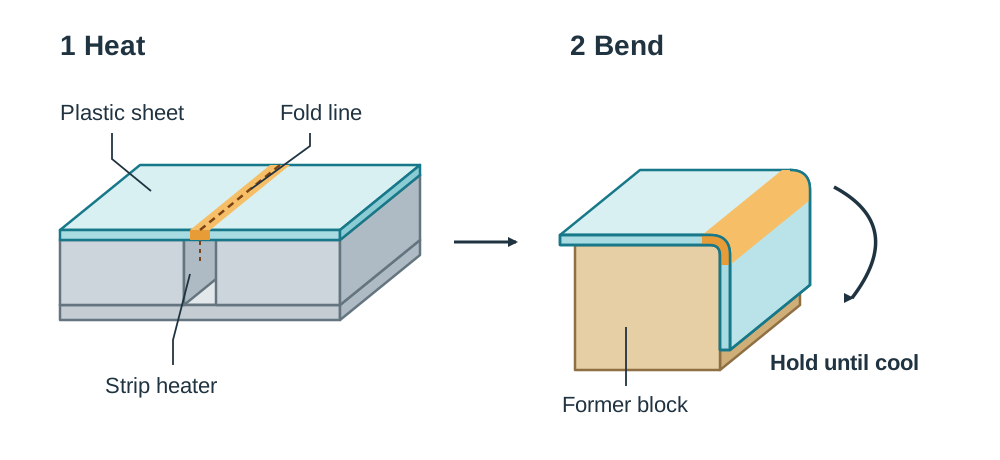
- Heat the sheet along a marked fold line using an electric strip heater.
- When the plastic softens and becomes pliable, bend it over a former block to the desired angle.
- Hold the piece firmly until it cools and sets.
- Check the finished bend using an engineer's protractor.
Drilling and Workshop Safety
- Wear safety glasses when cutting or drilling plastic, and ensure good ventilation to disperse fumes.
- Clamp acrylic over a backing board and ease feed pressure as the drill breaks through.
- Use heat-resistant gloves when handling hot sheet from the strip heater.
Edge Finishing
- Draw file the sawn edge to remove saw marks.
- Rub down with progressively finer grades of wet-and-dry abrasive paper lubricated with water.
- Buff the edge on a polishing wheel with plastics polish to produce a smooth, glossy surface.
Industrial Manufacturing: Moulding and Forming
Injection moulding produces solid, highly detailed plastic components in large volumes, such as bottle caps, chair shells, and joystick handles.
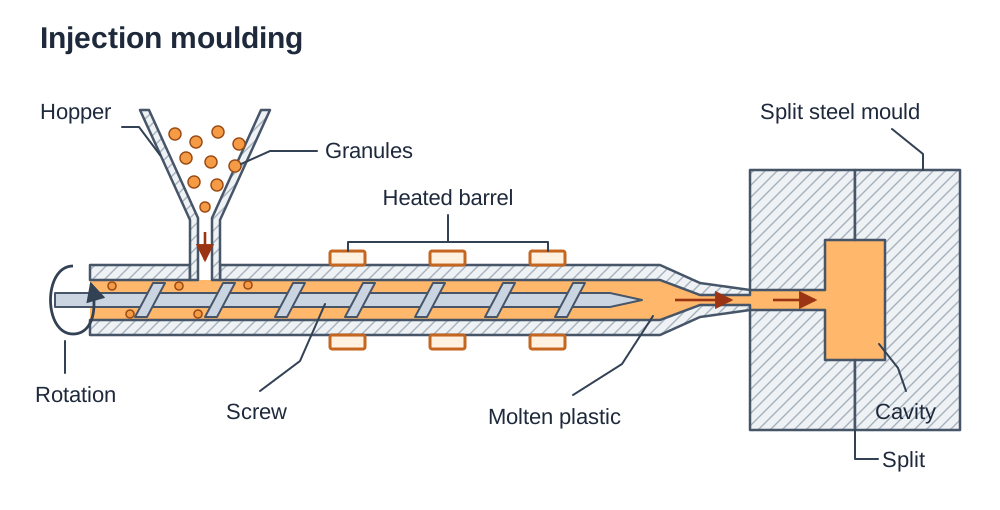
- Thermoplastic granules feed from a hopper into a heated barrel.
- A rotating screw melts the granules and injects molten plastic under high pressure into a split steel mould.
- The mould is cooled, opened, and the solid part is ejected.
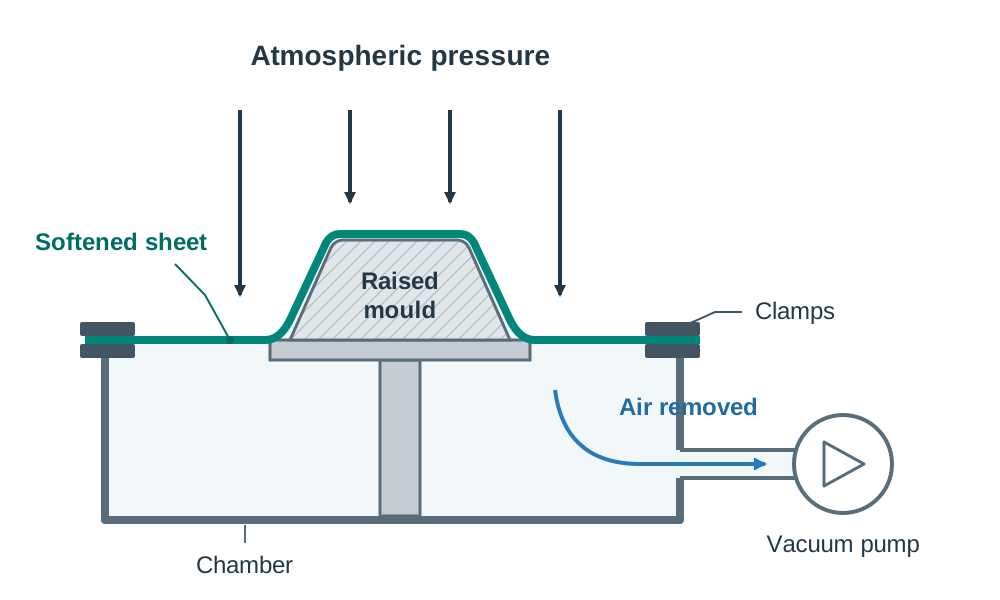
Vacuum forming shapes thin thermoplastic sheets into hollow, open items such as packaging trays.
- The sheet is clamped over a chamber and warmed with radiant heaters until soft.
- A mould rises into the softened plastic, and a vacuum pump removes the trapped air.
- Atmospheric pressure pushes the pliable sheet tightly over the mould.
- Once cooled and hardened, the component is removed and trimmed.
Plastic Waste and Sustainability
Most synthetic plastics do not biodegrade easily and can persist in ecosystems for centuries if mismanaged.
- Reduce: Design products to use less plastic, minimise wall thickness, and eliminate single-use packaging.
- Reuse: Repurpose plastic containers and project offcuts rather than discarding them.
- Recycle: Collect, sort by polymer resin code, clean, shred, and melt thermoplastics into pellets for remanufacture.
- Landfill and incineration are the least sustainable options: landfill wastes non-renewable resources, while incineration releases carbon emissions.
Key terms
- Polymer
- A material composed of long molecular chains created by chemically linking smaller monomer units.
- Thermoplastic
- A plastic that softens when heated and hardens when cooled, allowing repeated reshaping and recycling.
- Thermosetting plastic
- A plastic that sets permanently during curing and cannot subsequently be softened, remelted, or reshaped.
- Plastic memory
- Plastic memory: previously bent acrylic sheet tends to return towards its original flat shape when reheated.
- Strip heater
- A workshop tool with an electric element used to heat and soften plastic sheet along a narrow bend line.
- Injection moulding
- An industrial process where molten plastic is forced under pressure into a closed mould to form solid, complex parts.
- Vacuum forming
- A process in which air is removed beneath softened plastic sheet, allowing atmospheric pressure to push it over a mould.
- Polymer identification code
- A code using numbers 1–7 in a triangle to identify plastic categories; the code alone does not guarantee recyclability.
Check yourself
Why is Bakelite an ideal material for saucepan handles?
It is a thermosetting plastic that acts as a heat insulator and will not soften or melt when the pan gets hot.
Which industrial process is best suited for mass-producing solid plastic joysticks?
Injection moulding.
Why should an acrylic sheet be clamped over a backing board when drilling?
To support the sheet and prevent it from flexing and cracking as the drill breaks through.
What workshop tool is used to check that a plastic sheet has been bent to the correct angle?
An engineer's protractor.
What is the meaning of the chasing arrows in a polymer identification code?
The arrows represent recycling, but a numbered resin code does not guarantee that the item can be recycled.