
Modern and smart technology combines electronics, mechanical mechanisms, and computer software to create automated engineering systems. The Junior Cycle exam tests your ability to classify system components, explain control loops and mechanisms, and evaluate technologies like robotics, smart materials, and digital security.
Mechatronic Systems and Control Loops
A smart technology device connects to networks via Wi-Fi or Bluetooth to share data and operate interactively. Mechatronics integrates mechanical, electronic, and software engineering to control these systems.
Every basic system follows an input process output model:
| Stage | Function | Real Components |
|---|---|---|
| Input | Detects physical signals from the environment | LDR, push button, ultrasonic sensor, camera |
| Process | Makes a decision using a program or logic circuit | Microcontroller, microprocessor, logic gates |
| Output | Produces movement, light, or sound | DC motor, servo motor, solenoid, LED, buzzer |
Control systems operate in two main ways:
- Open-loop system: runs without feedback to verify the result, such as a hand dryer timed for 20 seconds.
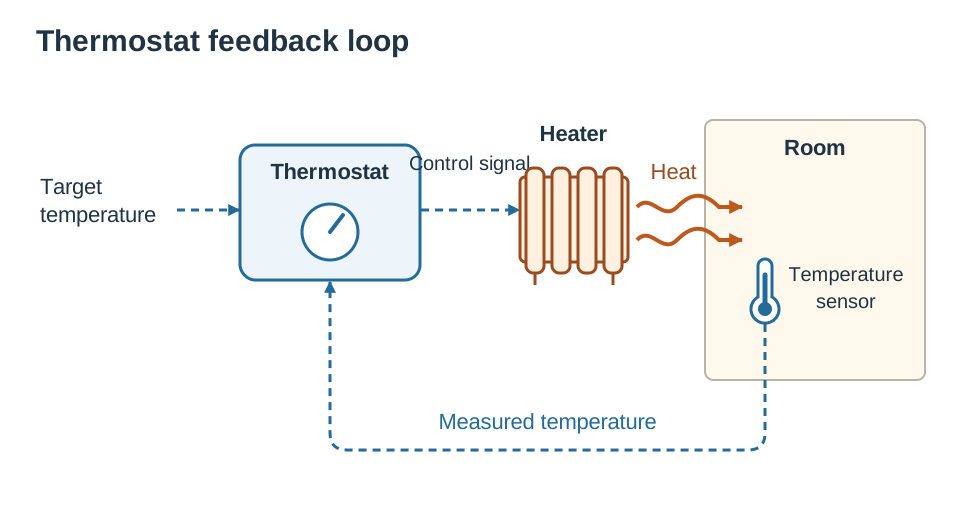
- Closed-loop systems use sensor feedback to adjust output, such as a thermostat controlling temperature.
Mechanisms and System Programming
A mechanism changes the speed, direction, or type of motion produced by an output actuator:
| Mechanism | Motion Change | Use in Controlled Systems |
|---|---|---|
| Gear train | Changes speed and turning force (torque) | Slows a motor to drive a conveyor belt |
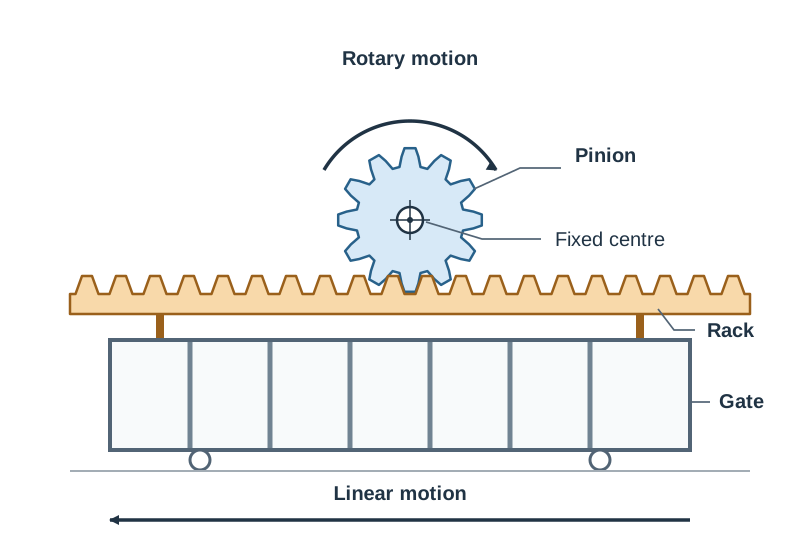
| Rack and pinion | Converts rotary motion to linear motion | Slides an automated gate open and shut |
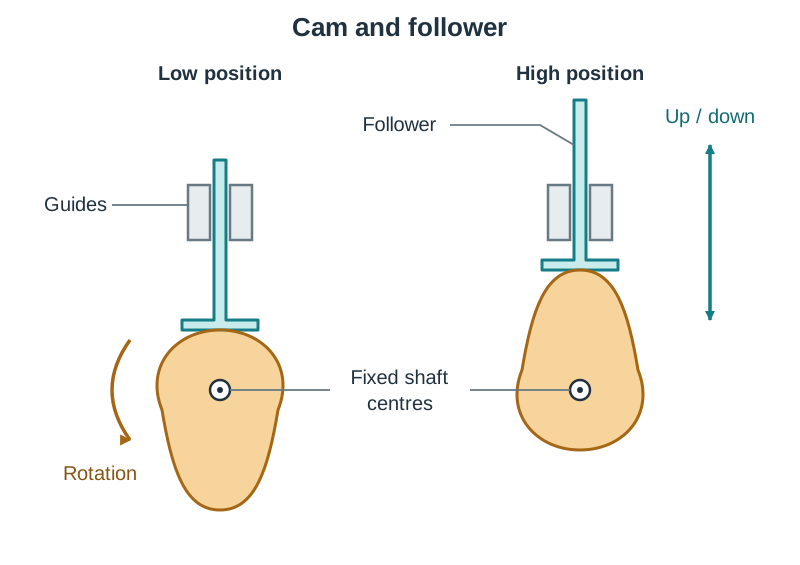
| Cam and follower | Converts rotary motion to reciprocating motion | Lifts a mechanical sorting arm on an assembly line |
| Pulley and belt | Transfers drive between distant shafts | Moves a 3D-printer carriage smoothly |
Configuring and Programming
- Configuring arranges software settings or assigns pins, such as setting a sensor to pin A0 and choosing its trigger threshold.
- Programming writes the sequential instructions that dictate how and when the system acts.
- Flowcharts standardise programs: rounded boxes represent Start/Stop, rectangles denote Processes, diamonds evaluate Decisions, and arrows show flow direction.
Robotics, Automation, and Artificial Intelligence
Automation performs tasks with reduced human input. An autonomous system uses sensor data and programmed logic to operate independently without direct human control.
- Positional Servos: A positional servo turns to and holds a selected angle for positioning a robot joint.
- Simulations: Computer models test system behaviour and stress variables virtually before manufacture, saving material and time.
- Research: Compare reliable sources, record them, and explain a technology’s application in your own words.
- Artificial Intelligence (AI): Software that learns from data to make decisions normally requiring human intelligence.
- AI Application: AI is used in social media to create targeted online marketing content.
- AI Risks: Risks include job displacement from automation and the generation of false information.
| Robotics Factor | Engineering Reality |
|---|---|
| Advantages | High repeatable accuracy, works non-stop, keeps workers safe from heat and fumes |
| Disadvantages | High initial purchase and setup costs, skilled maintenance required, halts lines if broken |
Smart Materials, Biometrics, and Security
A smart material changes its physical properties reversibly in response to an external environmental change:
- Thermochromic: Changes colour with heat; used on infant spoons to provide a visual scald warning.
- Photochromic: Darkens under ultraviolet light; used in reactive spectacle lenses.
- Shape-Memory Alloys (SMA): Nitinol recovers its original shape when heated; used in dental braces and anti-scald shower valves.
Biometrics and Security
- Biometric authentication verifies identity using unique physical traits such as fingerprints, facial structure, or iris scans.
- Border systems compare the chip’s facial image with the traveller to help reduce identity fraud.
- Smart devices on networks risk phishing and malware. Engineers protect data using encryption, unique passwords, and two-factor authentication (2FA).
- Smart controls can reduce wasted energy, but hardware production consumes scarce minerals and produces electronic waste.
Key terms
- Smart Technology
- Electronic devices that connect to networks to share data and operate interactively.
- Mechatronics
- The multidisciplinary engineering field combining mechanical, electronic, and software systems.
- Feedback Loop
- Output measurements return to the controller, which compares them with the target and adjusts the system.
- Open-Loop System
- A control system that operates purely on pre-set instructions without measuring or adjusting for the final output.
- Closed-Loop System
- A control system that uses continuous sensor feedback to monitor and correct its output against a set target.
- Autonomous
- A system capable of operating independently using sensors and programmed instructions without human intervention.
- Smart Material
- A material whose physical properties change reversibly in response to an external stimulus like heat or light.
- Biometric Authentication
- A security process that verifies identity by scanning unique biological characteristics such as fingerprints or irises.
Check yourself
Which mechanism converts rotary motion directly into linear motion?
A rack and pinion.
What is the difference between an open-loop and a closed-loop control system?
An open-loop system runs without checking the result, while a closed-loop system uses sensor feedback to make corrections.
Why is a positional servo suitable for positioning a robot joint?
It turns to and holds a selected angle to accurately position the joint.
Why is thermochromic plastic used to manufacture infant feeding spoons?
It changes colour when food is too hot, providing an immediate visual warning to prevent burns.