

Energy is the ability to do work, powering everything from workshop motors to microcontrollers. In the Junior Cycle exam, you need to identify energy conversions in mechanisms, explain how electromagnets work, and weigh up the environmental trade-offs of power sources.
Energy Forms and Conversions
Energy cannot be made or destroyed. It simply changes from one form to another to do useful work.
| Device | Input Form | Useful Output Form |
|---|---|---|
| Solar PV cell | Light | Electrical |
| Wind turbine | Kinetic | Electrical |
| Battery | Chemical | Electrical |
| DC generator | Mechanical | Electrical |
| DC motor | Electrical | Rotary mechanical |
| Solenoid | Electrical | Linear mechanical |
| LED | Electrical | Light |
| Buzzer | Electrical | Sound |
In exam questions, always state the supplied energy input first and the intended output second.
Electromagnets and Solenoids
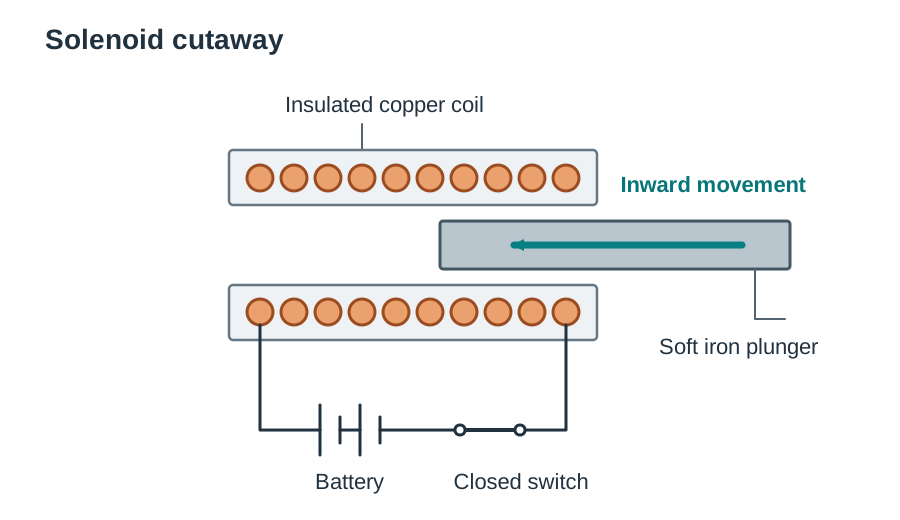
An electromagnet is a temporary magnet created by coiling insulated copper wire around a soft iron core. It only produces a magnetic field while electric current flows through the coil.
- Winding more turns of wire or increasing the electric current strengthens the magnetic pull.
- Switching off the electrical current causes the magnetic field to collapse right away.
- A soft iron core magnetises easily and loses its magnetism instantly when switched off.
- A solenoid uses this magnetic pull to draw an iron plunger straight into its coil.
- Solenoids convert electrical energy into linear mechanical movement for door latches and sorting gates.
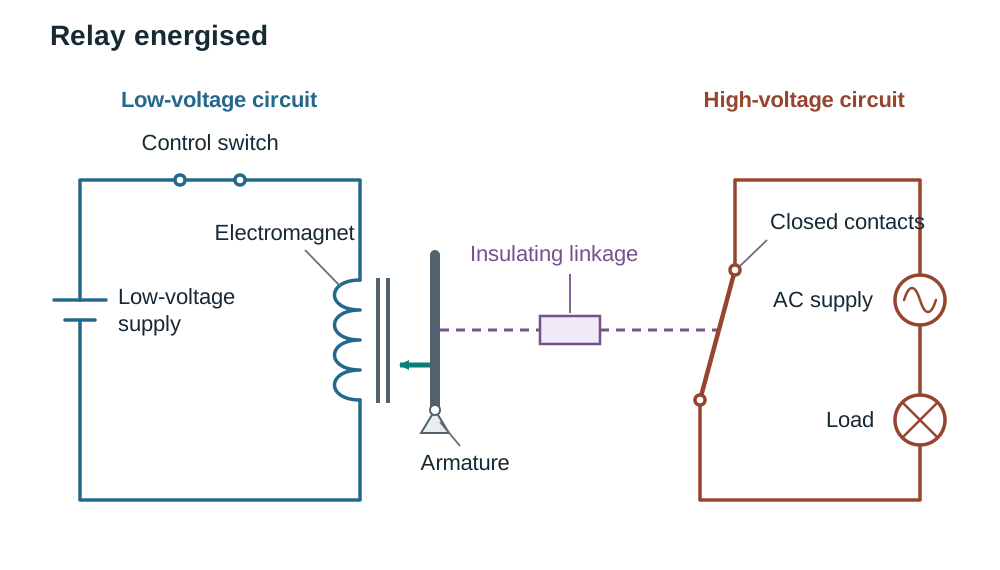
- A relay uses an electromagnet to allow a low-voltage circuit to safely switch a high-voltage circuit.
Renewable and Finite Power Sources
Engineers select power supplies by balancing reliability, financial cost, and environmental impact.
- Renewable sources like wind, solar, and running water replenish naturally and will never run out.
- Non-renewable sources like coal, oil, and gas come from finite reserves that deplete with use.
- Solar photovoltaic panels produce clean electricity on site for houses and roadside warning signs.
- Solar output drops during heavy cloud cover and stops completely at night.
- Wind turbines generate zero carbon emissions while turning, but they can be noisy and disrupt birds.
- Burning fossil fuels offers reliable energy on demand, but releases carbon dioxide and drives air pollution.
Efficiency, Transport, and the Environment
Every real machine wastes some input energy as unwanted heat or sound. Better efficiency means a larger share of input energy becomes useful output energy.
- LEDs use less electricity and waste less energy as heat than filament bulbs producing the same light output.
- Input: movement sensor; process: controller checks inactivity; output: light switches off after a delay, saving energy.
- A hybrid vehicle pairs an internal combustion engine with an electric motor to cut fuel burn.
- Battery electric vehicles produce zero tailpipe emissions on the road, lowering local street pollution.
- Charging an electric vehicle still creates indirect emissions if the local electricity grid burns fossil fuels.
Key terms
- Energy
- The ability to do work, measured in joules (J).
- Energy conversion
- The process of changing energy from one state or form into another.
- Electromagnet
- A temporary magnet formed by passing electric current through a wire coil wrapped around a soft iron core.
- Solenoid
- An electro-mechanical component that converts electrical energy into linear mechanical motion using a coil and plunger.
- Renewable energy
- Energy from natural sources that replenish naturally, such as sunlight, wind and moving water.
- Non-renewable energy
- Energy from finite resources, such as coal, oil and gas, that are not replaced on a human timescale.
- Energy efficiency
- The ratio of useful energy output compared to total energy input in an engineered system.
- Carbon footprint
- The total greenhouse gas emissions caused directly and indirectly by a product, machine, or activity.
Check yourself
What happens to the magnetic field of an electromagnet when the power supply is disconnected?
The magnetic field collapses immediately and the core loses its magnetism.
What energy conversion occurs inside an electrochemical battery while powering a circuit?
Chemical energy converts into electrical energy.
Why does an LED consume less power than an incandescent filament bulb for the same light output?
The LED has higher energy efficiency and wastes far less input energy as heat.
What specific movement does a solenoid plunger make?
It moves along a straight line, providing linear mechanical motion.