
A piston petrol engine converts energy from burning fuel into rotary motion through a crank-slider mechanism. Practise identifying strokes and explaining valve operation and lubrication.
The Crank-Slider Mechanism and Engine Parts
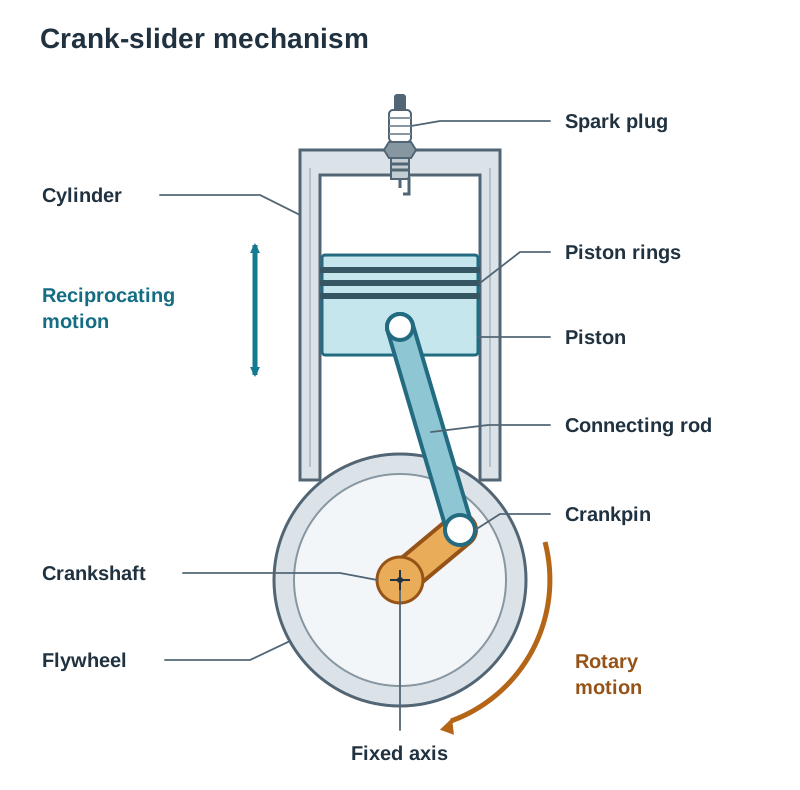
An internal combustion engine burns fuel inside a cylinder to push a piston up and down. A crank-slider mechanism converts that up-and-down straight-line motion into turning drive at the crankshaft.
Engines are studied in mechanical engineering, which deals with the design and operation of mechanical devices and machine systems.
| Component | Function |
|---|---|
| Cylinder | Guides the piston and forms the combustion chamber. |
| Piston | Slides up and down inside the cylinder under gas pressure. |
| Piston rings | Seal combustion gases and control oil on the cylinder wall. |
| Connecting rod | Links the piston directly to the crankshaft. |
| Crankshaft | Converts reciprocating piston motion into usable rotary motion. |
| Flywheel | Heavy wheel that stores energy to keep the crankshaft turning smoothly between power strokes. |
| Spark plug | Delivers a timed spark to ignite the compressed air–fuel mixture. |
The Four-Stroke Petrol Engine
A stroke is the movement of the piston from top dead centre (TDC) to bottom dead centre (BDC), or from BDC to TDC. One complete four-stroke cycle requires four piston strokes and two full turns of the crankshaft.
| Stroke | Piston Movement | Inlet Valve | Exhaust Valve | What Happens |
|---|---|---|---|---|
| 1. Induction | Down (TDC to BDC) | Open | Closed | Low pressure draws fresh air–fuel mixture into the cylinder. |
| 2. Compression | Up (BDC to TDC) | Closed | Closed | Piston compresses the mixture; at the top of this stroke the spark plug fires. |
| 3. Power | Down (TDC to BDC) | Closed | Closed | Burning gas expands rapidly and forces the piston down. This stroke produces drive. |
| 4. Exhaust | Up (BDC to TDC) | Closed | Open | Rising piston pushes burnt exhaust gases out through the exhaust valve. |
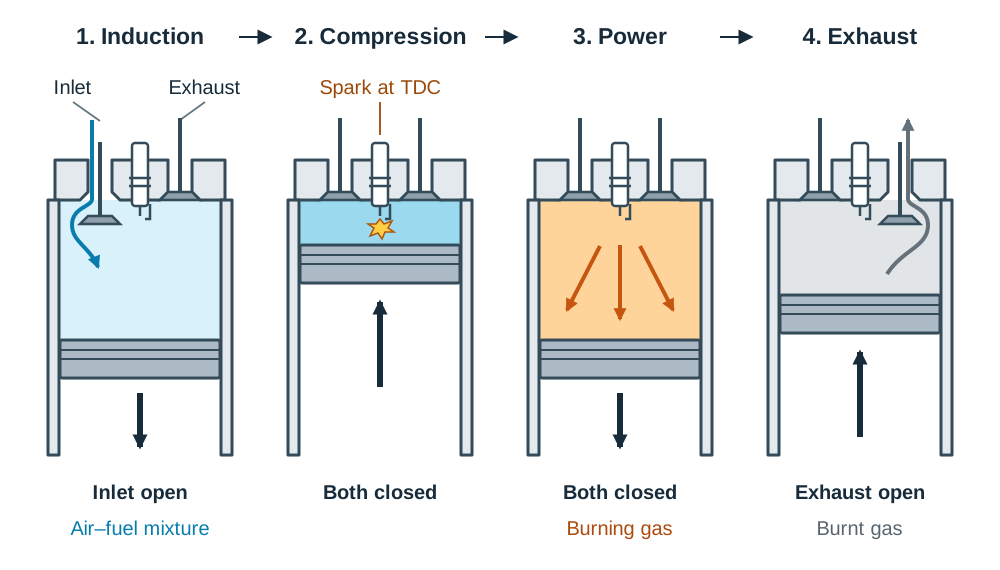
Remember the order as I-C-P-E: Induction, Compression, Power, Exhaust.
Valve Operation and Lubrication
Valve Mechanism
Four-stroke engines use valves operated by a camshaft:
- As the camshaft rotates, its egg-shaped lobe pushes down against the valve stem to force the valve open.
- When the lobe rotates away, the valve spring pushes the valve closed, sealing it tightly against its seat.
Engine Lubrication
- Four-stroke engine: Lubricating oil sits in an oil sump at the bottom of the crankcase. A pump or splashing action distributes oil across bearings, crankshaft, and cylinder walls to reduce friction and wear.
- In this premixed two-stroke petrol engine, oil mixed with petrol lubricates moving parts before burning in the cylinder.
Two-Stroke Engines and Comparison
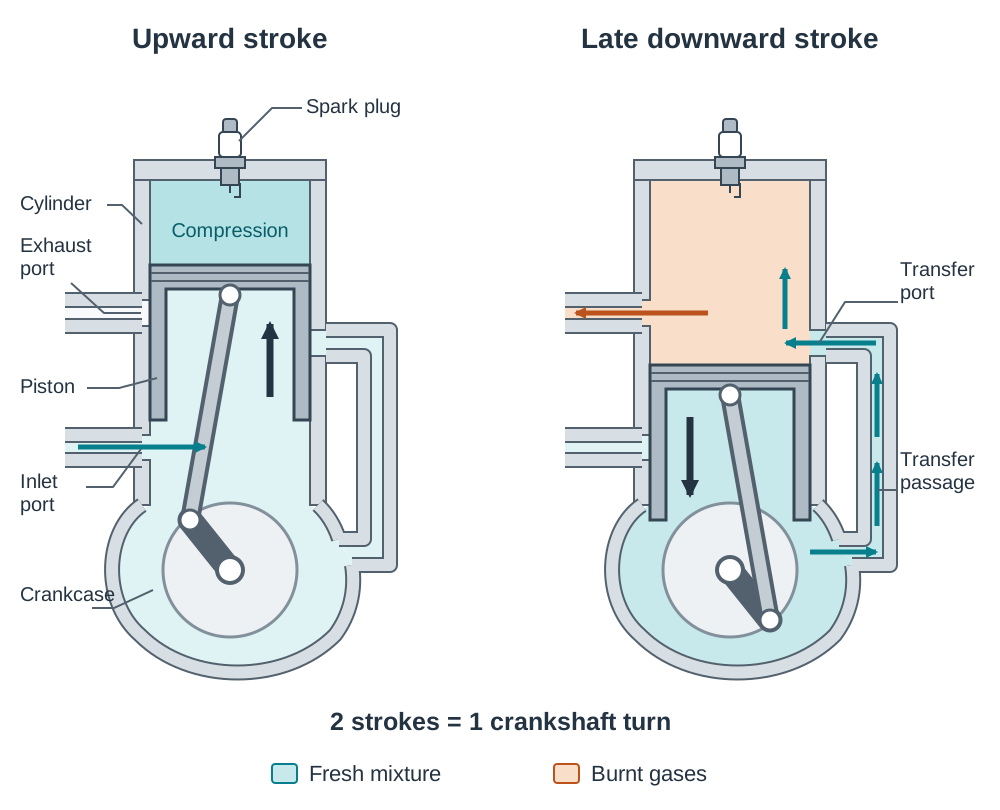
In this simple two-stroke petrol engine, the piston opens and closes openings called ports in the cylinder wall instead of cam-operated valves. It completes a power cycle in two piston strokes (one crankshaft turn).
- Upward stroke: Piston compresses the air–fuel mixture above it, and the spark plug fires at the top. Below the piston, fresh mixture enters the crankcase through the inlet port.
- Downward stroke: Burning gases drive the piston down, pressurising the crankcase. The piston uncovers the exhaust port to release burnt gases, then the transfer port allows pressurised mixture into the cylinder.
Comparing Engine Types
- Two-stroke advantages: This simple two-stroke design is generally lighter and simpler than a comparable four-stroke engine, and produces a power stroke every crankshaft turn.
- Two-stroke disadvantages: Burning lubricating oil adds exhaust pollution.
- Four-stroke advantages: Comparable four-stroke engines are generally more fuel-efficient.
Key terms
- Crank-slider mechanism
- A mechanical linkage converting reciprocating piston motion into continuous rotary crankshaft motion.
- Reciprocating motion
- Continuous back-and-forth or up-and-down motion in a straight line.
- Rotary motion
- Continuous turning movement around a fixed central axis.
- Top dead centre (TDC)
- The highest point reached by the piston during its travel up the cylinder.
- Bottom dead centre (BDC)
- The lowest point reached by the piston during its travel down the cylinder.
- Camshaft
- A rotating shaft with shaped lobes that push engine valves open at timed intervals.
- Valve spring
- A heavy spring that pushes an engine valve closed when the cam lobe turns away.
- Oil sump
- The reservoir pan at the base of a four-stroke engine that stores lubricating engine oil.
Check yourself
Which engine mechanism converts linear reciprocating motion into rotary motion?
The crank-slider mechanism.
Explain how a four-stroke engine is lubricated.
Oil is held in the oil sump and pumped or splashed over moving parts to reduce friction.
What component stores energy during the power stroke to keep the crankshaft rotating smoothly?
The flywheel.
How is lubricating oil supplied to the moving parts of the premixed two-stroke petrol engine described here?
Oil is mixed with the petrol before fuelling and lubricates the engine as the mixture passes through.