
A mechanism is an assembly of parts that transforms an input motion and force into a desired output. In the Junior Cycle examination, you will identify mechanisms in controlled systems, describe their operation, and calculate drive speeds and directions.
Motion and controlled systems
A motor supplies motion to a mechanism, which changes it into the movement the product needs.
There are four types of motion:
- Linear: moving in a straight line in one direction, like a part carried along a conveyor belt.
- Rotary: turning continuously in a circle around an axis, like a wheel or motor shaft.
- Reciprocating: repetitive back-and-forth movement in a straight line, like an engine piston.
- Oscillating: repetitive swinging back and forth along an arc, like a clock pendulum.
Actuators provide different mechanical outputs:
- A servo motor provides precise position and speed control for robotic arms and cameras.
- A DC motor and gearbox reduces motor speed to provide greater torque, meaning a greater turning effect.
Levers, moments and fluid power
A lever is a rigid bar that turns around a pivot called a fulcrum. An applied effort force overcomes a load force. Levers are classified by whichever part sits in the middle:
- Class 1: fulcrum in the middle (e.g. pliers, scissors).
- Class 2: load in the middle (e.g. wheelbarrow, nutcracker).
- Class 3: effort in the middle (e.g. tweezers, tongs).
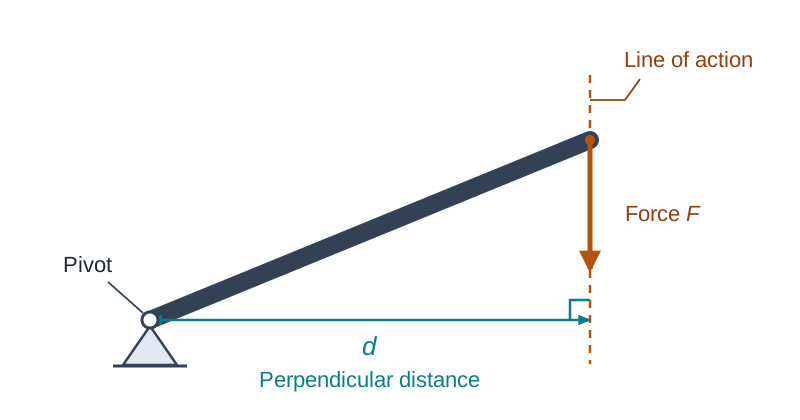
Moment = force × perpendicular distance from the pivot to the force’s line of action—the line along which it acts, measured in N m. A lever balances in equilibrium when total clockwise moments equal total anticlockwise moments.
Fluid mechanisms also transmit force:
- Hydraulic mechanisms use liquid under pressure to transmit force, as in a digger arm.
- Pneumatic: a mechanism that works by compressed air, such as a factory assembly cylinder.
Drive systems: gears, belts and chains
Drive systems transfer rotary power from a driver input shaft to a driven output shaft.
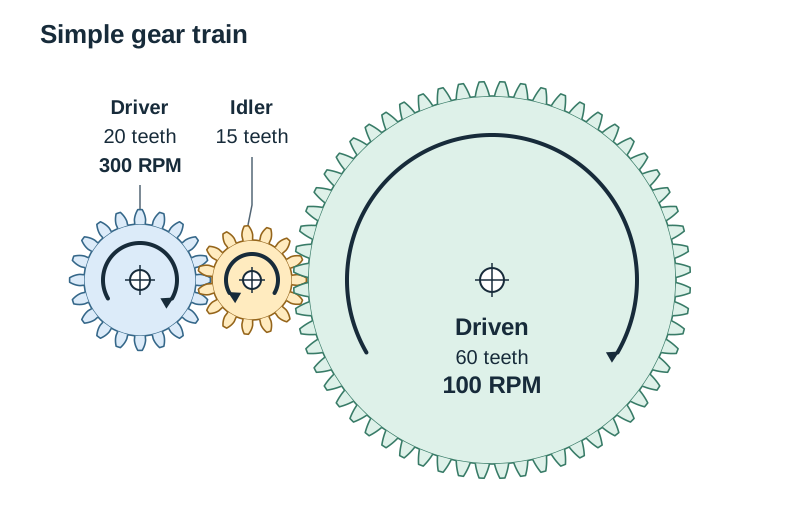
- Velocity ratio equals driver teeth (or diameter) divided by driven teeth (or diameter).
- Output speed = driver speed × velocity ratio.
- A simple gear train has one gear per shaft; meshing external spur gears turn in opposite directions.
- An idler gear changes output direction without changing the overall speed ratio.
- A compound gear train has at least two gears fixed together on one shaft, rotating at the same speed.
- Bevel gears are cone-shaped toothed gears that transfer drive through 90°.
- Toothed belts mesh with pulleys to eliminate slip, whereas plain belts can slip under load.
- Chains and sprockets provide positive drive with zero slip on bicycles and machines.
Motion converters, bearings and testing
Specialised mechanisms convert motion type or direction:
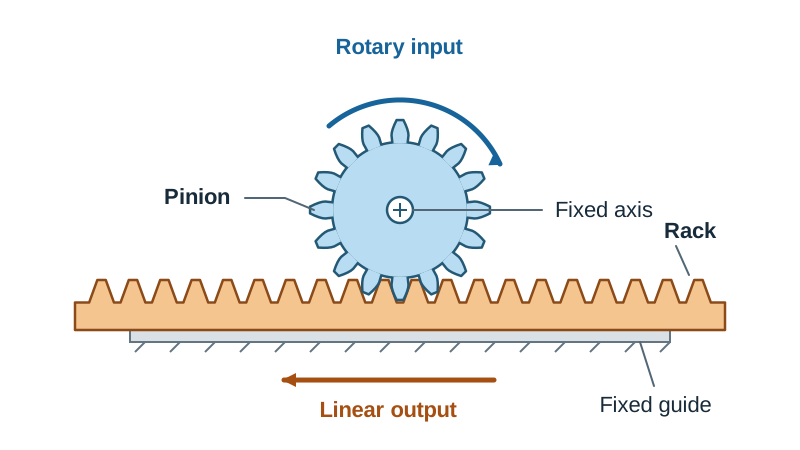
- A rack and pinion converts rotary motion into linear motion, as in steering and sliding gates.
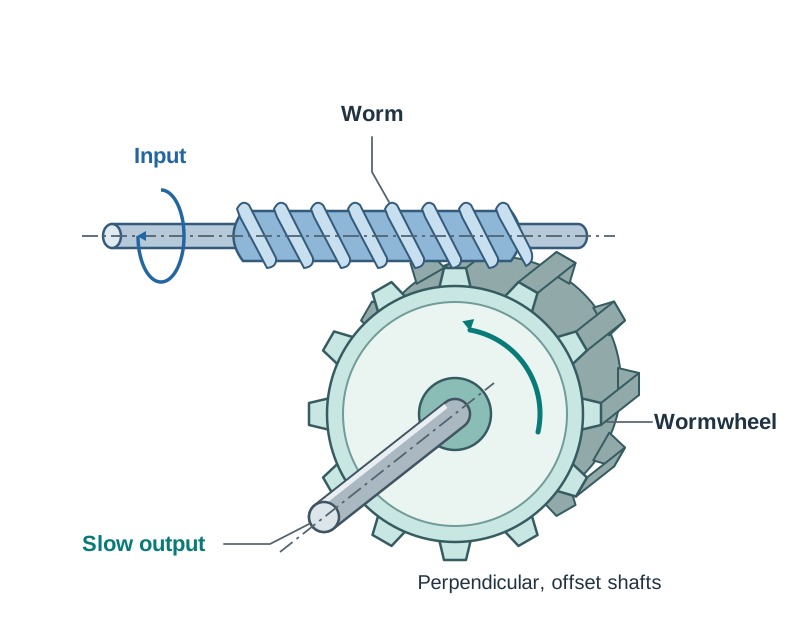
- A worm and wormwheel drives slowly through 90°; a self-locking design prevents the wormwheel driving the worm backwards.
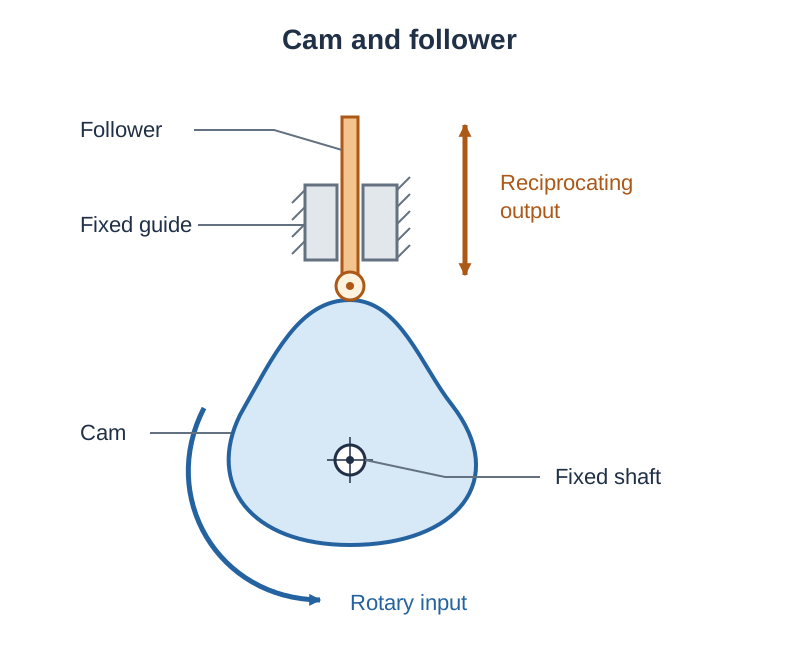
- A cam and follower converts rotary motion into reciprocating motion.
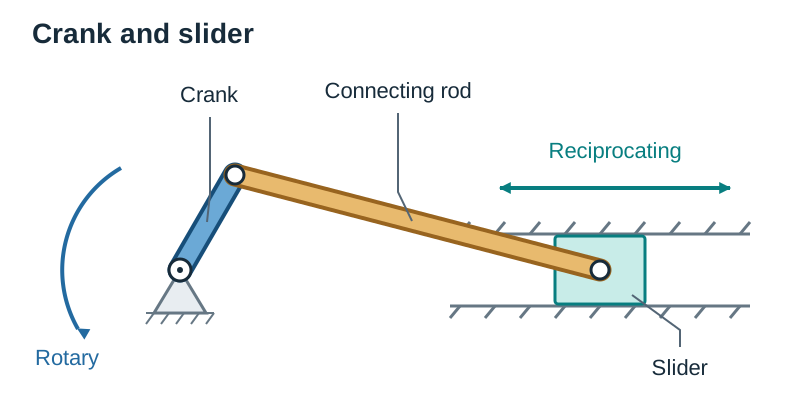
- A crank and slider converts between rotary and reciprocating motion; an engine piston drives the crankshaft.
- A ratchet and pawl permits rotation in one direction.
- A ball bearing positions a rotating shaft and allows it to turn freely by reducing friction.
- Lubricants reduce friction and wear; dumping waste oil contaminates land and waterways.
- When building a mechanism, test movement direction, smooth operation, and total travel.
Key terms
- Fulcrum
- The fixed pivot point about which a lever rotates.
- Velocity ratio
- The ratio of driver size (teeth or diameter) to driven size, determining output speed.
- Idler gear
- An intermediate gear that changes output rotation direction without changing the overall gear ratio.
- Rack and pinion
- A mechanism comprising a round gear and flat toothed rail that converts rotary motion into linear motion.
- Worm and wormwheel
- A worm turns a wormwheel slowly through 90°; a self-locking design prevents the wormwheel driving the worm backwards.
- Hydraulic
- A system or mechanism operated by liquid under pressure, usually oil.
- Pneumatic
- A system or mechanism operated by compressed air.
- Ball bearing
- A ring of steel balls that supports a rotating shaft and reduces friction.
Check yourself
Gear A drives gear B, which drives gear C, each mounted on its own shaft. Name this arrangement.
A simple gear train.
Which mechanism changes rotary motion into linear motion to move a sliding gate?
A rack and pinion.
How does a worm and wormwheel mechanism tension a sports net?
Turning the handle rotates the worm, which turns the wormwheel slowly to pull the net tight.
Why is a servo motor chosen for a robotic gripper instead of a standard DC motor?
It provides precise control of both position and speed, combined with high torque.
State two environmental hazards caused by the improper disposal of workshop lubricants.
Contamination of land and pollution of rivers and waterways.