

Sustainable development connects global economic inequality with environmental protection. Topic 8 explores why poverty and ecological damage persist side by side, examines six syllabus arguments from the political left and right, and evaluates actions across five levels of society. The Leaving Certificate course contrasts market-led modernisation theories with structural critiques from named thinkers André Gunder Frank, Vandana Shiva, and Fr Seán McDonagh.
What is Sustainable Development? The Three Pillars
The starting point for understanding sustainable development is the United Nations Brundtland Commission report, Our Common Future (1987). It defines sustainable development as development that meets the needs of the present without compromising the ability of future generations to meet their own needs.
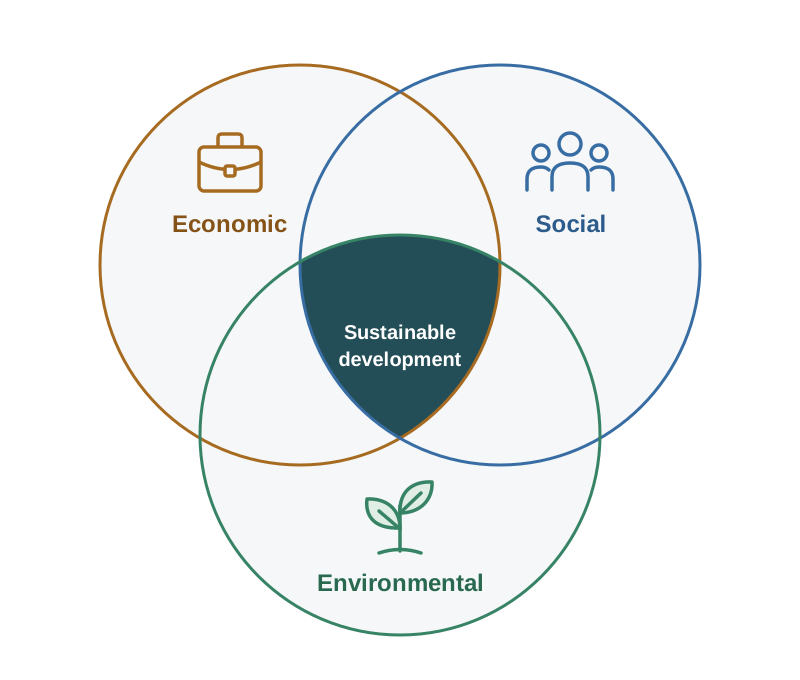
To make this operational, the model balances three interdependent pillars:
- Economic: creating viable livelihoods, steady employment, and infrastructure without exhausting finite raw materials.
- Social: protecting human rights, healthcare, education, community wellbeing, and gender equality.
- Environmental: safeguarding biodiversity, reducing greenhouse gas emissions, and keeping soil, air, and water clean.
Think about how these pillars interact in practice. If a gold mine brings high-paying jobs to a valley but poisons the local drinking water with cyanide tailings, it fails the environmental test. If a government cuts national carbon emissions by shutting peat plants overnight while leaving the workers with no pensions or retraining, it fails the social test. Real sustainable development demands that all three pillars hold up together.
The Six Arguments on Underdevelopment and Sustainability
Learning Outcome 8.2 sets out six specific arguments about why underdevelopment occurs and how we ought to tackle ecological damage. In the exam, you need to explain each argument in your own words, test it against real-world evidence, and identify whether it sits on the political left, the right, or could belong to either.
Right-wing arguments lean into private enterprise, competitive markets, technological breakthroughs, and economic growth. They usually view underdevelopment as an internal problem caused by a lack of skills or bad policies inside poorer countries.
Left-wing arguments focus on structural power, colonial history, unfair trade rules, and wealth extraction. They argue that market competition rewards the powerful and insist on public regulation, wealth redistribution, and ecological limits.
| Syllabus Argument | Theory & Thinker | Political Stance | Evidence For | Evidence Against |
|---|---|---|---|---|
| 1. Knowledge and technology deficit | Modernisation Theory (W.W. Rostow) | Right-wing | South Korea and Ireland modernised rapidly by importing advanced machinery, digital infrastructure, and foreign direct investment. | Poorer countries often receive foreign technology yet stay poor because multinational firms send their profits straight back to parent headquarters. |
| 2. Unfair terms of trade | Dependency Theory (André Gunder Frank) | Left-wing | Smallholder farmers growing cocoa or coffee get pennies on the euro compared to Western supermarket retail prices. Subsidies in the EU and US also undercut Southern growers. | Countries like Vietnam and China plugged straight into world trade networks and lifted hundreds of millions of people out of extreme poverty. |
| 3. Corrupt local elites | Institutional Governance analysis | Either left or right (with justification) | Rulers like Mobutu Sese Seko in Zaire looted billions from state coffers while public hospitals collapsed. Transparency International's Corruption Perceptions Index measures perceived public-sector corruption. Poverty must be assessed using separate data. | Blaming local corruption lets Western banks off the hook for sheltering stolen loot, and ignores how foreign governments backed dictators during the Cold War. |
| 4. Industrialisation displaced women | Eco-feminism (Vandana Shiva) | Left-wing / Green radical | The Chipko movement in India showed village women defending mountain forests from commercial loggers to protect drinking water and fertile topsoil. | Export factories and commercial farming have sometimes offered women independent wages outside traditional village patriarchies. |
| 5. Free markets and technology will solve problems | Neoliberalism / Free-Market Environmentalism | Right-wing | The dramatic drop in solar panel and battery costs shows how market competition speeds up green innovation. Carbon pricing puts a cost on industrial pollution. | Global greenhouse emissions climbed for decades while markets grew, because pollution is an unpriced negative externality that businesses ignore unless forced by law. |
| 6. Small-scale, self-reliant communities | Ecological Localism / Communitarianism | Either left or right (with justification) | Community-supported agriculture, local wind cooperatives, and seed banks cut long-distance transport pollution and rebuild topsoil. | Tiny settlements cannot build high-tech hospitals, run universities, or fund national train lines. High-density cities often burn far less energy per person. |
Small-scale communities can appeal to the green left (limits on corporate power and growth) and to conservatives (tradition, local self-reliance, suspicion of big government), for different reasons.
Make sure you can link these arguments to the named course thinkers (Frank, Shiva, McDonagh) and to Rostow, a widely used theorist for Argument 1 who is not named in the specification:
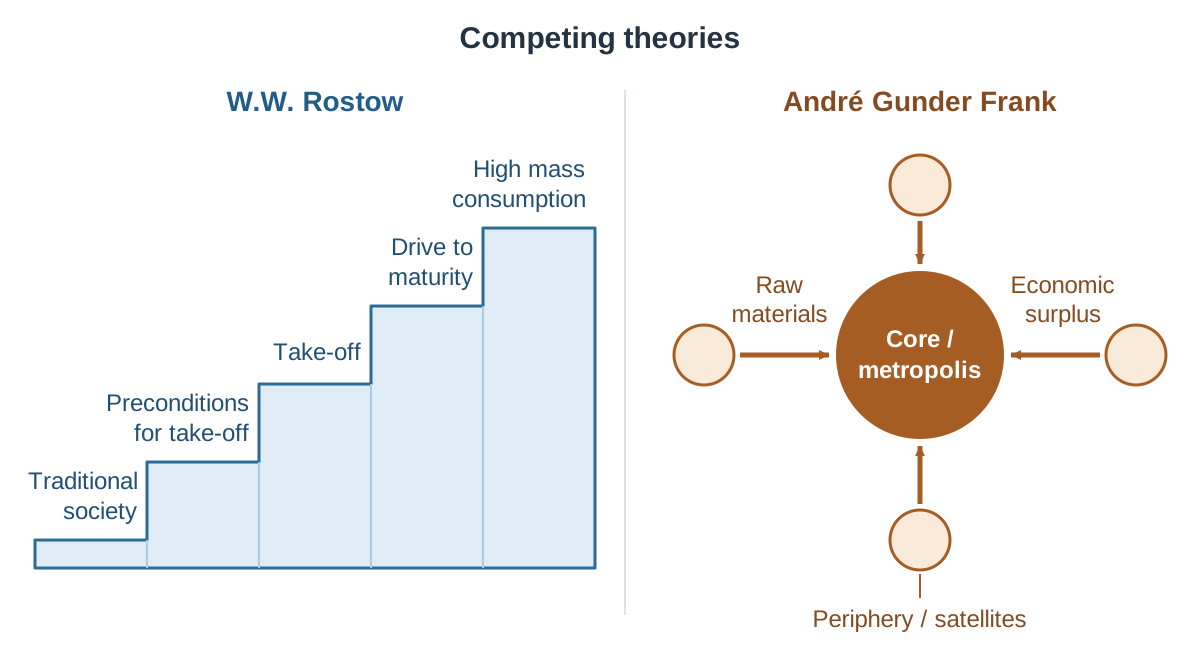
- W.W. Rostow matches Argument 1. In The Stages of Economic Growth (1960), he claimed all societies climb five rungs: the traditional society, preconditions for take-off, take-off, drive to maturity, and the age of high mass consumption. Developing nations simply sit on the lower rungs and need Western investment to take off.
- André Gunder Frank challenges Rostow with Argument 2, arguing that world trade traps peripheral economies in poverty.
- Vandana Shiva directly supplies Argument 4, arguing that corporate monoculture robs women of their traditional role as soil and seed keepers, while also backing Argument 6 through local seed saving.
- Fr Seán McDonagh challenges Argument 5 by arguing that free markets ignore physical planetary boundaries, and champions Argument 6 through community-level care of creation.
Named Thinkers and Their Contexts: Frank, Shiva, and McDonagh
The specification explicitly demands that you understand the historical and geographic context in which each thinker wrote.
André Gunder Frank and Latin America
Frank developed his ideas while living and teaching in Latin America during the 1960s, publishing Capitalism and Underdevelopment in Latin America in 1967. He coined the famous phrase the development of underdevelopment to reject modernisation theory. Frank insisted that poorer countries were never just backwards or isolated. Instead, centuries of European conquest and merchant capitalism actively impoverished them. He visualised a global metropolis-satellite chain, which we also study as the core-periphery model. Wealthy metropoles in Europe and North America pull raw timber, minerals, cash crops, and cheap labour out of satellite colonies, leaving those countries structurally trapped without capital to develop their own domestic manufacturing.
Vandana Shiva and the Indian Ecological Movements
Shiva is an Indian physicist and activist whose thinking grew out of two major struggles: the Chipko movement of the 1970s and resistance to the Green Revolution in northern India. In Uttarakhand, Himalayan women clung to forest trees to stop commercial contractors from clear-felling slopes that protected their villages from fatal landslides and dried-up springs. In Staying Alive (1988), Shiva pointed out that rural women were India's traditional agricultural experts, selecting resilient seeds, preserving soil humus, and gathering firewood without destroying the forest.
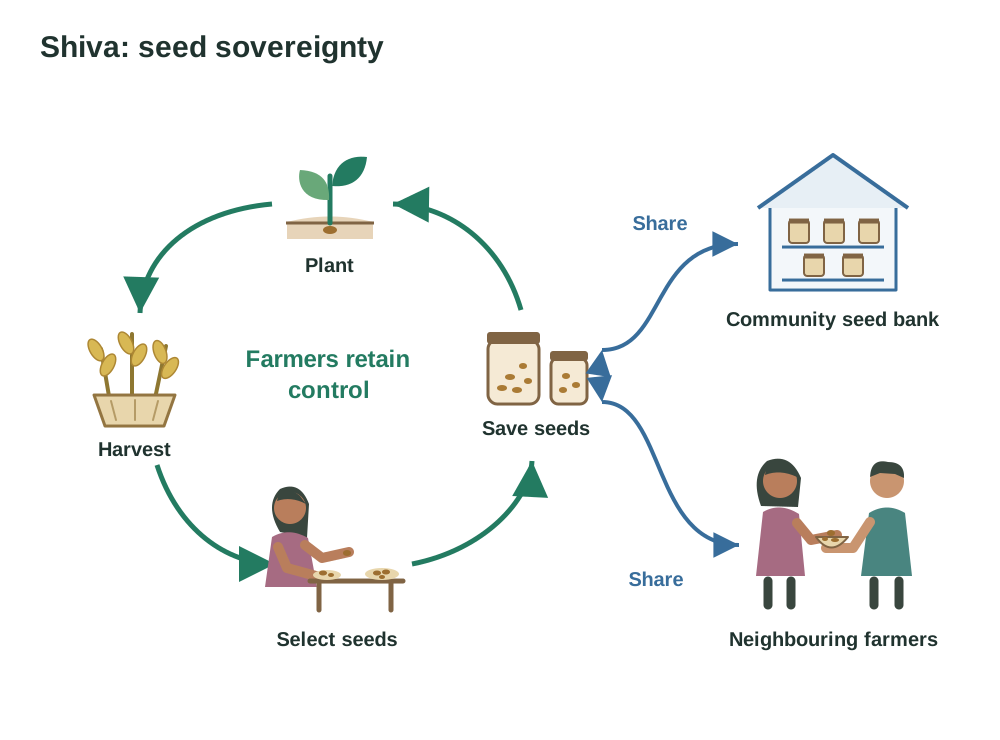
The Green Revolution, promoted by the Indian government and Western foundations from the 1960s, replaced traditional seeds with high-yielding varieties that depended on chemical fertilisers, pesticides and heavy irrigation. Aquifers sank, debt climbed, and women lost their economic standing. Later, multinationals sold patented seeds such as Bt cotton. Shiva strongly campaigns against biopiracy, where Western corporations claim private patents on traditional plants like neem and basmati rice. In 1987 she set up Navdanya to run community seed banks, defending seed sovereignty so farmers keep the legal right to save and share their own grain without corporate licenses.
Fr Seán McDonagh and Mindanao, Philippines
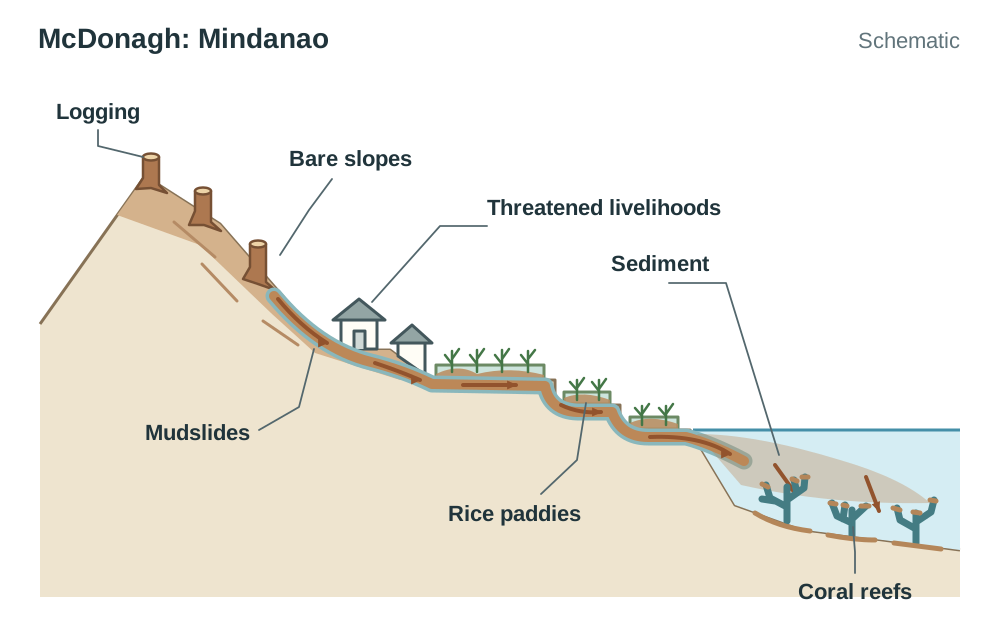
McDonagh is an Irish Columban missionary priest who lived among the indigenous T'boli people on the island of Mindanao during the 1970s and 1980s. While there, he watched international timber firms strip ancient tropical rainforests across the mountains. The bare slopes unleashed devastating mudslides, choked community rice paddies with silt, and buried coastal coral reefs. McDonagh saw firsthand that ecological ruin always harms the poorest first, because vulnerable people depend directly on healthy rivers and forests to eat.
In books like To Care for the Earth (1986) and The Greening of the Church (1990), McDonagh treated environmental protection as a core moral duty, stressing intergenerational justice. He argued that the generation living today has no right to hand down an exhausted, overheated earth to its grandchildren. His work helped push ecological ethics into Catholic social thought, eventually informing the background consultations for Pope Francis's 2015 environmental encyclical Laudato Si'.
Five Levels of Action: From Local Groups to Global Treaties
Syllabus section 8.1 requires you to evaluate how different groups make sustainable development happen across five distinct levels:
1. Individual and Local Community Efforts
Grassroots efforts include community allotments, repair workshops, Tidy Towns pollinator plans, and local energy cooperatives. These projects prove that sustainable lifestyles work in practice and build local solidarity quickly. Their main limitation is scale: local volunteers cannot build high-speed rail networks, overhaul national electricity grids, or stop deep-sea oil drilling on their own.
2. Corporate and Business Sector
Businesses design products, manage international freight, and employ millions of workers. Real corporate action means redesigning goods for reuse, cutting plastic packaging, and powering data centres with renewable energy. The big danger here is greenwashing, where a corporation spends millions on advertising its eco-friendly credentials while keeping its core fossil-fuel investments running untouched.
3. Civic Society Groups and Trade Unions
Campaign groups act as independent watchdogs, lobbying lawmakers and using the legal system to force change. In Ireland, Friends of the Irish Environment took the state to court in the landmark Climate Case Ireland (2020). The Supreme Court quashed the government's 2017 National Mitigation Plan because it was too vague about how Ireland would cut emissions and therefore lacked the specificity required by the Climate Action and Low Carbon Development Act 2015. A legally compliant plan was needed; the judgment did not itself order politicians to enact tougher legislation.
Trade unions make sure environmental policies do not sacrifice working people. This is the heart of a just transition. When Bord na Móna ended industrial peat harvesting in the Midlands to switch into bog restoration and wind power, unions like SIPTU stepped in. Working with a state-appointed Just Transition Commissioner, national funding, and the EU Just Transition Fund, they secured early retirement packages, retraining schemes, and regional investments so that former peat workers were not left behind on the scrapheap.
4. National Governments
Governments possess the statutory power to pass binding laws, levy taxes, and invest public money. The Irish Oireachtas passed the Climate Action and Low Carbon Development (Amendment) Act 2021, which legally commits Ireland to a 51% emissions cut by 2030 (from 2018 levels) and net-zero emissions by 2050. The law set up legally binding five-year carbon budgets. Separately, the government legislated in the Finance Act 2020 for the carbon tax to rise steadily to €100 per tonne by 2030. The hardest political challenge for any national government is managing pushback from influential interest groups, particularly the farming lobby, since agriculture produces the largest single share of Ireland's greenhouse emissions.
5. International Agreements
Pollution and rising temperatures do not stop at national borders. The United Nations Sustainable Development Goals (SDGs) set out 17 global goals to achieve by 2030, linking poverty reduction (Goal 1) directly with climate action (Goal 13). Alongside the SDGs, the 2015 Paris Climate Agreement (COP21) committed countries to hold the global temperature rise 'well below 2°C' above pre-industrial levels, while aiming to keep it to 1.5°C.
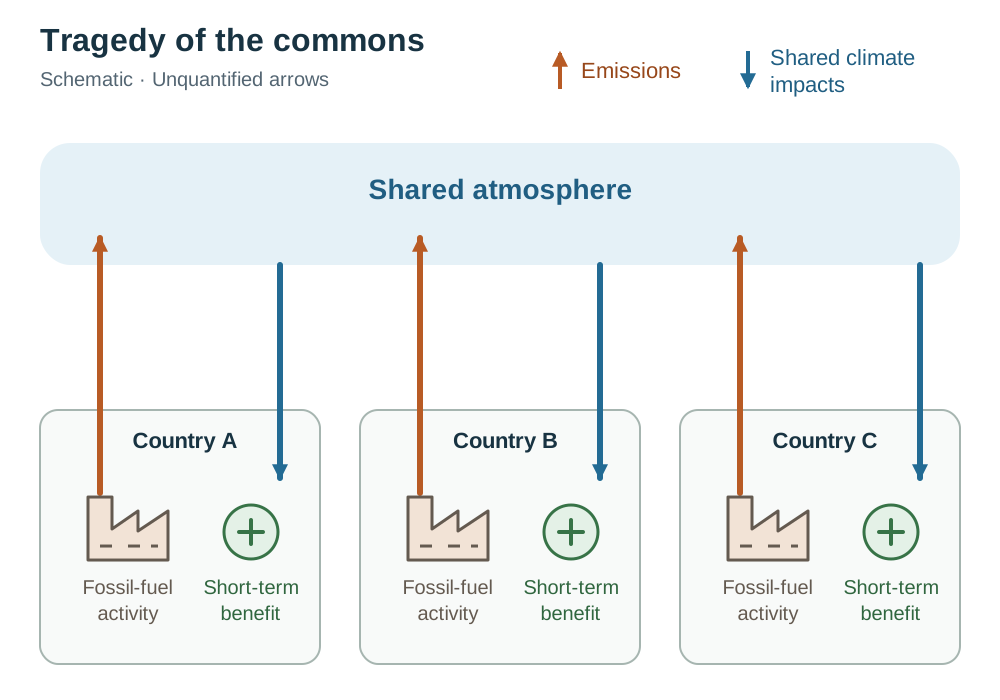
Under Paris, each government sets its own target through a Nationally Determined Contribution (NDC). However, because international law respects national sovereignty, there is no international police force to fine or penalise a country that misses its pledges. This brings us straight to Garrett Hardin's concept of the tragedy of the commons. Because everyone shares the global atmosphere, individual governments face a strong economic temptation to keep burning fossil fuels while hoping other countries make the painful cuts. At COP28 in Dubai (2023), the first formal global stocktake showed a huge emissions gap between national promises and the cuts needed to keep the 1.5°C goal alive.
Critical Evaluation of Development Research (Section 2 Skills)
Section 2 of the Leaving Certificate written paper carries 30% of the total marks. It tests your ability to take an unseen table, chart, or research excerpt and tear its methodology apart with a critical eye. Never accept a researcher's conclusion at face value.
When you examine unseen data in the exam, run through these six checks:
- Source bias: Look closely at who paid for the research. A mining multinational, the World Bank, a state agency, or an environmental NGO like Greenpeace will each come with different institutional priorities. Check whether the evidence actually proves what the author claims.
- Date: Look at when the survey was carried out. Technology, energy markets, and environmental laws move fast, so five-year-old numbers might be completely out of date.
- Sample size and representativeness: Check how many people were interviewed or how many countries were counted. If an NGO interviews twenty people living in an urban slum, that study cannot tell you what is happening across rural farming regions.
- Methodology: Quantitative data gives you wide trends, percentages, and national averages. Qualitative interviews give you personal stories, cultural values, and power struggles. Spot what the chosen method leaves out.
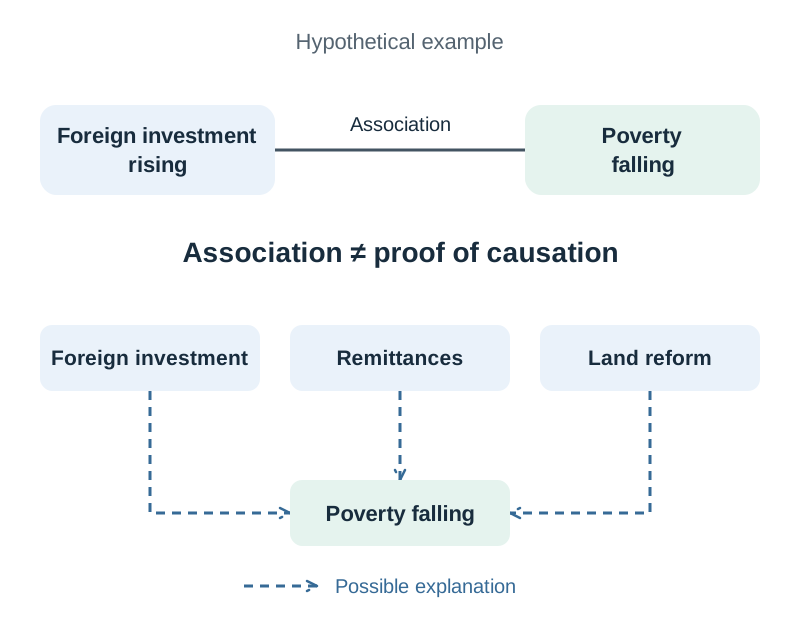
- Correlation versus Causation: Do not let a chart trick you into thinking that because two trends move together, one caused the other. An area might show rising foreign investment alongside falling poverty, but that improvement could have come from families sending wages back from abroad or local land reforms.
- Measurement tools (GDP vs HDI): Gross Domestic Product measures the value of final goods and services produced within an economy over a period. Timber production can add to GDP without a deduction for the loss of the forest itself. GDP does not show how income is distributed and excludes most unpaid household care work, so it is not a complete measure of well-being. Contrast GDP with the United Nations Human Development Index (HDI), which combines life expectancy, years of schooling, and gross national income per head.
Key terms
- Sustainable Development
- Development that meets the needs of the present without compromising the ability of future generations to meet their own needs, balancing economic, social, and environmental pillars.
- Dependency Theory
- A structural economic theory, associated especially with André Gunder Frank, arguing that wealth flows from an exploited periphery of poor nations to enrich a core of wealthy capitalist states.
- Modernisation Theory
- An economic theory, associated with W.W. Rostow, claiming that underdevelopment stems from internal deficits in technology, industry, and skills that can be overcome by following Western industrial stages.
- Metropolis-Satellite Model
- André Gunder Frank's concept describing how dominant urban and industrial centres (metropoles) extract economic surplus from subordinate regions and countries (satellites).
- Eco-feminism
- A philosophy, championed by Vandana Shiva, connecting the commercial exploitation and destruction of nature with the economic marginalisation and oppression of women.
- Seed Sovereignty
- The right of farmers and communities to breed, save, exchange, and plant open-pollinated, non-patented seeds without interference from corporate intellectual property monopolies.
- Biopiracy
- The practice of commercial corporations patenting indigenous seeds, plants, or traditional ecological knowledge that local communities developed over generations.
- Just Transition
- A policy framework that guarantees income support, retraining, and community investment for workers in high-carbon industries as economies shift toward renewable energy.
- Greenwashing
- The practice where organisations spend money marketing themselves as environmentally responsible while their core commercial operations remain ecologically damaging.
- Intergenerational Justice
- The ethical principle that the present generation has a moral duty to safeguard the planet so that future generations inherit a healthy, viable environment.
- Nationally Determined Contributions (NDCs)
- National climate plans that Parties to the Paris Agreement must prepare, communicate and maintain, setting their own targets and policies for reducing greenhouse gas emissions. The duty to submit and update a plan is binding; achieving its emissions target is not itself a binding obligation under the Agreement.
- Tragedy of the Commons
- An economic concept where multiple independent actors deplete or spoil a shared, unregulated public resource (such as the earth's atmosphere) out of short-term self-interest.
Check yourself
What are the three pillars of sustainable development?
The three pillars are economic, social, and environmental sustainability, all of which must be balanced to protect future generations.
Which named thinker coined the phrase 'the development of underdevelopment,' and what does it mean?
André Gunder Frank. It means that poverty in the Global South is not an original natural state, but the direct result of historical and ongoing exploitation by wealthy core capitalist nations.
What is 'biopiracy' as defined by Vandana Shiva?
Biopiracy is the practice where commercial corporations patent indigenous seeds, crops, or traditional community knowledge, transforming shared common resources into private monopoly property.
What was the significance of the 2020 Climate Case Ireland Supreme Court ruling?
The Supreme Court quashed the 2017 National Mitigation Plan because it lacked the specificity required by the Climate Action and Low Carbon Development Act 2015. A legally compliant plan was needed. The case shows a civil-society group, Friends of the Irish Environment, using the courts to hold the government to its legal duties.
Why does Garrett Hardin's 'tragedy of the commons' make international climate agreements hard to implement?
Because the global atmosphere is a shared, unregulated commons, individual states have an economic incentive to keep burning fossil fuels while relying on other nations to bear the cost of emissions cuts.
Why is the argument that 'corrupt local elites cause underdevelopment' classified as an argument that could be used by either the left or the right?
Right-wing thinkers use it to blame poverty on internal governance failures and bad leadership, while left-wing thinkers highlight how corrupt elites collaborate with global corporations and Western banks to extract national wealth.