

Work is how a force transfers energy to an object. Energy is what the object then has because it moves, is high up, or is stretched. Power tells you how fast that energy is transferred. The Principle of Conservation of Energy applies in every process: energy cannot be created or destroyed; it can only be transferred from one body to another or converted from one form to another.
Work Done by a Constant Force
In everyday speech, work means any kind of mental or physical exertion. In physics, it has a precise mechanical meaning.
Work done is defined as force multiplied by displacement in the direction of the force:
Where:
- is work done in joules ()
- is the constant applied force in newtons ()
- is the displacement in metres ()
Work is a scalar quantity. It has magnitude but no direction in space.
When the applied force acts at an angle to the direction of travel, only the component along the displacement does work:
For example, if you pull a sledge across a horizontal path with a force of at an angle of above the ground for :
The vertical component pulls upward against gravity, but because there is no vertical displacement, it does no work.
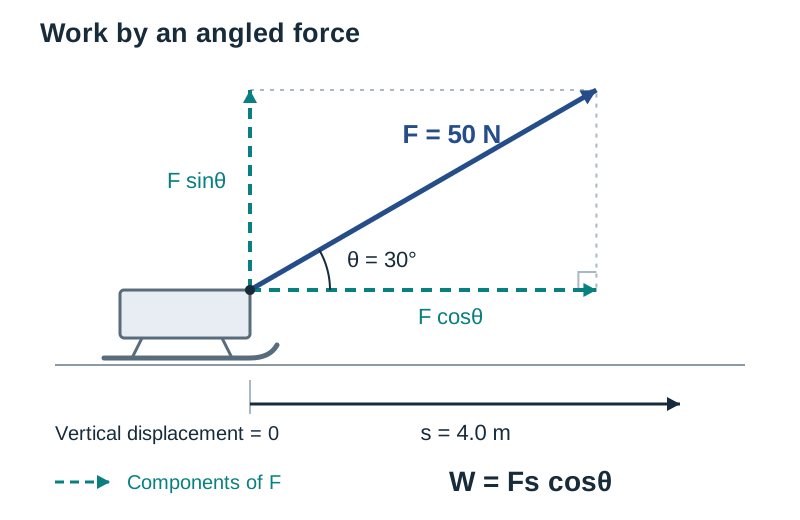
Two special angles appear frequently in exam problems:
- Perpendicular force (): Because , no work is done. A satellite in a circular orbit experiences a centripetal force directed toward the Earth, but this force acts at right angles to the satellite's velocity, so gravity does zero work on it.
- Opposing force (): Because , the work done is negative (). Friction opposes motion and does negative work on an object, removing mechanical energy from it and dissipating it as heat.
The SI unit of work and energy is the joule (). One joule is the work done when a force of 1 newton moves an object through a displacement of 1 metre in the direction of the force ().
Forms of Mechanical Energy
Energy is defined as the ability to do work. Like work, it is a scalar quantity measured in joules ().
In mechanics, you will encounter the symbol for two different quantities: gravitational potential energy () and elastic potential energy (). Be clear from the context which form of stored energy you are using.
Kinetic Energy
Kinetic energy () is the energy an object possesses due to its motion:
Where is mass in kilograms and is speed in metres per second. Because velocity is squared, doubling an object's speed quadruples its kinetic energy. For the same braking force, doubling the speed makes the braking distance four times longer, because the brakes must remove four times as much kinetic energy (, so ).
The work-energy theorem connects applied force directly to speed changes: the net work done on a body equals its change in kinetic energy:
Gravitational Potential Energy
Gravitational potential energy () is the energy an object possesses by virtue of its position in a gravitational field. When you lift an object of mass vertically through a height at constant speed, you apply an upward force equal to its weight ():
Here is the acceleration due to gravity (). The height must always be the vertical displacement, regardless of whether the object travelled up a ramp, along a curve, or straight up.
Hooke's Law and Elastic Potential Energy
When you stretch or compress a spring or elastic material, internal forces act to restore it to its original shape. Within the elastic limit, elastic bodies obey Hooke's Law:
Where:
- is the restoring force in newtons ()
- is the spring constant in newtons per metre (), representing the force needed per metre of extension
- is the extension or compression from equilibrium in metres ()
The negative sign shows that the restoring force acts opposite to the direction of displacement. The external force applied to stretch the spring has the same magnitude: .
The elastic limit is the point beyond which an object ceases to obey Hooke's Law and will not return to its original length when the deforming force is removed.
Derivation of Elastic Potential Energy (Higher Level)
Because the applied force increases steadily from zero to , the force is not constant. The average force needed to produce an extension is:
Work done equals average force multiplied by displacement:
Graphically, on a plot of applied force (vertical axis) against extension (horizontal axis), the graph is a straight line through the origin. The work done equals the triangular area under this line:
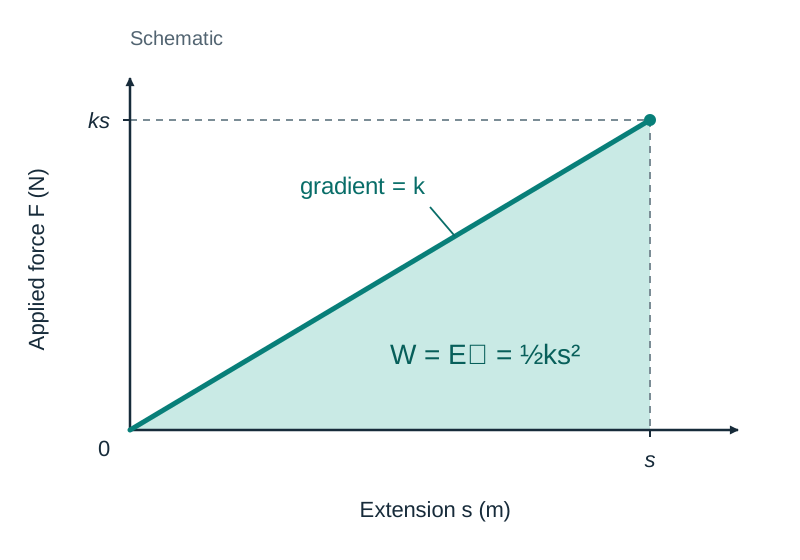
This work is stored as elastic potential energy ():
Investigation: Verifying Hooke's Law
The specification asks you to carry out this investigation using primary data and to analyse secondary data, so be ready to describe the method or to work from a table of results.
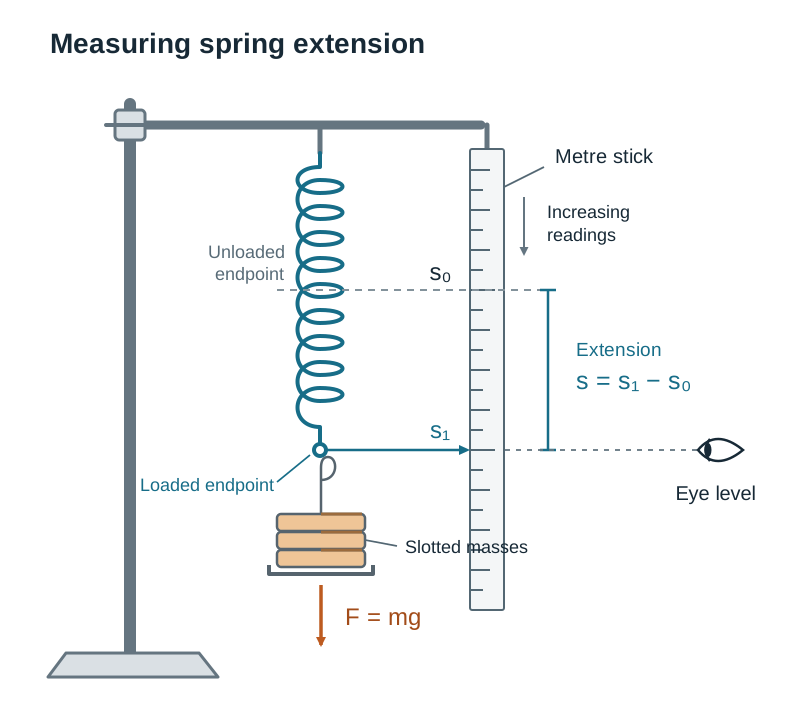
- Apparatus: Retort stand, clamp, spiral spring, weight hanger with slotted masses, and a vertical metre stick.
- Method: Suspend the spring and clamp the metre stick beside it. Note the initial position of the bottom of the spring on the scale with no load (). Add slotted weights in equal steps (such as or ), recording each added load and the new scale reading . Calculate extension as . Unload the spring step by step to confirm the spring returns to its original length.
- Primary and secondary data analysis: Plot applied force on the vertical axis against extension on the horizontal axis. A straight line passing through the origin verifies Hooke's Law (). The slope of this line equals the spring constant in . If inspecting a secondary data table, any point lying well away from the trend line represents an anomalous result; identify it, explain why it does not fit, and exclude it when drawing the line of best fit.
- Sources of error: Parallax error when reading the metre stick (minimised by reading the scale with your eye level with the bottom of the spring, at right angles to the metre stick); exceeding the elastic limit by adding too much load.
Conservation of Energy and Real-World Applications
The Principle of Conservation of Energy states that energy cannot be created or destroyed; it can only be transferred from one body to another or converted from one form to another. In any isolated system, the total energy remains constant.
If there is no friction or air resistance, no mechanical energy converts into heat, so kinetic energy plus potential energy stays the same throughout the motion:
For a body dropped from rest through a vertical height in a vacuum, its initial gravitational potential energy converts entirely into kinetic energy:
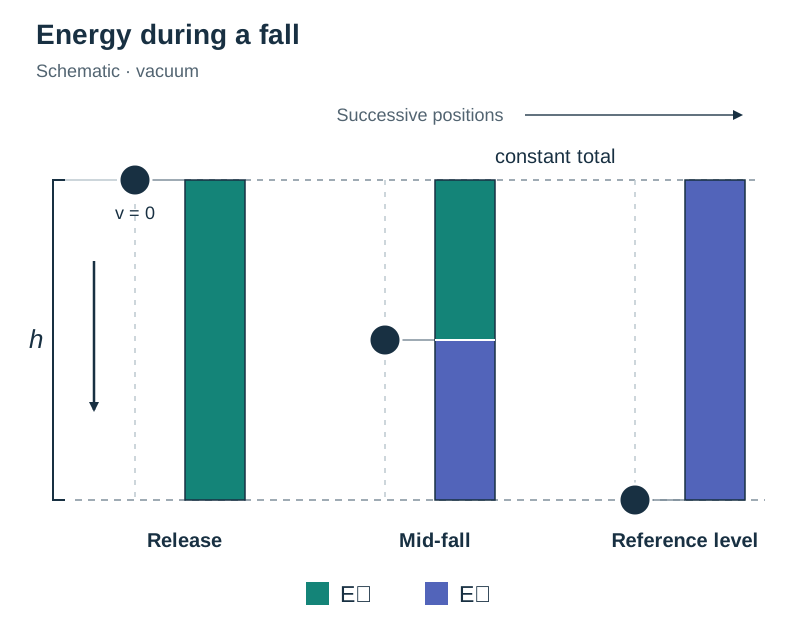
When friction acts, mechanical energy is converted into non-mechanical forms like thermal energy (heat) and sound:
Where .
In modern engineering, regenerative braking in electric and hybrid cars uses an electric generator to convert the vehicle's kinetic energy into chemical energy in a battery when slowing down, rather than dissipating it all as waste heat in brake pads. This improves vehicle efficiency and sustainability.
Investigation: Conservation of Energy
The specification asks you to carry out this investigation using primary data and to analyse secondary data, so be ready to describe the method or to work from a table of results.
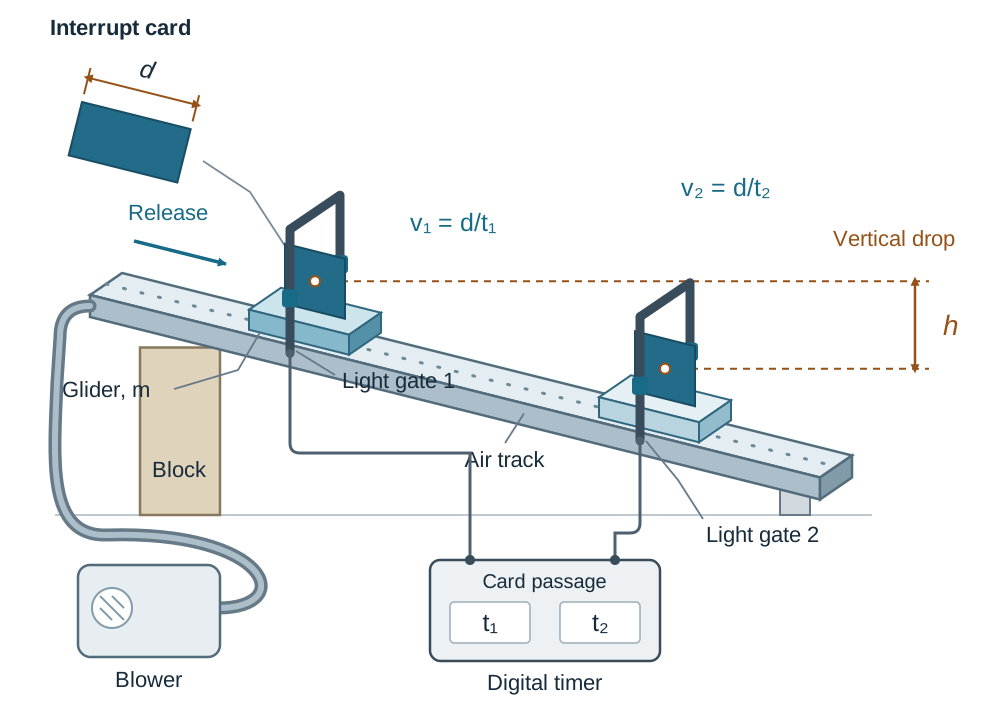
- Apparatus: Linear air track, blower, glider of mass with an interrupt card of width , two light gates connected to a digital timer, a block to elevate one end, and a metre stick.
- Method: Raise one end of the air track on a block. Set up two light gates along the track separated by a measured distance. Measure the vertical height difference between the card positions at the two light gates using a metre stick. Turn on the air supply. Release the glider from rest above the first light gate so it travels through both gates. The timer records the time intervals and for the card of width to pass through gate 1 and gate 2.
- Primary and secondary data analysis: Calculate speeds using and . Calculate the loss in gravitational potential energy, , and the gain in kinetic energy, . If they agree within the limits of experimental error, the principle is supported. When working with secondary data tables, look to see if the gain in is consistently slightly smaller than the loss in ; this systematic shortfall is due to air resistance or residual friction.
- Sources of error: Friction and air resistance (minimised by keeping the track clean and the air holes clear); uncertainty in measuring the small vertical height (minimised by measuring over a larger distance along the track or using trigonometry to calculate , where is the distance along the track between the two gates and is the angle of the track to the horizontal).
Power and Efficiency
Power is defined as the rate at which work is done, or the rate at which energy is transferred:
Where is power in watts (), is work done in joules (), and is time taken in seconds ().
The SI unit of power is the watt (). One watt is an energy transfer rate of one joule per second ().
Rearranging the definition gives the total energy transferred over time:
Always ensure time is converted to seconds before calculating energy in joules.
Power at Constant Velocity
When an engine or applied force drives an object at a steady speed along the line of action of the force:
Because velocity under uniform motion:
Percentage Efficiency
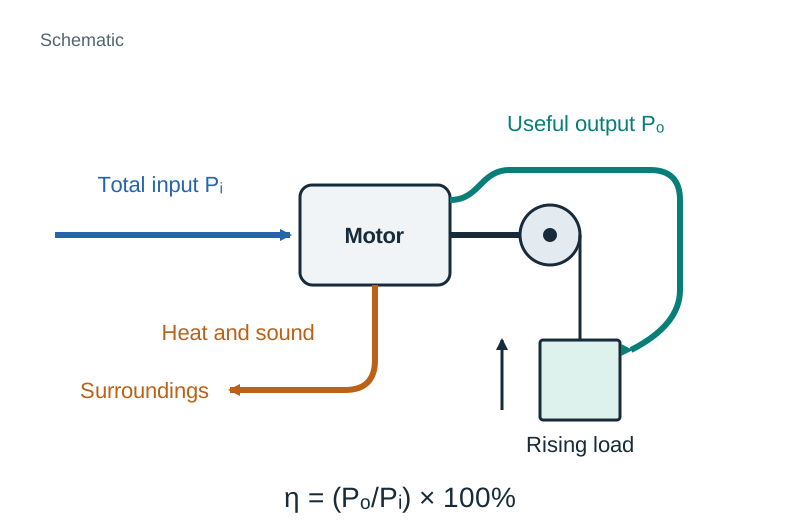
Because resistive forces like friction and electrical resistance always convert some energy into unwanted heat and sound, no practical machine is efficient.
Percentage efficiency is calculated using:
Where is useful power output and is total power input. When calculating efficiency from energies, use the input and output energy for the same length of time. The easiest way is to compare power in with power out.
Key terms
- Work done
- Force multiplied by displacement in the direction of the force ().
- Joule
- The SI unit of work and energy, defined as the work done when a force of 1 newton acts through a displacement of 1 metre in the direction of the force ().
- Energy
- The ability to do work, measured as a scalar in joules.
- Kinetic energy
- The energy an object possesses due to its motion, given by .
- Gravitational potential energy
- The energy an object possesses by virtue of its position in a gravitational field, given near Earth's surface by .
- Hooke's Law
- The law stating that the restoring force exerted by an elastic object is directly proportional to its displacement from equilibrium, provided its elastic limit is not exceeded ().
- Spring constant
- The force needed per metre of extension or compression of an elastic material (), measured in .
- Elastic limit
- The maximum extension an elastic object can experience such that it still returns to its original length when the deforming force is removed.
- Elastic potential energy
- The energy stored in an elastic body when deformed by an extension or compression , given by .
- Principle of Conservation of Energy
- The fundamental principle stating that energy cannot be created or destroyed; it can only be transferred from one body to another or converted from one form to another.
- Power
- The rate at which work is done, or the rate at which energy is transferred ().
- Watt
- The SI unit of power, equivalent to an energy transfer rate of 1 joule per second ().
- Percentage efficiency
- The ratio of useful power output to total power input expressed as a percentage: .
Check yourself
A student holds a heavy 20 kg bag stationary at waist height for 45 seconds. How much work is done on the bag?
Zero joules. Although an upward force is exerted, displacement is zero (), so .
By what factor does the kinetic energy of an object increase if its speed is tripled?
By a factor of 9. Kinetic energy is proportional to the square of speed (), and .
A spring with spring constant k = 200 N m⁻¹ is stretched by 5.0 cm. How much elastic potential energy is stored in the spring?
0.25 J. Convert extension to metres: . Then .
A car travels along a level motorway at a steady 30 m s⁻¹ against a total resistive drag force of 550 N. What power must the engine deliver to maintain this speed?
16,500 W (or 16.5 kW). Using .
An electric pump has an input power of 800 W and operates at 70% efficiency. What is its useful power output?
560 W. .