

Circular motion describes the movement of a body along a curved circular path. Even when travelling at constant speed, an object moving in a circle continually changes its direction of travel. Because velocity is a vector quantity combining speed and direction, this continuous change in direction means the object experiences an inward acceleration towards the centre of the circle, known as centripetal acceleration. By Newton's second law, this requires a resultant inward centripetal force supplied by real physical interactions such as tension, friction, or gravity. For orbiting moons, planets, and artificial satellites, gravity provides this required inward pull, giving rise to Kepler's third law and governing satellite orbits in near-Earth and geostationary space.
Describing Circular Motion: Angular Velocity and Linear Speed
To analyse circular paths, we measure rotation using angles in radians rather than degrees. One radian is the angle subtended at the centre of a circle by an arc whose length is equal to the radius of the circle (). A complete revolution of corresponds to radians.
Angular velocity (symbol , unit ) is the rate of change of angle with respect to time:
For one complete revolution, the angle turned is radians in an orbital period (measured in seconds). Therefore, angular velocity can be written as:
where is the rotational frequency in revolutions per second ( or ).
Linear speed () is the actual tangential speed at which the body travels along the circumference. We connect linear speed and angular velocity in three formal steps:
- The arc length travelled is .
- Dividing both sides by time gives .
- Since linear speed is and angular velocity is , we obtain:
For two points on a rigid rotating arm, both share the exact same angular velocity , but the point positioned farther from the pivot (larger radius ) travels at a greater linear speed because it sweeps out a larger circumference in the same time.
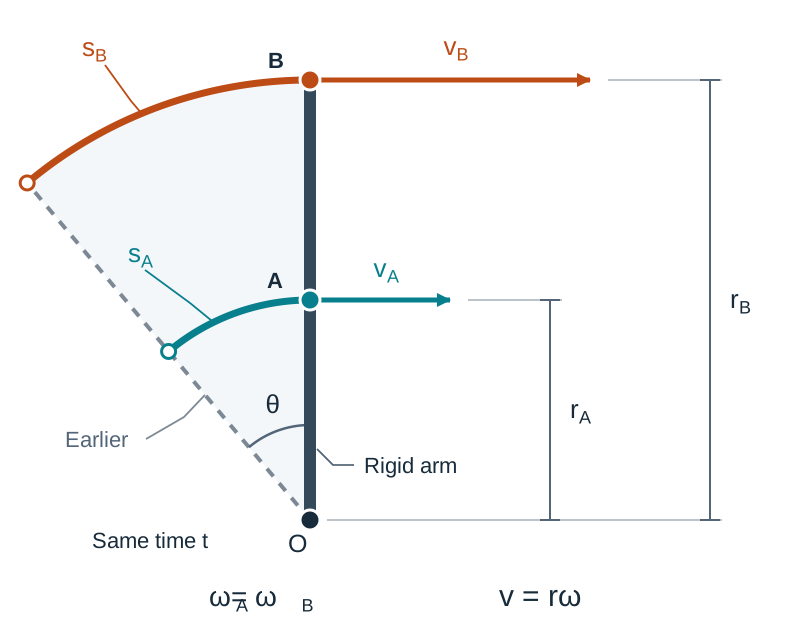
Centripetal Acceleration and Centripetal Force
Because velocity changes direction continuously towards the centre of rotation, an inward centripetal acceleration is produced, directed along the radius towards the centre of the circular path. Its magnitude is given by:
By Newton's second law (), any acceleration requires an unbalanced resultant force acting in the direction of the acceleration. Centripetal force is not a distinct, independent physical force; it is simply the net inward force required to maintain circular motion, directed towards the centre of the circle:
A quick check of units confirms this relationship: mass in , radius in , and angular velocity in gives . Radians are dimensionless ratios of two lengths (arc length divided by radius), so they drop out of unit calculations.
Centripetal force is always provided by real physical interactions:
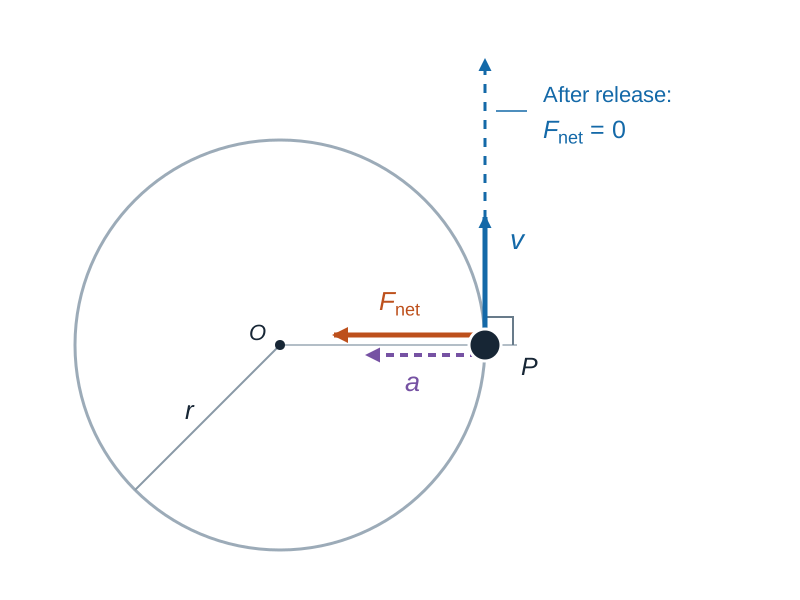
- A car rounding a horizontal bend: Friction between the tyres and the road surface provides the inward force (). If the road is icy, there is not enough friction to supply , so the car does not follow the bend: it slides off in a straight line along the tangent, not directly outwards.
- An aircraft making a banked turn: The lift force acts perpendicular to the wings. The horizontal component of this lift force acts towards the centre of the curved turn, supplying the centripetal force.
- A stone whirled on a string: Tension in the string pulls the stone inward.
- A charged particle in a magnetic field: A charged particle moving at right angles to a magnetic field follows a circle because the magnetic Lorentz force supplies the centripetal force ().
If the centripetal force suddenly ceases, such as when a string snaps, Newton's first law takes over: the object continues moving in a straight line along the tangent to the circle at the point of release.
Motion in a Vertical Circle
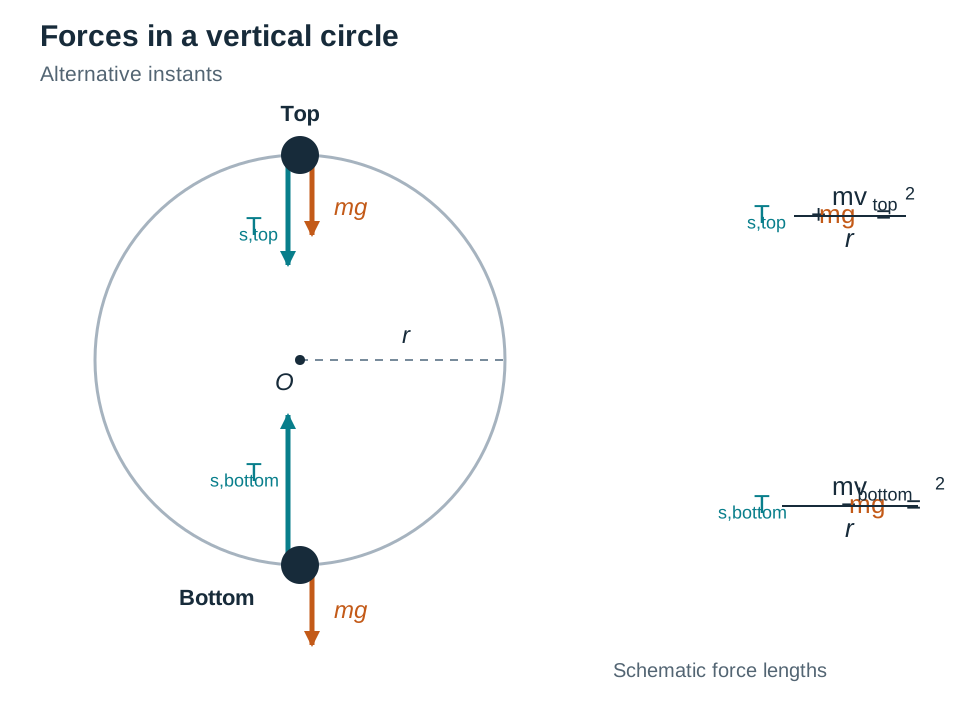
When an object of mass is whirled in a vertical circle of radius , gravity acts vertically downwards throughout the motion. To avoid confusing tension with the orbital period , let us denote the tension in the string as :
- At the top: Both the string tension and weight act vertically downwards towards the centre: , giving:
- At the bottom: Tension pulls upwards towards the centre while weight pulls downwards away from the centre: , giving:
Because gravity opposes tension at the bottom and assists it at the top, tension is greatest at the bottom of the circle. This is why a string or cable is most likely to snap at the very lowest point of the swing.
Universal Gravitation and Kepler's Third Law
Newton's law of universal gravitation states that the attractive force between any two point masses is directly proportional to the product of their masses and inversely proportional to the square of the distance between their centres:
where is the universal gravitational constant, and is the separation between their centres.
When an object of mass orbits a central body of mass in a circular path of radius , gravity supplies the required inward centripetal force:
Dividing both sides by and multiplying by yields the square of the orbital speed:
The mass of the orbiting satellite cancels completely. Orbital speed depends only on the mass of the central body and the orbital radius .
Deriving Kepler's Third Law
To express this relationship in terms of orbital period , we use the linear speed expression :
Equating this to our gravitational orbital speed expression:
Cross-multiplying to isolate gives:
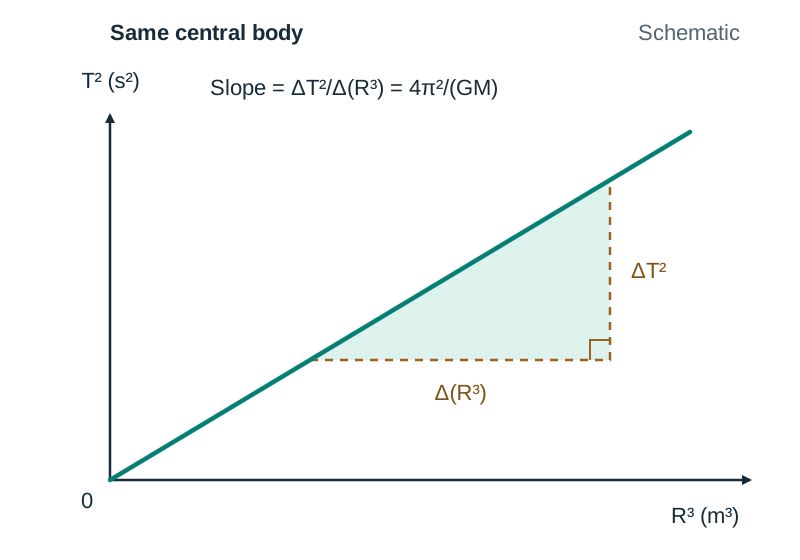
Because , , , and are constant for any chosen central body, Kepler's third law shows that the square of the orbital period is directly proportional to the cube of the orbital radius ().
Verifying Kepler's Third Law Using Secondary Data
We can verify this law by examining planetary data for bodies orbiting the Sun:
| Planet | Orbital Radius () | Period () | () |
|---|---|---|---|
| Venus | |||
| Earth | |||
| Mars |
The ratio remains constant within experimental uncertainty. A graph of on the y-axis against on the x-axis gives a straight line passing through the origin. The slope of this line is , from which the mass of the central body can be calculated directly:
Gravitational Field Strength and Evidence from the Earth–Moon System
The gravitational field strength at any distance from the centre of a celestial body of mass is defined as the gravitational force per unit mass:
When an object is above the surface of a planet of radius at an altitude , the total distance is . For instance, for the International Space Station orbiting at an altitude of () around Earth (, ):
This is roughly of the value at Earth's surface. Gravity in low Earth orbit is definitely not zero.
Don't confuse orbital speed with escape velocity , which is the minimum launch speed required at the surface for an unpowered projectile to escape a celestial body's gravitational field entirely. For Earth, (about ), which is times the circular orbital speed at the surface.
Does Gravity Provide the Centripetal Force? The Earth–Moon Check
To test whether Newton's universal gravitation actually accounts for lunar motion, we compare the required centripetal force against the gravitational pull using astronomical data:
- Distance between centres:
- Orbital period of the Moon:
- Mass of Earth:
- Mass of Moon:
First, find the Moon's angular velocity:
Second, calculate the centripetal force required to hold the Moon in this orbit:
Third, calculate the gravitational attraction between Earth and the Moon:
The two calculated forces agree closely. This numerical agreement provides direct evidence that gravitational attraction supplies the exact centripetal force needed to maintain the Moon's orbit.
Near-Earth Orbits, Geostationary Orbits, and Apparent Weightlessness
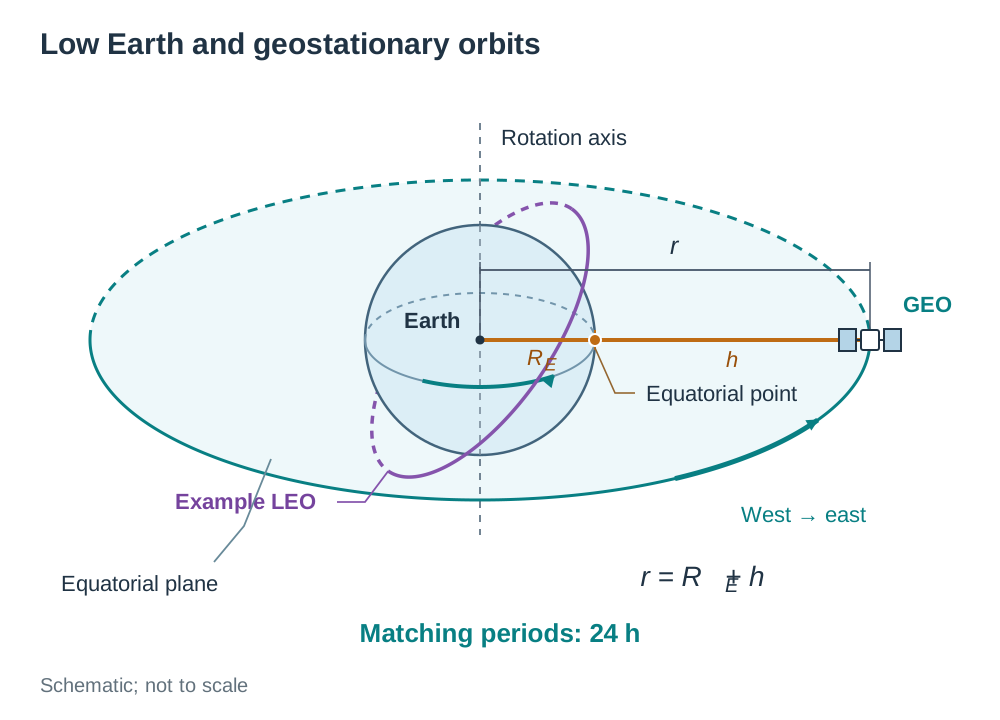
Satellites are mainly used in two kinds of orbit: near-Earth (low) orbits and geostationary orbits. You need to be able to compare them and link each orbit to its uses:
| Feature | Low Earth Orbit (LEO) | Geostationary Orbit (GEO) |
|---|---|---|
| Typical Altitude | to above surface | About above the equator (orbital radius ) |
| Orbital Period | Roughly to minutes (about mins for ISS at ) | hours () |
| Orbital Plane | Variable inclinations; frequently polar | Equatorial plane only |
| Direction of Orbit | Varies depending on mission | West to east (matching Earth's rotation) |
| Apparent Motion | Crosses rapidly across the sky | Appears stationary above a fixed spot on the equator |
| Primary Uses | Earth observation, weather mapping, International Space Station | Telecommunications, satellite television, continental weather tracking |
| Practical Advantage | High resolution images and low signal latency | Receiving dishes on homes remain permanently pointed at a fixed spot in the sky |
The Three Essential Conditions for a Geostationary Orbit
For a satellite to remain in a geostationary orbit, it must satisfy three criteria:
- Its orbital period must be hours (), the same as Earth's rotation.
- It must orbit in the equatorial plane.
- It must travel from west to east, rotating in the same direction as Earth.
Free Fall and Apparent Weightlessness
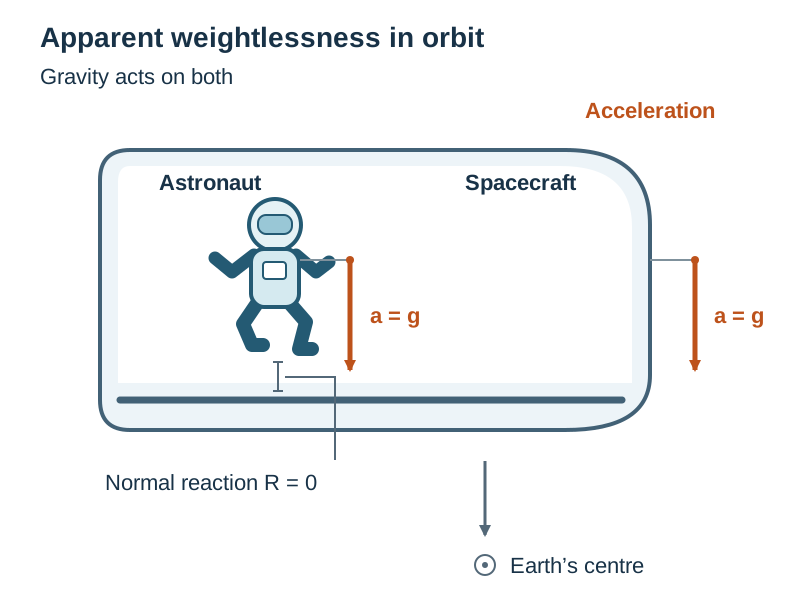
Astronauts floating inside an orbiting spacecraft are not beyond the reach of gravity. As shown above, gravity at is roughly .
The sensation of apparent weightlessness occurs because both the astronaut and the spacecraft are in continuous free fall towards the centre of the Earth with the same acceleration (). Because the spacecraft travels forward at high tangential speed (around ), Earth's surface curves away beneath it at the exact rate it falls. With the cabin floor falling at the identical rate as the astronaut's feet, there is no normal reaction force between the astronaut and the floor (). Without a reaction force supporting the body, the astronaut experiences apparent weightlessness.
Key terms
- Radian
- The angle subtended at the centre of a circle by an arc whose length is equal to the radius of the circle.
- Angular Velocity
- The rate of change of angle with respect to time, measured in radians per second (rad s⁻¹).
- Centripetal Acceleration
- The acceleration directed towards the centre of a circular path experienced by a body moving in uniform circular motion.
- Centripetal Force
- The resultant inward force directed towards the centre of a circle required to keep an object moving in a circular path.
- Newton's Law of Universal Gravitation
- The attractive force between any two point masses is directly proportional to the product of their masses and inversely proportional to the square of the distance between their centres.
- Kepler's Third Law
- For all bodies orbiting the same central body, the square of the orbital period is directly proportional to the cube of the orbit radius: T² ∝ R³ (T² = 4π²R³ / (GM)).
- Geostationary Orbit
- An orbit in the equatorial plane with an orbital period of 24 hours (86,400 s), the same as Earth's rotation, travelling west to east, so the satellite remains stationary relative to a point on Earth's surface.
- Apparent Weightlessness
- The condition experienced when an object and its surrounding frame are in free fall under gravity with the same acceleration, resulting in a normal reaction force of zero.
Check yourself
A 0.50 kg stone is attached to a 0.60 m string and whirled in a horizontal circle at a constant speed of 4.0 m s⁻¹. What is the centripetal force acting on the stone?
F = mv²/r = (0.50 × 4.0²) / 0.60 = (0.50 × 16) / 0.60 ≈ 13.3 N (or 13 N to two significant figures), directed towards the centre.
A satellite in low Earth orbit has an orbital period of 90 minutes. Calculate its angular velocity in rad s⁻¹.
Convert period to seconds: T = 90 × 60 = 5400 s. Then ω = 2π / T = 2π / 5400 ≈ 1.16 × 10⁻³ rad s⁻¹.
Why does the orbital speed of a satellite around Earth not depend on the satellite's mass?
Equating gravitational force to centripetal force gives GMm/R² = mv²/R. The satellite's mass m cancels on both sides, yielding v = √(GM/R).
What are the three essential conditions for an orbit to be geostationary?
(1) An orbital period of 24 hours (86,400 s), the same as Earth's rotation, (2) positioned in the equatorial plane, and (3) travelling west to east in the same direction as Earth's rotation.
Where in a vertical circle is the tension in the string greatest, and why?
Tension is greatest at the bottom because the string must support the object's weight as well as provide the required centripetal force: T_s = (mv²/r) + mg.