

This topic explains how forces change the way things move, using Newton's three laws of motion, linear momentum, and Hooke's law. It covers finding resultant forces, resolving velocities into components, impulse and vehicle safety design, direct and two-dimensional collisions, explosions, elastic potential energy, and experimental investigations for verifying dynamics and elasticity.
Force, Mass, and Newton's Laws of Motion
A force is anything that causes a body to accelerate. In other words, it changes the body's speed or direction. Force is a vector quantity measured in newtons (N).
Mass (), measured in kilograms (kg), is a scalar quantity and does not change from place to place. It measures the amount of matter in a body and its inertia—the natural resistance of any object to a change in its velocity.
The centre of mass is the point where all the body's mass can be thought of as concentrated; for a uniform ruler, it is right at the middle. Formally, it is the point through which the line of action of an applied force must pass if the body is to accelerate without rotating. In a uniform gravitational field, the centre of mass coincides with the centre of gravity (the point through which the entire weight of the body acts).
Newton's Three Laws of Motion
- Newton's First Law: Every body will remain in a state of rest or travel with constant velocity unless acted upon by a net external force.
- Newton's Second Law: The rate of change of a body's momentum is directly proportional to the net applied force and takes place in the direction of that force.
- Newton's Third Law: If body A exerts a force on body B, then body B exerts an equal and opposite force on body A ().
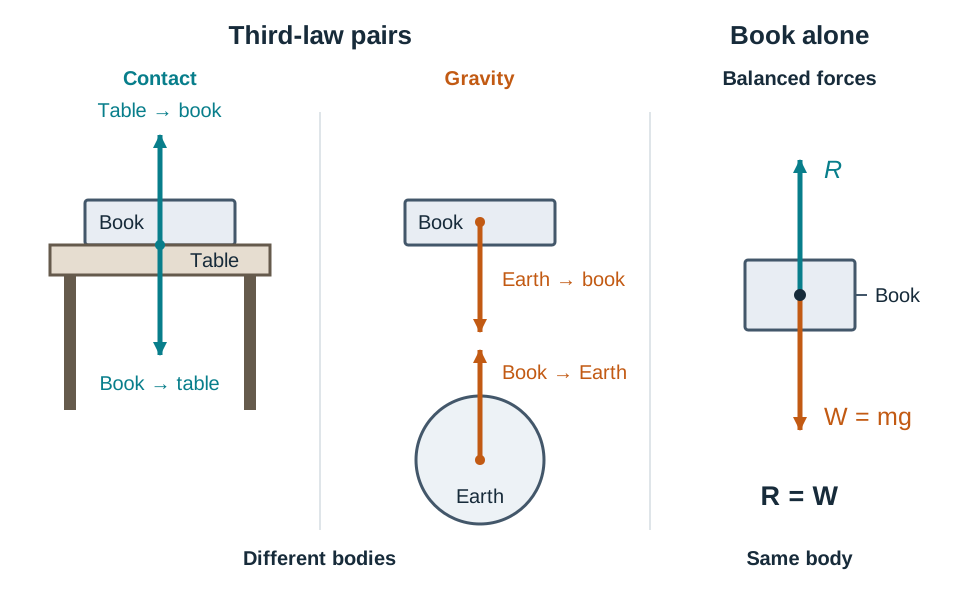
Four conditions define an action–reaction pair under the third law:
- The forces have equal magnitude.
- They act in opposite directions.
- They act on two different interacting bodies (meaning they never cancel each other out on the same object).
- They are the exact same physical type of force (for example, both are gravitational, or both are contact forces).
For a book resting on a table, the downward pull of gravity on the book is paired with the upward gravitational pull of the book on the Earth. The upward contact push of the table on the book is paired with the downward push of the book on the table.
Derivation of
You should be able to show that follows from Newton's second law when the mass is constant. This has been a regular exam question and it shows where comes from:
- From the second law, applied force is proportional to the rate of change of momentum:
- Momentum is defined as . For an initial velocity and final velocity over time :
- Assuming mass remains constant, factor out :
- Since linear acceleration is :
- The newton is defined such that a force of gives a mass of an acceleration of . Substituting , , and :
- Therefore:
Mass versus Weight
Mass is a scalar measured in kilograms. Weight () is the gravitational force acting on that mass: , where near the surface of the Earth. A student with a mass of has the same mass on the Moon, but their weight drops from on Earth to roughly on the Moon because the local gravitational field is weaker.
Forces in Everyday Situations and Resultant Force
In practical mechanics problems, multiple forces act on a body at the same time:
- Weight (): the pull of gravity on a body, acting vertically downwards.
- Normal reaction force ( or ): the push of a surface on a body resting on it, acting at right angles (normal) to the surface.
- Friction: acts parallel to the contact surface and opposes the motion or attempted motion of one surface over another.
- Resistant force (drag or air resistance): opposes motion through a fluid (liquid or gas) and increases as speed increases.
- Tension (): the pull transmitted along a string, rope, or cable, acting away from the body.
- Buoyancy (upthrust): the upward force exerted by a fluid on an object immersed in it.
The resultant force () is the single vector sum of all individual forces acting on a body. Newton's second law strictly uses this net force: .
Problem-Solving Method
- Draw a clear free-body diagram: sketch the body as a simple box or dot, and draw every force acting directly on it with an arrow indicating direction.
- Choose a positive direction (usually the direction of acceleration).
- Write the net force equation: .
- Set and solve.
For example, if an applied pull of acts on a box across a rough horizontal floor with of friction, the net force is . The acceleration is .
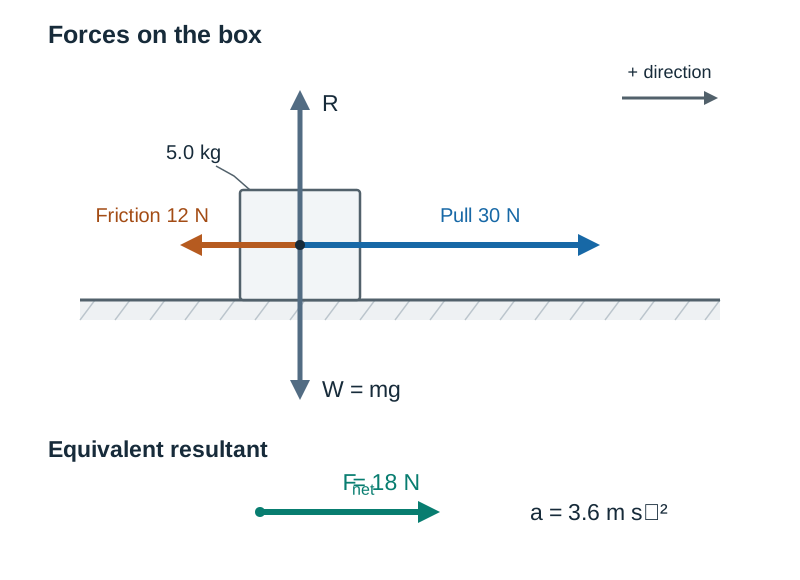
Similarly, when a person stands in a lift accelerating upwards at , taking upwards as positive gives . Rearranging gives . The floor pushes upwards with , which is greater than the person's true weight of , making the person feel heavier.
When a body moves at constant velocity or remains stationary, the resultant force acting on it must be zero by Newton's first law. A car travelling down a motorway at a steady has its forward driving force completely balanced by air resistance and tyre friction.
Momentum, Impulse, and Safety Design
Momentum () is the product of a body's mass and its velocity:
Momentum is a vector quantity with the unit (or ). Its direction is always the direction of velocity.
Impulse and Impact Force
Rearranging Newton's second law gives the relationship between force, time, and momentum:
The quantity is called impulse, measured in . Impulse equals the change in momentum produced on a body.
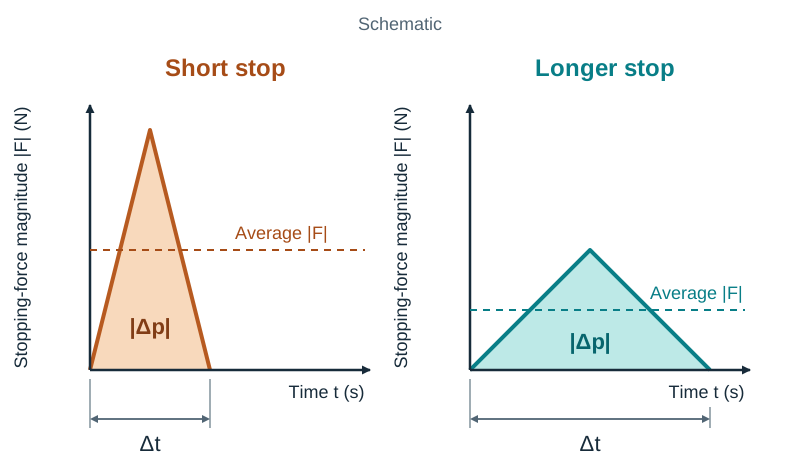
This principle underpins modern vehicle safety features such as airbags, crumple zones, and seatbelts:
- In a collision, the vehicle and occupant undergo a fixed change in momentum () to come to rest.
- Airbags and crumple zones deform progressively during the crash, substantially increasing the time taken for the occupant to stop ().
- Because , lengthening for a fixed reduces the average force on the occupant, which lowers the risk of serious injury.
Conservation of Momentum, Recoil, and Newton's Laws
The principle of conservation of momentum states that in any interaction between bodies, the total momentum before the interaction equals the total momentum after the interaction, provided no external force acts on the system.
For a direct, one-dimensional collision between two masses and :
When two bodies collide and stick together, they move off with one common velocity :
Collisions are classified by what happens to kinetic energy:
- Elastic collisions: Total kinetic energy is conserved. Real collisions are at best approximately elastic, for example between gas molecules or hard steel ball bearings.
- Inelastic collisions: Total momentum is conserved, but kinetic energy is not conserved; some kinetic energy is transformed into internal energy (heat), sound, or permanent deformation.
Why Momentum is Conserved in a Collision
Conservation of momentum is not an independent postulate; it directly follows from Newton's second and third laws:
- When body A hits body B, by Newton's third law the force B exerts on A is equal and opposite to the force A exerts on B at every instant: .
- The two forces act for the exact same contact time .
- From Newton's second law in impulse form, the change in momentum of B is , and the change in momentum of A is .
- Because , it follows that .
- Adding these gives . The net change in momentum of the closed system is zero, meaning total momentum is conserved.
In experimental setups using force sensors on colliding trolleys, the force–time graphs for the two sensors have identical shapes and areas but opposite signs at every instant. The area under a force–time graph is impulse, showing directly that the momentum lost by one trolley equals the momentum gained by the other.
Explosions and Recoil
When a stationary system splits or fires apart, the total momentum before the event is zero. Therefore, the total momentum afterwards must also be zero:
The two parts fly apart in opposite directions with equal and opposite momenta. Because their momentum magnitudes are equal, the lighter piece moves with a much higher speed (). This explains why a rifle recoils backwards into the shoulder when firing a high-speed bullet, and why a daughter nucleus recoils when ejecting an alpha particle during radioactive decay.
Collisions in Two Dimensions
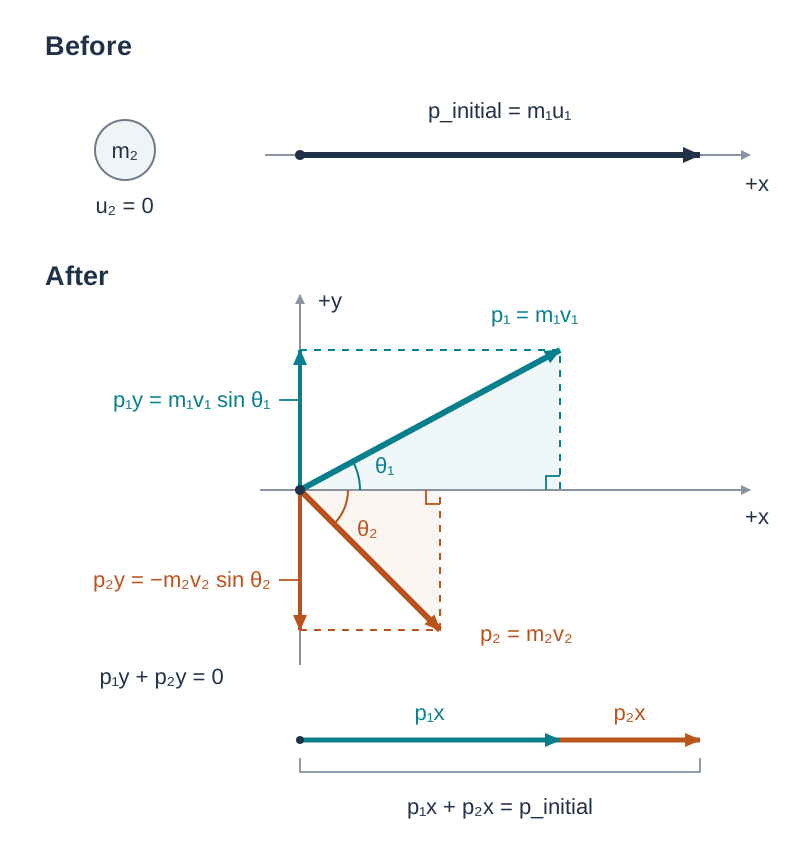
When objects collide at an angle rather than head-on, motion occurs in a plane. Because momentum is a vector, it is conserved independently along any two mutually perpendicular axes. The standard approach is to resolve each velocity into components parallel and perpendicular to the original direction of motion:
Systematic Method for 2D Problems
- Take the positive -axis along the original line of motion of the incoming body, and the -axis perpendicular to it.
- Resolve every velocity vector into perpendicular components using and .
- Set up two separate conservation equations: one for the -direction and one for the -direction. Assign negative signs to any component pointing in the negative direction.
- Solve the two equations to find unknown velocity components and .
- Combine components using Pythagoras' theorem to find the final speed: .
- Find the angle to the -axis using , then describe the direction in words using the signs of the components (for example, '60° below the original line of motion').
Hooke's Law and Elastic Potential Energy
Hooke's law states that the restoring force in an elastic material is directly proportional to displacement, provided the elastic limit is not exceeded:
Here, is the restoring force in newtons (N), is the spring constant in newtons per metre (), and is the change in length from the spring's natural (unloaded) length, in metres (m). It is an extension if the spring is stretched and a compression if it is squashed.
The minus sign indicates that the restoring force acts in the opposite direction to the displacement, always pulling or pushing the object back towards its natural equilibrium position. The magnitude of the external force applied to stretch or compress the spring by is .
The elastic limit is the point beyond which a material becomes permanently deformed; if stretched past this limit, it will not return to its original natural length when the force is removed.
Elastic Potential Energy ()
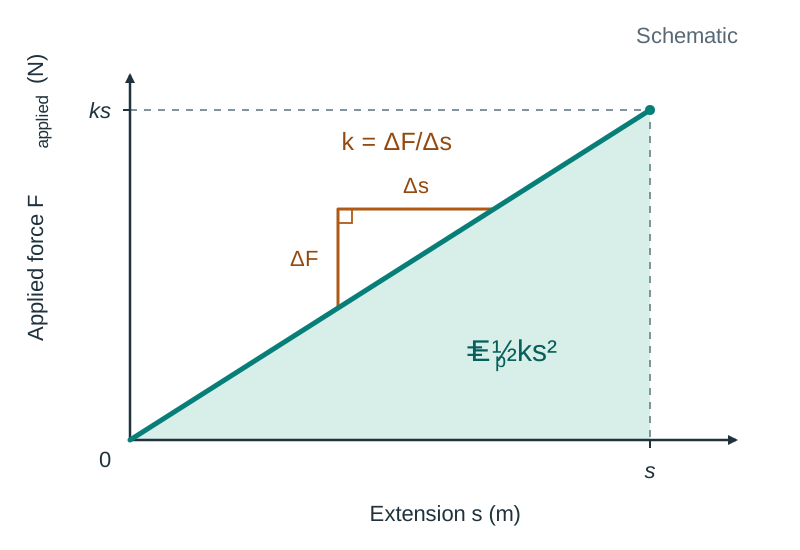
The applied force needed to stretch or compress a spring is not constant. It starts at zero and rises linearly to . The average force applied during deformation is .
The work done in stretching the spring () is stored as elastic potential energy:
On a force–extension graph ( on the -axis, on the -axis):
- The slope of the straight-line section equals the spring constant .
- The area under the straight line up to extension equals the work done, which is the stored elastic potential energy .
Core Laboratory Investigations
The specification asks you to verify Newton's second law and Hooke's law, and to investigate the principle of conservation of momentum, using primary data (your own measurements) and secondary data (data collected by someone else).
1. Verification of Newton's Second Law ()
- Purpose: To verify that the acceleration of a body is directly proportional to the applied net force when its mass is constant.
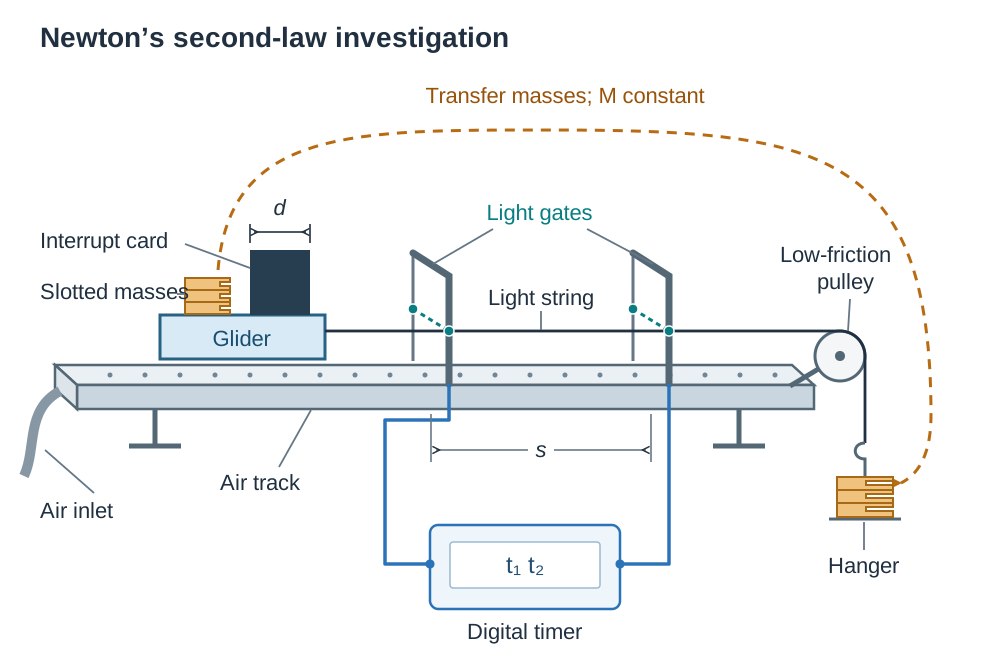
- Apparatus: Linear air track (or inclined friction-compensated runway), glider or trolley with interrupt card, two light gates connected to a digital timer, light string, low-friction pulley, and a hanging weight hanger with slotted masses.
- Friction compensation: If using a wheeled trolley on a track, tilt the track slightly until the trolley, after a slight push, travels at constant velocity with no acceleration. The component of gravity down the track balances friction.
- Keeping total mass constant: The total mass being accelerated includes the trolley, the string, the hanger, and all slotted masses. To vary the accelerating force , move slotted masses one by one from the trolley onto the hanging hanger. Never add masses from the bench, as that would alter the total accelerated mass.
- Method and measurements: Measure the length of the card mask and distance between the light gates. Release the trolley. Photogate 1 measures time to give initial speed , and photogate 2 gives final speed . Compute acceleration using . Repeat for different hanging forces.
- Result: Plot accelerating force (-axis) against acceleration (-axis). A straight line through the origin verifies that . The slope of the graph equals the total accelerated mass .
- Sources of error and precautions: If friction is not compensated, the graph still forms a straight line but has a positive intercept on the -axis equal to the frictional force. Parallax error when measuring card length and distance is reduced by reading scales perpendicularly at eye level.
2. Investigation of the Principle of Conservation of Momentum
- Purpose: To show that initial momentum equals final momentum in an isolated collision.
- Apparatus: Level linear air track, two gliders with card interrupt masks, velcro pads or needle-and-cork buffers (to cause gliders to stick together), two photogates, and a digital timer.
- Minimising external forces: Friction is minimised by floating the gliders on an air cushion. Gravitational acceleration along the track is eliminated by adjusting the track feet until a stationary glider placed anywhere on the track remains at rest.
- Method and measurements: Measure glider masses and on an electronic balance, and measure card width . With glider 2 at rest between the light gates (), push glider 1 through light gate 1, recording transit time to find . The gliders collide and stick together, passing through light gate 2 as a combined mass with transit time , giving final velocity .
- Result: Calculate momentum before () and momentum after (). Within experimental error, . Calculating kinetic energy before () and after () shows a loss of kinetic energy, as mechanical energy transforms into heat and sound.
- Sources of error and precautions: Systematic error arises if the track is not level. Random errors in light-gate timing are reduced by repeating trials. Ensure the card mask passes cleanly and perpendicularly through the light beams.
3. Verification of Hooke's Law
- Purpose: To verify that the extension of a spring is directly proportional to the applied force.
- Apparatus: Spiral spring suspended from a retort stand, weight hanger with slotted masses, vertical metre stick clamped beside the spring, and a pointer attached to the bottom of the spring.
- Method: Record the pointer reading with nothing attached; this is the natural length reading. Hang the weight hanger and add slotted masses one at a time. For each load, record the pointer reading, then calculate and , where is the total hanging mass including the hanger. Remove masses one by one to confirm the pointer returns to the starting position, ensuring the elastic limit has not been exceeded.
- Result: Plot applied force (-axis) against extension (-axis). A straight line through the origin verifies that , confirming Hooke's law. The slope of the line equals the spring constant .
- Precautions: Read the metre stick at eye level to avoid parallax error. Wait for the spring to stop oscillating before reading the pointer. Do not overload the spring.
Key terms
- Force
- Anything that causes a body to accelerate; a vector quantity measured in newtons (N).
- Newton (N)
- The SI unit of force; one newton is the force that gives a mass of 1 kilogram an acceleration of 1 metre per second squared.
- Mass
- A scalar property of an object that measures its quantity of matter and its resistance to acceleration (inertia), measured in kilograms (kg).
- Inertia
- The natural tendency of an object to resist any change in its velocity.
- Centre of Mass
- The point through which the line of action of an applied force must pass if a body is to accelerate without rotating.
- Weight
- The gravitational force acting on an object (W = mg), measured in newtons (N).
- Resultant Force
- The single overall force that has the same effect as all the individual forces acting on a body; the vector sum of all forces.
- Newton's First Law of Motion
- Every body will remain in a state of rest or travel with constant velocity unless acted upon by a net external force.
- Newton's Second Law of Motion
- The rate of change of a body's momentum is directly proportional to the net applied force and takes place in the direction of that force.
- Newton's Third Law of Motion
- If body A exerts a force on body B, then body B exerts an equal and opposite force on body A.
- Momentum
- The product of an object's mass and its velocity (p = mv); a vector quantity measured in kg m s⁻¹ or N s.
- Impulse
- The product of the average net force and the time during which it acts (FΔt = Δp), measured in N s.
- Principle of Conservation of Momentum
- In any interaction between bodies, the total momentum before the interaction equals the total momentum after the interaction, provided no net external force acts on the system.
- Hooke's Law
- The restoring force in an elastic material is directly proportional to displacement from its natural length, provided the elastic limit is not exceeded (F = -ks).
- Elastic Limit
- The maximum force or extension an elastic material can endure without suffering permanent deformation.
- Spring Constant
- The restoring force per unit displacement in an elastic material (k = F/s), measured in N m⁻¹.
- Elastic Potential Energy
- The energy stored in an object as a result of deformation, given by Ep = ½ks².
Check yourself
A book rests motionless on a desk. Are the book's weight and the upward push of the desk an action–reaction pair under Newton's third law?
No. Both forces act on the same object (the book), and they are different force types (gravitational pull versus normal contact force). They balance under Newton's first law. The third-law pair to the book's weight is the gravitational pull of the book on the Earth.
In a laboratory experiment to verify Newton's second law, a plot of accelerating force F against acceleration a yields a straight line through the origin with a slope of 0.71. What physical quantity does this slope represent?
The slope ΔF/Δa represents the total mass of the accelerated system (trolley, hanger, and masses), which is 0.71 kg.
A 0.40 kg sphere travelling at 6.0 m s⁻¹ collides head-on with a 0.15 kg sphere travelling at 9.0 m s⁻¹ in the opposite direction. After the collision, the 0.40 kg sphere stops dead. Find the speed and direction of the 0.15 kg sphere.
Taking the 0.40 kg sphere's direction as positive: (0.40)(6.0) + (0.15)(-9.0) = 0 + (0.15)v. This gives 2.4 - 1.35 = 0.15v, so 1.05 = 0.15v and v = +7.0 m s⁻¹ (moving in the original direction of the 0.40 kg sphere).
What is the physical significance of the minus sign in Hooke's law, F = -ks?
It shows that the restoring force is directed opposite to the displacement from the spring's natural equilibrium position.
If the extension of a spring is doubled within its elastic limit, by what factor does the stored elastic potential energy change?
Because Ep = ½ks², the stored energy is proportional to the square of extension (s²). Doubling s increases the stored energy by a factor of 2² = 4.