

A wave carries energy from one place to another without carrying matter. In Leaving Certificate Physics, waves are classified by whether they need a physical material medium (mechanical waves) or travel through empty space via oscillating fields (electromagnetic waves), and by the direction of their vibrations relative to energy flow (transverse versus longitudinal). This topic covers the wave equation v = fλ, how to interpret wave graphs, wave interactions at boundaries and apertures, stationary waves on stretched strings, resonance in real-world systems, and the Doppler effect with its quantitative applications.
The Nature of Waves and Energy Transfer
A travelling wave is a regular disturbance that moves through a medium or through space, transferring energy from one location to another without transferring matter. While energy travels forward, the particles of the medium oscillate about fixed rest positions without travelling along with the wave.
Mechanical and Electromagnetic Waves
- Mechanical waves require a physical material medium (solid, liquid, or gas) to travel. Energy passes from particle to particle by mechanical forces. Examples include sound in air, waves on a string, water ripples, and seismic vibrations. Mechanical waves cannot travel through a vacuum. A classic demonstration is an electric bell ringing inside an evacuated glass bell jar: as air is pumped out, the sound fades to silence even though the clapper is visibly striking the gong.
- Electromagnetic waves require no physical medium. They consist of coupled electric and magnetic fields oscillating at right angles to each other and both at right angles to the direction of travel. In a vacuum, all electromagnetic waves travel at the speed of light:
Wave Speed, Frequency, and Medium
For sound in air and waves on a stretched wire, the wave speed is set by the properties of the medium (such as elasticity, tension, or density) and does not depend on amplitude. In most everyday media, wave speed is practically the same across all frequencies. The main exception is light travelling through transparent materials like glass or water: different frequencies (colours) travel at slightly different speeds, causing white light to separate into a spectrum (dispersion).
Amplitude and Energy
The energy transported by a wave depends directly on its amplitude:
Doubling the amplitude quadruples the energy carried (). Tripling the amplitude increases the energy ninefold (). In sound waves, greater amplitude corresponds to greater loudness, while higher frequency corresponds to higher pitch.
Transverse and Longitudinal Waves
Waves are sorted into two groups based on how particles vibrate relative to the direction of wave travel:
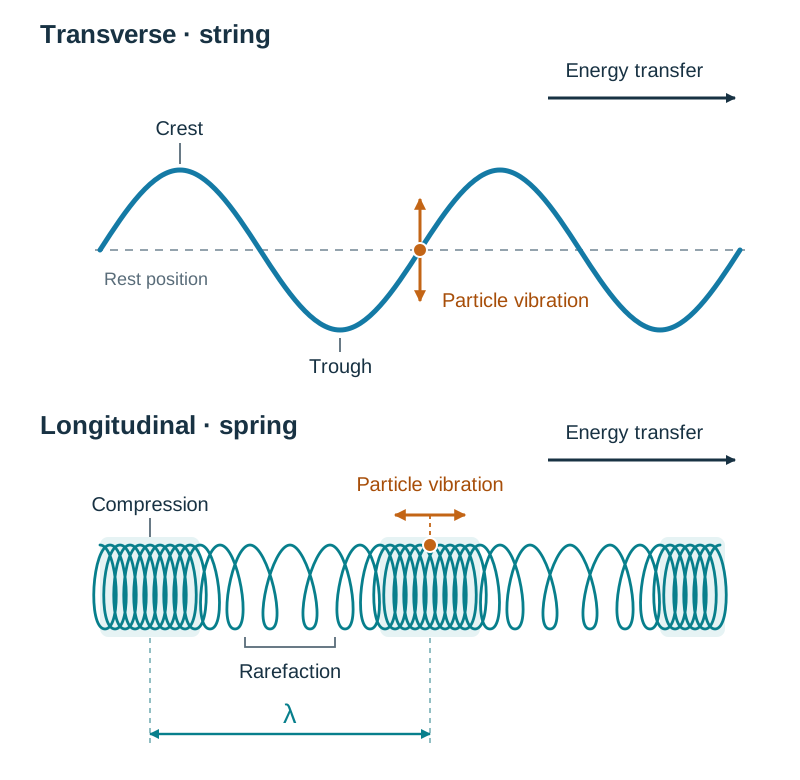
- Transverse waves: The vibrations are perpendicular (at right angles) to the direction the wave travels. In water waves and string waves the particles vibrate up and down. In electromagnetic waves there are no particles: the electric and magnetic fields vibrate. The highest point above the equilibrium rest position is the crest, and the lowest point below is the trough.
- Longitudinal waves: The vibrations of the medium are parallel to the direction the wave travels. Examples include sound waves in air and compression pulses on a slinky spring. Regions where particles are crowded together at higher pressure are compressions, and regions where particles are spread further apart at lower pressure are rarefactions.
Core Wave Measurements
- Displacement (): Distance of an oscillating particle from its undisturbed equilibrium position in a specified direction (m).
- Amplitude (): Maximum displacement of a particle from its undisturbed rest position (m).
- Wavelength (): Distance between two successive points that are in phase, such as crest to crest or compression to compression (m).
- Period (): Time taken for one complete wave cycle to pass a fixed point (s).
- Frequency (): Number of complete wave cycles passing a fixed reference point per second (Hz, where ).
Frequency and period are reciprocals:
Because a wave travels a distance of one wavelength in one period , wave speed is :
For electromagnetic waves in a vacuum:
Reading Wave Graphs
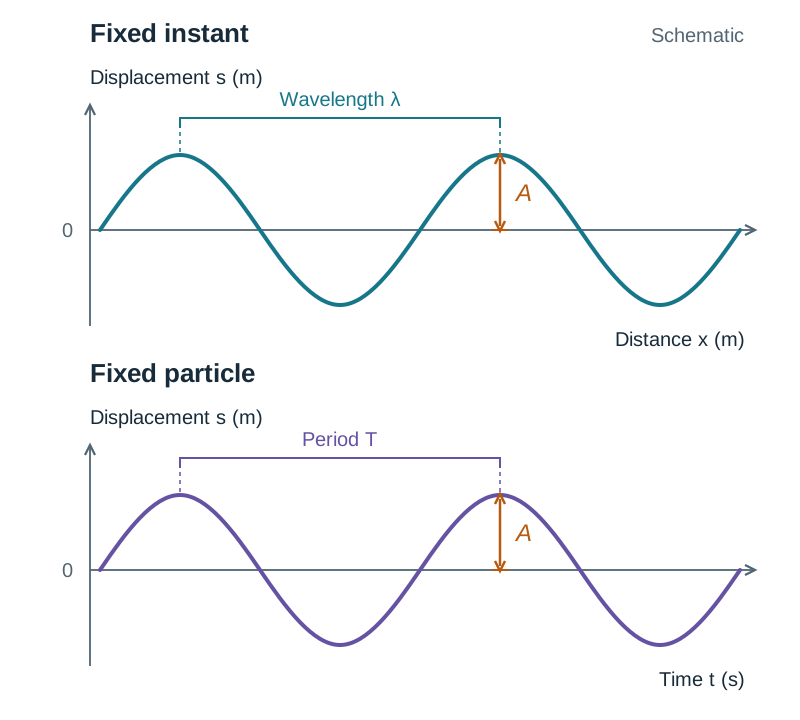
- Displacement–distance graph: A snapshot of the entire wave at one fixed instant in time. The horizontal distance between two consecutive identical points is the wavelength .
- Displacement–time graph: Shows how a single particle moves as time passes. The horizontal time for one complete repeat is the period .
- On both graphs, the vertical height from the central rest line to a crest is the amplitude . It is never measured from crest to trough.
Wave Boundary Behaviours: Reflection, Refraction, and Diffraction
Reflection
Reflection is the bouncing of waves off an obstacle in their path. Because the wave remains in the same medium, its speed, frequency, and wavelength do not change. An echo is sound reflecting from a distant surface.
Refraction
Refraction is the change in direction of a wave when travelling from one medium to another in which its speed is different.
- The frequency is set by the source, so it stays the same when the wave enters a new medium. Only the speed and the wavelength change.
- If the wave slows down ( decreases), its wavelength decreases in exact proportion because .
- At a boundary, the ratio of speeds defines the refractive index: , where is the wave speed in the first medium (where the wave comes from) and is the speed in the second medium.
- If the wave meets the boundary at an angle (angle of incidence not equal to , so not travelling along the normal), one side of the advancing wavefront changes speed before the other, bending the wave path. A wave travelling along the normal changes speed and wavelength but does not bend.
Diffraction
Diffraction is the spreading out of a wave as it passes through a gap or around an obstacle.
Diffraction is most noticeable when the gap width is about the same size as the wavelength of the wave.
- When the gap is much wider than the wavelength, the wave passes straight through with only slight spreading at the edges.
- When the gap is much narrower than the wavelength, circular wavefronts emerge, but very little wave energy passes through.
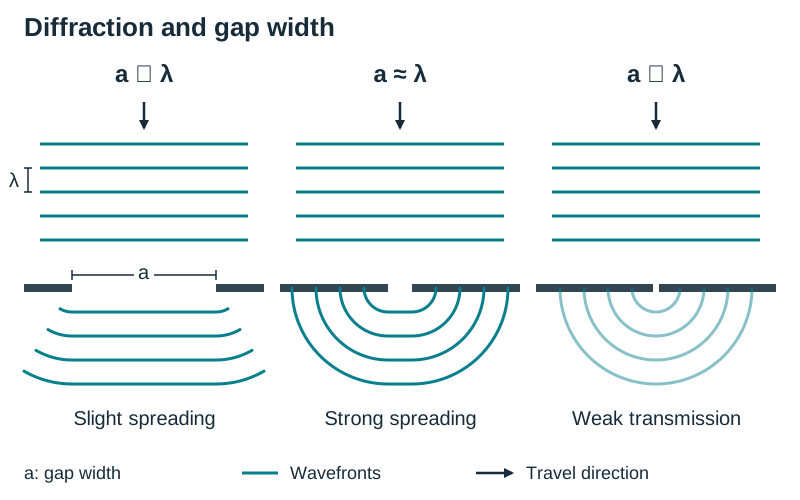
Visible light has very short wavelengths (about to ), far smaller than a doorway, so it hardly spreads and we see sharp shadows. Sound, with wavelengths from centimetres to metres, is comparable in size to doorways, so it spreads into the room, letting you hear around corners.
Superposition, Interference, and Polarisation
The Principle of Superposition
The principle of superposition states that when two or more waves meet, the resultant displacement at that point is equal to the algebraic sum of the individual displacements produced by each wave acting alone.
Interference and Path Difference
Interference occurs when waves combine according to the principle of superposition:
- Constructive interference: Waves arrive in phase (crest meets crest or trough meets trough). Displacements reinforce to produce a wave of larger amplitude.
- Destructive interference: Waves arrive completely out of phase (crest meets trough). Displacements oppose each other; identical amplitudes cancel out entirely, producing zero resultant displacement.
To produce a stable, observable interference pattern, sources must be coherent: they must have the same frequency and maintain a constant phase difference.
For two coherent sources vibrating in phase, the path difference is the difference in distance from each source to a given point:
- Constructive interference occurs when the path difference (where ).
- Destructive interference occurs when the path difference (where ).
The Diffraction Grating
A diffraction grating consists of many fine, closely spaced, parallel slits. Light diffracts through each slit and interferes, forming bright lines at specific angles:
Here is the order number (), is the wavelength (m), is the angle from the central maximum, and is the grating constant (slit separation in metres), where and is lines per metre. Generating an interference pattern like this confirms that light behaves as a wave.
Polarisation
Polarisation is the restriction of the vibrations of a transverse wave to a single plane perpendicular to the direction of wave travel.
To demonstrate that light is transverse:
- Look at a light source through two polarising filters (polaroids).
- Rotate one filter while keeping the other fixed.
- The transmitted light dims and drops to near zero when the filters are at to each other ('crossed polaroids').
- As rotation continues towards , maximum brightness returns.
This shows light is a transverse wave, because only vibrations perpendicular to travel can be blocked in one plane. Sound cannot be polarised because it is longitudinal; its vibrations are already along the line of travel.
Stationary Waves and the Stretched String
A stationary (standing) wave is formed when two periodic waves of identical frequency, wavelength, and amplitude travel in opposite directions along the same medium and interfere.
Unlike travelling waves, stationary waves do not transmit net energy through the medium. Instead, energy remains confined in standing loops:
- Nodes (): Points of permanent destructive interference where displacement is always zero.
- Antinodes (): Points of constructive interference where displacement reaches maximum amplitude.
Distances on a Stationary Wave
- Distance between two consecutive nodes
- Distance between two consecutive antinodes
- Distance between an adjacent node and antinode
Frequency of a Stretched String
For a string of length fixed at both ends, nodes occur at the ends. In the fundamental mode (first harmonic), the string vibrates with one loop: , giving . The fundamental frequency is:
- = vibrating length (m)
- = tension in the string (N)
- = mass per unit length (kg m⁻¹), where
This yields three relationships:
- at constant and (shorter strings produce higher notes).
- at constant and (tightening a string raises its pitch).
- at constant and (thicker strings produce lower notes).
Harmonics are whole-number multiples of the fundamental frequency (). For the harmonic, there are loops: .
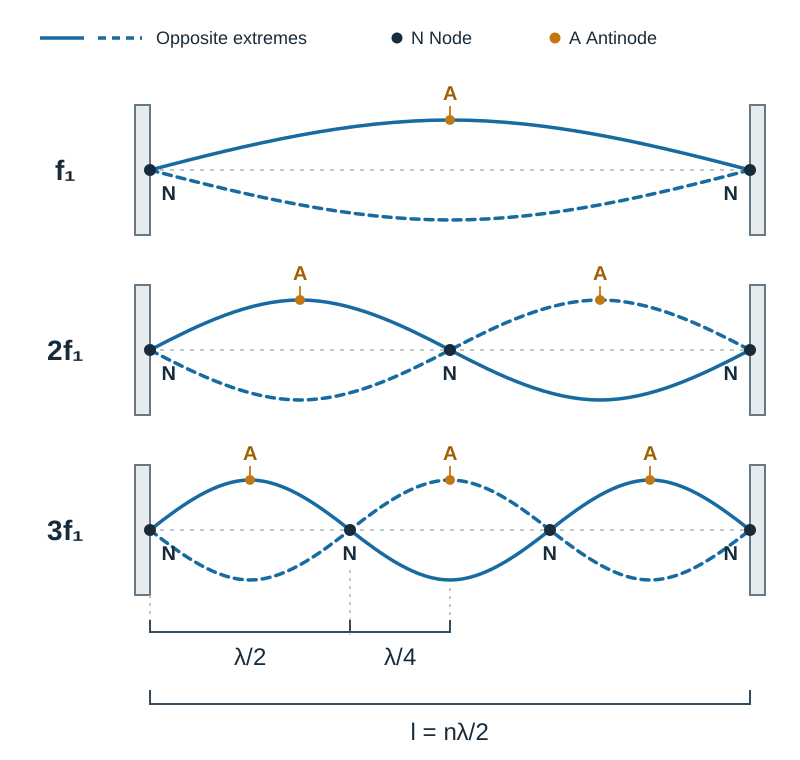
Worked Example: String Harmonics Problem: A string stretched between two fixed points apart vibrates at its third harmonic. The wave speed along the string is . Calculate the wavelength and frequency, and state the number of nodes and antinodes. Solution:
- At the third harmonic there are 3 loops, so :
- Using :
- Fixed at both ends with 3 loops, the wave pattern has 4 nodes (two at the fixed ends, two inside) and 3 antinodes.
| Property | Travelling Waves | Stationary (Standing) Waves |
|---|---|---|
| Energy transmission | Energy transfers continuously through space | No net energy transfer; energy is confined in loops |
| Amplitude distribution | Every particle has the same amplitude | Amplitude varies from zero at nodes to maximum at antinodes |
| Phase relationships | Phase changes continuously from point to point | All particles between two adjacent nodes vibrate in phase |
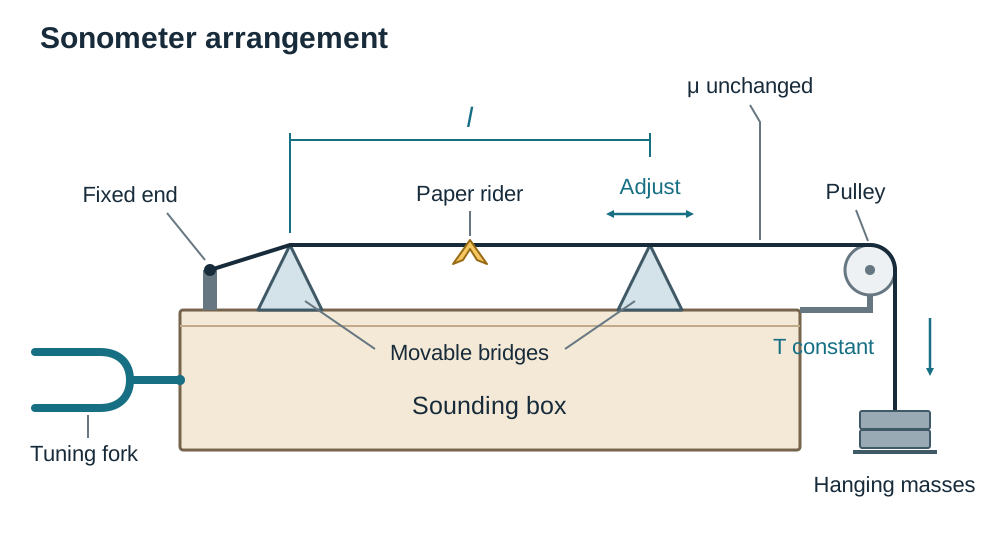
Investigating How Frequency Depends on Length
To verify for a stretched string at constant tension:
- Set up a sonometer wire over two movable bridges with a fixed tension provided by hanging masses.
- Place a light paper rider at the midpoint of the wire between the bridges.
- Sound a tuning fork of known frequency and hold its stem firmly against the sonometer sounding box.
- Move one bridge until the wire resonates and throws the paper rider off. Measure the vibrating length between the bridges.
- Repeat for several tuning forks of different frequencies.
- Plot against . A straight line through the origin verifies that .
Resonance
Resonance occurs when a system is made to vibrate at its natural frequency by a periodic driving force of the same frequency (). Energy is transferred efficiently into the system, resulting in a large amplitude of vibration.
Every elastic mechanical system has one or more natural frequencies at which it tends to vibrate freely when disturbed.
Demonstrating Resonance
Mount two identical tuning forks of the same frequency on hollow resonance boxes placed open-end to open-end. Strike the first fork, then silence its prongs by hand. The second fork continues sounding audibly because sound waves transferred energy to it at its exact natural frequency. If plasticine is attached to one fork to alter its frequency, the resonance stops immediately.
Similarly, holding a sounding tuning fork over a tube open at the top and closed by water at the bottom gives a loud resonance when the air column length is about a quarter wavelength ().
Resonance in Everyday Life
- Pushing a swing: Pushing a swing with small pushes timed to its natural swing period transfers energy efficiently, driving it to a large amplitude.
- Acoustic instruments: The wooden body of a violin or acoustic guitar resonates with vibrating strings, coupling energy to the air to produce a much louder sound.
- Radio tuning: Adjusting the tuning dial matches the natural frequency of an internal electrical circuit to the radio carrier frequency, amplifying only that station.
- Vibration damage: Car body panels rattle loudly at specific engine speeds when matching frequencies align.
- Bridge oscillations: London's Millennium Bridge (2000) swayed excessively when the sideways rhythm of pedestrians' footsteps matched a natural swaying frequency of the span. Mechanical dampers were installed to absorb and dissipate the vibrational energy.
The Doppler Effect
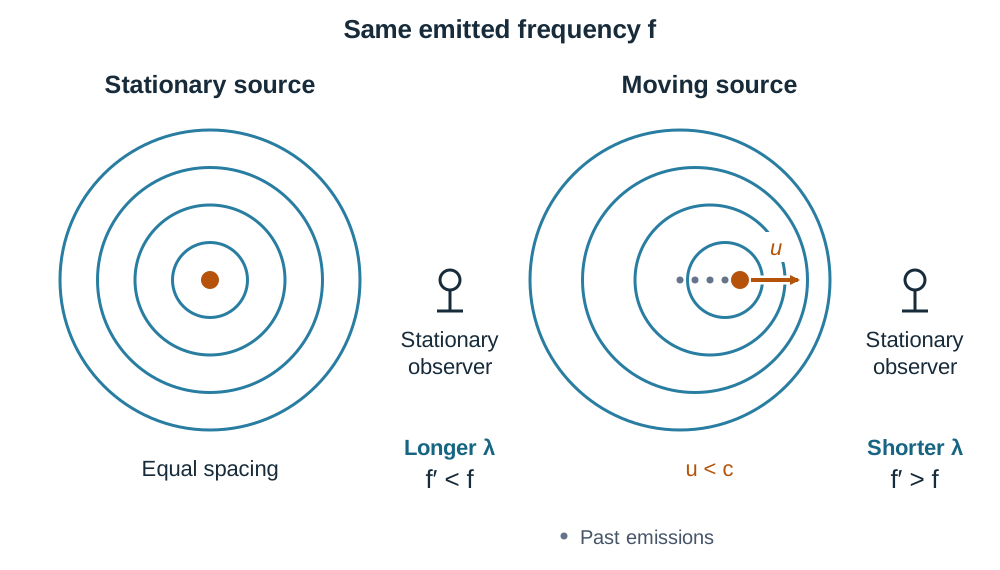
The Doppler effect is the apparent change in the frequency (or wavelength) of a wave observed when there is relative motion between the source of the waves and the observer.
Wavefront Model
- When a wave source is stationary, wavefronts spread outwards as evenly spaced concentric circles.
- When the source moves forward at speed , it chases the wavefronts it emits. Ahead of the moving source, successive wavefronts are crowded closer together, producing a shorter observed wavelength and a higher observed frequency (, heard as a higher pitch).
- Behind the moving source, wavefronts are left further apart, producing a longer observed wavelength and a lower observed frequency (, heard as a lower pitch).
Formula and Calculation Strategy
For a stationary observer and a moving source:
where is the emitted frequency, is the wave speed in the medium ( for sound in air), and is the source speed. The official specification writes μ in place of u in this Doppler formula: here μ means source speed in m s⁻¹, not the mass per unit length used in the stretched-string formula.
- Source approaching: Use the minus sign: . The smaller denominator increases above .
- Source receding: Use the plus sign: . The larger denominator decreases below .
Applications
- Radar speed guns: Microwaves are directed at a moving car. The Doppler shift in the frequency of the reflected microwave signal allows the vehicle's speed to be calculated. (Note: Handheld laser guns / LIDAR measure the time of flight of light pulses rather than the Doppler shift).
- Medical Doppler ultrasound: High-frequency sound waves reflect off moving red blood cells. The measured Doppler frequency shift maps the speed and direction of blood flow through heart valves and arteries.
- Astronomy (Red Shift): Light emitted by distant galaxies shows spectral lines shifted towards longer wavelengths (lower frequencies). This red shift indicates that galaxies are receding from Earth, providing core evidence that the universe is expanding.
Key terms
- Travelling wave
- A disturbance that moves through a medium or space, transferring energy from one point to another without transferring matter.
- Transverse wave
- A wave in which the direction of vibration is perpendicular (at right angles) to the direction of wave travel.
- Longitudinal wave
- A wave in which the direction of vibration is parallel to the direction of wave travel.
- Amplitude
- The maximum displacement of an oscillating particle from its undisturbed equilibrium position.
- Wavelength
- The distance between two successive points on a wave that are in phase with each other.
- Frequency
- The number of complete wave cycles or oscillations passing a fixed point per second, measured in hertz (Hz).
- Period
- The time taken for one complete wave cycle or oscillation to occur, measured in seconds (s).
- Diffraction
- The spreading out of a wave as it passes through a gap or around an obstacle.
- Principle of superposition
- When two or more waves meet, the resultant displacement at that point is equal to the algebraic sum of the individual displacements of the waves.
- Coherent sources
- Sources of waves that have the same frequency and maintain a constant phase difference relative to each other.
- Stationary (standing) wave
- A wave pattern formed when two periodic waves of identical frequency, wavelength, and amplitude travel in opposite directions along the same medium and interfere.
- Node
- A point along a stationary wave where destructive interference causes the amplitude of vibration to be permanently zero.
- Antinode
- A point along a stationary wave where constructive interference causes the amplitude of vibration to reach its maximum.
- Fundamental frequency
- The lowest frequency at which a system or stretched string vibrates to produce a stationary wave.
- Harmonics
- Frequencies that are positive integer multiples of the fundamental frequency.
- Mass per unit length
- The mass of a piece of string divided by the length of that piece (μ = m/l), measured in kg m⁻¹.
- Polarisation
- The restriction of the vibrations of a transverse wave to a single geometric plane perpendicular to the direction of wave travel.
- Resonance
- The phenomenon where a system is driven at its natural frequency by another vibrating body of the same frequency, resulting in efficient energy transfer and a large amplitude of vibration.
- Natural frequency
- The characteristic frequency at which an elastic system vibrates freely when disturbed.
- Doppler effect
- The apparent change in the frequency (or wavelength) of a wave observed when there is relative motion between the source and the observer.
- Red shift
- The shift of spectral lines towards longer wavelengths (lower frequencies) observed in light from distant receding astronomical bodies.
Check yourself
What happens to the energy carried by a wave if its amplitude is tripled?
Energy is directly proportional to the square of amplitude (Energy ∝ A²). Tripling the amplitude multiplies the transported energy by 3² = 9.
A wave has a period of 0.004 s and a wavelength of 1.36 m. Calculate its speed.
Frequency is f = 1 / T = 1 / 0.004 = 250 Hz. Speed is v = fλ = 250 × 1.36 = 340 m s⁻¹.
Why can sound waves bend around open doorways while light waves cast sharp shadows?
Diffraction is noticeable when the gap width is close to the wavelength. Sound wavelengths (metres to centimetres) are similar in size to a doorway, causing wide diffraction, whereas light wavelengths (400–700 nm) are far smaller than the doorway, so light travels straight through without noticeable spreading.
A string's vibrating length is halved while maintaining the same tension. What happens to its fundamental frequency?
The fundamental frequency doubles, because frequency is inversely proportional to length (f ∝ 1/l) when tension and mass per unit length remain constant.
Define resonance.
Resonance occurs when a system is made to vibrate at its natural frequency by a driving force of the same frequency. Energy is transferred efficiently, resulting in a large amplitude of vibration.
Two coherent loudspeakers in phase emit sound with λ = 0.50 m. A point is 2.00 m from one speaker and 2.25 m from the other. What type of interference occurs at this point?
The path difference is 2.25 m - 2.00 m = 0.25 m, which equals half a wavelength (λ/2). Destructive interference occurs, producing a quiet zone.