

Atomic physics explores how matter is structured on the smallest scales and how unstable nuclei achieve stability through radioactive decay. This topic tracks the development of atomic theory from Thomson's plum pudding model to Rutherford's nuclear atom and Bohr's quantised energy levels, showing how electron transitions create emission line spectra that reveal the chemistry and motion of the universe. It details the composition of the nucleus, the fundamental forces that hold it together, mass defect and nuclear binding energy, the properties and equations of alpha, beta, and gamma radiation, radiation detectors, and the mathematical laws governing half-life and decay activity.
From Plum Pudding to Rutherford's Nuclear Atom
In 1897, J.J. Thomson discovered the electron. Because matter is electrically neutral in ordinary conditions, Thomson proposed the plum pudding model: an atom was imagined as a sphere of uniform positive charge with negatively charged electrons embedded throughout it like raisins in a pudding.
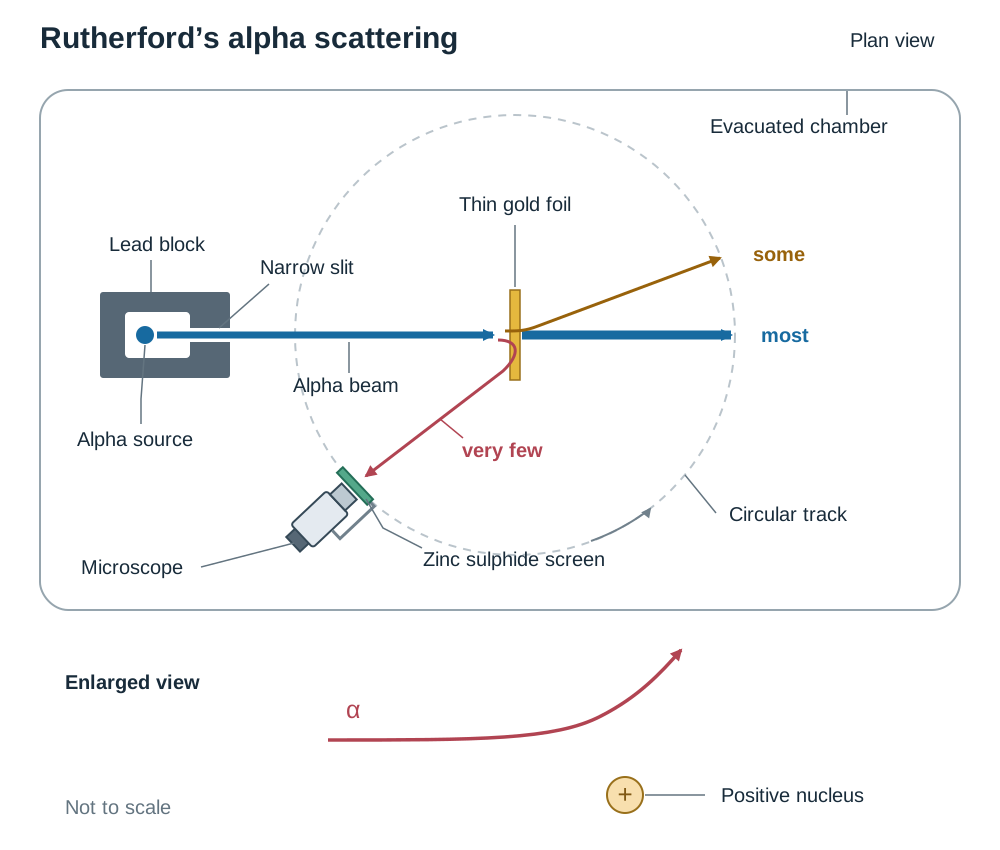
Between 1909 and 1911, Hans Geiger and Ernest Marsden, carrying out experiments directed by Ernest Rutherford, tested this model by firing high-speed alpha particles ( nuclei) at an extremely thin sheet of gold foil (around 2,000 atoms thick) inside an evacuated chamber.
Experimental Setup and Diagram
To draw the Geiger-Marsden apparatus:
- A radioactive alpha source is placed inside a heavy lead block with a narrow exit slit to produce a thin, straight beam.
- A thin sheet of gold foil stands at the centre of the chamber.
- A zinc sulphide screen attached to a microscope acts as the detector. It can be rotated on a circular track all the way around the gold foil.
- The entire apparatus is enclosed in an evacuated container so that air molecules do not absorb or deflect the alpha particles.
- Label arrows show: most alpha particles passing straight through, some deflecting through small angles, and a tiny number bouncing backwards.
Observations and Conclusions
Thomson's model predicted that positive charge was spread thinly throughout each atom, meaning the alpha particles would feel negligible electrostatic force and pass straight through with deflections of less than a degree. The experimental findings contradicted this:
- Most alpha particles passed straight through undeflected: This demonstrated that the atom is mostly empty space.
- Some alpha particles were deflected through small angles: This showed that an electrostatic repulsive force acts on alpha particles when they pass near a concentration of positive charge.
- A tiny fraction (roughly 1 in 8,000) was deflected through angles greater than , with some rebounding almost backwards: This showed that the positive charge and nearly all the mass of the atom are concentrated in a small, dense, positively charged nucleus.
Rutherford published his nuclear model in 1911. His calculations established that the nucleus has a radius of roughly , whereas the whole atom has a radius of about . The nucleus is tens of thousands of times smaller than the atom itself.
The Bohr Model, Line Spectra, and the Universe
Rutherford's planetary model had a severe limitation under classical physics: an orbiting electron accelerates continuously, which means it should continuously radiate electromagnetic energy, spiral inward, and collapse into the nucleus within a fraction of a microsecond. Furthermore, glowing low-pressure gases emit discrete lines of colour rather than a continuous rainbow.
In 1913, Niels Bohr resolved this by introducing quantum rules:
- Electrons can only occupy certain stable, non-radiating circular orbits known as energy levels.
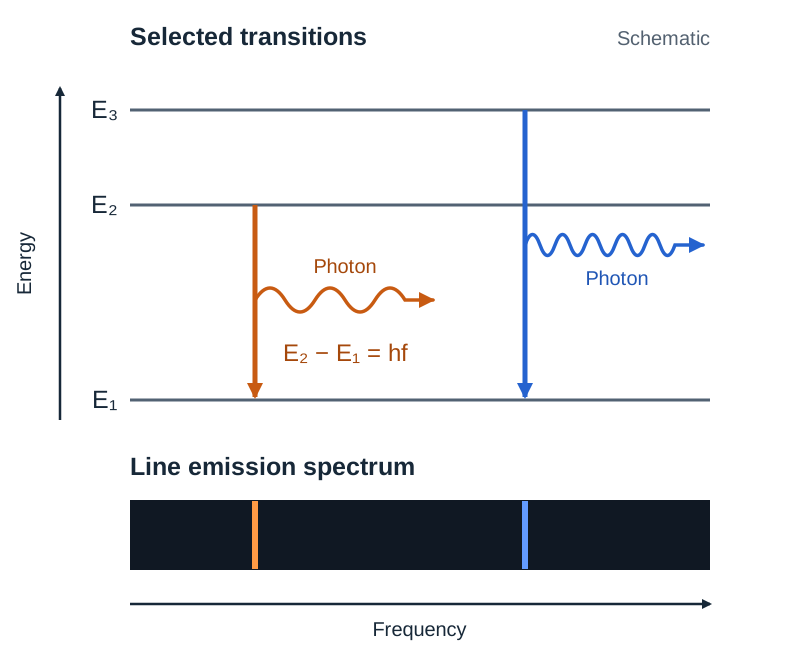
- An electron in an allowed orbit has a fixed, discrete energy. The lowest level is the ground state (); higher levels () are excited states.
- An electron can absorb a photon to jump to a higher excited state. When an excited electron falls from a higher level to a lower level , it emits a single photon whose energy equals the difference between the two states:
Using , the wavelength of the emitted light is:
Where is Planck's constant () and is the speed of light in a vacuum ().
Because each chemical element has a unique nuclear charge and arrangement of electrons, each element possesses a unique set of allowed energy levels. Therefore, excited atoms of a gaseous element produce a characteristic line emission spectrum (sharp, coloured lines on a dark background). Dense, glowing solids or liquids produce a continuous spectrum containing an unbroken band of wavelengths.
Spectra and the Universe
Every element produces its own set of spectral lines, acting like a chemical fingerprint. Astronomers split starlight into a spectrum using spectrometers (spectroscopy) and match the lines to laboratory measurements:
- Composition of stars: Identifying specific emission and absorption lines reveals which elements make up the star (principally hydrogen and helium).
- Discovery of helium: In 1868, an unknown bright yellow line was observed in the Sun's spectrum. The element was named helium (from the Greek helios, Sun) decades before it was discovered on Earth.
- Absorption lines: Cooler gases in a star's outer atmosphere absorb the exact photon frequencies that their atoms would emit when excited, leaving dark lines across the continuous spectrum.
- Motion of galaxies: When a star or galaxy moves away from Earth, its observed spectral lines shift toward longer wavelengths (red shift). Distant galaxies exhibit large red shifts, providing key evidence that the universe is expanding.
Nuclear Structure, Stability, and Fundamental Forces
The nucleus contains two types of subatomic particles, collectively called nucleons:
- Protons: Positively charged (), with a mass of .
- Neutrons: Electrically neutral (), with a mass of .
A nucleus of any element is written using standard nuclear notation:
Where is the atomic number (the number of protons, which determines the element), is the mass number (total number of nucleons, ), and is the chemical symbol. The number of neutrons is .
Isotopes are atoms of the same element that have the same number of protons but different numbers of neutrons. For example, carbon-12 () and carbon-14 () share identical chemical behaviour because they have the same electron configuration, but carbon-14 has two extra neutrons and is radioactive.
Fundamental Forces in the Nucleus
Protons inside a nucleus experience powerful electrostatic repulsion. Nuclear stability depends on the interplay of fundamental forces:
- Strong Nuclear Force: An attractive force that acts equally between all nucleons (proton-proton, proton-neutron, neutron-neutron) over a very short range (about ). It holds the nucleus together against electrostatic repulsion.
- Electromagnetic Force: An infinite-range repulsive force acting between positively charged protons.
- Weak Nuclear Force: A very short-range force responsible for radioactive beta decay.
- Gravitational Force: An attractive force between masses, but negligible on the nuclear scale.
A nucleus is stable when the strong nuclear force holds its nucleons together securely. Very large nuclei have so many protons that electrostatic repulsion makes them unstable; they often emit alpha particles to reduce size. Nuclei with too many neutrons for their number of protons are also unstable; a neutron transforms into a proton via beta decay, governed by the weak nuclear force. An unstable nucleus decays spontaneously toward a more stable state.
Mass Defect and Binding Energy
A nucleus always has less mass than the sum of the individual protons and neutrons that constitute it when separated. This missing mass is converted into energy that was released when the nucleus formed.
Mass defect (): the difference between the total mass of the separate nucleons and the mass of the nucleus.
Binding energy: the energy needed to separate a nucleus completely into its individual protons and neutrons. According to Einstein's mass-energy equivalence, it equals the energy equivalent of the mass defect:
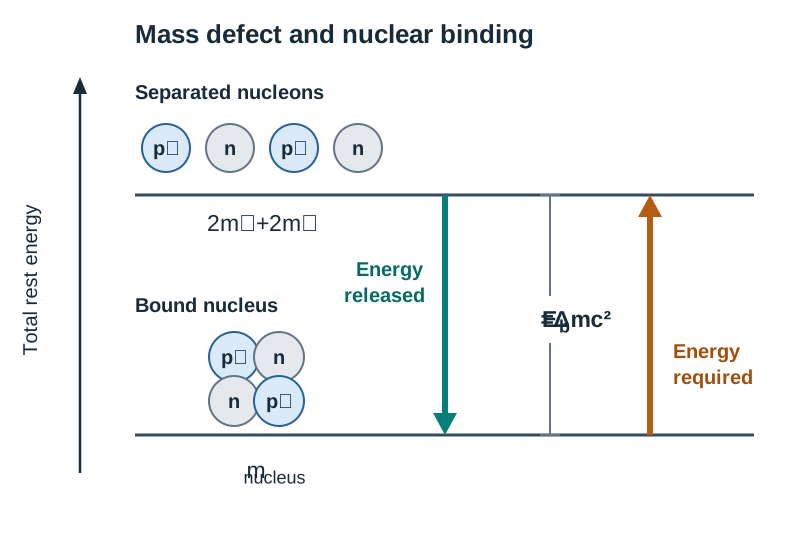
The stability of a nucleus is measured by its binding energy per nucleon (total binding energy divided by the mass number ). The greater the binding energy per nucleon, the more tightly bound the nucleons are and the more stable the nucleus. Nuclei near iron-56 have the highest binding energy per nucleon (roughly per nucleon), making them the most stable in the universe.
Radioactive Emissions and Nuclear Equations
Radioactivity is the spontaneous disintegration of an unstable nucleus accompanied by the emission of ionising radiation.
Properties of Alpha, Beta, and Gamma Radiation
| Property | Alpha () | Beta () | Gamma () |
|---|---|---|---|
| Nature | Helium nucleus () | Fast-moving electron () | High-frequency electromagnetic photon |
| Charge | |||
| Mass | |||
| Ionising Ability | Very high | Moderate | Low |
| Penetrating Power | Low (stopped by a sheet of paper or a few cm of air) | Moderate (stopped by a few mm of aluminium) | High (reduced, but never completely stopped, by several centimetres of lead or thick concrete) |
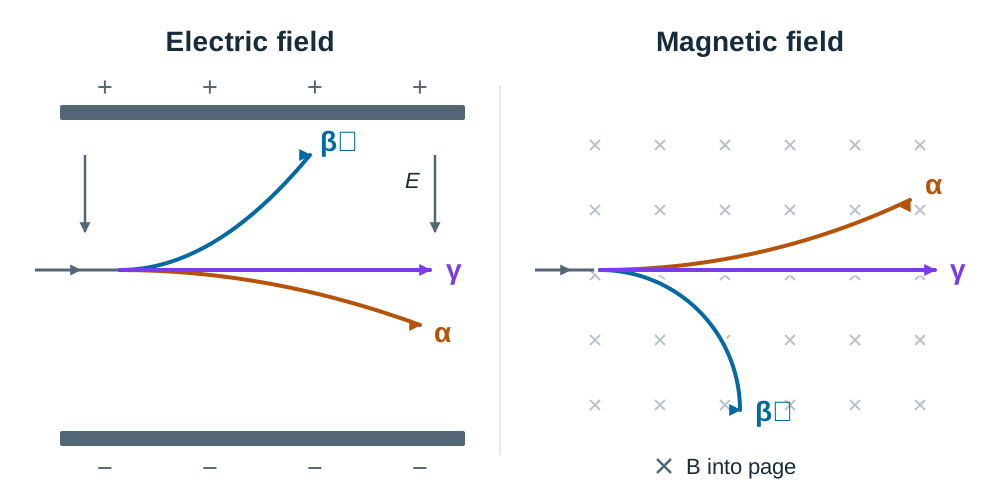
| Deflection in Electric Field | Deflected towards the negative plate | Deflected towards the positive plate | Undeflected |
| Deflection in Magnetic Field | Small deflection at right angles to field | Large deflection opposite to , at right angles to field | Undeflected |
In a magnetic field, a moving charge experiences a force () at right angles to both the particle's velocity and the magnetic field lines, making the particle travel in a curve. Alpha and beta particles deflect in opposite directions because they carry opposite charges. Beta particles deflect much more noticeably because their charge-to-mass ratio () is thousands of times larger (about 3,700 times) than that of an alpha particle.
Writing and Balancing Nuclear Equations
To write any nuclear reaction:
- Write the parent nucleus with mass number on top and atomic number on the bottom.
- Write the symbol for the emitted particle (, or ).
- Ensure total mass numbers (top) balance on both sides of the arrow.
- Ensure total atomic numbers (bottom) balance on both sides.
- Use the new atomic number to identify the daughter element from the periodic table.
Alpha decay: The parent nucleus ejects an alpha particle, reducing mass number by 4 and atomic number by 2:
Example (finding the daughter for Polonium-212 decay):
Beta () decay: A neutron inside the nucleus transforms into a proton, releasing an electron and an antineutrino ():
The atomic number increases by 1 while the mass number stays the same:
Example: Carbon-14 decay:
Wolfgang Pauli predicted the neutrino in 1930 to explain why emitted beta particles have a continuous range of kinetic energies rather than a fixed value. Without an unseen third particle sharing the available energy and momentum, conservation of energy and momentum would fail. The antineutrino is exceptionally difficult to detect because it carries zero charge and almost no mass, allowing it to pass through light years of matter without interacting.
Gamma decay: An excited nucleus releases excess energy as a high-energy photon without changing its atomic or mass numbers.
Radiation Detection, Background Radiation, and Safety
Detectors identify ionising radiation by the charged ions or charge carriers it creates when passing through matter.
The Geiger-Müller (GM) Tube
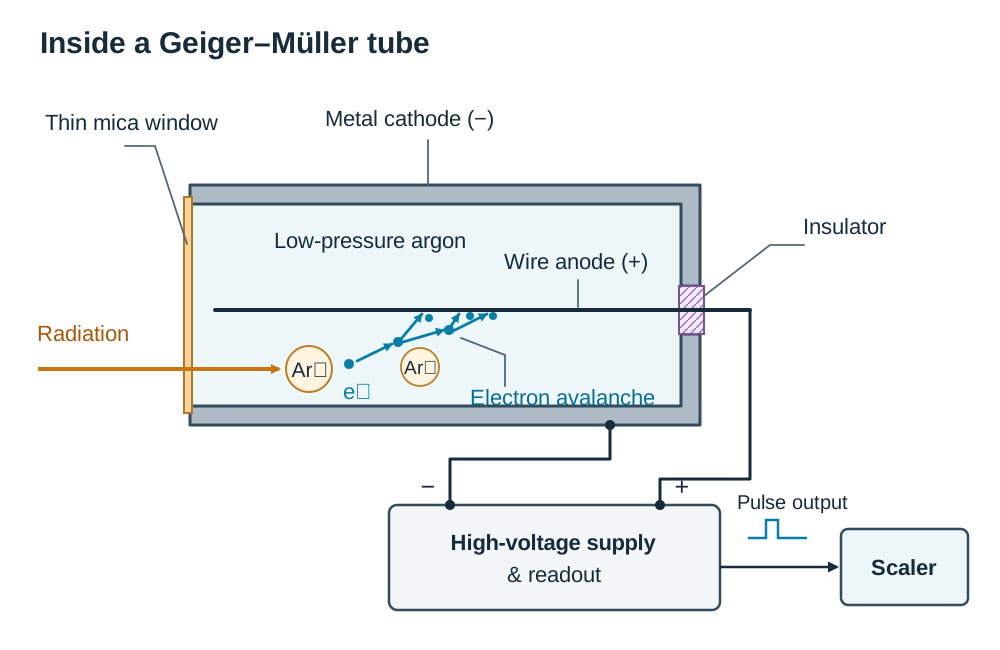
A GM tube consists of a cylindrical metal cathode enclosing argon gas at low pressure, with a thin mica entrance window at one end and a thin wire anode running down the centre. Radiation enters through the window and ionises argon atoms. A high voltage applied between the cathode and anode accelerates the freed electrons toward the wire anode. As they gain speed, these electrons collide with more argon atoms, triggering an avalanche of secondary ionisations. This produces a measurable pulse of electrical current that registers on a ratemeter or scaler.
A solid-state detector is an alternative modern sensor: a semiconductor device in which incoming radiation produces electron-hole pairs, creating a current pulse proportional to the particle's energy.
Measuring Background Radiation
Background radiation is measured by connecting a GM tube to a counter or scaler in the absence of any artificial radioactive sources:
- Record the count over a measured duration (such as 300 seconds) and divide by the time to find the background count rate in counts per second ().
- When measuring an experimental source, subtract this background count rate from the total measured count rate to obtain the corrected count rate.
In terms of experimental error:
- Radioactive decay is random, so counts fluctuate from second to second. Counting over a long time and repeating readings reduces this random error.
- Failing to subtract the background count rate is a systematic error that makes every measured activity too high.
Sources of Background Radiation and Safety
Background radiation is present everywhere in the environment. In Ireland, natural sources contribute the vast majority, with radon gas accounting for more than half of average public exposure. Radon is a radioactive alpha emitter formed by the natural decay of uranium in granitic bedrock, which can seep up into unventilated basements and homes. Other sources include cosmic rays from space, radioisotopes in rocks and soil, food (such as potassium-40), and medical procedures like diagnostic X-rays.
Ionising radiation damages biological cells, breaks chemical bonds, and mutates DNA, increasing the risk of cancer. Practical radiation safety relies on three rules: minimise exposure time, maximise distance from the source (using tongs), and employ appropriate shielding (such as lead blocks).
The Law of Radioactive Decay and Modelling Decay
Nuclear decay is spontaneous and completely random: we cannot predict when a specific nucleus will decay, and the rate cannot be altered by temperature, chemical reactions, or pressure.
The Law of Radioactive Decay
For a large sample, the activity () is directly proportional to the number of undecayed nuclei () present:
Where:
- is activity measured in becquerels (Bq) ().
- is the number of undecayed nuclei remaining.
- is the decay constant (unit: ), the constant of proportionality representing the probability per second that an individual nucleus will decay.
- In calculus notation, activity is the rate of loss of undecayed nuclei: .
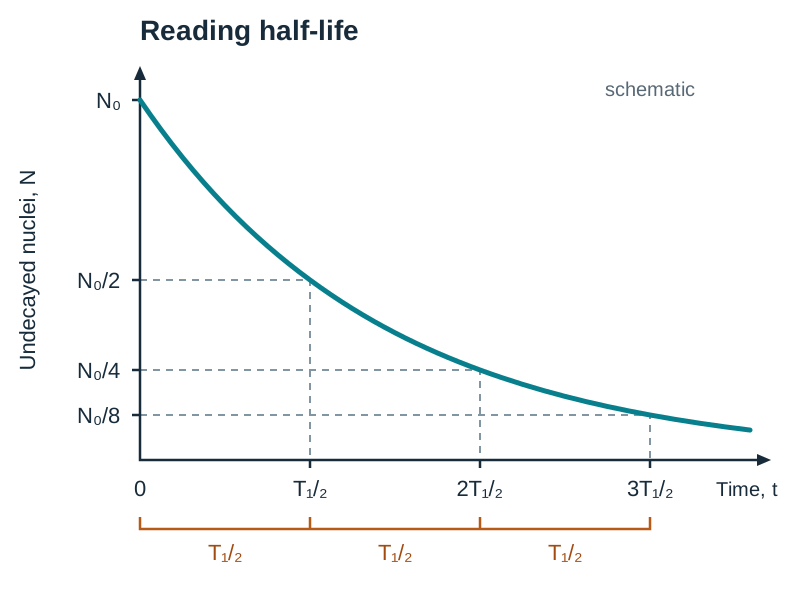
The half-life () is the time taken for half of the undecayed nuclei in a radioactive sample to decay (or the time for its activity to halve):
After half-lives, the fraction remaining is ().
Worked Example: Activity and Decay Over Half-Lives Problem: Iodine-131 has a half-life of 8 days. A sample contains nuclei. Calculate: (i) the decay constant and activity, and (ii) how long it takes for nuclei to decay.
Working:
- .
- .
- .
- If nuclei decay, then remain. This is of the original, which is 3 half-lives, so .
Modelling Random Decay
Although individual decays are unpredictable, every nucleus of a particular isotope has the same probability of decaying in any given second. In a large collection of nuclei, a constant fraction decays each second, generating a smooth mathematical curve.
The dice model: If you roll 600 ordinary six-sided dice, each die has a 1 in 6 chance of landing on a six. If you remove all dice that land on a six (representing decayed nuclei) and roll the survivors again, roughly of the remaining dice disappear on each roll. Plotting remaining dice against the roll number produces an exponential decay curve that drops by half approximately every 3.8 rolls. That roll count is the half-life of the dice model.
Reading half-life from a decay curve:
- Plot corrected count rate or undecayed nuclei on the y-axis against elapsed time on the x-axis, drawing a smooth curve through the points.
- Choose any initial activity value on the curve (e.g. ).
- Read the time value where the activity drops to half that initial value (). The difference in time is one half-life.
- Repeat from to and average the time intervals to reduce reading errors.
Radioisotopes in Practice
Selecting an isotope for an engineering or medical task requires choosing the correct radiation type (determining how far it penetrates and its ionising strength) and an appropriate half-life (how long it remains active).
- Smoke detectors (Americium-241): Americium-241 emits alpha particles that ionise air inside a small chamber, allowing a tiny electric current to pass between two electrodes. Smoke particles entering the chamber absorb the alpha particles and neutralise ions, dropping the current and triggering the alarm. Alpha particles cannot escape the detector's casing, so the risk from outside is negligible (the source must not be opened, swallowed or inhaled). Its half-life of 432 years ensures the detector operates reliably for years without needing replacement.
- Medical tracers and cancer therapy (Iodine-131): The human thyroid gland naturally concentrates iodine. Administering Iodine-131 delivers targeted beta particles and gamma rays directly to diseased thyroid tissue. Its short half-life of 8 days ensures the patient receives an effective therapeutic dose without remaining radioactive for extended periods.
- Carbon dating (Carbon-14): Cosmic rays continuously produce carbon-14 in the upper atmosphere, which living organisms absorb through photosynthesis and the food chain. When an organism dies, intake stops and carbon-14 decays via beta emission with a half-life of approximately 5,730 years. Measuring the remaining activity per gram of carbon reveals how long ago the organism died.
- Space exploration power sources (Plutonium-238): Deep-space probes traveling far from the Sun cannot rely on solar panels. Radioisotope thermoelectric generators (RTGs) capture the heat released by alpha-decaying Plutonium-238 and convert it into electricity using thermocouples. A half-life of 87.8 years supplies steady power for decades.
Key terms
- Atomic Number (Z)
- The number of protons in the nucleus of an atom.
- Mass Number (A)
- The total number of nucleons (protons and neutrons) in the nucleus of an atom.
- Isotopes
- Atoms of the same element that have the same number of protons but different numbers of neutrons.
- Energy Level
- A discrete, fixed amount of energy that an electron can have in an atom.
- Line Emission Spectrum
- A series of discrete, sharp coloured lines on a dark background emitted by an excited gas, corresponding to specific photon frequencies.
- Mass Defect
- The difference between the total mass of the separate nucleons and the mass of the assembled nucleus.
- Binding Energy
- The energy required to separate a nucleus completely into its individual constituent protons and neutrons.
- Radioactivity
- The spontaneous disintegration of an unstable nucleus accompanied by the emission of one or more types of ionising radiation.
- Law of Radioactive Decay
- States that the activity of a radioactive sample is directly proportional to the number of undecayed nuclei present.
- Becquerel (Bq)
- The SI unit of radioactive activity, equal to one disintegration per second.
- Decay Constant (λ)
- The constant of proportionality in A = λN, representing the probability per second that an individual nucleus will decay.
- Half-life (T₁/₂)
- The time taken for half of the undecayed nuclei in a radioactive sample to decay.
Check yourself
What observation in the Geiger-Marsden experiment showed that the atom contains a small, dense, positively charged nucleus?
A tiny fraction of alpha particles (roughly 1 in 8,000) was deflected through angles greater than 90°, with some rebounding almost backwards, which could only happen if repelled by a dense positive mass.
Write the balanced nuclear equation for the beta-minus decay of Carbon-14 (¹⁴₆C).
¹⁴₆C → ¹⁴₇N + ⁰₋₁e + ν̄
A radioactive sample has decayed to 12.5% of its initial activity after 24 days. What is its half-life?
12.5% remaining corresponds to 1/8 of the original activity, which equals 3 half-lives ((1/2)³ = 1/8). Therefore, 3 × T₁/₂ = 24 days, so T₁/₂ = 8 days.
Why is background radiation subtracted from experimental radiation measurements, and what kind of error occurs if this step is omitted?
Subtracting background radiation ensures only the radiation from the source is counted; omitting this step causes a systematic error, making every activity value too high.
Define mass defect and state the equation used to calculate nuclear binding energy from it.
Mass defect is the difference between the total mass of the separate nucleons and the mass of the nucleus. Binding energy is calculated using E = Δm c².