

Light is a transverse electromagnetic wave that transfers energy without transferring matter. At Leaving Certificate Higher Level, the wave nature of light is demonstrated through diffraction, interference, and polarisation. Young's double-slit experiment provided the first conclusive proof of wave behaviour, while the diffraction grating allows precise determination of wavelengths using the formula nλ = d sin θ (this equation is listed in the specification's equations; learn it and know where to find it). Polarisation confirms that light oscillates transversely perpendicular to its direction of propagation. This topic also explores dispersion through prisms and gratings, the full electromagnetic spectrum, photon energy, and solar irradiance.
The Wave Nature of Light and Young's Slits
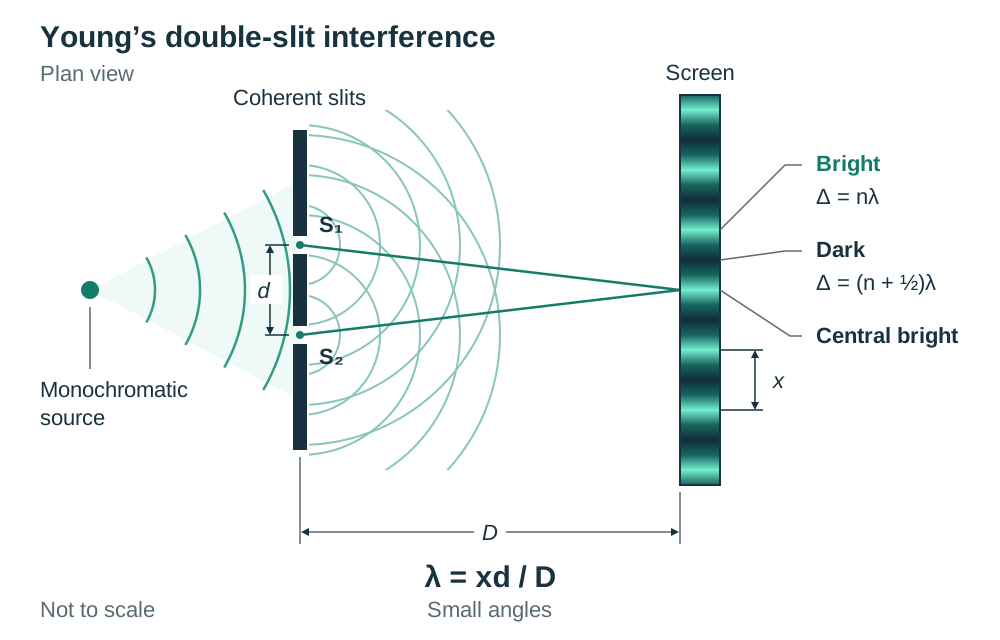
For centuries, debate persisted over whether light was a stream of particles or a wave. While reflection and refraction can be described with geometric rays, diffraction and interference prove decisively that light travels as a wave. Diffraction is the spreading of a wave as it passes through a gap or around an obstacle. Diffraction is most noticeable when the gap or obstacle is about the same size as the wavelength of the wave. Visible light has tiny wavelengths between 400 nm and 700 nm, so it casts sharp shadows and does not bend noticeably around everyday openings like open doors. In contrast, audible sound waves have wavelengths of the order of metres, so they diffract easily around doorway edges. In 1801, Thomas Young showed that light is a wave by passing it through two narrow slits and observing an interference pattern. Light from a single monochromatic source illuminates two closely spaced parallel slits. These slits act as coherent sources, meaning they have the same frequency and maintain a constant phase difference. Where the waves from the two slits overlap they add together (superposition), giving an interference pattern of bright and dark fringes on a screen. Constructive interference occurs where waves arrive in phase (crest meets crest), producing bright fringes. The path difference must equal a whole number of wavelengths: Path Difference = nλ (where n = 0, 1, 2, ...). Destructive interference occurs where waves arrive exactly out of phase (crest meets trough), producing dark fringes. The path difference equals an odd number of half-wavelengths: Path Difference = (n + 1/2)λ. For small angles at distance D from the slits, where slit spacing is d and adjacent fringe separation is x, the fringe formula is λ = xd / D. Note: if a problem gives the distance across a set of bright fringes, remember that 13 bright fringes span 12 fringe intervals.
The Diffraction Grating and Experimental Investigation
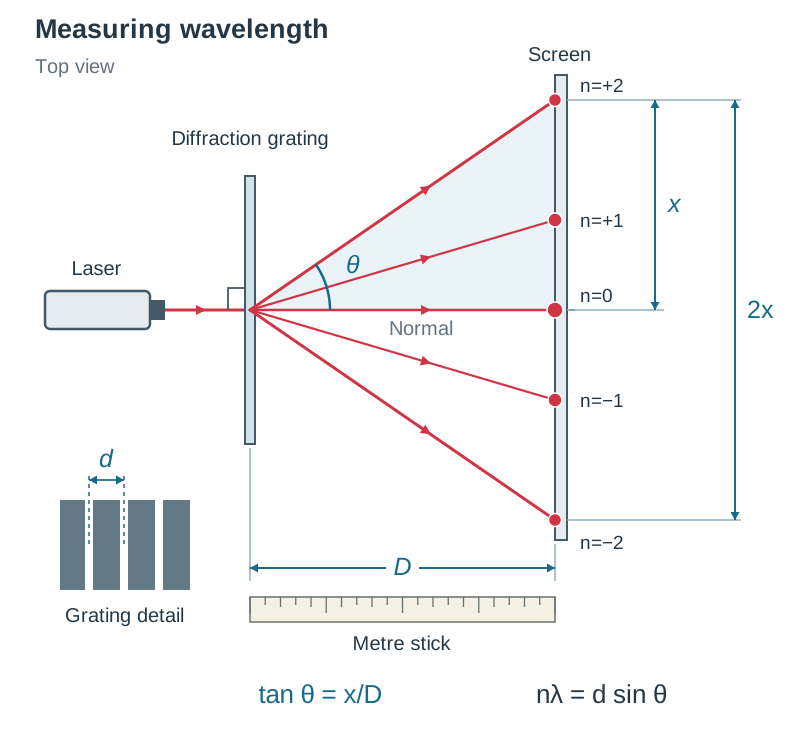
A diffraction grating consists of a transparent plate engraved with an enormous number of parallel, equally spaced lines, typically 300 to 600 lines per millimetre. A grating is vastly superior to double slits for measuring wavelength because having thousands of slits produces interference maxima that are far brighter, sharper, and spaced much further apart, drastically reducing experimental error. The distance between the centres of adjacent slits is the grating constant (d). If a grating has N lines per millimetre, convert to lines per metre by multiplying by 1000, then invert: d = 1 / (N × 1000) metres. When parallel monochromatic light strikes the grating normally, constructive interference occurs at angles θ according to: nλ = d sin θ, where n is the diffraction order (n = 0 for the central image, n = 1 for the first order, and so on). Because sin θ cannot exceed 1, the highest order that can be seen is the largest whole number less than d / λ. If d / λ evaluates to an exact integer, that order would lie at 90° along the plane of the grating and cannot reach a screen. The total number of bright images observable is 2n_max + 1, accounting for symmetrical orders on both sides plus the central zero-order maximum. ### Experimental Measurement of the Wavelength of Light. Apparatus: monochromatic light source (laser; note: a sodium vapour lamp requires a spectrometer to measure diffraction angles directly rather than projecting onto a screen), diffraction grating mounted perpendicular to the beam, screen, and metre stick. Method: 1. Set up the laser so the beam strikes the grating at right angles to its surface (along the normal). 2. On a screen placed at a distance D behind the grating, observe the bright diffraction spots. 3. For order n = 1 and n = 2, measure the total distance 2x between the corresponding bright spots on opposite sides of the central axis, and divide by 2 to get x. 4. Calculate the diffraction angle using tan θ = x / D. Calculation: Calculate d = 1 / (N × 10³). Substitute n, d, and θ into λ = (d sin θ) / n, and average the calculated wavelengths. Sources of error: judging the exact centre of diffracted spots; measuring small values of x or D with a metre stick; the grating not being set exactly perpendicular to the incident beam. Safety precaution: never look directly into a laser beam or its specular reflection; keep the beam aligned at bench height below eye level.
Polarisation as Proof of Transverse Waves
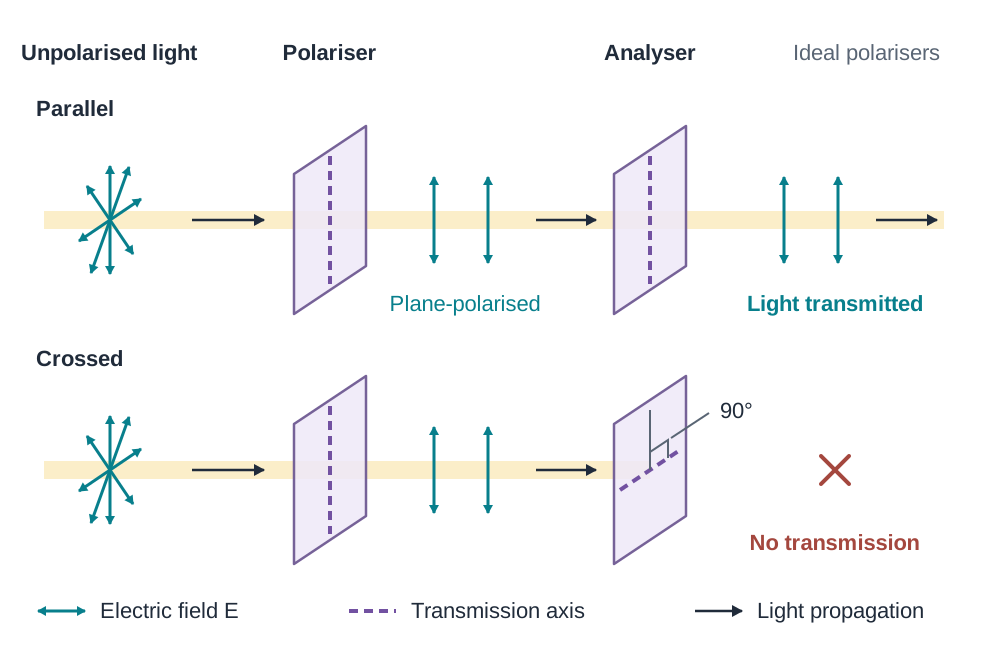
Polarisation is the restriction of the vibrations of a transverse wave to one plane. In unpolarised light, the electric field oscillates in all possible planes perpendicular to the direction of propagation. When light passes through a polarising filter (such as a Polaroid sheet), the filter transmits only the wave component vibrating parallel to its transmission axis, producing plane-polarised light. A three-step demonstration proves this behaviour: 1. Look at a light source through two Polaroid sheets held with their transmission axes parallel; light passes through clearly. 2. Slowly rotate one Polaroid (the analyser) relative to the other. The transmitted intensity steadily diminishes. 3. When the analyser has rotated through 90° (crossed polaroids), the light completely extinguishes. Rotating by another 90° restores transmission. Longitudinal waves, like sound, oscillate exclusively parallel to the direction of energy transfer and therefore cannot be polarised. The fact that light can be polarised proves that light is a transverse wave. Practical application: light reflected from non-metallic surfaces like glass, water, or wet asphalt becomes partially plane-polarised in the horizontal plane. Polaroid sunglasses have vertical transmission axes, so they block most of the horizontally polarised glare from water and wet roads while letting through about half of the ordinary unpolarised daylight.
Dispersion: Prisms versus Diffraction Gratings
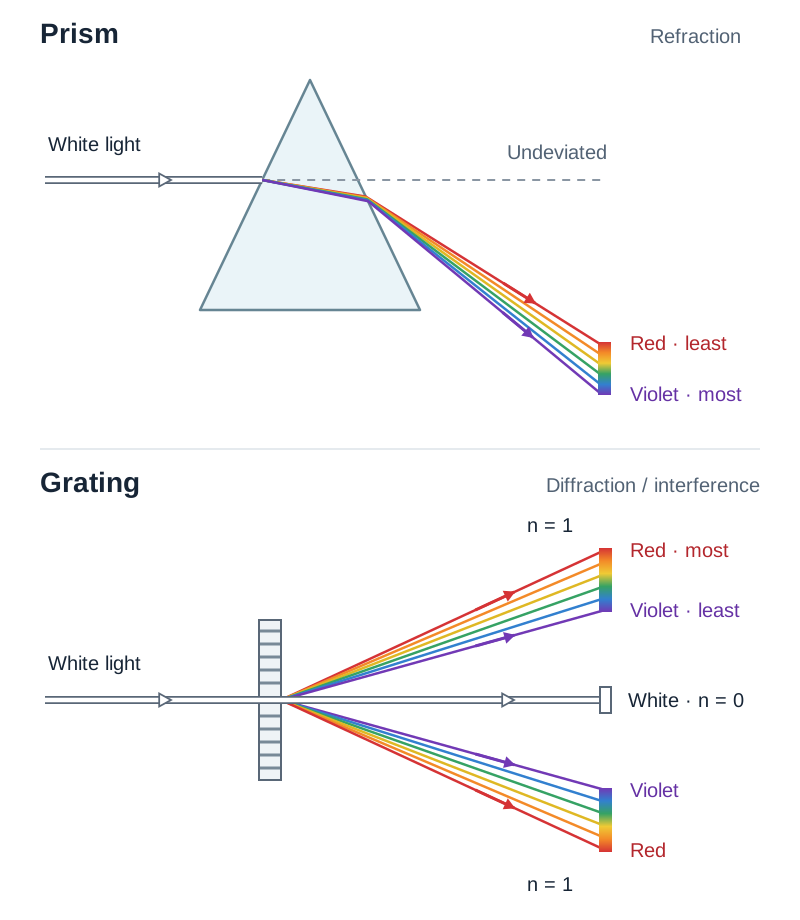
Dispersion is the separation of composite light (such as white light) into its constituent colours or wavelengths. White light comprises visible wavelengths from approximately 400 nm (violet) to 700 nm (red). Dispersion can be produced using either a triangular glass prism or a diffraction grating, but the underlying physics differs completely. In a glass prism, dispersion occurs by refraction. The refractive index of glass varies with wavelength: shorter wavelengths experience a higher refractive index and slow down more in the glass. Violet light has the shortest wavelength, slows down the most, and undergoes the greatest deviation. Red light has the longest wavelength, slows down least, and refracts least. A prism produces a single continuous spectrum with red bent least and violet bent most. In a diffraction grating, dispersion occurs by interference and diffraction. From nλ = d sin θ, for a given order n, sin θ is proportional to λ. Red light has a longer wavelength than violet light, so sin θ (and therefore angle θ) is larger for red light. In every non-zero diffraction order, red light deviates most and violet light deviates least. The central zero-order image (n = 0) has zero path difference for all wavelengths, so all colours arrive in phase at the centre to form an undispersed white line. Diagram comparison: for a prism, sketch an incoming white ray bending towards the base, spreading with red at the top (least deflected) and violet at the bottom (most deflected). For a grating, sketch a normal incident beam emerging as a central white line (n = 0), flanked symmetrically by first-order spectra (n = 1) where violet is closest to the centre and red is furthest away.
The Electromagnetic Spectrum and Solar Irradiance
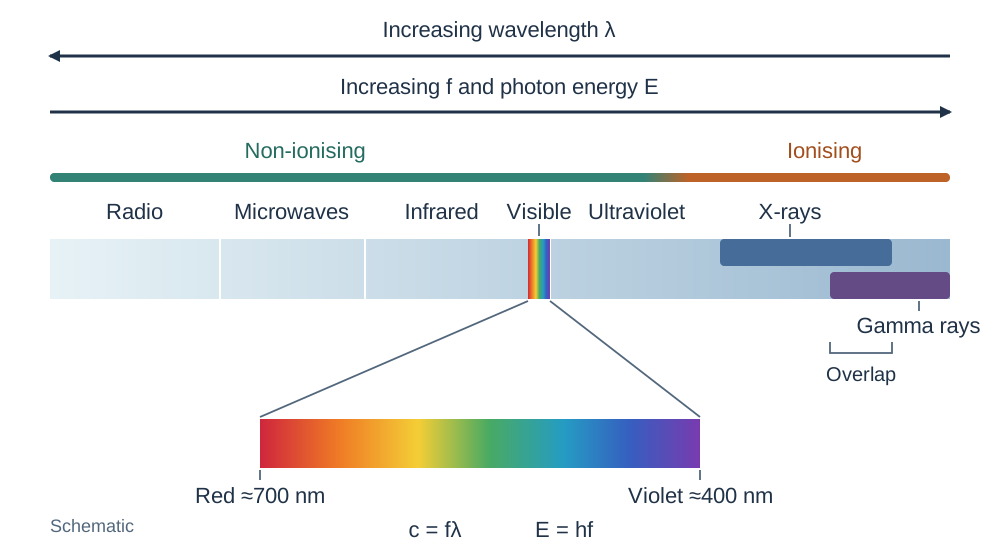
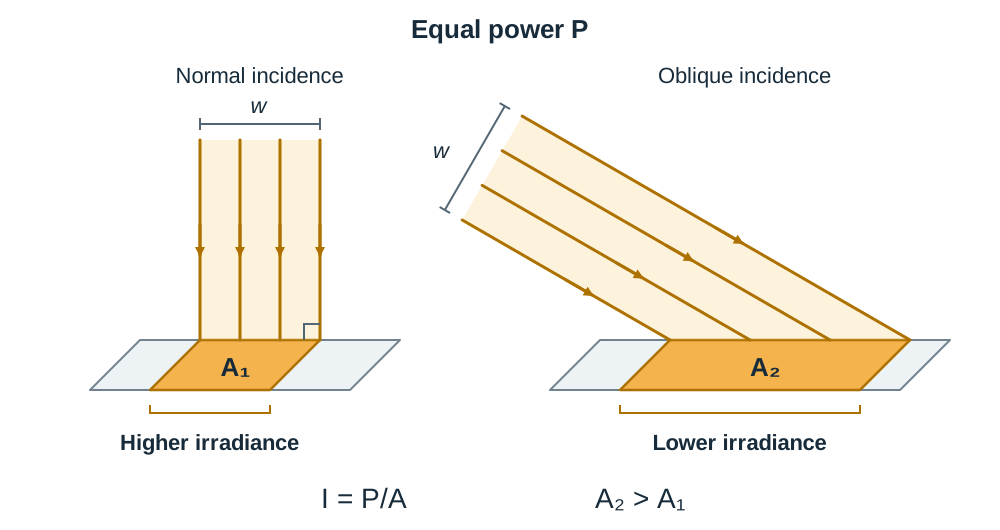
The electromagnetic spectrum is the continuous family of transverse electromagnetic waves that all travel through a vacuum at the speed of light, c = 3.00 × 10⁸ m s⁻¹. All members obey the wave equation c = fλ. Electromagnetic energy is carried in discrete packets called photons. The energy of a single photon is given by E = hf, where h is Planck's constant (6.6 × 10⁻³⁴ J s) and f is the frequency. Higher-frequency waves carry photons with greater energy. When photon energy is high enough, the radiation becomes ionising radiation, capable of removing electrons from atoms and damaging biological molecules and DNA. Spectrum Overview: 1. Radio waves: λ > 1 m; f < 3 × 10⁸ Hz; Source: accelerating electrons in transmitting aerials; Use: telecommunications, broadcasting; Non-ionising. 2. Microwaves: λ ≈ 1 mm to 1 m; f ≈ 3 × 10⁸ to 3 × 10¹¹ Hz; Source: magnetrons, mobile transmitters; Use: radar, satellite communication, heating food via water absorption; Non-ionising. 3. Infrared: λ ≈ 700 nm to 1 mm; f ≈ 3 × 10¹¹ to 4 × 10¹⁴ Hz; Source: warm and hot objects, radiant heaters; Use: optical fibre communication, thermal imaging, remote controls; Non-ionising. 4. Visible light: λ ≈ 400 nm (violet) to 700 nm (red); f ≈ 4 × 10¹⁴ to 7.5 × 10¹⁴ Hz; Source: very hot bodies, LEDs, lasers; Use: human vision, photography, photosynthesis; Non-ionising. 5. Ultraviolet: λ ≈ 10 nm to 400 nm; f ≈ 7.5 × 10¹⁴ to 3 × 10¹⁶ Hz; Source: the Sun, mercury discharge lamps; Use: counterfeit detection, medical sterilisation, vitamin D synthesis; Upper frequencies are ionising. 6. X-rays: λ ≈ 10⁻¹¹ to 10⁻⁸ m; f ≈ 3 × 10¹⁶ to 3 × 10¹⁹ Hz; Source: high-speed electrons striking a heavy metal target in an X-ray tube; Use: medical bone imaging, airport luggage scanners; Ionising. 7. Gamma rays: λ < 10⁻¹¹ m; f > 10¹⁹ Hz; Source: radioactive nuclear decay, cosmic events; Use: cancer radiotherapy, sterilising surgical equipment; Highly ionising. Note: X-ray and gamma ranges overlap; they are distinguished by their origin. ### Solar Irradiance. Solar irradiance is the solar power falling on a surface per unit area: I = P / A, measured in watts per square metre (W m⁻²). At the top of Earth's atmosphere, solar irradiance is approximately 1360 W m⁻². At ground level, it reaches up to 1000 W m⁻² at solar noon on a clear day. Factors reducing surface irradiance: 1. Solar elevation: when the Sun is lower in the sky (early morning, evening, winter, or high latitudes such as Ireland), solar power spreads over a larger surface area and travels through a thicker atmospheric path. 2. Atmospheric attenuation: clouds, dust, aerosols, and pollution scatter and absorb radiation. 3. Surface tilt: irradiance is maximised when the surface is perpendicular to incoming rays. Environmental impacts: solar irradiance powers photosynthesis at the base of food chains and drives planetary weather systems. Earth's atmosphere absorbs energetic bands: UVC is completely absorbed by oxygen and ozone high in the atmosphere; UVB is largely filtered by the stratospheric ozone layer, but remaining levels trigger vitamin D synthesis or cause sunburn and skin cancer; UVA penetrates to the surface, causing skin ageing and eye cataract risk.
Key terms
- Diffraction
- The spreading of a wave as it passes through a gap or around an obstacle.
- Interference
- The combination of two or more overlapping waves to form a resultant wave of greater, lower, or equal amplitude.
- Coherent Sources
- Sources of waves that have the same frequency and maintain a constant phase difference.
- Grating Constant (d)
- The distance between the centres of two adjacent slits on a diffraction grating.
- Constructive Interference
- Interference that occurs when waves arrive in phase, combining to produce a wave of maximum amplitude.
- Destructive Interference
- Interference that occurs when waves arrive exactly out of phase, cancelling each other to produce minimum amplitude.
- Polarisation
- The restriction of the vibrations of a transverse wave to one plane.
- Plane-Polarised Light
- Light in which the electric field oscillations are confined to a single plane perpendicular to the direction of propagation.
- Dispersion
- The separation of composite light into its component colours or wavelengths.
- Monochromatic Light
- Light consisting of a single frequency or a single wavelength.
- Ionising Radiation
- Radiation that carries enough energy per photon to remove electrons from atoms or molecules, creating ions.
- Solar Irradiance
- The solar power falling on a surface per unit area, measured in watts per square metre (W m⁻²).
Check yourself
Why does sound bend readily around an open doorway whereas light travels through in straight lines?
Diffraction is most noticeable when the wavelength is comparable to the aperture size. Sound waves have wavelengths of the order of metres, matching door dimensions, whereas visible light wavelengths are very small (400 to 700 nm).
What observation is made when an unpolarised light beam is viewed through two Polaroid filters whose axes are slowly rotated from parallel to perpendicular?
The light transmits clearly when axes are parallel, gradually dims as one filter is rotated, and completely extinguishes when the axes become perpendicular (crossed polaroids).
In a diffraction grating spectrum of white light, which colour deviates most from the central normal, and why?
Red light deviates most. From nλ = d sin θ, sin θ is proportional to wavelength. Red has the longest visible wavelength, so it produces the largest diffraction angle.
A diffraction grating has 500 lines per mm and is illuminated with light of wavelength 550 nm. Determine the highest order of diffraction that can be observed and the total number of images formed.
d = 1 / (500 × 10³) = 2.00 × 10⁻⁶ m. d / λ = (2.00 × 10⁻⁶) / (550 × 10⁻⁹) = 3.64. The highest observable order is n = 3. The total number of images formed is 2(3) + 1 = 7 images.
An electromagnetic wave has a wavelength of 1.0 × 10⁻¹⁰ m. Name this type of radiation and state whether it is ionising.
X-rays (or gamma rays). It is ionising radiation because its high frequency gives individual photons sufficient energy (E = hf) to remove electrons from atoms.
Why is solar irradiance on a horizontal surface in Ireland significantly lower in December than in June?
In December, the Sun is much lower in the sky, so the solar energy is spread over a larger surface area and must traverse a greater thickness of atmosphere, increasing absorption and scattering.