

Thermal physics explores how temperature is measured, how thermal energy transfers between substances, and the energy required to change temperature or state. This topic covers four core areas: measuring temperature and calibrating thermometers; heat capacity and specific latent heat; the mechanisms of conduction, convection, and radiation; and real-world applications of energy efficiency, including domestic heat pumps, building U-values, and insulation.
Temperature, Scales, and Thermometer Suitability
Temperature is a measure of the hotness or coldness of a body. In particle terms, the higher the temperature, the greater the average kinetic energy of the particles. (Kinetic energy is directly proportional to temperature only when temperature is measured on the absolute scale in kelvin.) Temperature is fundamentally different from heat: heat is a form of energy transferred between bodies because of a temperature difference, measured in joules (J).
To measure temperature objectively, we use a thermometric property—any physical property of a material that changes measurably, continuously, and reliably with temperature. Common examples include:
- Length of a liquid column: the expansion of mercury or coloured alcohol in a capillary tube.
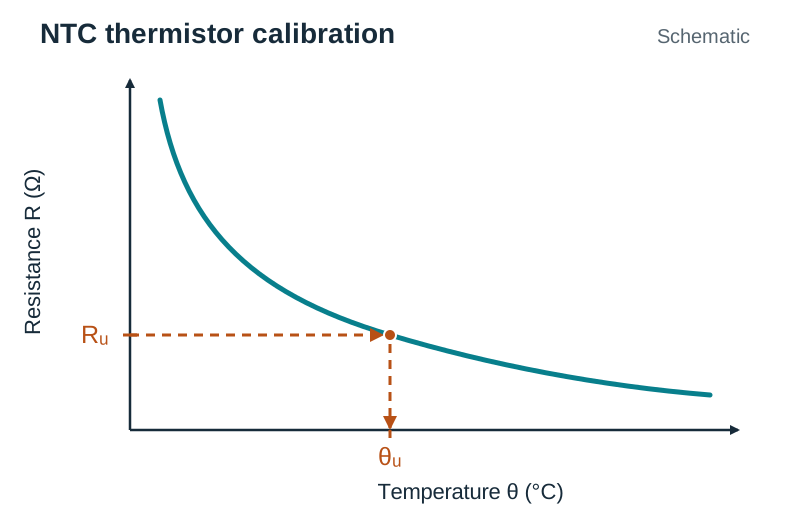
- Electrical resistance: the resistance of a metal wire (which increases with temperature) or an NTC thermistor (where resistance falls sharply as temperature rises).
- Electromotive force (emf): the voltage generated across the junctions of two dissimilar metals in a thermocouple.
- Pressure or volume of a fixed mass of gas.
- Colour: changes in liquid crystals or the peak wavelength of radiation from hot surfaces.
Choosing and Evaluating a Thermometer
Strand 2 requires analysing the suitability of materials for use as thermometers using primary and secondary data. A reliable thermometric property must be:
- Measurable: the change is large enough to read accurately.
- Repeatable: it returns the exact same value at a given temperature.
- Single-valued: each value of the property corresponds to one unique temperature.
When choosing a thermometer for a specific task, compare:
- Range: the lowest and highest temperatures it can record. Mercury freezes at −39 °C, so it cannot measure polar extremes. A thermocouple can measure temperatures exceeding 1000 °C.
- Sensitivity: the change in the property per degree change in temperature. A thermistor exhibits a very large resistance change per degree, making it exceptionally sensitive over narrow ranges.
- Response time: how rapidly it reaches thermal equilibrium with the system. A microscopic thermocouple junction responds almost instantaneously, whereas a bulky glass bulb filled with mercury responds slowly.
- Size and data capture: digital probes and thermistors are compact and connect directly to digital data loggers for automated recording.
Calibration and Temperature Scales
Because different thermometric properties do not vary linearly with one another between standard points, two different thermometers (e.g. resistance and mercury) calibrated at 0 °C and 100 °C will agree at those fixed points but diverge slightly at intermediate temperatures such as 50 °C.
To calibrate a thermometer:
- Measure the thermometric property at established reference temperatures (or against a standard laboratory thermometer).
- Plot the measured property against temperature to produce a calibration curve.
- Measure the property in an unknown environment and read the corresponding temperature directly from the curve.
The SI unit of temperature is the kelvin (K). The absolute zero of temperature (0 K) is the lowest theoretical temperature, at which particles have minimum internal energy:
In calculations, 273 is normally accepted (). Because an interval of 1 K is identical in size to an interval of 1 °C, any temperature change satisfies . You can use either unit for in heat equations.
Heat Capacity and Specific Heat Capacity
When thermal energy is added to a body without a change of state, its temperature rises.
Heat Capacity () is the heat energy required to change the temperature of an entire object by 1 kelvin (or 1 °C):
The unit of heat capacity is joules per kelvin (). Heat capacity depends on how much of the material there is as well as what it is made of. A full bath has a much bigger heat capacity than a cup of water, even though both consist of water.
Specific Heat Capacity () is the heat energy required to change the temperature of 1 kilogram of a substance by 1 kelvin:
Where is heat energy transferred in joules (J), is mass in kilograms (kg), is specific heat capacity in , and is temperature change in K or °C.
Quick check calculation: How much heat energy is needed to warm 2.0 kg of water from 15 °C to 65 °C? ()
Thermal Inertia of Water
Water has an extraordinarily high specific heat capacity () compared to common metals such as copper (). This has major environmental and engineering benefits:
- Climate moderation: Oceans and seas absorb immense quantities of solar radiation during summer with minimal temperature rise, and release that heat slowly through the winter. This moderates seasonal temperatures in coastal and island environments such as Ireland.
- Coolants and heating fluids: Water can transport large quantities of heat per unit mass with modest rises in temperature, making it ideal for vehicle cooling systems, domestic central heating circuits, and industrial cooling loops.
Latent Heat, Specific Latent Heat, and Heating Curves
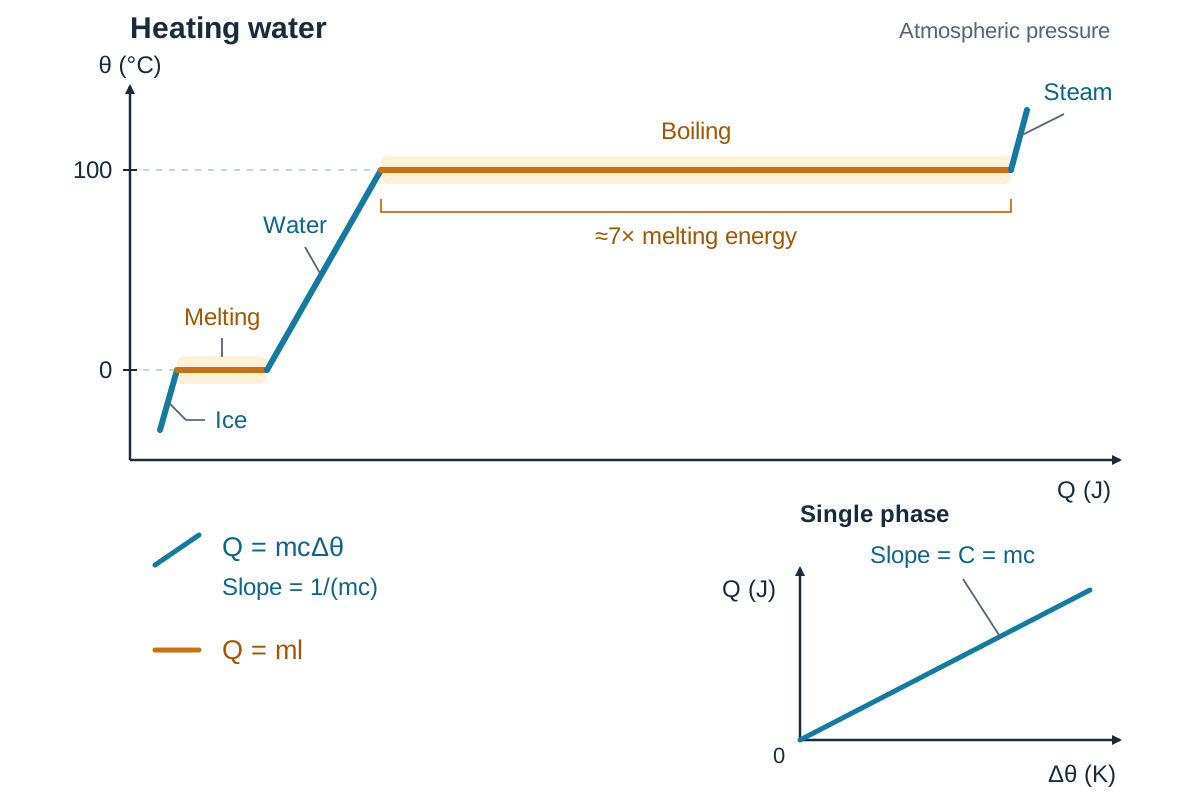
While a substance is changing state (melting or boiling), it takes in heat but its temperature stays the same. This stored energy is latent heat ().
In particle terms, latent heat does not make the particles move faster, so the temperature does not rise. Instead, the energy is used to pull the particles further apart against the attractive intermolecular bonds, increasing their potential energy.
Specific Latent Heat () is the heat energy required to change the state of 1 kilogram of a substance without any change in temperature:
The SI unit of specific latent heat is joules per kilogram ().
There are two specific latent heats:
- Specific Latent Heat of Fusion (): The heat energy required to change 1 kg of a substance from solid to liquid at its melting point without a change in temperature (for ice at 0 °C, ).
- Specific Latent Heat of Vaporisation (): The heat energy required to change 1 kg of a substance from liquid to gas at its boiling point without a change in temperature (for water at 100 °C, ).
Boiling needs far more energy than melting () because the molecules must be pulled completely apart, not just loosened. This explains why a steam scald at 100 °C is vastly more severe than a hot-water burn at 100 °C: each kilogram of condensing steam delivers of latent heat directly to the skin before the resulting liquid water begins cooling.
Conversely, ice is an exceptionally effective coolant because of its high specific latent heat of fusion. Each kilogram of ice absorbs of energy as it melts at 0 °C without warming up, chilling drinks and food packs efficiently.
Verifying Heat Models with Secondary Data: Heating Curves
A heating curve plots temperature (-axis) against time or energy supplied (-axis) for a substance heated at a constant rate:
- Sloped sections: Temperature rises. Heat increases particle kinetic energy according to . A steeper slope indicates a smaller specific heat capacity, because less energy is needed for each degree rise.
- Flat plateaus: Temperature remains constant during state changes. Heat is absorbed as latent heat (). The lower plateau at 0 °C represents melting (fusion); the higher plateau at 100 °C represents boiling (vaporisation). For water, the boiling plateau lasts roughly seven times longer than the melting plateau because .
In a graph of energy supplied against temperature rise for a fixed mass, the curve is a straight line through the origin. Its slope equals the heat capacity . Dividing the slope by the known mass yields the material's specific heat capacity , verifying that temperature rise is directly proportional to heat transferred.
Calorimetry Experiments: Measuring c and l
Calorimetric calculations apply the principle of conservation of energy: in an insulated system, heat lost by hot bodies equals heat gained by cold bodies (Heat lost = Heat gained).
For c, you need primary data from a solid or a liquid, and secondary data for both a solid and a liquid. For l, you need primary data from either the fusion of ice or the vaporisation of steam, and secondary data for both. So you need to do at least one c experiment and at least one l experiment yourself, and be able to analyse data from all four.
1. Specific Heat Capacity of Water (Electrical Method)
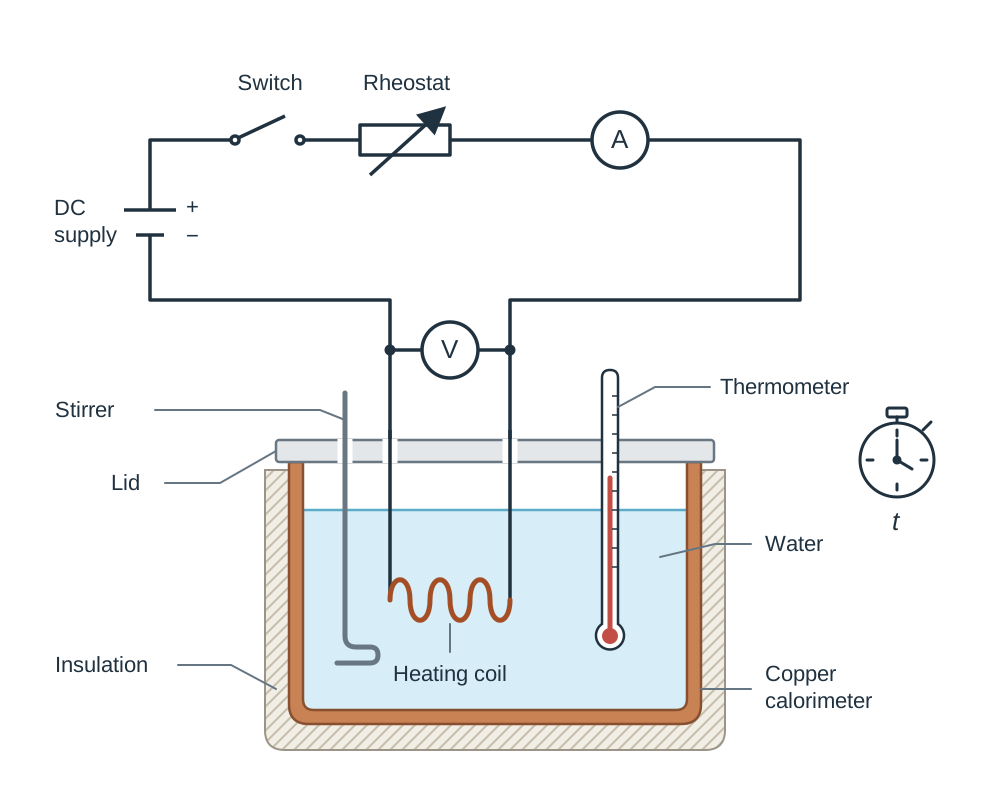
- Apparatus: Insulated copper calorimeter, heating coil, DC power supply, rheostat, ammeter, voltmeter, stopwatch, stirrer, and thermometer.
- Procedure:
- Weigh the empty calorimeter (). Add water to cover the heating coil and weigh again. Subtract to find the mass of water: .
- Note the initial steady temperature ().
- Switch on the current, start the timer, and adjust the rheostat to hold current constant. Record potential difference .
- Stir continuously. After a set time giving a 10 °C to 15 °C rise, switch off the power.
- Continue stirring and note the highest temperature ().
- Conservation equation: Electrical energy in = Heat gained by water and calorimeter:
- Error source: Heat lost to the room means the measured temperature rise is too small, making the calculated too high. Counteract this by insulating (lagging) the calorimeter, using a lid, and keeping the temperature rise modest.
2. Specific Heat Capacity of a Metal Block (Electrical Method)
- Apparatus: Cylindrical metal block (e.g. aluminium or copper) with two pre-drilled holes, immersion heater, thermometer, power supply, joulemeter (or voltmeter, ammeter, and stopwatch), lagging.
- Procedure: Weigh the block (). Place the heater in one hole and the thermometer in the other, adding a few drops of light oil into the thermometer hole to ensure good thermal contact. Insulate the block thoroughly. Supply energy and measure the temperature rise .
- Equation: . Heat loss to the room makes the calculated too high.
3. Specific Latent Heat of Fusion of Ice
- Procedure:
- Weigh the empty calorimeter (). Add water warmed 5 °C to 10 °C above room temperature and reweigh to obtain the mass of water ().
- Record the initial temperature ().
- Dry crushed ice with blotting paper to remove liquid surface water.
- Add the dried ice in small pieces while stirring until the temperature falls roughly as far below room temperature as it started above it.
- Record the minimum final temperature (). Reweigh to find the mass of ice: .
- Energy balance: Heat lost by water and calorimeter = Heat gained by melting ice + Heat gained warming melted ice water from 0 °C to :
- Key error: If ice is wet, liquid water at 0 °C enters the calorimeter. It adds mass but requires no latent heat to melt, making the calculated too low.
4. Specific Latent Heat of Vaporisation of Water
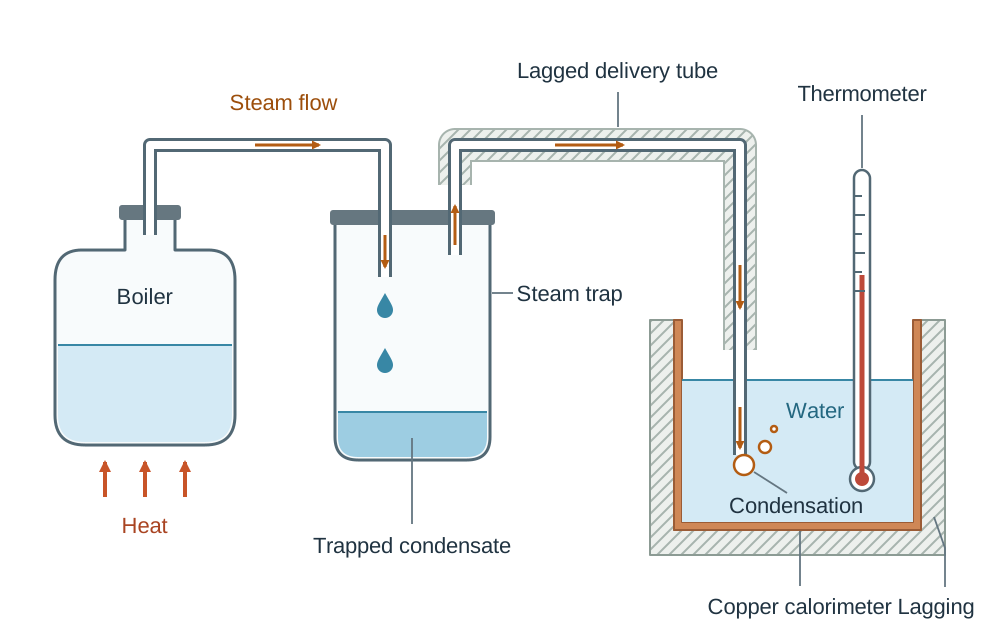
- Procedure: Pass dry steam from a boiler through a steam trap into cold water (started roughly 10 °C below room temperature) in a lagged calorimeter until the temperature rises about 10 °C above room temperature. Record final temperature and reweigh to find the condensed steam mass .
- Energy balance: Heat lost by condensing steam + Heat lost by cooling steam water = Heat gained by water and calorimeter:
- Key error: Condensation droplets entering from the delivery tube add mass without releasing latent heat inside the calorimeter, making the calculated too low. Using a steam trap and lagging the delivery tube ensures only dry steam reaches the water.
Mechanisms of Heat Transfer
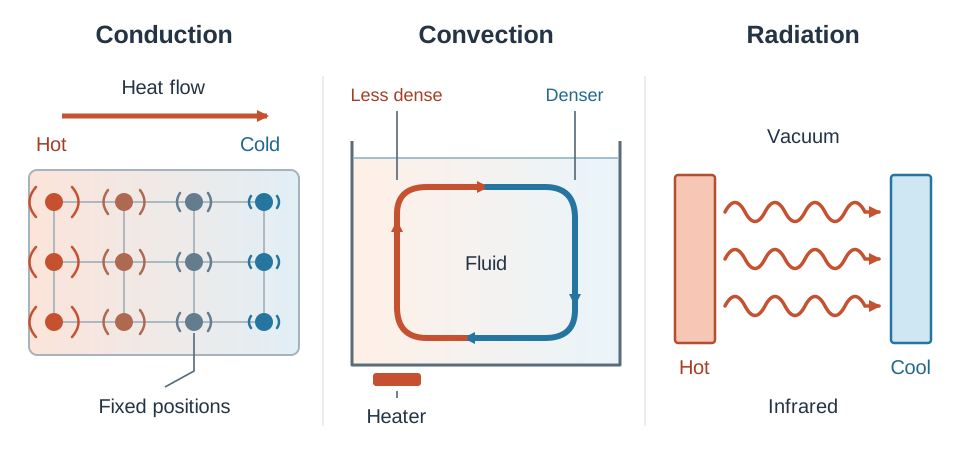
Heat transfers spontaneously down a temperature gradient by three physical mechanisms:
1. Conduction
Conduction is the transfer of heat through a substance from particle to particle, without the substance itself moving. It is the dominant transfer mode in solids.
- Non-metals (insulators): Particles at the hot end vibrate with greater amplitude. These vibrations are passed along to neighbouring particles through interatomic bonds. This process is relatively slow.
- Metals (conductors): Metals contain a sea of free (delocalised) electrons. These mobile electrons absorb thermal energy, move rapidly through the ionic lattice, and collide with ions throughout the metal, transferring heat swiftly across large distances.
2. Convection
Convection is the transfer of heat through a fluid (liquid or gas) by the bulk circulating motion of the fluid itself.
- When a fluid is heated, its particles gain kinetic energy, move faster, and spread further apart.
- The heated fluid expands, reducing its density.
- The cooler, denser surrounding fluid sinks under gravity, pushing the warmer, less dense fluid upward. This continuous cycle establishes a convection current.
- Convection cannot occur in solids (particles cannot flow) or in a vacuum (no particles).
3. Radiation
Radiation is the transfer of heat energy by means of electromagnetic waves, primarily in the infrared region. Radiation requires no material medium and travels through a vacuum at the speed of light ().
- All matter above absolute zero emits thermal radiation. Hotter objects emit higher total power and shorter peak wavelengths.
- Dull, dark, matte surfaces are the most effective absorbers and emitters of thermal radiation.
- Light, shiny, polished surfaces reflect radiation and are poor emitters and absorbers.
Heat Pumps, U-Values, and Sustainability
The Heat Pump
A heat pump does not create heat; it moves heat from a colder region (outside air or ground) into a warmer region (inside a building) using external mechanical work. It operates in a continuous closed circuit using a refrigerant chosen for its low boiling point and high specific latent heat of vaporisation.
The refrigeration cycle operates in four stages:
- Evaporator (outside/cold zone, low pressure): Cold liquid refrigerant at low pressure flows through evaporator coils. It absorbs latent heat from outdoor air or soil and boils into a low-pressure gas.
- Compressor: An electric pump compresses the gas, doing work on it and raising its pressure and temperature sharply.
- Condenser (indoors/warm zone, high pressure): Hot, high-pressure vapour flows through indoor coils or heat exchangers. It condenses into a liquid, releasing its latent heat of vaporisation into living spaces or water radiators.
- Expansion valve: The liquid expands through a constriction into a low-pressure region. The sudden drop in pressure makes the refrigerant very cold. It is now colder than the outside air or ground, so it can take in heat from them when it goes back into the evaporator.
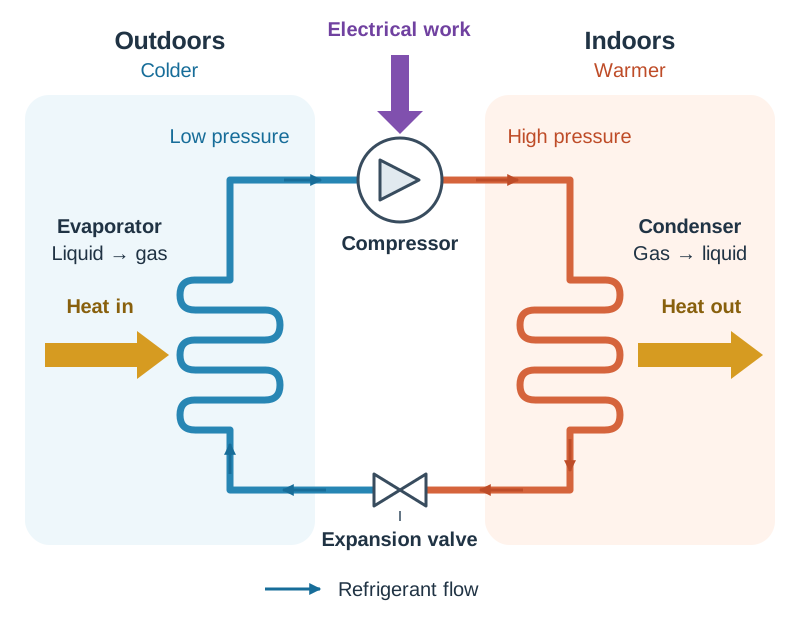
Because a heat pump moves thermal energy rather than generating it from fuel directly, 1 kJ of electrical energy supplied to the compressor can deliver 3 kJ to 4 kJ of heat indoors. Efficiency = (useful power output ÷ power input) × 100%. A heat pump can deliver more heat than the electrical energy it uses because most of the heat is moved in from outside, not made from the electricity. A heat pump works best in a well-insulated structure equipped with low-temperature emitters, such as underfloor heating.
U-Values and Insulation
The U-value of a building structure is the rate at which heat is transferred through of the structure when there is a temperature difference of 1 kelvin (or 1 °C) between its opposite faces:
Where is the rate of heat loss in watts (W), is the structural area in square metres (), is the temperature difference across the structure in K or °C, and is the U-value in .
- A low U-value indicates an effective insulator (low rate of heat loss).
- A high U-value indicates a poor insulator (rapid heat escape).
Practical building insulation targets each heat transfer mechanism:
- Cavity wall insulation: Foam or pumped beads fill the cavity to trap air, reducing conduction and stopping internal convection currents.
- Double or triple glazing: Inert argon gas between glass panes reduces conduction and convection; low-emissivity coatings reflect infrared radiation back into rooms.
- Loft insulation: Mineral wool blankets trap still air to cut conductive and convective heat losses through ceilings.
Evaluating insulation options using secondary sources involves comparing initial installation cost against yearly fuel savings (the payback period), the reduction in U-value, and the drop in domestic carbon emissions. Always check whether technical claims originate from independent bodies, such as the Sustainable Energy Authority of Ireland (SEAI), or commercial manufacturers.
Key terms
- Temperature
- A measure of the hotness or coldness of a body.
- Heat
- A form of energy transferred between bodies because of a temperature difference.
- Thermometric Property
- Any physical property of a material that changes measurably, continuously, and reliably with temperature.
- Heat Capacity (C)
- The heat energy required to change the temperature of an entire object by 1 kelvin (or 1 °C); C = Q / Δθ.
- Specific Heat Capacity (c)
- The heat energy required to change the temperature of 1 kilogram of a substance by 1 kelvin; c = Q / (m Δθ).
- Latent Heat (L)
- The heat energy required to change the state of a substance without any change in temperature; L = Q.
- Specific Latent Heat (l)
- The heat energy required to change the state of 1 kilogram of a substance without any change in temperature; l = Q / m.
- Specific Latent Heat of Fusion
- The heat energy required to change 1 kilogram of a substance from solid to liquid at its melting point without a change in temperature.
- Specific Latent Heat of Vaporisation
- The heat energy required to change 1 kilogram of a substance from liquid to gas at its boiling point without a change in temperature.
- Conduction
- The transfer of heat through a substance from particle to particle, without the substance itself moving.
- Convection
- The transfer of heat through a fluid by the bulk circulating movement of the fluid itself.
- Radiation
- The transfer of heat energy by means of electromagnetic waves without requiring a material medium.
- Heat Pump
- A device that transfers thermal energy from a colder region to a warmer region by doing external mechanical work on a circulating refrigerant.
- U-value
- The rate at which heat energy is conducted through 1 square metre of a structure when there is a temperature difference of 1 kelvin between its faces.
- Efficiency
- The percentage ratio of useful power output to total power input: (Useful Power Output / Total Power Input) × 100%.
Check yourself
A metal block and an equal mass of water receive the same heat energy. Which experiences the greater temperature rise, and why?
The metal block experiences a far greater temperature rise because its specific heat capacity is much smaller than that of water, requiring fewer joules per kilogram for each kelvin of rise.
Why must crushed ice be blotted dry with paper before being added to a calorimeter?
To remove liquid water at 0 °C adhering to the surface. Any liquid water entered would be weighed as ice without absorbing latent heat of fusion, making the calculated value of l_f too low.
Why does the boiling plateau on a heating curve for water last roughly seven times longer than the melting plateau when heat is supplied at a constant rate?
Because the specific latent heat of vaporisation of water (2.3 × 10⁶ J kg⁻¹) is roughly seven times larger than its specific latent heat of fusion (3.3 × 10⁵ J kg⁻¹).
In which component of a domestic heat pump does the refrigerant absorb heat, and what phase change occurs there?
In the evaporator, where cold liquid refrigerant at low pressure absorbs latent heat from the surroundings and vaporises into a gas.
In an electrical calorimetry experiment to determine the specific heat capacity of a liquid, how does heat loss to the surrounding air affect the calculated value of c?
Heat lost to the room reduces the measured temperature rise Δθ. Since c = Q / (m Δθ), a smaller Δθ in the denominator causes the calculated specific heat capacity to be too high.