

Integration reverses differentiation. It lets you recover an original function from its rate of change, find areas trapped under or between curves, and calculate the average value of a varying quantity over a given interval. In Leaving Certificate Higher Level Mathematics, you will work fluidly between algebraic rules, graphs, and real-world models.
Antiderivatives and Indefinite Integrals
When you differentiate a function, you find its rate of change. An antiderivative reverses that step, taking you from the derivative back to the original expression. Because any constant number differentiates to zero, many different curves share identical slopes everywhere. For instance, , , and all differentiate to . When you integrate an expression without boundaries, you must always add an arbitrary constant to represent this whole family of parallel curves.
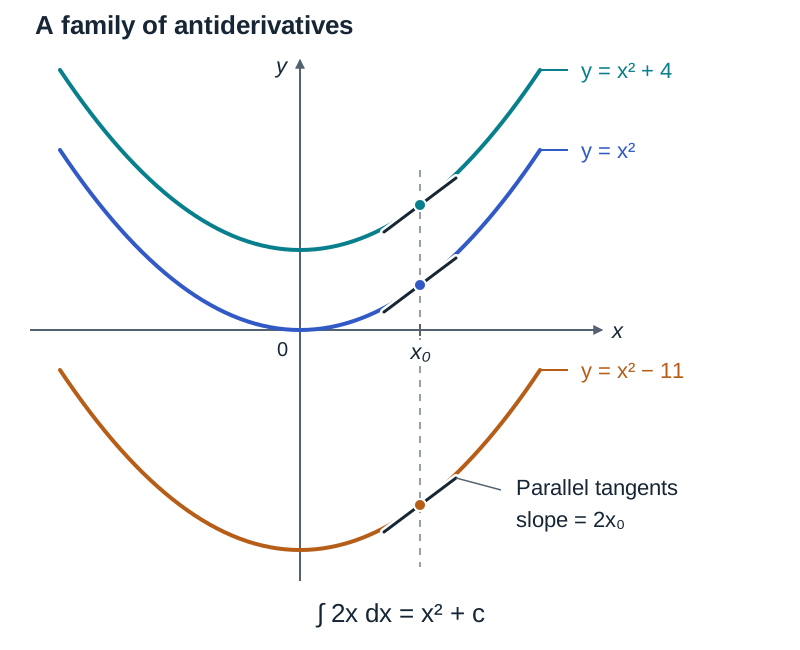
The core formula is the power rule: add one to the power and divide by that new power. In symbols, , as long as . When , dividing by zero is impossible, so you turn to the natural logarithm instead: . If an exam question gives you an initial condition such as a known point that the curve passes through, substitute those values into your general solution to calculate the exact numerical value of . For example, if and when , integrating gives . Substituting the coordinates gives , so , which gives and the particular solution .
Standard Integration Rules
Before you try to integrate anything, rewrite your algebra into neat index form. Change square roots into fractional powers like , and rewrite denominators using negative powers, so becomes .
You can pull constant multipliers out in front of the integral sign: . You can also break sums and differences into separate terms: . Be careful with products and quotients. There is no product rule or quotient rule for integration on the Leaving Certificate course. If you see brackets multiplied together or an algebraic fraction, multiply out the terms or simplify the fraction completely before integrating.
Exponential and Trigonometric Integration
When you integrate exponential and trigonometric terms, you must divide by the coefficient of . For the natural exponential, . For a positive base other than (), the rule includes a logarithm in the denominator: .
Trigonometric integration trips students up on signs. Cosine integrates directly to positive sine, but sine integrates to negative cosine. Specifically, , while . For example, integrating gives . Make sure your calculator stays in radians mode whenever you evaluate trigonometric calculus problems, as degree mode will destroy your final answer.
Definite Integrals and Area
A definite integral has two limits, and , and gives a single number rather than a formula: . You integrate as normal, put your antiderivative inside square brackets with the limits on the right, and subtract the value at lower limit from the value at upper limit . The constant cancels out during this subtraction, so you do not need to write it down.
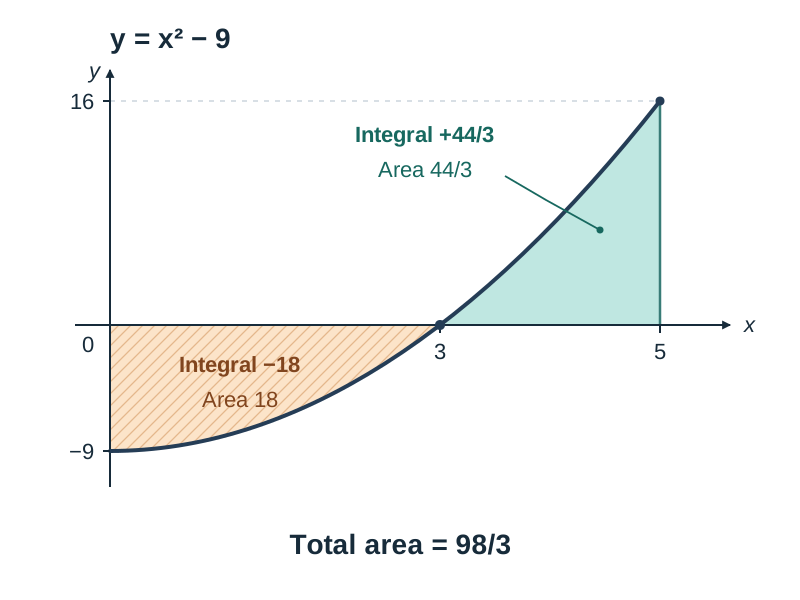
Definite integrals calculate signed area. Any region resting above the x-axis gives a positive value, while any region sitting below the x-axis produces a negative value. If a curve crosses the x-axis between your limits, the negative part is subtracted from the positive part, so a single integral gives less than the total area. To find the total geometric area, solve to find the intercepts, split the integration into separate pieces at those roots, and take the absolute positive value of each segment before adding them together. For example, to find the area bounded by , the x-axis, , and , first find the roots: (so is inside the interval). Between and , the curve lies below the axis: , giving an area of . Between and , the curve is above the axis: . Adding both positive areas gives square units.
Area Between Two Curves
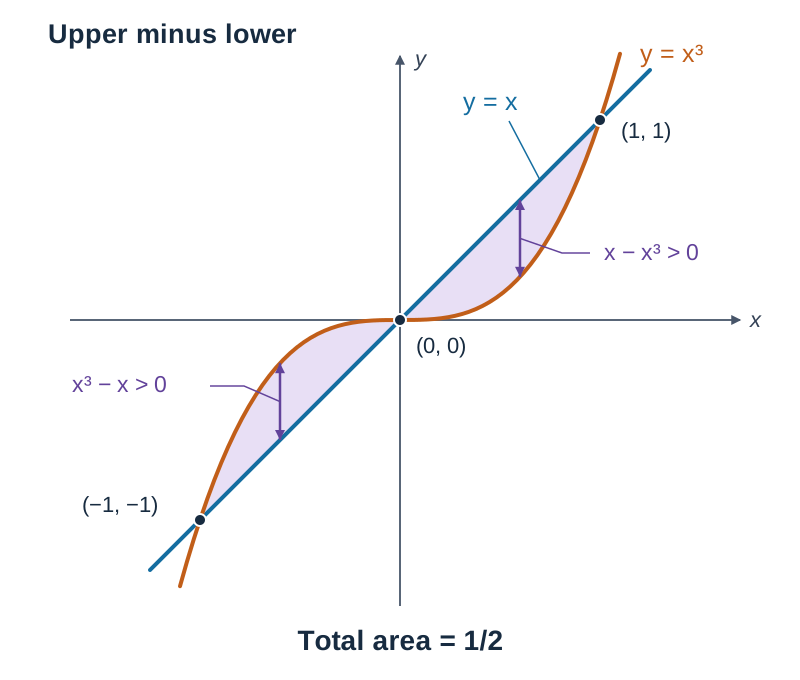
To find the area trapped between two intersecting curves and , first set them equal: . Solving this equation gives the x-coordinates of their intersection points, which become your integration limits and . If the curves meet at more than two points, the top curve can change. Work out the area between each pair of neighbouring meeting points separately and add the results. For example, y = x and y = x³ meet at x = −1, 0 and 1, and the total area is 2∫₀¹ (x − x³) dx = 1/2.
Next, identify which curve sits on top across that interval. You can do this with a quick sketch or by testing an intermediate x-value. Set up your definite integral as upper function minus lower function: . Doing top minus bottom automatically takes care of the signs, even if the region dips below the x-axis, producing a clean positive area in one calculation.
Average Value of a Function
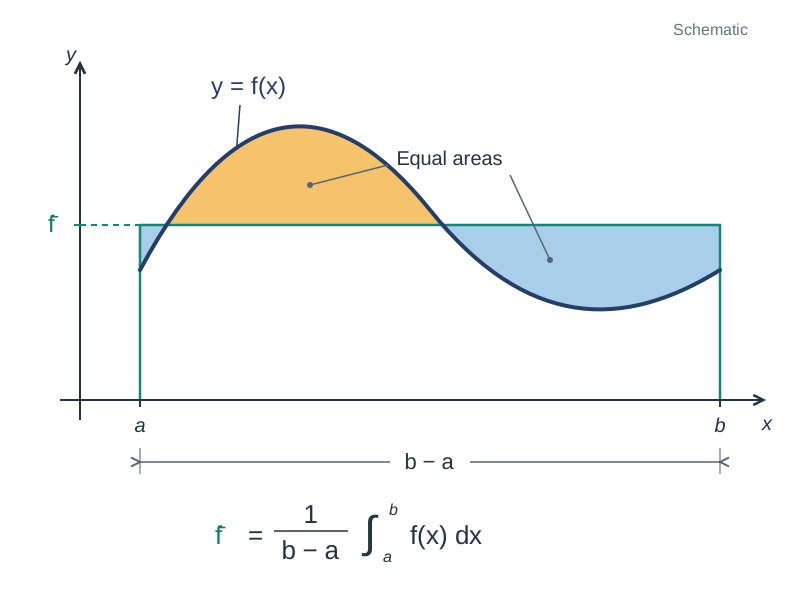
The average value of a continuous function over an interval is given by . Geometrically, this calculation flattens out the wavy curve into a horizontal line of constant height. The rectangle created by this height across the width covers the exact same area as the original curve.
This formula appears frequently in Paper 1 context questions, such as finding the mean speed of a vehicle, average temperature during a day, or the average depth of water in a tidal port. Always quote the formula first, substitute your limits and function, work through the integration step by step, and round your answer to the required decimal places.
Key terms
- Constant of integration (+c)
- The arbitrary number added to an indefinite integral to account for the family of parallel curves that share the same derivative.
- Definite integral
- An integral evaluated between an upper and a lower limit that produces a specific numerical value rather than a formula.
- Upper minus lower
- The standard method for calculating the area between two curves by subtracting the lower curve equation from the upper curve equation before integrating.
- Average value
- The mean height of a continuous function across a closed interval [a, b], found by multiplying 1/(b - a) by the definite integral of the function.
Check yourself
If you differentiate your answer to an indefinite integral, what should you get back?
The original integrand you started with.
What is the indefinite integral of sin(2x) with respect to x?
-(1/2)cos(2x) + c
What geometric feature do all antiderivatives of a given function share on a coordinate graph?
They form a family of parallel curves shifted vertically up or down by the constant c.