

Algebraic equations form the backbone of Leaving Certificate Higher Level Mathematics Paper 1. This topic focuses on solving linear, quadratic, and cubic equations, multi-variable linear systems, combined linear and non-linear systems, equations with algebraic fractions or surds, and polynomial identities.
Quadratic Equations and the Discriminant
A quadratic equation has the standard form , where . When factorising by inspection or the guide number method is awkward, we use the quadratic formula . The term under the square root, , is the discriminant. It tells us the nature of the roots without having to solve the equation completely.
If , the equation has two distinct real roots, meaning the graph crosses the x-axis twice. If , the equation has one repeated real root, meaning the curve touches the x-axis at its turning point. If , there are no real roots, so the parabola never meets the x-axis.
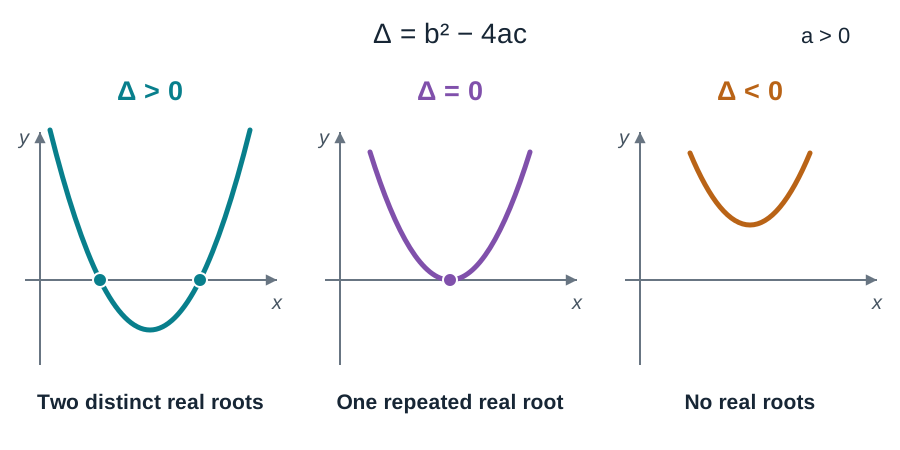
For example, if you are asked to find the values of for which has exactly one solution, set the discriminant equal to zero. Here , , and . Evaluating gives , which yields or . If roots and are given, you can rebuild the quadratic using the structure .
Simultaneous Linear Systems in Two and Three Variables
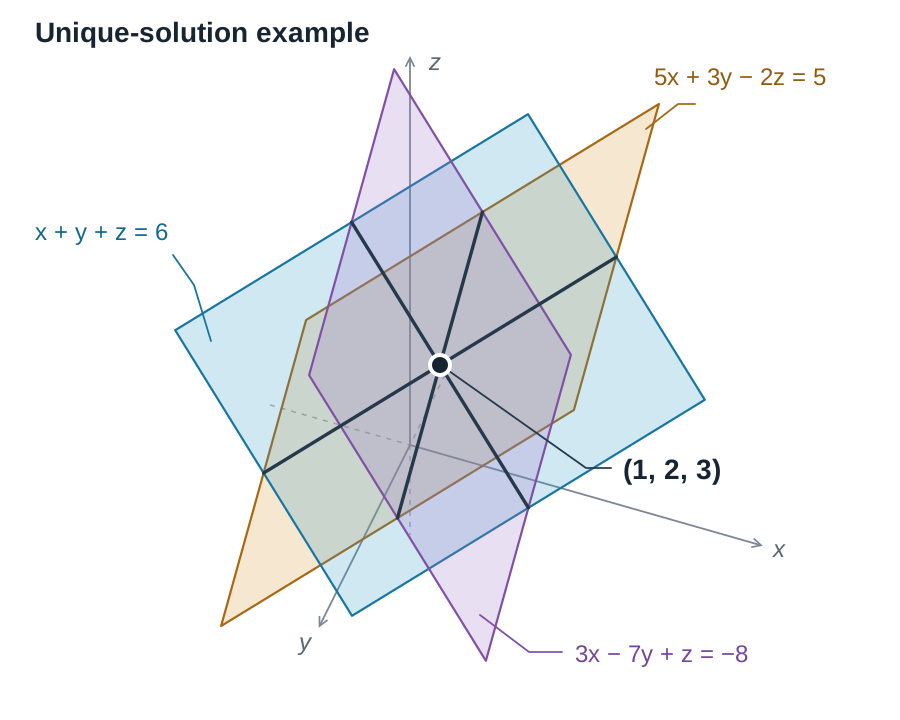
A linear equation in two variables represents a line, while a linear equation in three variables, , represents a flat plane in three-dimensional space. Solving three simultaneous equations means finding the single point where all three planes intersect.
To solve a three-variable system, eliminate the same variable twice using two different pairs of equations. This produces a pair of equations containing only two variables, which you can then solve using standard elimination or substitution.
Take the system:
Eliminating first is efficient. Multiply equation (1) by and add it to equation (2) to get . Next, subtract equation (3) from equation (1) to eliminate again, giving . Solving this two-variable system gives and . Substituting both values back into produces . Always substitute all three answers back into the unused original equations to check your arithmetic.
Simultaneous Equations: One Linear and One Non-Linear
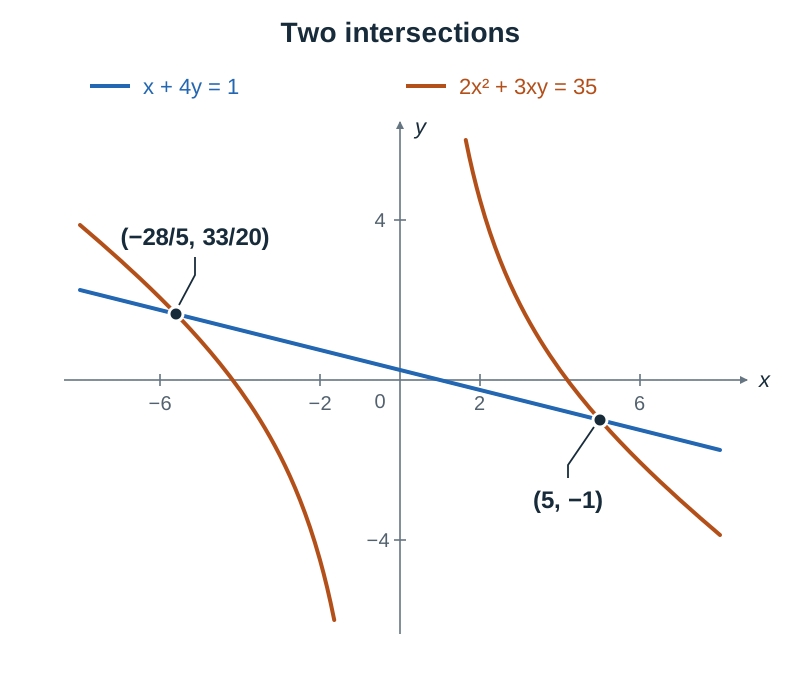
When one equation is linear and the other contains higher powers or product terms like , , or , always use the substitution method. Geometrically, this finds the coordinates where a line intersects a curve such as a circle, ellipse, or parabola.
Rearrange the linear equation to make one variable the subject, choosing whichever variable has a coefficient of to avoid cumbersome fractions. Then substitute this expression directly into the non-linear equation. Never try to substitute from the non-linear equation into the linear one.
For instance, given and , isolate in the linear relation to obtain . Substituting this into the non-linear equation gives . Expanding and collecting terms leads to the quadratic . Factoring gives , so or . Substituting each value back into yields the coordinate pairs and .
The Factor Theorem and Cubic Equations
The Factor Theorem establishes that a polynomial has a factor if and only if . Conversely, if , then is a root of the polynomial equation . Exam cubics usually have at least one integer root. If a cubic with integer coefficients has an integer root, that root must be a factor of the constant term, so test those factors (positive and negative) first.
To solve a cubic equation like , begin by testing integer factors of , such as . Evaluating gives . Because , is a factor.
Next, divide the cubic polynomial by using algebraic long division. This division yields the quadratic quotient . Factoring the quadratic gives . Setting each factor to zero provides the complete set of roots: , , and .
Fractions, Surd Equations, and Identities
Equations with algebraic fractions in the form (or with constant numerators) are solved by multiplying every single term by the lowest common denominator (LCD). This clears all denominators and reduces the expression to a linear or quadratic equation. Always identify values of that make any denominator zero, as these can never be valid solutions.
For example, to solve where :
- The LCD is . Multiply every term across by this LCD to eliminate fractions: .
- Expand and simplify: , which simplifies to .
- Divide by to give .
- Factorise: , giving or .
- Neither solution equals an excluded denominator value, so both are valid.
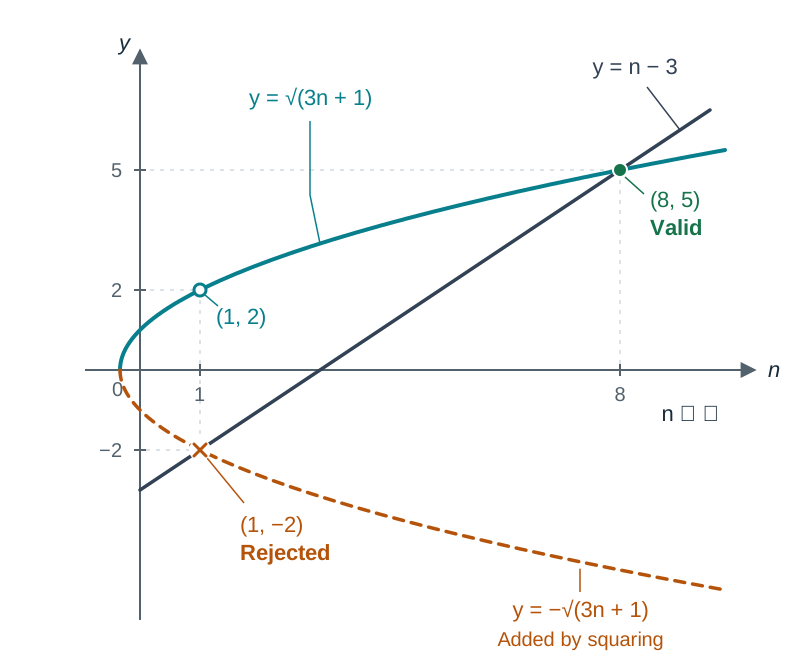
Surd equations contain an unknown under a radical sign. Isolate the square root term on one side before squaring both sides of the equation. Because squaring can introduce false solutions known as extraneous roots, you must test every algebraic answer in the original equation and reject any that fail.
An identity is an equation that holds true for every value of the variable, written with the symbol . If two polynomials are identical, the coefficients of corresponding powers of must be equal. For example, if , expand the left side to get . Equating coefficients gives , (so ), and (so ).
After solving, check each answer against the context of the question. Reject any value that gives a length , a negative count, or a number outside a stated set (such as ), and write the reason. For example, if triangle sides , , and give or , reject because the side would be .
Key terms
- Discriminant
- The expression b² - 4ac from the quadratic formula, used to determine whether the roots of a quadratic equation are real, repeated, or complex.
- Factor Theorem
- The algebraic theorem stating that a polynomial P(x) has a factor (x - k) if and only if P(k) = 0.
- Extraneous root
- A false solution introduced during an algebraic process, such as squaring both sides of an equation, that does not satisfy the original equation.
- Identity
- A mathematical statement showing that two expressions are equal for every value of the variable, written using the identity symbol ≡.
- Root
- A value of the variable that makes the equation true. For f(x) = 0, it is a value that makes f(x) equal to zero.
Check yourself
What discriminant condition indicates that a quadratic equation has exactly one real solution?
b² - 4ac = 0.
If (x - 5) is a factor of a polynomial P(x), what is the value of P(5)?
P(5) = 0.
Why must you check your solutions after solving an equation that contains a square root?
Squaring both sides can introduce extraneous roots that do not satisfy the original equation.
In a three-variable linear system, how many times must you eliminate your chosen first variable before solving for the remaining unknowns?
You must eliminate it twice using two different pairs of equations to create a system of two equations in two unknowns.